Spring Book of the Quarter at Santa Clara University

I hope the panelists take a critical perspective not just an inspirational one.  I have not read the book… is that wrong? (Kristof is regularly excoriated, often for good reason, by many, including Wronging Rights).

Half the Sky:  Turning Oppression Into Opportunity for Women Worldwide

By Kristof and WuDunn
Join use for a panel discussion with Linda Alepin, Sharmila Lodhia, Patricia Nevers
and Craig Stephens
Tuesday, May 1,  4 p.m.  – 5:30 p.m. Saint Clare Room in the Learning Commons
Spring Book of the Quarter
Co-sponsored by the University Library, Office of Student Life, Wellness Center, and Center for Multicultural Learning

Posted in Burkina Faso | Comments Off on Spring Book of the Quarter at Santa Clara University

My thoughts on revising SCU MBA Core Curriculum…. in area of “analytics”

I shared this with my colleagues… the quote going around is that it is “easier to move a cemetery than to change a university curriculum”… LOL.

There are a lot of topics that the analytics theme embraces (think about all the analytics that goes into sports analytics… regression, simulation, optimizing!).  Among them, one that many  think is important is applied regression analysis.  I believe that we serve our students well if they know how to, when they graduate:

1) Run an MBA-relevant regression (using a software package… not by hand ;-).
2) Interpret MBA-relevant estimated coefficients (as partial effects, as dummy variables).  So many companies now do experiments, etc. where they are measuring the effect size, controlling for demographics.  Our students should be able to reasonably understand these things, regularly asking “have we controlled for…?”.
3) Leverage the evaluation of “statistical significance” to a process of asking questions.  They should be able to run regressions and notice, “hmm… not significant… does that make sense? Isn’t that interesting? I wonder why?”
4) Present regression analysis and interpretation with words and graphics, focusing on relevant information for the decision-maker.

I would like to see our analytics offerings shift in this direction.  It might not show up in a course count, but it would be a real change in direction, and it would be great if we agreed as a faculty on this direction, and could pool our talent to come up with a really great module/course on this.  Moreover, it would be fantastic if downstream courses could all integrate/reinforce this concept, since we are pretty sure that knowledge like this sticks poorly if not reinforced/repeated.

This is not to argue that decision-making software tools, simulation tools, linear-programming, etc are not also important analytical tools that our MBA students should have knowledge of.  My sense is that for the typical MBA graduate, a better understanding of regression analysis is now more useful than it was before, and our capabilities to teach it well are better than they were before (we have a raft of faculty across disciplines doing applied empirical analysis), and employers of our students are more likely to notice an improvement in quality if we focus more attention to this area.


Posted in Burkina Faso | Comments Off on My thoughts on revising SCU MBA Core Curriculum…. in area of “analytics”

Alex Field at Legatum Institute

My colleague Alex Field spoke a couple weeks ago at the Legatum Institute in London.  Here’s what they had to say about his work:

His book, A Great Leap Forward, is a re-examination of the history of US economic growth is built around a novel claim, that potential output grew dramatically in the Depression years between 1929 and 1941 and that this advance provided the foundation for the economic and military success of the United States during the Second World War as well as for the Golden Age of 1948 to 1973 that followed.

Alexander J. Field takes a fresh look at growth data and concludes that, behind a backdrop of double-digit unemployment, the 1930s actually experienced very high rates of technological and organizational innovation, fueled by the maturing of a privately funded research and development system and the government building of the highway network.


Their promo photo was nice too.  But I forced Alex to let me share with you the photo of the dining room where they had the talk.  Eye candy.  Yup, once you give a talk in a room like this, you’re done!


Posted in Burkina Faso | Comments Off on Alex Field at Legatum Institute

Lydia and Heroes

My kids and I have been watching Heroes over the past two months.  It is so much better than the television I watched in Puerto Rico growing up (Kojak, Petrocelli, Mannix, Hawaii 5-0, Luis Vigoreaux Presenta, etc.).  We are enjoying the complex characterization (Sylar, especially) and the ambiguous morality of everyone, as they constantly struggle with  sacrificing the short term or narrow good for the greater good.  And we like Mr. Muggles.

But now it is almost over, and the ambiguously villain-like Samuel has a tattooed Lydia as his sidekick, and of course an earlier generation like me knows immediately why she is called Lydia….

Posted in Burkina Faso | Comments Off on Lydia and Heroes

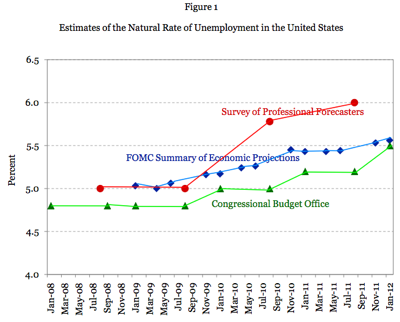
Nairu lately


Brad DeLong posted this image today, perhaps copies from paper by Christina Romer, and since we were talking about NAIRU in class on Thursday….

Posted in Burkina Faso | Comments Off on Nairu lately

Valeda Dent dissertation defense at Palmer School of Information at Long Island University

I participated on a dissertation defense for Valeda Dent, who has been one of a handful of researchers interested over the years in rural libraries in Africa.  She nicely defended her dissertation today: “An Exploratory Study of the Impact of the Rural Ugandan Village Library on the Academic Achievement of Secondary School Students.”  It has a terrific literature review and a great qualitative analysis of some focus groups with secondary school students.  The quantitative analysis of certain key effects/impact of library on reading turned out to be largely insignificant, not surprising given the small sample size.  The qualitative analysis of her focus group interviews was very interesting, as she “generated” some useful constructs for thinking about (and in future measuring) some of the non-academic impacts of libraries.  Congratulations Valeda!

Posted in Burkina Faso | Comments Off on Valeda Dent dissertation defense at Palmer School of Information at Long Island University

Why is it so hard to make a straightforward twoway table of means in R?

I mean, this code works, but it gives you the number, not the *table*, which would greatly reduce the cutting and pasting…

allchildren = read.csv(“C:\\Data\\Econ 135 Gender\\ps_1__all_children.csv”)
names(allchildren )
allchildren$recent <- as.numeric(decadeborn >75)
chsizenew  <- chsize
chsizenew[chsize>= 5] <- 5

attach(allchildren )
options(digits=3)
library(doBy) # you have to first install the package doBy
summaryBy(agediffm  ~ recent+ isboy, data=allchildren , FUN=c(mean),na.rm=TRUE)
summaryBy(agediffm  ~ recent+ firstb, data=allchildren , FUN=c(mean),na.rm=TRUE)
summaryBy(agediffm  ~ recent+ atlst1bn , data=allchildren , FUN=c(mean),na.rm=TRUE)
summaryBy(chsizenew ~ recent+ gender , data=allchildren , FUN=c(mean),na.rm=TRUE)

Posted in Burkina Faso | Comments Off on Why is it so hard to make a straightforward twoway table of means in R?

Small Arms Survey’s Arms Flows and Holdings in South Sudan

The Small Arms Survey’s Sudan/South Sudan Human Security Baseline Assessment (HSBA) is pleased to announce the release of a new Issue Brief: Reaching for the Gun: Arms Flows and Holdings in South Sudan

This Issue Brief reviews arms flows and holdings among both state and non-state armed forces as of early 2012, situating recent developments against historical trends and patterns of supply. It updates a previous HSBA report on small arms and light weapons flows and holdings in Sudan from December 2009.

Key findings include:

In 2010–11 the Sudan People’s Liberation Army (SPLA) acquired large quantities of small arms and light weapons and their ammunition, 10 Russian-manufactured Mi-17 transport helicopters, as well as final deliveries of 33 T-72 battle tanks that were delivered to Mombasa Port, Kenya, in February 2009.

Ukraine has been South Sudan’s principal supplier of weapons since 2005. Kenya and Uganda have been used as transshipment points for onward delivery to South Sudan

From November 2010 to May 2011, the South Sudan Police Service (SSPS) marked 41,200 firearms distributed among various official security forces, permitting it to trace a number of firearms that leaked out of state control to non-state actors. The SPLA would benefit from similarly marking its weapons.

South Sudanese rebel militia groups are well equipped with both small and large calibre small arms and light weapons. Analysis of captured materiel reveals that they have consistent access to new weapons from SAF and, to a lesser degree, from the SPLA, and a number of governments both inside and outside the region.

Although the SPLA and the Sudan People’s Liberation Army-North (SPLA-N) officially separated in July 2011, military and logistical cooperation and collaboration between the two forces continues.

via Small Arms Survey – Highlight: HSBA IB19.

Posted in Burkina Faso | Comments Off on Small Arms Survey’s Arms Flows and Holdings in South Sudan

In which I am validated by Tyler Cowen

“Vegetarians are more virtuous than the rest of us; they should be admired.”

via Marginal Revolution — Small steps toward a much better world..

Posted in Burkina Faso | Comments Off on In which I am validated by Tyler Cowen

What MBA students need to learn… enough to understand “Why Netflix Never Implemented The Algorithm That Won”

HT: Marginal Revolution.  From Why Netflix Never Implemented The Algorithm That Won The Netflix $1 Million Challenge | Techdirt.

You probably recall all the excitement that went around when a group finally won the big Netflix $1 million prize in 2009, improving Netflix’s recommendation algorithm by 10%. But what you might not know, is that Netflix never implemented that solution itself. Netflix recently put up a blog post discussing some of the details of its recommendation system, which as an aside explains why the winning entry never was used. First, they note that they did make use of an earlier bit of code that came out of the contest:

A year into the competition, the Korbell team won the first Progress Prize with an 8.43% improvement. They reported more than 2000 hours of work in order to come up with the final combination of 107 algorithms that gave them this prize. And, they gave us the source code. We looked at the two underlying algorithms with the best performance in the ensemble: Matrix Factorization which the community generally called SVD, Singular Value Decomposition and Restricted Boltzmann Machines RBM. SVD by itself provided a 0.8914 RMSE root mean squared error, while RBM alone provided a competitive but slightly worse 0.8990 RMSE. A linear blend of these two reduced the error to 0.88. To put these algorithms to use, we had to work to overcome some limitations, for instance that they were built to handle 100 million ratings, instead of the more than 5 billion that we have, and that they were not built to adapt as members added more ratings. But once we overcame those challenges, we put the two algorithms into production, where they are still used as part of our recommendation engine.

Posted in Burkina Faso | Comments Off on What MBA students need to learn… enough to understand “Why Netflix Never Implemented The Algorithm That Won”

from Econbrowser: Some Implications of the Trade Release

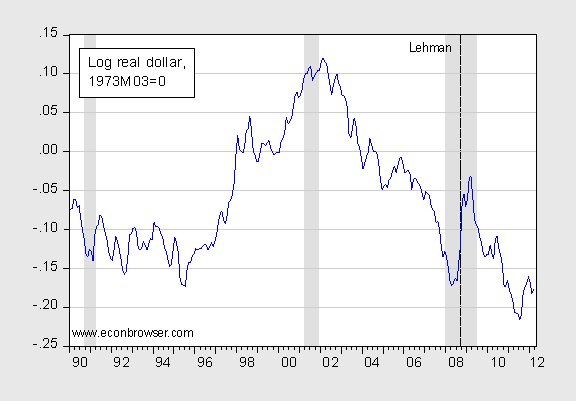
That being said, I think the important variable — that we have control over — is the exchange rate. Figure 5 plots the real value of the dollar against a broad basket of currencies.tr5.gifFigure 5: Log real trade weighted value of the US dollar, against a broad basket of currencies. NBER recession dates shaded gray. Source: Federal Reserve Board via St. Louis Fed FRED.The more expansionary the monetary policy either directly by increasing money supply, or by increasing inflationary expectations, the more we can drive the dollar down against other currencies, including the RMB and other East Asian currencies. If foreign demand holds up, then exports will continue to grow elasticity estimates here; HSBC argues that BRIC economies are doing that — with the exception of China.

via Econbrowser: Some Implications of the Trade Release.

Posted in Burkina Faso | Comments Off on from Econbrowser: Some Implications of the Trade Release

Seth’s Blog review of Gelman and Fung review of Levitt and Dubner: How “Wrong” is Freakonomics?

In the latest issue of American Scientist, Andrew Gelman (an old friend) and Kaiser Fung criticize Freakonomics and Superfreakonomics by Steve Levitt and Stephen Dubner (who wrote about my work). Although the article is titled “Freakonomics: What Went Wrong?” none of the supposed errors are in Freakonomics. You can get an idea of the conclusions from the title and this sentence: “How could an experienced journalist and a widely respected researcher slip up in so many ways?”

Gelman and Fung examine a series (“so many ways”) of what they consider mistakes. I will comment on each of them.

1. The case of the missing girls. I agree with Gelman and Fung: Levitt and Dubner accepted Emily Oster’s research too uncritically.

2. The risk of driving a car. I think Gelman and Fung miss the point. Yes, the claim (driving drunk is safer than walking drunk) was not well-supported by the evidence provided because the comparison was so confounded. However, I read the whole example differently. I didn’t think that Levitt and Dubner thought drunk people should drive. I thought their point was more subtle — that comparisons are difficult (“look how we can reach a crazy conclusion”).

via Seth’s Blog » Blog Archive » Gelman and Fung versus Levitt and Dubner: How “Wrong” is Freakonomics?.

Posted in Burkina Faso | Comments Off on Seth’s Blog review of Gelman and Fung review of Levitt and Dubner: How “Wrong” is Freakonomics?

Sex ratios varying by soil type? Really? I have not read it yet.

From a new paper by Eliana Carranza.

The female population deficit in India has been explained in a number of ways, but the great heterogeneity in the deficit across districts within India still remains an open question. This paper argues that across India, a largely agrarian economy, soil texture varies exogenously and determines the workability of the soil and the technology used in land preparation. Deep tillage, possible only in lighter and looser loamy soils, reduces the use of labor in cultivation tasks performed by women and has a negative impact on the relative value of girls to a household. The analysis finds that soil texture explains a large part of the variation in women’s relative participation in agriculture and in infant sex ratios across districts in India.

Posted in Burkina Faso | Comments Off on Sex ratios varying by soil type? Really? I have not read it yet.

Great war intrigue reported on Malijet… the real game of thrones in Azawad

En début de soirée, le colonel-major réussit à faire passer son message – une fausse déclaration de ralliement au MNLA – à la radio internationale. Puis les 204 militaires « sudistes » sont désarmés. Mais quand Ag Khabi demande que ceux-ci lui soient livrés comme prisonniers de guerre, Ag Gamou refuse. « Ces militaires sont désormais mes otages », rétorque-t-il. Le lendemain, les hommes du colonel-major continuent leur route en direction du Niger.

À 100 km de la frontière, Ag Gamou appelle le consul du Mali au Niger avec son téléphone satellitaire et lui demande de se préparer à l’arrivée de ses hommes pour qu’ils soient rapatriés vers Bamako, via le Burkina. Puis il prend congé de ses soldats originaires du sud, restant avec sa milice touarègue. « Depuis ce jour, je n’ai plus de nouvelles du Ag Gamou, mais je sais que tout ce qu’il a fait état pour sauver sa vie et les nôtres, car nous n’étions plus en état de combattre et lui était menacé par Ansar Dine qui ne l’aurait pas pris vivant », conclut notre source. En début de semaine, le colonel-major Ag Gamou a indiqué que son allégeance au MNLA sur RFI était une manœuvre pour s’enfuir et qu’il était désormais disposé à reprendre les combats contre les rebelles touaregs au côté de l’armée malienne.

via Malijet – L’actualité malienne au quotidien – Mali : comment Ag Gamou a échappé au MNLA et à Ansar Eddine.

Posted in Burkina Faso | Comments Off on Great war intrigue reported on Malijet… the real game of thrones in Azawad

Trouble with the Mali transition already after only a couple days… the soldiers like where they are, what else is new?

Good reporting from Abdoulaye Diakité:

Le ton a été donné par le chef de la junte lui-même Amadou Haya Sanogo le lundi dernier lors d’une conférence de presse de « rectification ». Il a presque prédit un retour du CNRDRE quarante jours après. Un discours qui fait écho à celui d’Oumar Mariko qui a tenu dans la matinée les mêmes propos allant jusqu’à dire la fin du mandat de Dioncounda Traoré le soir de son 40e jour de présidence.Une position partagée par d’autres acteurs politiques à l’instar du Front patriotique pour la sauvegarde de la démocratique qui rejette dorénavant toute prorogation de l’intérim du président de l’Assemblée nationale. Tout indique que l’affrontement entre les différents clans est prévisible ainsi qu’un nouveau bras de fer avec les putschistes qui n’ont pas visiblement envie de retourner dans les casernes.D’ailleurs, leur réticence a été forte dans la désignation du Premier ministre consensuel devant conduire la campagne de reconquête du Nord et de l’organisation des élections générales. Durant tout le week-end, les négociations entre la junte et le nouveau président de la République ont été sans concession et ont logiquement abouti à des rejets des différentes personnalités proposées.La volonté de la junte d’imposer son choix au très stratégique poste de Premier ministre de transition est sans limite surtout qu’elle est soutenue par les blocs politiques soutenant le putsch qui voient aux nouvelles circonstances sociopolitiques une aubaine pour en finir avec les grands partis comme l’Adéma, le RPM, l’URD et le PDES.Ces partis ont commencé de leur côté une contre-offensive pour déjouer les plans de la junte et de ses alliés. Un document expliquant leur position a déjà distillé au niveau des ambassades et des partenaires au développement. Et d’autres initiatives sont annoncées dans le même sens. Comme quoi, tout le monde est en train de fourbir en prévision des joutes devenues inévitables.

via Malijet – L’actualité malienne au quotidien – Crise post coup d’Etat : La transition déjà compromise.

Posted in Burkina Faso | Comments Off on Trouble with the Mali transition already after only a couple days… the soldiers like where they are, what else is new?

My colleague Helen Popper’s book reviewed… Pacific Horticulture : California Native Gardening: A Month-by-Month Guide

In recent years, California gardeners have been presented with a number of excellent books on the state’s native flora and its value for gardeners and landscape professionals. ….

Helen Popper has chosen a different approach in her delightful California Native Gardening. As the subtitle suggests, this is a seasonal guide to the care of native plants in our gardens and landscapes. Popper emphasizes the rhythm of growth, flowering, fruiting, and rest that is inherent in our natives. …

Popper leads the reader through the gardening year, beginning with October and the first hint of a change from the summer siesta. She presents a concise list of tasks for each month, then expands upon it in a wonderful readable prose-nurturing our understanding of the needs of native plants in the landscape, month-by-month. She concludes each monthly chapter with a discussion of the flowers that will likely be in bloom in that month….

This is the book I’ve been looking for to guide me through a year’s program of maintenance of the increasing number of native plants in my own garden. The native gardener in California should not be without it.

via Pacific Horticulture — Book Reviews: California Native Gardening: A Month-by-Month Guide.

You can buy the book on amazon.com.

Posted in Burkina Faso | Comments Off on My colleague Helen Popper’s book reviewed… Pacific Horticulture : California Native Gardening: A Month-by-Month Guide

Presidents of Jesuit universities largely take 0 salaries… hmmm… get what we pay for, or admirable public service?

These data show the compensation received in 2009 by 519 chief executives at 482 private, nonprofit colleges in the United States.  The Chronicle compiled compensation data from the Internal Revenue Service’s Form 990, which is filed by most major nonprofit entities. We obtained each institution’s form from the college or from GuideStar, an organization that posts the documents online.

Click on the link to see the very interesting graph…

via Graphic: How Presidents’ Pay Compares With Professors’ Salaries – Facts & Figures – The Chronicle of Higher Education.

Posted in Burkina Faso | Comments Off on Presidents of Jesuit universities largely take 0 salaries… hmmm… get what we pay for, or admirable public service?

An angry Menzie Chinn takes on Ed Lazear… uh oh this seems personal…

Lazear writes:

Indeed, that was the expectation [that the economy was in rapid catch-up mode and would eventually regain all that had been lost]. As economist Victor Zarnowitz of the University of Chicago argued many years ago, the strength of the recovery is related to the depth of the recession. Big recessions are followed by robust recoveries, presumably because more idle resources are available to be tapped. Unfortunately, the current post-recession period has not followed the pattern. The 2007-09 recession was induced by a financial crisis and some, most notably economists Carmen Reinhart and Kenneth Rogoff authors of “This Time is Different: Eight Centuries of Financial Folly”, argue that financial crises pose more difficult recovery problems than do policy-induced recessions.

After recounting the Reinhart-Rogoff thesis, Lazear essentially dismisses it, apparently in favor of John Taylor’s argument that the crisis was Fed induced.I want to take exception to the argument that the expectation was for a rapid recovery.

via Econbrowser: The Recovery According to Ed “We are not in a recession” Lazear.

Posted in Burkina Faso | Comments Off on An angry Menzie Chinn takes on Ed Lazear… uh oh this seems personal…

The Oster-Hepatitis B sex ratio thing is still instructional – article by Andrew Gelman and Kaiser Fung

Andrew Gelman and Kaiser Fung have an article on Freakonomics in American Scientist. My favorite part was the story of Emily Oster and her theory of Hepatitis B: Monica Das Gupta is a World Bank researcher who, along with others in her field, has attributed the abnormally high ratio of boy-to-girl births in Asian countries to a preference for sons, which manifests in selective abortion and, possibly, infanticide. As a graduate student in economics, Emily Oster now a professor at the University of Chicago attacked this conventional wisdom. In an essay in Slate, Dubner and Levitt praised Oster and her study, which was published in the Journal of Political Economy during Levitt’s tenure as editor:

[Oster] measured the incidence of hepatitis B in the populations of China, India, Pakistan, Egypt, Bangladesh, and other countries where mothers gave birth to an unnaturally high number of boys. Sure enough, the regions with the most hepatitis B were the regions with the most “missing” women. Except the women weren’t really missing at all, for they had never been born.

Oster’s work stirred debate for a few years in the epidemiological literature, but eventually she admitted that the subject-matter experts had been right all along. One of Das Gupta’s many convincing counterpoints was a graph showing that in Taiwan, the ratio of boys to girls was near the natural rate for first and second babies 106:100 but not for third babies 112:100; this pattern held up with or without hepatitis B. In a follow-up blog post, Levitt applauded Oster for bravery in admitting her mistake, but he never credited Das Gupta for her superior work. Our point is not that Das Gupta had to be right and Oster wrong, but that Levitt and Dubner, in their celebration of economics and economists, suspended their critical thinking. I think that this story actually has two elements. One is the dangers of a convincing explanation. There are a lot of associations that can appear and would be extremely exciting if they were true. Just consider the recent article on statins reducing mortality due to pneumonia: it is an amazing result that would be extremely exciting if it were true.

via Observational Epidemiology: A really nice article by Andrew Gelman and Kaiser Fung.

Posted in Burkina Faso | Comments Off on The Oster-Hepatitis B sex ratio thing is still instructional – article by Andrew Gelman and Kaiser Fung

Tyler Cowen on the Hong Kong versus SIngapore growth pattern

From 1992, the paper is here note by the way an interesting written comment from Paul Krugman at the end. The basic story was that Hong Kong and Singapore had obtained their prosperity by two different paths. Hong Kong had made real productivity gains, but Singapore grew just by throwing more factors of production at the problem of economic growth, including a massive dose of savings and investment, including foreign investment. The share of investment in Singapore’s gdp rose from 9% in 1960 to 43% in 1984, while Hong Kong’s remained roughly steady at about 20%. If you back this out from national income statistics, you can measure that Singapore had very low levels of total factor productivity growth.But should we believe that story, which by now is twenty years old? After all, these days, Singapore is extremely interested in cutting-edge science and on the frontier in the biosciences and with satellite launches, among other areas. Hong Kong has done fine, but as a finance center and entrepot for the China trade. Not many people look to them as ideas leaders. Maybe both countries somehow turned on the proverbial dime, but I don’t believe the initial Young result for a few reasons:

via Marginal Revolution — Small steps toward a much better world..

Posted in Burkina Faso | Comments Off on Tyler Cowen on the Hong Kong versus SIngapore growth pattern