Alessandra Cassar on effects of institutional experience on trust

We had a great departmental seminar today with Alessandra Cassar reporting on experiments done in Italy and Kosovo.  She and co-author ask whether playing a “trade game” where some players have an impartial enforcement mechanism and other players have a pay-in-advance partial enforcement mechanism affects subsequent willingness to pay “generalized trust”… and indeed it does… players with the impartial mechanism seem to become more trusting of the other players.  That is, there is an institutional spillover effect onto a different game.

My colleagues John Ifcher and Homa Zarghamee recently published a paper on how mood/affect changes decisions about patience, and I assume there is a growing body of evidence now about the short-term mutability of underlying preferences… what is needed now is some theory about how short-term effects aggregate up to longer-term enduring background preferences.  Because another literature finds that historical events seem to leave enduring spillovers on preferences.

An interesting area for theory.

Posted in Burkina Faso | Comments Off on Alessandra Cassar on effects of institutional experience on trust

Who actually wants a son, when we see strong son preference?

Not women, very much, it seems. A new paper by Laura Zimmermann from University of Michigan, using data from India.

It is well-documented that in a number of countries unnaturally few girls are born relative to boys. Explanations have focused on a range of potential reasons, including economic and cultural benefits from having a son. Households are usually treated as monolithic entities, however, and the motivations of particular
household members are understudied. In contrast, this paper looks at a potential benefit mothers derive from giving birth to a boy – an improvement in their position within the household. I analyze this hypothesis using households with young first-borns from a nationally representative Indian dataset. The results
suggest that women do indeed gain in non-monetary terms: Having a boy rather than a girl leads to increased joint household decision-making powers. This effect seems to vanish after six months, however, implying that the female-specific self-interest in practicing son preference may be low.

The draft of the paper is here.

Posted in Burkina Faso | Comments Off on Who actually wants a son, when we see strong son preference?

via Econbrowser: Lessons from the Crisis for Teaching Macro

The short article by Menzie is a pithy summary of the most important “missing link” in most intermediate macro… unfortunately not that easy to incorporate into the model without seeming very ad hoc, and without ending up with a $20 bill on the sidewalk… and yet it happens!

The NY Times “Room for Debate” recently had a forum on “Rethinking How We Teach Economics”, with contributions by Blinder, Taleb and Skidelsky, among others. In my contribution, I focused on the importance of asymmetric information and self-reinforcing feedback loops:

In the typical introductory textbook, wages and prices adjust so that labor is fully employed and goods are sold at the right price. A more sophisticated treatment shows up in more advanced texts, but even in some graduate texts, there is an emphasis on the self-correcting aspects of the modern macroeconomy. Recessions are eventually overcome as prices adjust to the right levels, even in the absence of government policy.

via Econbrowser: Lessons from the Crisis for Teaching Macro.

Posted in Burkina Faso | Comments Off on via Econbrowser: Lessons from the Crisis for Teaching Macro

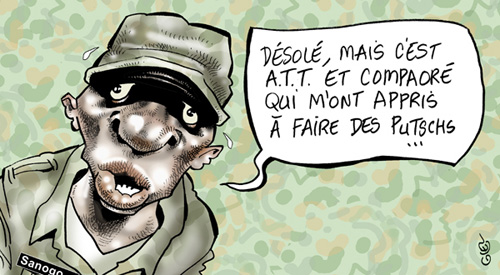
The cartoon says it all – Mali and Burkina

« Quand la barbe de ton voisin brûle, arrose d’eau la tienne », indique un proverbe sahélien. Mais quand c’est la case du voisin qui brûle, il devient dérisoire d’enfouir sa tête dans le sable. Les destins du Mali et du Burkina sont historiquement parallèles. Même si les populations des deux pays n’ont pas oublié la « Guerre de Noël » qui les opposa brièvement en décembre 1985, autour de la bande de terre semi-désertique d’Agacher, c’est à une franche coopération qu’elles assistent depuis les années 90, amitié sahélienne sublimée par l’entente cordiale d’Amadou Toumani Touré et de Blaise Compaoré, deux anciens militaires officiellement ou officieusement adeptes de putschs « moralisateurs ». Mais où le parallélisme s’arrêtera-t-il ? Le Burkina célèbre le premier anniversaire des mutineries qui secouèrent le régime pendant de longues semaines. Alors, pour que le concept de destins parallèles ne se mue pas en oracle pour le président du Faso, les autorités burkinabè ne peuvent pas se contenter d’arroser d’eau leur menton. Si l’Ivoirien Ibrahim “I.B.” Coulibaly avait pu tranquillement préparer son hypothétique destin national à Ouagadougou, en 2002, les rebelles maliens présents sur le territoire burkinabè, eux, se sont vu rapidement remis à leur place. Lorsqu’en février, le quotidien burkinabè L’Observateur paalga donna la parole à un colonel touareg présent au Burkina, le Conseil supérieur de la Communication déplora officiellement la légèreté avec laquelle le journal ouvrait ses « colonnes à des rebelles qui tiennent des propos racistes et appellent à la partition d’un Etat souverain voisin. » Pendant le bras de fer entre l’organe de régulation et la presse, le ministre des Affaires étrangères et de la coopération Régionale, Djibrill Bassolé, enfonçait le clou en rappelant leur droit de réserve à tous les réfugiés présents sur le territoire national. Pas question que le Faso, longtemps considéré comme un pompier-pyromane dans les crises de la région, ne devienne une base arrière de la rébellion malienne. Pour mieux empêcher toute contagion putschiste, le régime a choisi d’annihiler toute importation politique. Mais l’implication du Burkina Faso n’a pu se cantonner à la neutralité passive et à la bienveillance humanitaire.

via Les barbus d’AQMI et la “barbe” burkinabè – leFaso.net, l’actualité au Burkina Faso.

Posted in Burkina Faso | Comments Off on The cartoon says it all – Mali and Burkina

Essential for following Mali crisis realtime… Martin Vogl (martinvogl) on Twitter

Martin Vogl ‏ @martinvogl tweets and retweets

What is ordinary life in Kidal, Gao, Timbuktu going to be like now? Shops? Banks? Hospitals? Administration

Off the phone with friends in #Gao: Vehicles stolen, banks/NGOs/hospitals looted. Medicine, gas and water in short supply. #Mali

Timbuktu calm now. Looting and thefts during the day. Many southerners, military and civil servants, have fled south.

via Martin Vogl (martinvogl) on Twitter.

Posted in Burkina Faso | Comments Off on Essential for following Mali crisis realtime… Martin Vogl (martinvogl) on Twitter

Viral picture that still brings a smile

Posted in Burkina Faso | Comments Off on Viral picture that still brings a smile

Sad and absurd for a country to fall this low… Sanogo annonce le rétablissement des institutions ce 1er avril

Timbuktu apparently has been abandoned to the MNLA, and Sanogo realizes that he’s going to be jailed or killed in a couple days if he doesn’t throw in the towel.  What on earth are the soldiers thinking, or are they too busy looting?  Speaking of looting, I was just reading about the looting of Tipoo Sultan’s palace back in 1799, by the British.

Au Mali, le capitaine Sanogo a promis, dimanche 1er avril, de rétablir la Constitution et les institutions, et de remettre le pouvoir aux civils. Dix jours après le coup d’Etat, le chef de la junte militaire au pouvoir s’est exprimé devant la presse, dans son quartier général de Kati, en banlieue nord de Bamako. Le ministre burkinabè des Affaires étrangères, Djibril Bassolé, émissaire du président Compaoré et médiateur de la Cédéao dans cette crise, était à ses côtés.

via Au Mali, le capitaine Sanogo annonce le rétablissement des institutions ce 1er avril – MALI – RFI.

Posted in Burkina Faso | Comments Off on Sad and absurd for a country to fall this low… Sanogo annonce le rétablissement des institutions ce 1er avril

“Terrific” criticism of the coup and its aftermath, from unnamed sources, via Xinhua…

The assessment of the coup at this point has to be that the soldiers have taken Mali to a very grim turn indeed.

BAMAKO, 30 mars (Xinhua) — L’annonce de la prise de Kidal par les rebelles a plongé le Mali dans la stupeur.

….

“Voila le résultat de l’inconscience; de l’indiscipline, de la précipitation et du geste impulsif et irréfléchi des soldats mutins. C’est toutes les communautés civiles noires et blanches ( sonrhaï, tamacheques et arabe) qui vont bientôt affronter cette horde de hors la loi qui croient que l’Azawad est leur terre à eux seuls”, s’indigne un responsable de communication dans une ambassade du Mali à l’étranger.

….

“Les fonctionnaires à qui on ne payera pas leurs salaires pourront manifester dans les rues. Mais, avec des militaires sans solde et sans vivres, bonjour le désordre. EDM (Energie du Mali) est déjà à bout de souffle et dans les jours à venir, faute de combustibles, les groupes vont s’arrêter et le pays sera plongé dans le noir. Une obscurité que les bandits de grand chemin adorent pour sévir”, craint un officier de la gendarmerie nationale.

via Malijet – L’actualité malienne au quotidien – Mali : les putschistes dépassés par les événements, les populations dans la stupeur.

Posted in Burkina Faso | Comments Off on “Terrific” criticism of the coup and its aftermath, from unnamed sources, via Xinhua…

Still at 14% it seems, the gold revenue take of the government of Burkina Faso

The Prime Minister of Burkina, Luc Adolphe Tiao, just gave his “discours a la nation” where he mentioned:

Les six (6) mines d’or en activité ont porté la production industrielle d’or à 32,60 tonnes en 2011, contre 23,08 tonnes en 2010, soit une augmentation de 41%. La production attendue en 2012 pourrait atteindre 42 tonnes. La production artisanale déclarée, quant à elle, est estimée à 460 Kg. La seule mine de manganèse, celle de Kiéré, a produit et exporté 49 715 tonnes.  C’est environ, 127,43 milliards de francs CFA qui ont été reversés au budget de l’Etat au titre des recettes minières en 2011. 4 556 emplois permanents ont été dénombrés au sein des six (6) mines industrielles, dont 93% de ces emplois occupés par des nationaux.

So 42 tons exported is valued at around $2billion (42×32,000x$1500), and tax receipts are around $282 million (127b FCFA divided by 450 CFA/$), so the effective taxation of gold production is around 14%.  This is close to what EITI reports found for 2008 and 2009 for Burkina.

Posted in Burkina Faso | Comments Off on Still at 14% it seems, the gold revenue take of the government of Burkina Faso

Uh oh… from RFi… Mali not going to get better anytime soon… hello Cote d’Ivoire… in the worst way

Le capitaine Sanogo s’est en revanche rendu à l’aéroport de Bamako. Pendant plusieurs heures, il s’est entretenu à huis clos avec Djibril Bassolé ou Mohamed Bazoum, chefs des diplomaties burkinabè et nigérienne, ainsi qu’avec Adama Bictogo, ministre ivoirien de l’Intégration régionale.

…

Par ailleurs, la tension de ce matin est remontée à Bamako. Plusieurs centaines de militants anti-putschs se sont réunis à la Bourse du travail. Les jeunes favorables au capitaine Sanogo sont venus perturber le rassemblement en jetant des pierres. Les anti-putschs ont répliqué. Les affrontements se seraient maintenant arrêtés, mais on déplore plusieurs blessés.

via Mali : la Cédéao annule sa venue face à une manifestation pro-junte à l’aéroport de Bamako – Mali – RFI.

Posted in Burkina Faso | Comments Off on Uh oh… from RFi… Mali not going to get better anytime soon… hello Cote d’Ivoire… in the worst way

Why I am glad I don’t have to do political commentary for a living

The Mali coup is one of those opaque events that are really hard to figure out.  Observers try, and they have to produce something (for their blogs, or their employers) … but in their hearts they know they really have no idea, and also that there is a circle of people who actually do know, but there is no real way to verify what they know because at this stage they presumably are in full lying mode as they jockey for power (or even their lives).  So…. tough position to be in, I sympathize (and see how I get to blog about the coup without knowing anything at all!).

Mann’s analysis raises a question I’ve pondered since we got our first glimpse of Mali’s coup plotters on Malian state television, early in the morning of March 22: What are these guys after? While I cannot take the putschists’ justifications of their actions at face value, I also cannot say what their motivations are. Did these junior army officers set out deliberately to derail Mali’s democratic process and seize power for themselves? I doubt it. More likely, they simply filled a void that opened up before them, without either adequately preparing for or fully considering the consequences of their actions. Here’s why I think this is the case.

via Bridges from Bamako | life in a budding West African metropolis.

Posted in Burkina Faso | Comments Off on Why I am glad I don’t have to do political commentary for a living

Fukuyama review of Why Nations Fail by Acemoglu and Robinson

Over at The American Interest:

They present a sharply bifurcated distinction between what they call good “inclusive” economic and political institutions, which are sometimes also labeled “pluralistic,” in contrast to what they call bad “extractive” or “absolutist” ones. Unfortunately, these terms are way too broad, so broad indeed that AR never provide a clear definition of everything they encompass, or how they map onto concepts already in use. “Inclusive” economic institutions, for example, seem to include formal property rights and court systems, but also have to do with social conditions that allow individuals access to the market such as education and local custom. “Inclusive” political institutions would seem to imply modern electoral democracy, but they also include an impersonal centralized state as well as access to legal institutions, and forms of political participation that fall well short of modern democracy. We find, for example, that England following the Glorious Revolution of 1688-89 was incipiently inclusive, despite the fact that well under ten percent of the population had a right to vote. When AR first used the term “extractive” in their early articles, it referred to truly extractive practices like the mines of Potosí or the sugar plantations of the Caribbean which extracted commodities out of the labor of slaves. In the current book extractive seems to mean any institution that denies any degree of participation to citizens, from tribal communities to ranchers in 19th century Argentina to the contemporary Chinese Communist Party.

Since each of these broad terms (inclusive/extractive, absolutist/pluralistic) encompasses so many possible meanings, it is very hard to come up with a clear metric of either. It also makes it hard to falsify any of their historical claims. Since more real-world societies are some combination of extractive and inclusive institutions, any given degree of growth (or its absence) can then be attributed either to inclusive or extractive qualities ex post.

Posted in Burkina Faso | Comments Off on Fukuyama review of Why Nations Fail by Acemoglu and Robinson

Martin Vogl interview with Sanogo in Mali (in English)

Link to the interview, not sure where it broadcast.  Sanogo asserts ATT has no soldiers with him.  “No one” is protecting ATT.  No fear of counter-coup.

Posted in Burkina Faso | Comments Off on Martin Vogl interview with Sanogo in Mali (in English)

Opinion on the “vrai-faux” coup d’etat in Mali… it really is a weird coup…

An excellent opinion piece by Jean-Pierre Béjot of La Dépêche Diplomatique:

It’s crazy ! Totalement fou. A-t-on jamais vu un président de la République être destitué par un « coup d’Etat » à quelques semaines d’une présidentielle (à laquelle il n’était pas candidat) pour « incompétence » après dix années passées au pouvoir ? A-t-on jamais vu un « héros national » – il y aura demain, lundi 26 mars 2012, 21 ans que Amadou Toumani Touré (ATT) a renversé la dictature de Moussa Traoré -, président de la République en exercice, rester ainsi plusieurs jours sans donner signe de vie alors que le pays est occupé par une clique de charlots à peine galonnés ?It’s crazy ! Totalement fou. A-t-on jamais vu un président de la République être destitué par un « coup d’Etat » à quelques semaines d’une présidentielle (à laquelle il n’était pas candidat) pour « incompétence » après dix années passées au pouvoir ? A-t-on jamais vu un « héros national » – il y aura demain, lundi 26 mars 2012, 21 ans que Amadou Toumani Touré (ATT) a renversé la dictature de Moussa Traoré -, président de la République en exercice, rester ainsi plusieurs jours sans donner signe de vie alors que le pays est occupé par une clique de charlots à peine galonnés?

Read the rest here.

Posted in Burkina Faso | Comments Off on Opinion on the “vrai-faux” coup d’etat in Mali… it really is a weird coup…

Nigeria Central Bank governor Sanusi on fuel subsidies…

Posted in Burkina Faso | Comments Off on Nigeria Central Bank governor Sanusi on fuel subsidies…

Students returning from Africa study abroad… what films to watch and discuss?

Seven films come immediately to mind. (With cut and paste description blurbs.)

1) A Panther in Africa – On October 30, 1969, Pete O’Neal, a young Black Panther in Kansas City, Missouri, was arrested for transporting a gun across state lines. One year later, O’Neal fled the charge, and for over 30 years, he has lived in Tanzania, one of the last American exiles from an era when activists considered themselves at war with the U.S. government. Today, this community organizer confronts very different challenges and finds himself living between two worlds – America and Africa, his radical past and his uncertain future.

2) Chocolat – A depiction of the relationships between colonist and colonized set in Cameroon prior to its independence as seen through the eyes of a young white girl and her black servant.  By Claire Denis.

3) Mississipi Masala – An Indian family is expelled from Uganda when Idi Amin takes power. They move to Mississippi and time passes. The Indian daughter falls in love with a black man, and the respective families have to come to terms with it.

4) Little Senegal – This beautifully photographed, touching film follows Alloune, a man who gives tours of the Senegal coastline where long ago his ancestors where imprisoned and shipped across the Atlantic in the slave trade. Through a slender doorway looking out to the wide ocean beyond, participants in Alloune’s tour are moved, saddened, and quieted by the thought of what once was. Then one day, Alloune decides that he must track the path of his own ancestors, and so he travels to the southern United States. He wanders from one former plantation to the next, asking questions, looking in libraries, and researching an extended family tree, always carrying the weight of history on his small, long, thin frame. Finally his search leads him to New York City, where he locates a young nephew, and then a female cousin who is about his same age, in her fifties. Taking a job for his cousin as a security guard at her Harlem newspaper stand, Alloune begins the difficult task of adapting to city life. The relationship between Alloune and his cousin starts off as professional, changes to family relation, and finally ends up as a love affair. However, the distance between Africa and New York, history and present, can never be escaped or forgotten.

5) Lumumba: La Mort Du Prophète – (Raoul Peck’s early film) The life and legacy of Patrice Lumumba, one of the legendary figures of modern Africa’s struggle for self-determination, is reconstructed and examined through home movies, photographs, old newsreels and interviews with Belgian journalists and Lumumba’s own daughter.

6) Rouch in Reverse – A critique of visual anthropology through the work of Jean Rouch looks at European anthropology from an African perspective. Jean Rouch and filmmaker Manthia Diawara compare their interpretations of clips from Rouch’s work.

7) Umgidi (Shadow Dancing) –  Sipho is a former political prisoner on Robben Island who decides to return to his home town to complete the Xhosa initiation ritual he began while in prison. But his younger brother, Vuyo is quite reluctant to have his own ceremony, partly because he is gay and is conflicted about adopting traditional practices. This film explores a family and a country trying to embrace both modernity and tradition

Posted in Burkina Faso | Comments Off on Students returning from Africa study abroad… what films to watch and discuss?

Popular action against Essakane gold mine

Apparently youth in Seno have blocked the mining trucks, demanding more local hires, more training, more transparency.

Les engins de la Société minière ESSAKANE SA sont bloqués depuis le 19 mars dernier à l’entrée de la ville de Dori. Selon nos sources, les véhicules de IAM Gold sont interdits d’accès à leur site par les jeunes du Séno. Ils reprochent à cette entreprise de n’avoir pas tenu promesse vis-à-vis de sa politique locale en matière d’emploi et son manque de transparence dans l’exploitation des ressources locales. Ils citent en exemple, la promesse non tenue de cette société de recruter et de former des jeunes en conduite d’engins miniers. Sur sept points de revendication, les jeunes en furie exigent la révision par cette société minière, du mode de recrutement avec une quote-part pour les jeunes de la localité, la mise en place d’un comité de suivi de l’exploitation du métal précieux du Séno impliquant les jeunes et les parties prenantes de la province, un bilan de l’étude d’impact environnemental de l’exploitation minière dans la zone avant tout autre projet d’extension.

Posted in Burkina Faso | Comments Off on Popular action against Essakane gold mine

Political rally… Boromo, Burkina Faso… in front of the library

From lefaso.net, a UPC political rally in front of the CLAC of Boromo.  Will Diabré emerge as the serious competitor for the CDP candidate(s)?  That the rally was at the CLAC is meaningful really only to me!

L’Union pour le progrès et le changement (UPC) continue son maillage du Burkina avec cette récente installation du correspondant provincial des Balé qui a eu lieu à Boromo le samedi 17 mars 2012. Devant le président du parti et des militants ravis, Kassoum Traoré a été investi du pouvoir de défendre les idéaux et les intérêts de ce regroupement politique dans la zone.  Sur l’esplanade du Centre de lecture et d’animation culturelle de Boromo, une ferveur toute particulière y régnait. Les enceintes acoustiques d’un orchestre dépêché directement de Ouagadougou, avec le maestro Abdoulaye Cissé, crachaient des tonalités qui poussaient à la danse. Côté mobilisation, il n’y avait pas grand-chose à redire, avec ces nombreuses délégations venues de la capitale des Balé, de ses communes et villages. Le degré d’ambiance a atteint son paroxysme avec l’arrivée de la mission venue de la capitale, conduite par le président du parti, Zéphirin Diabré. La preuve que, visiblement, l’UPC (Union pour le progrès et le changement) a sonné le grand cor des retrouvailles et n’a pas ménagé aucun moyen pour que sa rentrée politique reste longtemps gravée dans les mémoires de ceux qui y assistaient.

Posted in Burkina Faso | Comments Off on Political rally… Boromo, Burkina Faso… in front of the library

I was (almost) there… Bernanke on gold standard, Isaacson on Jobs, and Knell on NPR

I was at a conference today at George Washington University on liberal learning in undergraduate business education, and Bernanke kicked us out of his room so he could kill the gold standard people….

“Unfortunately, gold standards are far from perfect monetary systems,” Bernanke said. “There’s an awful big waste of resources.”  Plus, he said, they don’t fix things.  There wouldn’t be enough gold in the world to meet global demand, the U.S. would need to mine in South Africa and ship what it could get to a vault in New York City — and most importantly, the Fed would be left unable to respond to rising levels of unemployment.  Pegging the value of dollar to gold led to financial panics and sharp swings in the economy during the 19th Century, he continued, the kinds of problems the Fed was established in 1913 to stop.  “The gold standard would not be feasible for both practical reasons and policy reasons,” Bernanke said. “I understand the impulse, but I think if you look at actual history the gold standard didn’t work well.”

Last night Walter Isaacson gave his very nice talk on his autobiography of Steve Jobs… I walked out wondering aloud, “Why do I get inspired by inspirational talks?”  Thirty minutes later as I was waiting for dinner, I realized, “I’m not inspired anymore.”  Seems like right after an inspirational talk you should move to a room full of whiteboards or something.  Kind of a waste.
Today we had a nice chat from Gary Knell, president of NPR.  Candid and refreshing, though I think his take on public schooling (it stinks) is too knee-jerk.  I think probably the vast majority of public schooling in America does a fairly decent job given the circumstances: ideologicalization of school politics, growth of very significant competition for kids’ attention (video games, I mean you), changing demographic trends, and the largest recession since Great Depression.  But he was spot on about how streaming creates a gigantic problem/opportunity for his industry (radio) while absolutely killing newspapers.
Posted in Burkina Faso | Comments Off on I was (almost) there… Bernanke on gold standard, Isaacson on Jobs, and Knell on NPR

More Kony 2012 reflection

My daughter Sukie watched the whole video last night (she’s 9) and then she had a bad dream. But when Leslie questioned whether it was OK for her to be watching, Sukie piped up, “Gaby already watched it and she’s only 6!” The video is so well done, it’s very impressive.

Trying to pinpoint why it makes me ambivalent is hard, but I think I know what is going on. And these remarks have to be prefaced by saying that making Kony a household name I think is a good thing. In other words, there may be unintended consequences, but overall I think they are small, and I think the success of the campaign makes it more likely rather than less likely that Kony will be arrested and tried and found guilty.  There is a clear consensus that Kony is responsible for horrible crimes, and a fair and partial judicial process (the ICC) has issued an arrest warrant. So there is no moral ambiguity (except quibbling) about a campaign to splash his poster everywhere in the world and make his name and face well-known everywhere. All persons who commit crimes against humanity should fear that.

So where is the moral ambivalence?
1. Should someone with the power to mobilize tens of millions of people advocate that they deluge “celebrities” with a message, making it difficult for those “celebrities” to disagree or simply be indifferent? Maybe the celebrities have other, laudable or reprehensible, goals in life. What does Rhianna (whoever she is) have to do with Joesph Kony and justice?
2. Should someone use their child, knowingly, in a campaign intended to reach millions of persons, so that their child becomes a “celebrity”. This is an obvious troubling moral issue in the era of “viral” video: How do we retain privacy if we are always one click away from intended or unintended 15 minutes of fame? The key word there is that Gavin is being “used” as an instrumentality. Of course children have always been used in that sense (Shirley Temple), but shouldn’t part of “development as freedom” imply the freedom of children to not be used that way? It’s a tough moral tradeoff, to constrain one child’s life with the intent to improve opportunities for thousands of other children.
3. Does the very high production quality of the video not have a “medium is the message” effect? I worry a little that by taking an attitude that only a Hollywood style production can generate the intended outcome, means that at some complex level one is accomplishing the same thing as the very Hollywood/Corporate manipulation criticized in the last third of the video. Shouldn’t we be careful about holding on to a deliberate anti-slickness as a mechanism to signal credibility?
4. Related to this, the video appears to celebrate Facebook in a somewhat strange way, as if Facebook were a global commons, rather than a private corporation.

Those are my thoughts, but of course as I noted earlier, contextualized in the very earnest desire to see the campaign indeed achieve the intended goal of redoubling effective efforts to have Kony captured.

Posted in Burkina Faso | Comments Off on More Kony 2012 reflection