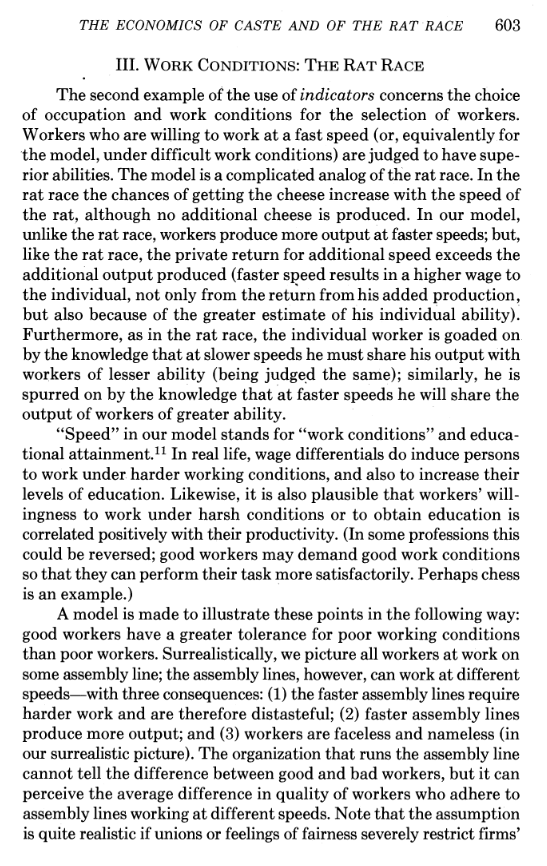
Somehow he succinctly describes the key insight in one page. Here is the full paper at jstor. I vainly searched the web for “Akerlof rat race intuition” and of course there was nothing better, because why bother? The article marked a key turning point in the shifting of thinking of most economists away from a “with free markets and people and firms engaging in voluntary transactions the presumption should be to leave things alone” to a perspective of “with information asymmetries ubiquitous and indeed constantly ‘manufactured’ the presumption should be that we know very little about how economies are really working.” The issue came up in a student discussion of the 35 hour work week, versus, say, a 40 or 50 hour work week. How would we research and justify a stance as a citizen one way or the other? (Assuming that the whole point of the work week restriction is that it is fairly binding on what some people and firms would otherwise want to do.)
-
Recent Posts
- Reading Nov-Dec 2025 and Jan 2026
- AI as an existential threat – Kevane preliminary draft
- “What can it do?” A living list of computational problems that deep learning/AI/neural nets can or seems likely to “do” (at varying cost and efficacy)
- Reading August-September 2025
- The typical popular sci-fi version of AI posing an existential risk?
Archives
Categories
Friends of African Village Libraries (I post regularly here)- Sumbrungu Community Library nighttime reading
- Résumé du livre Une grande mère criminelle
- Organisation d’une séance de discussion autour d’un livre à la bibliothèque de Dimikuy
- Librarians of Tuy monthly meeting January 2026, Burkina Faso
- Impressions sur la production de livres CMH au Burkina Faso
- Compte rendu de la première rencontre des gérants de la zone du Tuy
- Science fiction books for libraries in Burkina Faso and Ghana
- Animation d’une séance de lecture à la bibliothèque de Dimikuy
- Nyariga Community Library in Ghana, photos January 2026
- Visite à la bibliothèque de Béréba, Burkina Faso
