My colleague John Ifcher rationalizes his (happy) choices ;-)

Two college professors, Chris M. Herbst and John Ifcher, are challenging the collective, if counterintuitive, wisdom. Being a parent, they say, really does make people happier than the alternative — in part because over the past few decades, those who aren’t parents have been becoming gradually less happy.

Dr. Herbst, an assistant professor of public affairs and social work at Arizona State University, and Dr. Ifcher, an assistant professor of economics at Santa Clara University, set out to critically assess the body of research that led to the generally accepted “parental happiness gap” — repeated findings showing that parents are less happy, experience more depression and anxiety, and are more likely to be unhappy in their marriages than those who are not parents.

….

What the two researchers found, in a paper titled “A Bundle of Joy: Does Parenting Really Make You Miserable?” presented at the annual Population Conference of America, suggests that the balance of happiness is shifting, and that ultimately, we who protest as parents may be proved right. But it’s not necessarily because we’re getting happier. Rather, parents’ happiness has held steady over time, while the absolute happiness of those who aren’t parents responding to questions like “Taken all together, how would you say things are these days — are you very happy, pretty happy, or not too happy?” decreased from 1972 to 2008.

via Having Children Makes You Relatively Happier, Research Finds – NYTimes.com.

Posted in Burkina Faso | Comments Off on My colleague John Ifcher rationalizes his (happy) choices ;-)

The gender differences are persistent

One-Time Transfers of Cash or Capital Have Long-Lasting Effects on Microenterprises in Sri Lanka

Suresh de Mel, David McKenzie, Christopher Woodruff in Science 24 February 2012:Vol. 335 no. 6071 pp. 962-966DOI: 10.1126/science.1212973

Abstract: Standard economic theory suggests that one-time business grants can have at most temporary effects, and accordingly, policies to increase incomes of the self-employed in developing countries typically rely on sustained engagement. In contrast, we found long-lasting impacts from one-time grants given in a randomized experiment to subsistence firms. Five years after we gave $100 or $200 to 115 of 197 male and 100 of 190 female Sri Lankan microenterprise owners, we found 10-percentage-point-higher enterprise survival rates, and $8-to-$12-per-month-higher profits for male-owned businesses that received the grants. Female-owned businesses showed no long-term or short-term impacts. Our follow-up investigation interviewed 94% of the original sample and collected survivorship data from the remaining 6%, demonstrating that tracking long-term outcomes is both feasible and worthwhile. The results suggest that one-off grants may have lasting impacts on some types of subsistence firms, challenging the view that sustained engagement is always required.

via One-Time Transfers of Cash or Capital Have Long-Lasting Effects on Microenterprises in Sri Lanka.

Posted in Burkina Faso | Comments Off on The gender differences are persistent

Sober Look: India facing stagflation

Rising import costs (particularly food inflation) are nearly impossible to control when the currency weakens this much.

Credit Suisse: With India looking rather stagflationary at present, the Reserve Bank of India faces somewhat of a dilemma. Does it ease policy further on the basis that economic growth is very weak and core inflation soft or keep rates unchanged as it worries about headline inflationary pressures?

The Reserve Bank of India (RBI) will likely cut rates again, simply because the core inflation remains relatively tame (core inflation as measured by RBI actually declined 0.1% due to a slowdown in manufacturing demand). But the outlook for growth is far from certain. With currency weakening, inflation could become difficult to control while growth is showing signs of slowing. These are the signs of stagflation.

via Sober Look: India facing stagflation.

Posted in Burkina Faso | Comments Off on Sober Look: India facing stagflation

What was supposed to happen with Greece in terms of EU sanctions?

I wonder if Greece was actually sanctioned?  I can’t find relevant news articles, but this one suggests they were not (it suggests Hungary will be first country sanctioned).

EU FINANCE ministers have backed a European Commission plan to impose financial sanctions against Hungary over its budget deficit, the first such move against any member of the union.

The development, if followed through by the ministers, would see Budapest deprived of some €495 million in EU cohesion funding.

The procedure against Hungary represents a key test of a new system to toughen the enforcement of EU budget rules, one which will be underpinned by Europe’s new fiscal treaty.

A good short article by Mark Spiegel:

The Growth and Stability Pact proposes regulations which strengthen the surveillance of budgetary positions and defines the procedure for handling excessive deficits. Under this pact, each EMU member is committed to a medium-term budgetary position of close to balance, or surplus. This policy allows for some movements of the budget deficit over a business cycle due to “automatic stabilizers.” For example, budgets which are balanced under full employment will go into surplus and deficit by themselves during booms and busts respectively, due to fluctuations in government revenues and social spending. Nevertheless, the stability pact forbids countries from running government deficits in excess of 3 percent of gross domestic product.

The surveillance measures are designed to insure that nations which are in danger of violating budgetary guidelines are identified early. Member states will be required to publicly announce stability programs which specify their budget objectives and make plans for adjustment in the government budget as needed to achieve compliance. The European Commission and the European Council will also monitor countries’ budget positions to give early warning to a member state whose budget path appears to be headed towards excessive government deficit.

The more controversial component of the Growth and Stability Pact concerns the provision of sanctions for nations running excessive deficits. The Commission will prepare a report whenever a nation’s actual or planned government deficit exceeds the 3 percent benchmark. The stability pact does make exceptions for excessive deficits resulting from major economic downturns. In order to qualify for exception, however, countries must suffer an annual fall in GDP of at least 2 percent. Such a downturn would be severe; for example, France has not experienced a downturn of this magnitude in the post-war era.

Should the European Commission report an excessive deficit, the Economic and Financial ECOFIN Committee will then report an opinion to the European Council concerning the Commission report. The European Commission, taking the ECOFIN report into account, will then recommend to the European Council whether or not to excuse an excessive deficit as exceptional.

The stability pact gives the European Council some discretion in making the decision whether or not to excuse the excessive deficit. In particular, it may consider an annual fall of less than 2 percent of exceptional nature in “… light of supporting evidence, in particular on the abruptness of the downturn or on the accumulated loss of output ….” The European Council Resolution on the Stability and Growth Pact provides a benchmark value of a 0.75 percent decrease in real output for an “abrupt downturn” meriting exception.

If the European Council does decide that an excessive deficit exists, it will set clear deadlines for policy adjustments. Countries with excessive deficits are expected to begin taking action within four months of the identification of a violation, and the deficit should be brought into compliance within a year of identification of a violation. If a member state fails to comply with the recommendations of the European Council, sanctions are to be imposed on the country in violation within ten months of identification of a violation. However, if the European Council perceives that the violating nation is complying with its policy recommendations, it may hold the sanctions in abeyance and continuously monitor the offending nation until its deficits are at acceptable levels.

In the event that sanctions are implemented, the stability pact calls first for countries to contribute non-interest bearing deposits of a fixed component, not to exceed 0.2 percent of GDP, and a variable component equal to 0.1 times the excess of the government deficit as a percent of GDP over 3 percent. The overall sanction amount cannot exceed 0.5 percent of GDP. There is still a difference of opinion concerning how this ceiling should be applied. Germany, the Netherlands, and the European Commission want the fines to be applied cumulatively, while most other member states want 0.5 percent of GDP to represent an “absolute ceiling,” even for a deficit which persists for a number of years.

Posted in Burkina Faso | Comments Off on What was supposed to happen with Greece in terms of EU sanctions?

Greek financial chicanery leading up to crisis

In 2001, just after Greece was admitted to Europe’s monetary union, Goldman helped the government quietly borrow billions, people familiar with the transaction said. That deal, hidden from public view because it was treated as a currency trade rather than a loan, helped Athens to meet Europe’s deficit rules while continuing to spend beyond its means.Athens did not pursue the latest Goldman proposal, but with Greece groaning under the weight of its debts and with its richer neighbors vowing to come to its aid, the deals over the last decade are raising questions about Wall Street’s role in the world’s latest financial drama.As in the American subprime crisis and the implosion of the American International Group, financial derivatives played a role in the run-up of Greek debt. Instruments developed by Goldman Sachs, JPMorgan Chase and a wide range of other banks enabled politicians to mask additional borrowing in Greece, Italy and possibly elsewhere.In dozens of deals across the Continent, banks provided cash upfront in return for government payments in the future, with those liabilities then left off the books. Greece, for example, traded away the rights to airport fees and lottery proceeds in years to come.Critics say that such deals, because they are not recorded as loans, mislead investors and regulators about the depth of a country’s liabilities.

via Wall St. Helped Greece to Mask Debt Fueling Europe’s Crisis – NYTimes.com.

Posted in Burkina Faso | Comments Off on Greek financial chicanery leading up to crisis

Euro Zone Economy Skirts Recession – NYTimes.com

The Greek economy has shrunk by more than a quarter since 2008, and continued to plunge at the beginning of the year without adjusting for seasonal effects, although at a slower velocity. While Greece’s official statisticians do not make such adjustments, statistics agencies in most countries adjust quarterly data to reflect the fact that economic activity typically picks up at the end of a year and slows at the beginning of the next.Another euro zone trouble spot, Portugal, also performed less dismally than expected. Its economy shrank 0.1 percent in the first quarter from the previous quarter, compared with a 1 percent decline that analysts had forecast.Portugal, which is seen as having done more than Greece to improve economic performance, may have benefited from stronger exports. But Mr. Fois of Barclays said a recovery probably remains distant.“Expecting sustained growth in the short term would be a bit optimistic,” he said. “You still have a lot of fiscal austerity to come through.”Germany has benefited from the European Central Bank’s low lending rate of 1 percent, a benchmark that is set with the euro zone as a whole in mind but is probably too low for German conditions.While credit is tight in much of Europe, it is still available in Germany at inexpensive rates that have pushed up real estate prices in urban areas. German wages are also likely to rise as companies have trouble finding skilled workers, fueling inflation which is already above the official target of about 2 percent.Higher wages and inflation in Germany are likely to trouble some policy makers and segments of the German public, but may be good news for other countries in Europe. They would have an easier time competing with Germany for investment, while higher wages might increase German demand for their products.

via Euro Zone Economy Skirts Recession – NYTimes.com.

Posted in Burkina Faso | Comments Off on Euro Zone Economy Skirts Recession – NYTimes.com

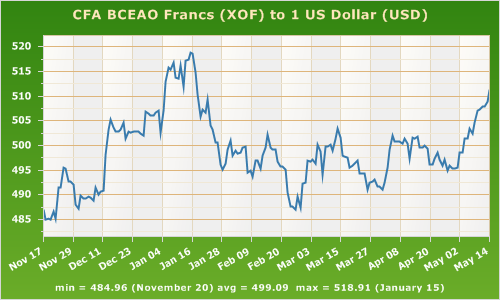
Euro drops, and so does the Franc CFA, the West African currency, tied to the euro

Posted in Burkina Faso | Comments Off on Euro drops, and so does the Franc CFA, the West African currency, tied to the euro

What if Greece leaves the eurozone? Nice article by AP

FRANKFURT, Germany — Let Greece go. It’s a possibility that’s being considered more and more publicly in Europe.There have been two and a half years of bailouts and broken promises by Greece to reform. The result: a fifth year of recession and, this week, political chaos. Voters on Sunday favored parties that either oppose the country’s international bailout or want to renegotiate it. If it cannot get more rescue loans, Greece will go bankrupt and likely have to leave the eurozone, the currency union of 17 countries.The question confronting leaders in Athens, Berlin and the other eurozone capitals could soon be:What would happen if Greece left the euro? How much damage would that do to it and other countries in the eurozone? Has Europe insulated itself to a degree that it can cut Greece loose, while keeping its currency alive?

via Greek euro exit no longer unthinkable | cleveland.com.

Posted in Burkina Faso | Comments Off on What if Greece leaves the eurozone? Nice article by AP

I hope those star economists will donate to FAVL!!!

Established or not, economists are hot commodities. Last year, the average starting salary for new assistant economics professors was nearly $112,000 – the highest ever in inflation-adjusted terms and one of the highest across academic departments, according to the American Economic Association.“I tell our PhD students, you’re fortunate to have chosen economics instead of philosophy or English,” says John Cawley, professor of economics at Cornell University in Ithaca, New York. “Because the reality is, everyone gets a job.”

via Battle for Academic Economists Is Heating Up – Real Time Economics – WSJ.

Posted in Burkina Faso | Comments Off on I hope those star economists will donate to FAVL!!!

Slowdown in growth in China? Trend or blip is the question

Exports, a cornerstone of China’s torrid economic growth over the past three decades, grew only 4.9 percent last month — half as fast as economists had expected. And a slump in new orders over the past month at the Canton Fair, China’s main marketplace for exporters and foreign buyers, suggests that overseas shipments by the world’s second-biggest economy, after that of the United States, may not recover quickly.Growth in other sectors appears to be slowing, too, particularly in real estate. Soufun Holdings, a Chinese real estate data provider, released figures Monday showing that residential land sales in the country’s 20 largest cities had fallen 92 percent last week from the week before, as declining prices for apartments have left developers short of cash and reluctant to start further projects.

via Data Signals Economic Trouble in China – NYTimes.com.

Posted in Burkina Faso | Comments Off on Slowdown in growth in China? Trend or blip is the question

Replication data for Michael Ross Oil Islam and Gender

Is available here.

Posted in Burkina Faso | Comments Off on Replication data for Michael Ross Oil Islam and Gender

Michael Ross … Oil, Islam, and Gender on Vimeo

Posted in Burkina Faso | Comments Off on Michael Ross … Oil, Islam, and Gender on Vimeo

Oil, Islam, and Women … Michael Ross

A nice discussion of the issues…

Last year we had a by Monkey Cage standards vigorous debate about Michael Ross’ American Political Science Review article “Oil, Islam, and Women.” Ross argued that poor progress towards gender equality in the Middle East was caused not so much by the region’s Islamic traditions as by its preponderance of oil. The argument goes as follows. Oil tends to crowd out other exports, especially manufacturing. Manufacturing demands large numbers of low wage workers and has been the primary source for increased female non-farm labor participation in countries across the globe. Moreover, manual jobs in the extraction of natural resources are male-dominated. Increased female labor participation has in turn been the stepping stone for greater political representation and equal rights. Ross demonstrates that within the Middle East oil-poor countries like Morocco and Tunisia have relatively better records on gender equality than oil-rich countries. Outside the Middle East oil-poor countries also tend to do better in this regard.It has not taken long for proponents of the cultural approach to respond. SSRN has two working papers that both apply multi-level modelling to World Values surveys to show that islam, not oil, correlates with variation in opinions about gender equality across countries. Attitudes towards gender equality, in turn, shape whether women achieve equal rights and leadership positions, such as elected office. one paper is by Amy Alexander and Christian Welzel the other one comes from Harvard’s Pippa Norris .

via Oil, Islam, and Women Revisited — The Monkey Cage.

Posted in Burkina Faso | Comments Off on Oil, Islam, and Women … Michael Ross

Finally a way in R to create a simple table of means

with(datasetname, tapply(analysisvariable , list(rowvariable , columnvariable ), mean))

and also after installing reshape and plyr packages:
library(reshape)
cast(bill1, female ~ competitive , value = ‘score2’, fun = mean)

Posted in Burkina Faso | Comments Off on Finally a way in R to create a simple table of means

The famous sterling devaluation of 1992

Wikipedia has a nice discussion of Black Wednesday.

Posted in Burkina Faso | Comments Off on The famous sterling devaluation of 1992

Nothin like a good old-fashioned devaluation when you are teaching international economics…

BBC News – Malawi devalues kwacha by 33%, leading to panic-buying

The kwacha was devalued as part of moves by the new government to restore donor funding.The former government had rejected IMF calls to devalue the currency.Our reporter says that other goods such as rice, maize flour and orange squash were running short in Blantyre’s Chichiri shopping centre – the main retail area in Malawi’s biggest city.He has been told that the same panic-buying is also happening in Malawi’s main towns.The scramble comes despite economists saying they did not expect the devaluation to immediately lead to higher prices, as many businesses were expecting the move and were already using the new exchange rate.The central bank announced that one dollar would now be worth 250 kwacha, up from 168, while the peg to the US currency would be scrapped.”The devaluation of the kwacha and the liberalisation of the foreign exchange market are expected to continue the government’s efforts to reach agreement with the IMF,” said Reserve Bank of Malawi Governor Charles Chuka, adding that this would hopefully lead to more donor funding in the next few months.

via BBC News – Malawi devalues kwacha by 33%, leading to panic-buying.

Posted in Burkina Faso | Comments Off on Nothin like a good old-fashioned devaluation when you are teaching international economics…

Will one-way bet capital inflow destabilize Chinese financial system?

Is this still the main “danger” facing the renmimbi?

Measures to suppress volatility may encourage speculators to all line up on one side of the market, at present the side anticipating further appreciation, subjecting the economy to worrisome capital inflows and aggravating the risk of overheating.

Barry Eichengreen “Long and Short of It” p. 6.

Posted in Burkina Faso | Comments Off on Will one-way bet capital inflow destabilize Chinese financial system?

Econbrowser: Thinking about the Double Dip Recession in the UK

The first courses in our training were identical, and so of course I have to agree with Menzie (since that was it for me!) writing about what explains lackluster U.K. performance:

I believe the data are not puzzling from an open economy perspective but that might reflect my training; deficient aggregate demand and relatively high inflation can occur when there is a large imported share in GDP.

via Econbrowser: Thinking about the Double Dip Recession in the UK.

Posted in Burkina Faso | Comments Off on Econbrowser: Thinking about the Double Dip Recession in the UK

Land dispute in Tanghin-Dassouri

I have a special place for the village/town of Tanghin-Dassouri just outside of Ouaga because it is home to the lovely (but closed) Louis Lacaille library.  The town seems like it has a lot of political problems, in evidence in this short article published in Le Reporter (and a previous article I blogged about).  The whole issue of how important writing, transparency and communication are for functioning in a modern economy is seen clearly.

Devant le refus de ses interlocuteurs, le maire hausse le ton et se montre même menaçant dans un premier temps. « Vous devez accepter cette main tendue. C’est par pure indulgence, sinon nous aurions pu retirer le terrain sans contrepartie, puisque vous n’avez pas de titre foncier… », leur aurait-il fait savoir à un moment donné. Mais ils ne se laissent pas intimider. Ils décident de mettre en valeur leur terrain. Ils fixent une date pour le début des travaux. Ils ne manquent pas de tenir le maire informé au travers d’une correspondance en date du 6 mars 2012. « Nous avons l’honneur de vous faire part que tout l’ensemble de la famille a refusé votre proposition de changer le terrain ou de le déplacer. Raison pour laquelle nous vous envoyons cette note à titre d’information que nous allons mettre notre terrain en valeur… », peut-on lire dans cette correspondance. La veille du début des travaux, la tension monte d’un cran dans la ville. Pendant que les frères du défunt s’affairaient à déposer des agrégats sur le terrain, des jeunes identifiés comme des partisans du maire font irruption et menacent de les affronter le lendemain s’ils s’entêtent à mettre le terrain en valeur. La gendarmerie est saisie de l’affaire. Des représentants des deux camps sont entendus par cette dernière. Pour éviter toute situation déplorable, il est demandé que toute action sur le terrain soit suspendue. Nous avons contacté le maire.

via TANGHIN-DASSOURI : Grosse bagarre autour d’un terrain de 3 hectares.

Posted in Burkina Faso | Comments Off on Land dispute in Tanghin-Dassouri

BBC News – Africa’s share of foreign direct investment largest ever

Africa received its largest ever share of global foreign direct investment FDI last year, an Ernst and Young survey has said.FDI projects grew by 27% in 2011, pushing Africa’s share of the world’s investment to almost a quarter.FDI inflows, now about $80bn £50bn, should reach $150bn by 2015, according to the global consultants.But potential investors still see Africa as “the least attractive” destination, the report finds.

via BBC News – Africa’s share of foreign direct investment largest ever.

When I am on sabbatical starting this summer I’ll have time to verify that practically all of the investment is in oil and mining.  Still, clear that for many GDP is growing rapidly.  Less clear whether highly unequal growth is sustainable: across the continent stark inequality promotes movements for redistribution.  Think 1848?

Posted in Burkina Faso | Comments Off on BBC News – Africa’s share of foreign direct investment largest ever