Presidential amnesty and constitutional role for chiefs in Burkina Faso

“Le Conseil a été informé d’un projet de loi portant modification de la Constitution. Les innovations majeures portent entre autres sur : la constitutionnalisation de la chefferie coutumière et traditionnelle, du genre, du Médiateur du Faso et du Conseil supérieur de la communication ; la création d’un Sénat et d’un tribunal des conflits ; la sanction de la Déclaration de politique générale (DPG) du Premier ministre par l’Assemblée nationale ; l’amnistie au profit des anciens chefs d’Etat de 1960 à la date d’adoption des dispositions de la nouvelle Constitution.

via Autant le dire… : Réformes politiques : top on y va ! – leFaso.net, l’actualité au Burkina Faso.
Posted in Burkina Faso | Comments Off on Presidential amnesty and constitutional role for chiefs in Burkina Faso

Not sure about how many levels of irony are here now….

Posted in Burkina Faso | Comments Off on Not sure about how many levels of irony are here now….

Fastest return to order ever? Wow… could we please have access to the magic words, for future use?

Le capitaine Sanogo, chef de la junte malienne qui a pris le pouvoir le 22 mars a annoncé, ce vendredi 6 avril, la signature d’un accord-cadre avec le représentant du médiateur burkinabè pour la crise malienne Djibril Bassolé. Lors d’une déclaration à la télévision publique ORTM, la junte a détaillé les points de cet accord qui prévoit le transfert du pouvoir.« Nous sommes parvenus à un accord, accord qui permettra dans les heures et les jours à venir de mettre effectivement en place les organes prévus par la Constitution et qui fonctionneront de manière régulière », a déclaré à l’ORTM le ministre burkinabè Djibrill Bassolè au nom de la Cédéao.L’accord-cadre de cinq pages signé entre le chef de la junte et la Cédéao prévoit le transfert des affaires à un président intérimaire. Ce dernier devrait être le président du Parlement Diouncounda Traoré, qui prêtera serment et sera chargé d’organiser des élections dans un délai de 40 jours. Il sera aussi en charge de gérer la situation dans le nord du pays.Parallèlement, les putshistes devraient bénéficier d’une amnistie générale aux termes d’une proposition de loi contenue dans l’accord.Le président en exercice de la Cédéao Alassane Ouattara a déclaré la levée immédiate des sanctions de l’organisation contre le Mali.

via Malijet – L’actualité malienne au quotidien – Mali : la junte et la Cédéao concluent un transfert de pouvoir.

Posted in Burkina Faso | Comments Off on Fastest return to order ever? Wow… could we please have access to the magic words, for future use?

Dramatic account of ATT’s escape from Presidential palace, from Jeuneafrique-Malijet

Koulouba est au sommet d’une butte. Il n’y a qu’une seule voie d’accès. Or, les putschistes tiennent cette route. Il ne reste qu’une solution : descendre à pied la colline par-derrière, en direction du quartier de Dar Salam. C’est là qu’un béret rouge entre en scène : le lieutenant-colonel Abidine Guindo (homonyme de Boureima Guindo). Lui n’a pas trahi. Jusqu’en novembre dernier, il était l’aide de camp du président. Aujourd’hui, il commande le 4e régiment de parachutistes basé à Djicoroni, à 6km de Koulouba. Ce soir-là, il est aux côtés du chef de l’Etat et prend la direction des opérations. Avec trois autres parachutistes, il aide ATT à franchir la clôture puis à dévaler la pente. Le président à 63 ans. Il souffre d’un genou et a prévu de se faire opérer l’été prochain, après la fin de son mandat. A certains endroits de la descente, ses compagnons doivent le porter. Enfin, le petit groupe atteint la route en contrebas, l’avenue de l’Indépendance. Pourtant, à ce moment, le président en fuite n’est pas encore tiré d’affaire. Pour rejoindre le camp de parachutistes de Djicoroni, il faut un véhicule. Mais pas un 4×4, qui pourrait attirer l’attention des putschistes. Une Mercedes 190 de couleur blanche passe sur la route. Abidine Guindo et ses hommes braquent le chauffeur, qui s’enfuit sans demander son reste. ATT et ses compagnons montent dans le véhicule et réussissent à gagner Djicoroni sans encombre. Un choix judicieux. Les hommes d’Abidine Guindo sont plus fidèles que ceux de la garde présidentielle. Et l’ambassade des Etats-Unis est voisine du camp. ATT est donc doublement protégé. Il peut souffler. Mais il a eu chaud.

via Malijet – L’actualité malienne au quotidien – Révélation sur le coup d’Etat au Mali: Comment ATT a fui Koulouba.

Posted in Burkina Faso | Comments Off on Dramatic account of ATT’s escape from Presidential palace, from Jeuneafrique-Malijet

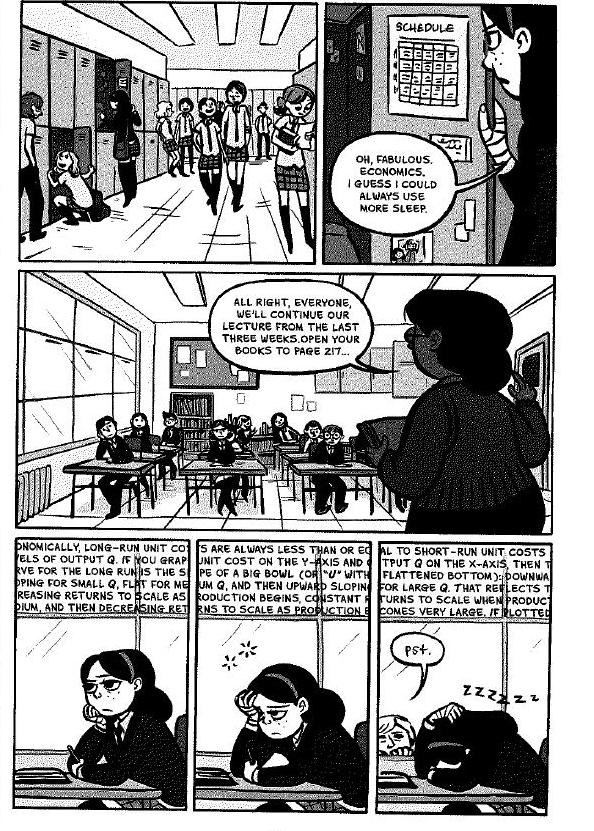
Vera Brosgol makes fun of economics in Anya’s Ghost

I loved reading this quite charming graphic novel, about difference and courage….  More about Vera Brosgol is here.


Posted in Burkina Faso | Comments Off on Vera Brosgol makes fun of economics in Anya’s Ghost

Alessandra Cassar on effects of institutional experience on trust

We had a great departmental seminar today with Alessandra Cassar reporting on experiments done in Italy and Kosovo.  She and co-author ask whether playing a “trade game” where some players have an impartial enforcement mechanism and other players have a pay-in-advance partial enforcement mechanism affects subsequent willingness to pay “generalized trust”… and indeed it does… players with the impartial mechanism seem to become more trusting of the other players.  That is, there is an institutional spillover effect onto a different game.

My colleagues John Ifcher and Homa Zarghamee recently published a paper on how mood/affect changes decisions about patience, and I assume there is a growing body of evidence now about the short-term mutability of underlying preferences… what is needed now is some theory about how short-term effects aggregate up to longer-term enduring background preferences.  Because another literature finds that historical events seem to leave enduring spillovers on preferences.

An interesting area for theory.

Posted in Burkina Faso | Comments Off on Alessandra Cassar on effects of institutional experience on trust

Who actually wants a son, when we see strong son preference?

Not women, very much, it seems. A new paper by Laura Zimmermann from University of Michigan, using data from India.

It is well-documented that in a number of countries unnaturally few girls are born relative to boys. Explanations have focused on a range of potential reasons, including economic and cultural benefits from having a son. Households are usually treated as monolithic entities, however, and the motivations of particular
household members are understudied. In contrast, this paper looks at a potential benefit mothers derive from giving birth to a boy – an improvement in their position within the household. I analyze this hypothesis using households with young first-borns from a nationally representative Indian dataset. The results
suggest that women do indeed gain in non-monetary terms: Having a boy rather than a girl leads to increased joint household decision-making powers. This effect seems to vanish after six months, however, implying that the female-specific self-interest in practicing son preference may be low.

The draft of the paper is here.

Posted in Burkina Faso | Comments Off on Who actually wants a son, when we see strong son preference?

via Econbrowser: Lessons from the Crisis for Teaching Macro

The short article by Menzie is a pithy summary of the most important “missing link” in most intermediate macro… unfortunately not that easy to incorporate into the model without seeming very ad hoc, and without ending up with a $20 bill on the sidewalk… and yet it happens!

The NY Times “Room for Debate” recently had a forum on “Rethinking How We Teach Economics”, with contributions by Blinder, Taleb and Skidelsky, among others. In my contribution, I focused on the importance of asymmetric information and self-reinforcing feedback loops:

In the typical introductory textbook, wages and prices adjust so that labor is fully employed and goods are sold at the right price. A more sophisticated treatment shows up in more advanced texts, but even in some graduate texts, there is an emphasis on the self-correcting aspects of the modern macroeconomy. Recessions are eventually overcome as prices adjust to the right levels, even in the absence of government policy.

via Econbrowser: Lessons from the Crisis for Teaching Macro.

Posted in Burkina Faso | Comments Off on via Econbrowser: Lessons from the Crisis for Teaching Macro

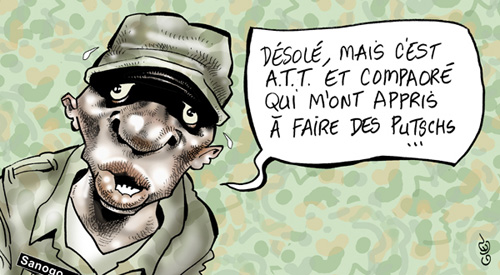
The cartoon says it all – Mali and Burkina

« Quand la barbe de ton voisin brûle, arrose d’eau la tienne », indique un proverbe sahélien. Mais quand c’est la case du voisin qui brûle, il devient dérisoire d’enfouir sa tête dans le sable. Les destins du Mali et du Burkina sont historiquement parallèles. Même si les populations des deux pays n’ont pas oublié la « Guerre de Noël » qui les opposa brièvement en décembre 1985, autour de la bande de terre semi-désertique d’Agacher, c’est à une franche coopération qu’elles assistent depuis les années 90, amitié sahélienne sublimée par l’entente cordiale d’Amadou Toumani Touré et de Blaise Compaoré, deux anciens militaires officiellement ou officieusement adeptes de putschs « moralisateurs ». Mais où le parallélisme s’arrêtera-t-il ? Le Burkina célèbre le premier anniversaire des mutineries qui secouèrent le régime pendant de longues semaines. Alors, pour que le concept de destins parallèles ne se mue pas en oracle pour le président du Faso, les autorités burkinabè ne peuvent pas se contenter d’arroser d’eau leur menton. Si l’Ivoirien Ibrahim “I.B.” Coulibaly avait pu tranquillement préparer son hypothétique destin national à Ouagadougou, en 2002, les rebelles maliens présents sur le territoire burkinabè, eux, se sont vu rapidement remis à leur place. Lorsqu’en février, le quotidien burkinabè L’Observateur paalga donna la parole à un colonel touareg présent au Burkina, le Conseil supérieur de la Communication déplora officiellement la légèreté avec laquelle le journal ouvrait ses « colonnes à des rebelles qui tiennent des propos racistes et appellent à la partition d’un Etat souverain voisin. » Pendant le bras de fer entre l’organe de régulation et la presse, le ministre des Affaires étrangères et de la coopération Régionale, Djibrill Bassolé, enfonçait le clou en rappelant leur droit de réserve à tous les réfugiés présents sur le territoire national. Pas question que le Faso, longtemps considéré comme un pompier-pyromane dans les crises de la région, ne devienne une base arrière de la rébellion malienne. Pour mieux empêcher toute contagion putschiste, le régime a choisi d’annihiler toute importation politique. Mais l’implication du Burkina Faso n’a pu se cantonner à la neutralité passive et à la bienveillance humanitaire.

via Les barbus d’AQMI et la “barbe” burkinabè – leFaso.net, l’actualité au Burkina Faso.

Posted in Burkina Faso | Comments Off on The cartoon says it all – Mali and Burkina

Essential for following Mali crisis realtime… Martin Vogl (martinvogl) on Twitter

Martin Vogl ‏ @martinvogl tweets and retweets

What is ordinary life in Kidal, Gao, Timbuktu going to be like now? Shops? Banks? Hospitals? Administration

Off the phone with friends in #Gao: Vehicles stolen, banks/NGOs/hospitals looted. Medicine, gas and water in short supply. #Mali

Timbuktu calm now. Looting and thefts during the day. Many southerners, military and civil servants, have fled south.

via Martin Vogl (martinvogl) on Twitter.

Posted in Burkina Faso | Comments Off on Essential for following Mali crisis realtime… Martin Vogl (martinvogl) on Twitter

Viral picture that still brings a smile

Posted in Burkina Faso | Comments Off on Viral picture that still brings a smile

Sad and absurd for a country to fall this low… Sanogo annonce le rétablissement des institutions ce 1er avril

Timbuktu apparently has been abandoned to the MNLA, and Sanogo realizes that he’s going to be jailed or killed in a couple days if he doesn’t throw in the towel.  What on earth are the soldiers thinking, or are they too busy looting?  Speaking of looting, I was just reading about the looting of Tipoo Sultan’s palace back in 1799, by the British.

Au Mali, le capitaine Sanogo a promis, dimanche 1er avril, de rétablir la Constitution et les institutions, et de remettre le pouvoir aux civils. Dix jours après le coup d’Etat, le chef de la junte militaire au pouvoir s’est exprimé devant la presse, dans son quartier général de Kati, en banlieue nord de Bamako. Le ministre burkinabè des Affaires étrangères, Djibril Bassolé, émissaire du président Compaoré et médiateur de la Cédéao dans cette crise, était à ses côtés.

via Au Mali, le capitaine Sanogo annonce le rétablissement des institutions ce 1er avril – MALI – RFI.

Posted in Burkina Faso | Comments Off on Sad and absurd for a country to fall this low… Sanogo annonce le rétablissement des institutions ce 1er avril

“Terrific” criticism of the coup and its aftermath, from unnamed sources, via Xinhua…

The assessment of the coup at this point has to be that the soldiers have taken Mali to a very grim turn indeed.

BAMAKO, 30 mars (Xinhua) — L’annonce de la prise de Kidal par les rebelles a plongé le Mali dans la stupeur.

….

“Voila le résultat de l’inconscience; de l’indiscipline, de la précipitation et du geste impulsif et irréfléchi des soldats mutins. C’est toutes les communautés civiles noires et blanches ( sonrhaï, tamacheques et arabe) qui vont bientôt affronter cette horde de hors la loi qui croient que l’Azawad est leur terre à eux seuls”, s’indigne un responsable de communication dans une ambassade du Mali à l’étranger.

….

“Les fonctionnaires à qui on ne payera pas leurs salaires pourront manifester dans les rues. Mais, avec des militaires sans solde et sans vivres, bonjour le désordre. EDM (Energie du Mali) est déjà à bout de souffle et dans les jours à venir, faute de combustibles, les groupes vont s’arrêter et le pays sera plongé dans le noir. Une obscurité que les bandits de grand chemin adorent pour sévir”, craint un officier de la gendarmerie nationale.

via Malijet – L’actualité malienne au quotidien – Mali : les putschistes dépassés par les événements, les populations dans la stupeur.

Posted in Burkina Faso | Comments Off on “Terrific” criticism of the coup and its aftermath, from unnamed sources, via Xinhua…

Still at 14% it seems, the gold revenue take of the government of Burkina Faso

The Prime Minister of Burkina, Luc Adolphe Tiao, just gave his “discours a la nation” where he mentioned:

Les six (6) mines d’or en activité ont porté la production industrielle d’or à 32,60 tonnes en 2011, contre 23,08 tonnes en 2010, soit une augmentation de 41%. La production attendue en 2012 pourrait atteindre 42 tonnes. La production artisanale déclarée, quant à elle, est estimée à 460 Kg. La seule mine de manganèse, celle de Kiéré, a produit et exporté 49 715 tonnes.  C’est environ, 127,43 milliards de francs CFA qui ont été reversés au budget de l’Etat au titre des recettes minières en 2011. 4 556 emplois permanents ont été dénombrés au sein des six (6) mines industrielles, dont 93% de ces emplois occupés par des nationaux.

So 42 tons exported is valued at around $2billion (42×32,000x$1500), and tax receipts are around $282 million (127b FCFA divided by 450 CFA/$), so the effective taxation of gold production is around 14%.  This is close to what EITI reports found for 2008 and 2009 for Burkina.

Posted in Burkina Faso | Comments Off on Still at 14% it seems, the gold revenue take of the government of Burkina Faso

Uh oh… from RFi… Mali not going to get better anytime soon… hello Cote d’Ivoire… in the worst way

Le capitaine Sanogo s’est en revanche rendu à l’aéroport de Bamako. Pendant plusieurs heures, il s’est entretenu à huis clos avec Djibril Bassolé ou Mohamed Bazoum, chefs des diplomaties burkinabè et nigérienne, ainsi qu’avec Adama Bictogo, ministre ivoirien de l’Intégration régionale.

Par ailleurs, la tension de ce matin est remontée à Bamako. Plusieurs centaines de militants anti-putschs se sont réunis à la Bourse du travail. Les jeunes favorables au capitaine Sanogo sont venus perturber le rassemblement en jetant des pierres. Les anti-putschs ont répliqué. Les affrontements se seraient maintenant arrêtés, mais on déplore plusieurs blessés.

via Mali : la Cédéao annule sa venue face à une manifestation pro-junte à l’aéroport de Bamako – Mali – RFI.

Posted in Burkina Faso | Comments Off on Uh oh… from RFi… Mali not going to get better anytime soon… hello Cote d’Ivoire… in the worst way

Why I am glad I don’t have to do political commentary for a living

The Mali coup is one of those opaque events that are really hard to figure out.  Observers try, and they have to produce something (for their blogs, or their employers) … but in their hearts they know they really have no idea, and also that there is a circle of people who actually do know, but there is no real way to verify what they know because at this stage they presumably are in full lying mode as they jockey for power (or even their lives).  So…. tough position to be in, I sympathize (and see how I get to blog about the coup without knowing anything at all!).

Mann’s analysis raises a question I’ve pondered since we got our first glimpse of Mali’s coup plotters on Malian state television, early in the morning of March 22: What are these guys after? While I cannot take the putschists’ justifications of their actions at face value, I also cannot say what their motivations are. Did these junior army officers set out deliberately to derail Mali’s democratic process and seize power for themselves? I doubt it. More likely, they simply filled a void that opened up before them, without either adequately preparing for or fully considering the consequences of their actions. Here’s why I think this is the case.

via Bridges from Bamako | life in a budding West African metropolis.

Posted in Burkina Faso | Comments Off on Why I am glad I don’t have to do political commentary for a living

Fukuyama review of Why Nations Fail by Acemoglu and Robinson

Over at The American Interest:

They present a sharply bifurcated distinction between what they call good “inclusive” economic and political institutions, which are sometimes also labeled “pluralistic,” in contrast to what they call bad “extractive” or “absolutist” ones. Unfortunately, these terms are way too broad, so broad indeed that AR never provide a clear definition of everything they encompass, or how they map onto concepts already in use. “Inclusive” economic institutions, for example, seem to include formal property rights and court systems, but also have to do with social conditions that allow individuals access to the market such as education and local custom. “Inclusive” political institutions would seem to imply modern electoral democracy, but they also include an impersonal centralized state as well as access to legal institutions, and forms of political participation that fall well short of modern democracy. We find, for example, that England following the Glorious Revolution of 1688-89 was incipiently inclusive, despite the fact that well under ten percent of the population had a right to vote. When AR first used the term “extractive” in their early articles, it referred to truly extractive practices like the mines of Potosí or the sugar plantations of the Caribbean which extracted commodities out of the labor of slaves. In the current book extractive seems to mean any institution that denies any degree of participation to citizens, from tribal communities to ranchers in 19th century Argentina to the contemporary Chinese Communist Party.

Since each of these broad terms (inclusive/extractive, absolutist/pluralistic) encompasses so many possible meanings, it is very hard to come up with a clear metric of either. It also makes it hard to falsify any of their historical claims. Since more real-world societies are some combination of extractive and inclusive institutions, any given degree of growth (or its absence) can then be attributed either to inclusive or extractive qualities ex post.

Posted in Burkina Faso | Comments Off on Fukuyama review of Why Nations Fail by Acemoglu and Robinson

Martin Vogl interview with Sanogo in Mali (in English)

Link to the interview, not sure where it broadcast.  Sanogo asserts ATT has no soldiers with him.  “No one” is protecting ATT.  No fear of counter-coup.

Posted in Burkina Faso | Comments Off on Martin Vogl interview with Sanogo in Mali (in English)

Opinion on the “vrai-faux” coup d’etat in Mali… it really is a weird coup…

An excellent opinion piece by Jean-Pierre Béjot of La Dépêche Diplomatique:

It’s crazy ! Totalement fou. A-t-on jamais vu un président de la République être destitué par un « coup d’Etat » à quelques semaines d’une présidentielle (à laquelle il n’était pas candidat) pour « incompétence » après dix années passées au pouvoir ? A-t-on jamais vu un « héros national » – il y aura demain, lundi 26 mars 2012, 21 ans que Amadou Toumani Touré (ATT) a renversé la dictature de Moussa Traoré -, président de la République en exercice, rester ainsi plusieurs jours sans donner signe de vie alors que le pays est occupé par une clique de charlots à peine galonnés ?It’s crazy ! Totalement fou. A-t-on jamais vu un président de la République être destitué par un « coup d’Etat » à quelques semaines d’une présidentielle (à laquelle il n’était pas candidat) pour « incompétence » après dix années passées au pouvoir ? A-t-on jamais vu un « héros national » – il y aura demain, lundi 26 mars 2012, 21 ans que Amadou Toumani Touré (ATT) a renversé la dictature de Moussa Traoré -, président de la République en exercice, rester ainsi plusieurs jours sans donner signe de vie alors que le pays est occupé par une clique de charlots à peine galonnés?

Read the rest here.

Posted in Burkina Faso | Comments Off on Opinion on the “vrai-faux” coup d’etat in Mali… it really is a weird coup…

Nigeria Central Bank governor Sanusi on fuel subsidies…

Posted in Burkina Faso | Comments Off on Nigeria Central Bank governor Sanusi on fuel subsidies…