Best post Econ 3402 reading ever!

Bernanke covers practically every topic covered in my summer Macroeconomics class.  Great summary discussion!  Thanks Vic Chia for the pointer.

Estimates of potential output growth (y*) have declined primarily for two reasons.  First, potential growth depends importantly on the pace of growth of productivity (output per hour). Unfortunately, productivity growth has repeatedly disappointed expectations during this recovery. For example, in 2009, leading scholars were predicting productivity growth in the coming years of about 2 percent per annum; in fact, growth in output per hour worked has recently been closer to half a percent per year. It’s possible that productivity may recover, of course, but if it doesn’t, then potential growth rates in the future will be lower than had been expected earlier.Second, although Fed forecasters have been too optimistic about output growth in recent years, they have also been, interestingly, too pessimistic about unemployment, which has fallen faster than expected despite the slow rise in GDP.

Source: BERNANKE: Pay attention to the data, not the Fed – Business Insider

Posted in Burkina Faso | Comments Off on Best post Econ 3402 reading ever!

Bank of England thinks impact of Brexit is pretty bad

The short-term impact [of Brexit], however, has been largely negative. In the weeks since the vote, the pound has fallen sharply, and stocks in a number of sectors, including banking and construction, have been under pressure. Several real estate funds suspended withdrawals as investors tried to pull out their cash, fearing a slowdown in the British property market. Surveys in recent weeks also indicated that consumer confidence, services output and purchasing-manager sentiment had plummeted. The International Monetary Fund has cut its growth forecast for Britain’s economy, which had been one of the region’s strongest since the financial crisis. “There is a clear case for stimulus, and stimulus now, in order to be there when the economy really needs it — to have an effect when the economy really needs it,” Mark J. Carney, the bank’s governor, said at a news conference on Thursday. The central bank’s Monetary Policy Committee voted unanimously to lower its benchmark interest rate to 0.25 percent, the lowest level in the bank’s 322 years. The rate had been at 0.5 percent since March 2009. Mr. Carney also signaled on Thursday that the committee could cut rates further this year, but he ruled out the possibility of negative interest rates.

Source: Bank of England Cuts Interest Rate to Historic Low, Citing Economic Pressures – The New York Times

Posted in Burkina Faso | Comments Off on Bank of England thinks impact of Brexit is pretty bad

Jobs and wages in the United States: Finally some policy debate

A student shared a recent oped by Alan Blinder at the WSJ.

Andrew, Thanks for sharing! Something like this should be on the final, right? 😉  Actually, this is more about micro-level policies and supply side policies that we have not focused on.  I will note that [some] economists are generally pretty skeptical of this:

Mrs. Clinton also advocates widespread profit-sharing as a way to put more money into workers’ pockets. She would promote that goal both by using the presidential bully pulpit and by providing tax incentives for businesses that share profits. Since the scholarly evidence suggests that profit-sharing raises productivity, such tax breaks will partly pay for themselves.

If profit sharing were good for the bottom-line, then presumably many more companies would have adopted it. Like Silicon Valley firms do with stock options.  Anyway, an empirical issue, and the jury is very mixed about whether a big initiative would do much. But FDR encouraged us to experiment, and hopefully if she [Clinton] does do it it will be something that states can match (or opt out) so we get evidence for the effects, and learn something. Incidentally, the health care legislation also was partly designed to induce variation across states so we (the polity) could learn more about what programs are more/less effective.

Economists also pretty much agree that adult retraining has relatively low payoff (except for highly motivated adults… like you MBA students).   A good (somewhat old) discussion of the issues is by Lalonde.  As Blinder notes, early childhood interventions (like getting lead out of water) have enormous benefit-cost ratios by comparison. But young kids don’t vote.

I’ll also take issue with Blinder’s cavalier dismissal of protectionism… raising tariff (by being more aggressive in filing complaints of dumping and export subsidies through the WTO process) probably would have short term effects of raising employment and wages. The problem is that the mechanism it does this is often very inefficient- costs are raised for everyone else. Autoworkers would definitely benefit from a 30% tariff… but everyone who buys a new car has to pay, and much of the benefit goes to shareholders rather than workers.

Anyway, thanks Andrew… I should post this to my blog!

Posted in Teaching macroeconomics | Comments Off on Jobs and wages in the United States: Finally some policy debate

Are we in a nation-wide housing bubble?

Maybe?  The 20-city Case-Shiller index suggests that while nation-wide prices are rising rapidly (about 10% a year) for the past three years, we are still pretty far away from a bubble.  But the peak back in 2006 was really high, so getting to that peak 12 years alter should cause much concern. Has anything fundamental changed in the U.S. economy? Not incomes, for the bulk of residential buyers who intend to live in the home.  Here is Shiller a few months ago, sounding cautious.  Here is a good “yes bubble, so short” view from a finance perspective.

housing

Posted in Burkina Faso | Comments Off on Are we in a nation-wide housing bubble?

 IMF quota and governance reforms were finally approved by members earlier this year

The IMF’s 2010 quota and governance reforms have finally become effective and will give emerging markets like BRICS more power and greater say at the lender of last resort. “The conditions for implementing the International Monetary Fund’s 14th General Quota Review, which delivers historic and far-reaching changes to the governance and permanent capital of the Fund, have now been satisfied,” the IMF said in a statement. China will have the third largest IMF quota and voting share after the United States and Japan, and India, Brazil and Russia will also be among the top 10 members of the IMF. The reforms were approved by the IMF’s Board of Governors in 2010. US foot-dragging on reforms to the institution had blocked changes meant to give more voting power to BRICS and other emerging economies, frustrating countries around the world. These reforms will double the IMF’s quota resources and reallocate the quota. That meant reducing the role of advanced European countries and Gulf states, and increasing that of emerging nations, particularly China.

Source: IMF Reforms: China, India, Brazil, Russia Get Greater Say | The BRICS Post

Posted in Teaching macroeconomics | Comments Off on  IMF quota and governance reforms were finally approved by members earlier this year

Why is higher inflation worse than lower inflation?

Fredrik Wulfsberg’s analysis of Norwegian data suggests it is because when inflation gets higher (i.e. 10-15% range) firms change prices much more frequently, and so presumably this is more confusing for consumers.

The main result in this paper is that the variation in the frequency of price changes is more important than the size of price changes when inflation is high and vola-tile, and for the transition from the high-inflation to the low-inflation regime. When inflation is low and stable, both the frequency and the size of price adjustments are important, but the size is more important than the frequency. Prices thus changed more often and in smaller steps when inflation was high and volatile, and less often but by larger steps when inflation was low

Source: Inflation and Price Adjustments: Micro Evidence from Norwegian Consumer Prices 1975–2004 – mac.20140095

Posted in Teaching macroeconomics | Comments Off on Why is higher inflation worse than lower inflation?

Total Factor Productivity growth accounts for all growth in U.S. agriculture according to USDA

The TFP indexes reveal the dramatic contraction of labor in the farm sector. Agricultural land, a component of capital, also fell steadily, except for a brief cessation in the 1970s, and by 2004 amounted to less than three-quarters of its 1948 value. In contrast, the sector’s use of equipment and of material inputs—energy, fertilizers, pesticides, and purchased services—increased considerably until the early 1980s. After that, materials inputs fluctuated but showed no strong growth, and equipment inputs declined. Between 1948 and 1979, the sector substituted expanded usage of equipment and agricultural chemicals for declining land and labor inputs. As a result, materials accounted for a significant share of agricultural output growth, even though growth in total factor productivity was also important. However, output continued to grow after 1979, while capital inputs declined and material inputs (including chemicals) grew very little, compared with levels in 1979. Consequently, growth in TFP accounted for all of the post-1979 expansion of output. There can be little doubt that productivity growth has been the engine of economic growth in post World War II agriculture. TFP growth sparked most of the gains in production between 1948 and 1979, with added capital and materials accounting for the remainder. After 1979, when inputs in total declined, TFP drove all of the substantial increase in aggregate agricultural production.

Source: USDA ERS – Productivity Growth Drives Expanded Agricultural Production

Posted in Teaching macroeconomics | Comments Off on Total Factor Productivity growth accounts for all growth in U.S. agriculture according to USDA

Bad news on GDP growth (very slow) and business investment continues to drag

Based on more complete information about recent years, the government also revised last year’s growth rate up slightly to 2.6 percent — the best so far since the severe recession ended in 2009. But that’s still well below the gains the American economy recorded in the mid-2000s, let alone the booming late 1990s. Over all, the economy expanded at an annualized rate of 1.2 percent in the second quarter, the Commerce Department reported Friday morning, just slightly better than the 0.8 percent pace recorded in the first quarter. The major drags were plunging business spending and excess inventories. Besides the drop in corporate investment, weaker government spending also held back growth, reinforcing a trend that has hobbled the recovery in recent years. Consumer behavior was resilient in the spring: Household spending rose at an annualized rate of 4.2 percent. “The consumer is doing all the heavy lifting,” said Nariman Behravesh, chief economist at IHS Markit. “Aside from technology and software, business spending was bad and housing was also surprisingly weak, which is payback for gains in recent quarters.”

Source: Weak Spending by Businesses Hinders 2nd-Quarter Growth – The New York Times

Posted in Teaching macroeconomics | Comments Off on Bad news on GDP growth (very slow) and business investment continues to drag

“The Story of a Scar” by James Alan McPherson

McPherson passed away earlier this week. Go out and buy his books!

mkevane's avatarMichael Kevane

Last night I read “The Story of a Scar” by James Alan McPherson, and I have to say that it is an excellent short story.  The dialogue is gripping, and the characters sympathetic.  I wasn’t quite sure about the ending.  Not sure how/why it tied the story together; it does so in an obvious way, but in short stories like this there is a deeper text, that I just didn’t apprehend right away.  Have to think more about it.  I had never heard of McPherson, even though he apparently still teaches at Iowa.  So I have some more stories to look forward to.  His collection, Elbow Room, won the Pulitzer prize back in 1978.

View original post

Posted in Burkina Faso | Comments Off on “The Story of a Scar” by James Alan McPherson

Growth accounting West Africa

The results show that during the period 1980–2012, with the exception of Nigeria and Cote d’Ivoire productivity growth was not the hardcore of the growth observed in the ECOWAS countries but the growth was driven by factor accumulation. In addition, the contribution of labour to growth was positive but low in all the countries, the contribution of capital was negative in Cote d’Ivoire and Nigeria but positive in the other countries and that of total factor productivity was negative in Burkina Faso, Cape Verde, Ghana, Guinea, Mali, Niger and Senegal. The policy implication of this result is that in order to enhance long run economic growth in ECOWAS countries there is need to exert more efforts at raising productivity of factors of production. This requires more efforts at building human capacity for labour to be more effective and more investment in infrastructure, especially energy, in order to make capital more productive.

Source: Growth Accounting in ECOWAS Countries: A Panel Unit Root and Cointegration Approach – Springer

Posted in Teaching macroeconomics | Comments Off on Growth accounting West Africa

U.S. savings rate vary by age

Nice graphic from WSJ.  The source and article worth reading is here.

Posted in Teaching macroeconomics | Comments Off on U.S. savings rate vary by age

Dollar declines

The dollar had been strengthening against the euro the past few weeks, but the “soft” Fed meeting statement caused the market to reverse the recent gains.  (Gains for me, because our expenses at Friends of African Village Libraries in Burkina Faso are in FCFA which is tied to the euro, so stronger dollar means more libraries and books and reading programs.)

On Wednesday, the major dollar cross rates initially showed no directional trend as investors counted down to the Fed policy statement. EUR/USD was paralysed near 1.10 . USD/JPY hovered up and down in the 105 big figure. The Fed acknowledged the recent improvement in data and said that near term risks to the economic outlook have diminished. However, with no hint on the timing of a rate hike, the market considered the statement soft. US bond yields declined a few basis points and the dollar declined. EUR/USD closed the session at 1.1058 (from 1.0986). USD/JPY also declined a bit further off the intraday highs reached in Asia and finished the session at 105.40 (from 104.66).

Source: Dollar Declines As Fed Stays Muted On Next Rate Hike – Action Forex

Posted in Burkina Faso | Comments Off on Dollar declines

Fixed exchange rate arrangements per IMF 2014

e arrangements

Posted in Teaching international trade, Teaching macroeconomics | Comments Off on Fixed exchange rate arrangements per IMF 2014

Kordofan Invaded rocks on…

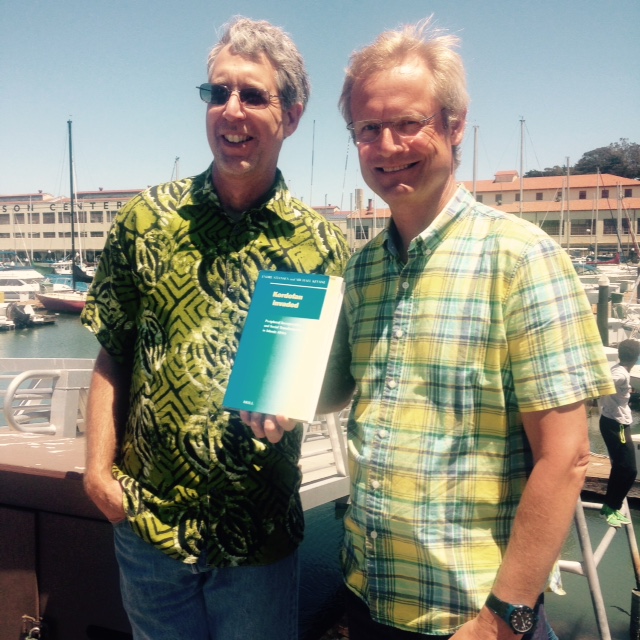
Endre Stiansen and I edited Kordofan Invaded: Peripheral Incorporation and Social Transformation in Islamic Africa almost 20 years ago (it was published in a beautiful typography and layout volume by Brill in 1998).  Here is my favorite review of the volume, by Robert Kramer.  Our paths separated over the ensuing years, as Endre took on more of a role as a diplomat and I had to satisfy certain gods in Economics.  It was nice to get together in San Francisco with Endre and family.  We had a nice long brunch at Greens, on a beautiful day, with unusual waiter service.

image1


Posted in Burkina Faso | Comments Off on Kordofan Invaded rocks on…

U.S. economy looking decent for remainder of year

The Federal Reserve left its benchmark interest rate unchanged on Wednesday, but it issued an upbeat assessment of economic conditions that suggested a growing chance that it would increase rates later this year.The Fed, in a statement after a two-day meeting of its policy-making committee, said that the economy had overcome wobbles this year and that job creation had increased with moderate economic growth.Importantly, the central bank added that it saw fewer clouds on the horizon as the United States entered the eighth year of an economic expansion.“Near-term risks to the economic outlook have diminished,” the statement said, though it added that the Fed remained wary about the weakness of inflation and about “global economic and financial developments.”Janet L. Yellen, the Fed’s chairwoman, has won broad support among Fed officials for a patient approach to raising rates.

Source: Fed Suggests a Growing Chance That Rates Will Rise This year – The New York Times

Posted in Burkina Faso | Comments Off on U.S. economy looking decent for remainder of year

Emily Wolfe… honest profile

Posted in Music | Comments Off on Emily Wolfe… honest profile

Emily Wolfe in San Francisco Tuesday August 3, Bottom of the Hill

Posted in Music | Comments Off on Emily Wolfe in San Francisco Tuesday August 3, Bottom of the Hill

“Reading Harry Potter lowers Americans’ opinions of Donald Trump, study finds”: When you read a headline like that, please click somewhere else

The are so many reasons why this should be buried. But maybe it can bring some attention to Friends of African Village Libraries?

Mutz polled a nationally representative sample of 1,142 Americans in 2014, and again in 2016, asking about their Harry Potter consumption, their attitudes on issues such as waterboarding, the death penalty, the treatment of Muslims and gays, and (in 2016 only) their feelings about Donald Trump on a 0-100 scale. Party affiliation did not affect the likelihood that a person had read the Harry Potter books, the study found; Democrats, Republicans, and Independents have all read Rowling’s books in roughly equal numbers. The study found that each Harry Potter book read lowered respondents’ evaluations of Donald Trump by roughly 2-3 points on a 100 point scale. “This may seem small,” Mutz acknowledges, “but for someone who has read all seven books, the total impact could lower their estimation of Trump by 18 points out of 100. The size of this effect is on par with the impact of party identification on attitudes toward gays and Muslims.”

Source: Reading Harry Potter lowers Americans’ opinions of Donald Trump, study finds — ScienceDaily

Posted in Reading | Comments Off on “Reading Harry Potter lowers Americans’ opinions of Donald Trump, study finds”: When you read a headline like that, please click somewhere else

Lynn Scholl on how graduated drivers licenses for teens have huge effects in reducing car accident fatalities

For a paper I am working on, I am reviewing some of the econometric work that uses paired adjacent counties that straddle state borders to examine the effects of state-level policies.  There is a growing number of such papers, many citing the paper by Dube, Lester, and Reich, 2010, on the effects of minimum wage legislation.  One really good one is by Lynn Scholl, who is now at IAB, and is a chapter in her 2011 UC Berkeley School of Public Policy dissertation, Essays on Transportation Safety, Economics, and Policy, and estimates the effects of graduated drivers licenses on teen deaths in auto accidents.  By using adjacent counties that straddle state borders, Scholl gets much better control group for teen driver conditions (especially for metro areas, the driving conditions on either side of the border are likely to be very similar and the be changing over time in similar ways).  The results are striking.

I find that the strongest GDL programs, as rated  by the Insurance Institute for Highway Safety,  reduce teen driving related fatal crash  rates by 25 to 34 percent and teen  driving error  related fatal  crash rates by 34 to 45 percent.  The most effective components of the GDL were early nighttime driving curfews beginning between 6pm to 10pm at night. Passenger restrictions had statistically significant effects only when controlling for the number of licensed teens on the road. For example, the zero to one passenger limit reduced quarterly county-level young teen driver involved fatal crash rates per 100,000 by -6.388 points, relative to a mean rate of 9.5 in state-periods without restrictions.  These passenger limits were also highly effective at reducing nighttime crashes among teens, with a reduction in these crash rates of -5.909.

Having an 18 year old who has been driving for two years now, I am so happy California implemented this kind of graduated drivers license.  Compared with my youth in Puerto Rico, where we drove in exactly the ways that increased the risk of killing our friends, the driving under the GDL program was, in my sample of one, probably much safer.  It is nice to see Scholl’s work confirm and quantify that intuition.  And a new research agenda opens up: why are some states not implementing this very effective and presumably fairly costless program.

*Another paper using the same county state-border technique is Rocco Huang, 2008, Evaluating the real effect of bank branching deregulation: Comparing contiguous counties across US state borders.

Posted in United States | Comments Off on Lynn Scholl on how graduated drivers licenses for teens have huge effects in reducing car accident fatalities

Another #IGEL2016 paper: Anne Mangen on reading fiction

Anne Mangen from the Norwegian Reading Center reported on a replication effort (with Anezka Kuzmicova) of the widely reported Kidd and Castano 2013 paper on whether Chekhovian fiction produced more empathy than regular writing. The sample size was small, just 31, and the team measured multiple outcomes including reading mind in the eyes of Baron-Cohen, PISA-like questions and others. They used a text by Katherine Mansfield, The Fly, originally written in a relatively baroque, ornamented style, and had a professional writer strip away all metaphor, simile and obscure phrasing with more straightforward phrasing.  Less foregrounding, in short.   They found no main effect, suggesting, as others have noted, that the Kidd and Castano effect was probably a p-hacking, hype-driven, power-posing, disservice to the scientific study of reading that everyone else in the field is secretly envious of!

Posted in Reading | Comments Off on Another #IGEL2016 paper: Anne Mangen on reading fiction