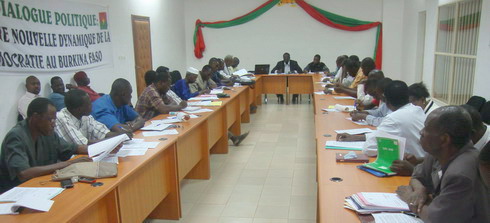
In Burkina Faso, gender still matters in politics

Why do I say that?  A nice article on the opposition parties meeting to coordinate their strategy in the national Assembly (trying to clarify the meaning of official opposition, all that good stuff that political scientists like to talk about).  The photo for the article showed all the opposition party leaders gathered in the HQ of the official opposition.

They were all men. Well, there appears to be one woman on the right hand side.

arton53585

Posted in Politics | Comments Off on In Burkina Faso, gender still matters in politics

Competition for groundnuts in Senegal….

On termine cette revue de presse au Sénégal. La Chine « déferle dans l’arachide » : c’est le titre choisi par Jeune Afrique dans son édition économique. Au port de Dakar, 53 000 tonnes d’oléagineux étaient en instance de départ mi-mars. « Assez pour que huiliers et opérateurs privés stockeurs les intermédiaires, tirent la sonnette d’alarme ». Ils demandent que la filière soit mieux encadrée pour « préserver l’industrie locale » mais aussi pour « constituer un stock semencier pour le prochain hivernage ». Jeune Afrique raconte que les opérateurs sénégalais stockeurs n’ont pas atteint leurs objectifs de récolte. Ces opérateurs sont d’ailleurs court-circuités par les négociants chinois. Contrairement aux autres étrangers, ceux de l’Empire du milieu « viennent avec leur argent et opèrent au bord du champ ou avec l’aide de rabatteurs locaux ». Les opérateurs trépignent, mais le journal souligne dans sa version en ligne que les paysans, eux, tirent leur épingle du jeu. « Les négociants, surtout chinois, proposent jusqu’à 270 FCFA le kilogramme d’arachide en lieu et place des 190 FCFA officiels. Du jamais vu ! »

via A la Une : l’Afrique minée par les crises sociopolitiques – RFI.

Posted in Burkina Faso | Comments Off on Competition for groundnuts in Senegal….

He didn’t call me?

From The New Yorker review of Justin Timberlake’s new album:

Timberlake’s …  “Let the Groove Get In” is… powered by a synthetic kick drum and a sample of vocals and percussion from Burkina Faso…”

Maybe because I don’t know a single Timberlake song, and have never been sure whether he also owns the shoe company, and just who is Timbaland?

Posted in Burkina Faso | 1 Comment

Department of buried in a footnote

I’m reading Esther Duflo, Michael Kremer, and Jon Robinson’s AER paper on fertilizer use in Kenya.  Summarized by Chris Blattman here.  I’m looking for the gender dimension.  It’s hard to find and interpret.  They sampled ~450 men and ~450 women  (based on lists of parents of children in primary school).  They are not clear in their various papers, but it appears the idea was the project  (ICS staff) would “deal” with the respondent (in supplying fertilizer, seed, demonstrations, the SAFI savings commitment program to purchase fertilizer in advance).  So presumably, even if a man or woman wasn’t the farm manager, the project would deal with them (somehow I cannot see the ICS field staff refusing the speak to the male farmer and instead talking about fertilizer and farming with the shopkeeping wife…). Like I said, not clear in this or the various other papers I have seen online. Probably there is some project document that explains more clearly.

But that’s not the department of buried in a footnote point.  There are three footnotes actually.

One is fn 3: “For instance, consider a farmer with an hourly wage of $0.16 (the average wage rate for the area in Tavneet
K. Suri 2011) for whom round-trip travel to town to buy fertilizer takes 30 minutes and who can initially afford only 3.7 kgs of fertilizer at a cost of $1.92 (the average bought through the program described in this paper). Since the returns to half a teaspoon of top dressing fertilizer are 15.0–27.2 percent over a season (52–85 percent on an annualized basis), netting out the lost wages for time spent shopping for fertilizer would leave the farmer with a 48–81 percent annualized rate of return.”

And then later fn 9: “Most farmers who bought fertilizer through the SAFI program did not buy enough that they would have had to pay for transportation. On average, farmers who bought fertilizer through the SAFI program bought 3.7 kilograms of fertilizer (at a total cost of 135 Kenyan shillings, or $1.92), and only 1 percent of farmers bought more than 10 kilograms. It would take the average farmer roughly a half-hour to walk to town, buy fertilizer, and walk back. For a farmer who makes $0.16 per hour (as in Suri 2011), the SAFI program would save her a bit less than 5 percent of the cost of the fertilizer bought by the average farmer. This cost would be substantially smaller if the farmer were going to town anyway and so would not miss any work time.”

And then the money footnote 11: “Throughout this paper, we focus on usage of fertilizer rather than the quantity of fertilizer used because there is substantial underlying variation in the quantity used by farmers, which would make it difficult to pick up effects in average quantities. The standard deviation in kilograms of fertilizer used is 53, whereas farmers who bought fertilizer through the SAFI program bought only 3.7 kilograms, on average.”

What does this all mean?  Nowhere in the text of the paper does the reader have any idea that they are talking about $2.  That the annualized return of, say, 50% on this $2 investment is $1.  That in the sample of ~900 farmers, the variation in fertilizer quantities is hugely overwhelming the amounts on offer in the experiment.

(If 50% of farmers are using zero kg, and those who do buy have a uniform distribution in quantities, then the average level of fertilizer use must be on the order of 150kg to have a standard deviation of 53 kg.   A study of fertilizer prices in Kenya suggests that three 50kg sacks of fertilizer cost about $45.  100-150 kg is in line with what cotton farmers in Burkina Faso, just as poor as Kenyan farmers, purchase every year for their cotton farms.  See this good paper on nation-wide use of fertilizer in Kenya, suggesting indeed 100kg per hectare is the average.)

Page  2354 of the paper: “As discussed in detail in online Appendix Table 2, panel B, using one-half teaspoon of fertilizer per plant increases yield by about $25.22 per acre and costs $19.83 per acre.”  So the cost is about $20 for a hectare’s worth of fertilizer, about the price of a 50kg sack.  And the benefits are about $5.  But farmers were only spending $2 in the program.

Isn’t this 20-25% of $2 program then a kind of quite low stakes experiment (they normally spend $20 on fertilizer) where response bias could overwhelm incentives, especially in the context of the experiment being run by an NGO that is probably distributing benefits in the hundreds of dollars to each village in the form of schooling, water, not to mention the large team of researchers?   Maybe it is excellent practice to run low stakes experiments like this that can be scaled, but I wish the authors had been more modest about the claims.  (Because they suggest the results could usefully inform fertilizer policy expenditures in the hundreds of millions of dollars .)  And not bury an important fact in the footnotes.

Posted in Burkina Faso | Comments Off on Department of buried in a footnote

Nice critique of Lean In from Kate Losse in Dissent Magazine

And so, in the end, Lean In may be a book not about a social movement, but about Sandberg’s own movement from Harvard to Google to Facebook, and now into her self-appointed role as leader of Lean In. The book advocates “lean in” circles for women in corporate environments. The circles are now being advocated by the book’s corporate partners like American Express, Amazon, and Bain, with her book as their guide. As memoir, it is instructive regarding Sandberg’s successful career trajectory, and provides some helpful advice for young women in how to follow her. But as a manual for navigating the workplace, it teaches women more about how to serve their companies than it teaches companies about how to be fairer places for women to work.

via Feminism’s Tipping Point: Who Wins from Leaning in? | Dissent Magazine.

Posted in Burkina Faso | Comments Off on Nice critique of Lean In from Kate Losse in Dissent Magazine

Mladic from Godspeed You! Black Emperor new album ‘Allelujah! Don’t Bend! Ascend!

a nice review of the album is here:

Posted in Burkina Faso | Comments Off on Mladic from Godspeed You! Black Emperor new album ‘Allelujah! Don’t Bend! Ascend!

I’d ask Emily, but don’t think she would have much to add

Robert Nozick, somewhere, wondered why older people didn’t sacrifice more for the common good.  He meant, I think, being prepared for really heroic events involving likely death.  Their lives were nearing the end, so the opportunity cost of great sacrifice was perhaps low while the wisdom to choose a meaningful (as opposed to fruitless) act was high.  I wonder about this, at this stage of my life.  Makes me think of the Brecht line, “Unhappy the land that has no heroes; no, unhappy the land in need of heroes.”  In an era where battle and assassination are plainly no longer meaningful (thanks, Bradley Manning, for that), what would great sacrifice look like, at age 75?

Posted in Burkina Faso | Comments Off on I’d ask Emily, but don’t think she would have much to add

Stone Book Quartet line by line: 1

A bottle of cold tea; bread and a half onion. That was Father’s baggin. Mary emptied her apron of stones from the field and wrapped the baggin in a cloth.

First paragraph. Delightfully sparse. Evokes the countryside of long ago. The man eats a lunch or snack of bread and half an onion, a “baggin” presumably. The “baggin,” Garner surely knows, is a signal to the reader to nevermind not knowing a word, infer it from context, and nevermind not knowing the theme, infer it from context. Mary has an apron of stones. We later find out what they are for. Since we know the title is “The Stone Book,” we are signaled right away that literally the story will concern stones. Tea was introduced into Britain around 1700, so the reference to tea helps date the story.  Tea, bread and onion: the basics of life.  Stones: the earth, from which food comes.  Cloth.  Two paragraphs later we have a weaver.  Garner starts at the beginning.  We begin by living, then we move on to what living is for.

***This blog entry is part of a series where I reflect on one of my favorite books, Alan Garner’s The Stone Book Quartet.  A fantastic overview essay by B. Renner is here.

Posted in Book and film reviews | Tagged , | Comments Off on Stone Book Quartet line by line: 1

War Witch

I didn’t realize this film War Witch (Rebelle) was one of the nominees for best foreign film; to be honest it looks too excruiciatingly sad for me to watch. I have a long-standing principle to put down books for adults about children who die or suffer awful fates: to easy to feel emotions that should not be felt, and then feel that one has cheapened the emotion, by turning the movie off, getting a sandwich, and tlaking about how great the movie was…

Film Clip: ‘War Witch’ by WSJ_Live

Posted in Burkina Faso | Comments Off on War Witch

The Day He Arrives

I am enjoying watching The Day He Arrives immensely… maybe I just needed to see something really intelligent in black and white… god how long has it been!

Posted in Culture | Comments Off on The Day He Arrives

Zéphirin Diabré gives up spot in National Assembly

There are many possible reasons for a move like this I suppose, but seems a bit odd, and doesn’t bode well that appears to have happened without groundwork… making him vulnerable to charge of being a bit wacky?  But perhaps he wants to cultivate image as not being a “politician”, and/or if/when he runs against Blaise/Francois for president, he can play the change/outsider card?  Or maybe he just wants to throw CDP off their tracks by being really different, Antonus Mockus-style…. could work.

Le président de l’UPC, Zéphirin Diabré, dont le mandat de député a été validé, et qui se trouve être le Chef de file de l’opposition politique, a signifié par correspondance au président de l’Assemblée nationale, sa démission à l’exercice de son mandat à l’hémicycle.

S’agit-il d’un acte de motivation au profit du Poé-Naba qui est l’un de ces rares chefs coutumiers « moaga » à militer au sein d’un parti d’opposition ? En effet, Poé-Naba a été un des candidats les plus en vue aux législatives passées. Mais, il ne fut pas élu. Il est donc à penser -comme on a coutume de constater sous nos tropiques- qu’il peut être pris de découragement, ou à tout le moins jouer profil bas. En tout cas, il aura été à l’abri de toutes ces chutes. Désormais, il siège à l’Assemblée nationale en qualité de député parfait.

A en croire le président du groupe parlementaire UPC, Louis Armand Ouali, Zéphirin Diabré s’est retiré de l’Assemblée nationale pour mieux se consacrer à sa fonction de Chef de file de l’opposition politique. Mais la décision de ce retrait, peut-on dire, a été prise à un moment on l’on s’y attendait le moins.

via Mandature de l’UPC à l’Assemblée nationale : « Zeph » fait place à « Poé-Naba » – leFaso.net, l’actualité au Burkina Faso.

3/7- from the comments on lefaso.net, where many people mention that Benewende Sankara and Gilbert Ouedraogo also did not take their seats in Assembly, so he is continuing in that tradition. Others do note that sitting in the Assembly for a year might have enabled him to “shake things up” in government itself…. we’ll see….

par CP0, 7 mars 09:43

Tout observateur averti de la scène politique du Faso voyait venir ce scénario et savait que DIABRE n’allait pas siéger et allait laisser son poste à son suppléant dont le choix a été bien etudié et qui a été positionné sciemment dans la liste de l’UPC. L’ADF-RDA a son bonet rouge à l’assemblé , le CDP à le sien, l’UPC pour des raisons de stratégie et de psychologie de la société Burkinabé notamment du groupe mossi et assimilé devait avoir également son bonnet rouge c’est chose faite et je félicite…

Posted in Politics | Comments Off on Zéphirin Diabré gives up spot in National Assembly

Today’s gender chuckle

Reading Charles Jones and Dietrich Vollrath’s Introduction to Economic Growth.  Great book.  But.  “Gender” and “women” do not appear in the index.   Nor do they appear in the text, even in the chapter on fertility and population growth.  But gender does make an appearance, on page 258: “If Microsoft had not expected to be able to charge more than the tiny marginal cost of Windows 8, he would not have invested hundreds of millions of dollars in creating the first copy.”  As the Supreme Court recently ruled, corporations are men too!

Posted in Burkina Faso | Comments Off on Today’s gender chuckle

So that’s what the pelleteuse in Béréba is for?

Plus surprenant : une pelleteuse fait partie des prises de guerre. Celle-ci permettait aux jihadistes de creuser des tranchées pour se dissimuler.

via Mali: la photo qui fait dire au Tchad que Belmokhtar est mort – Mali / Tchad – RFI.

Posted in Burkina Faso | Comments Off on So that’s what the pelleteuse in Béréba is for?

Homage video to Hollis Frampton

frampton’s lemma from dan browne on Vimeo.

Posted in Burkina Faso | Comments Off on Homage video to Hollis Frampton

Great abstract light video… it’s Hollis Frampton all over again

Philosophy by Light from Roman Palchenkov on Vimeo.

Posted in Burkina Faso | Comments Off on Great abstract light video… it’s Hollis Frampton all over again

Can you spare fifteen minutes for a quiet smile?

The Six Dollar Fifty Man from NZ Shorts on Vimeo.

Posted in Culture | Comments Off on Can you spare fifteen minutes for a quiet smile?

Pfc. Bradley E. Manning’s Statement for the Providence Inquiry

Scary stuff.  The video is below.

Facts regarding the unauthorized storage and disclosure of the 12 July 2007 aerial weapons team or AW team video.

During the mid-February 2010 time frame the 2nd Brigade Combat Team, 10th Mountain Division targeting analysts, then Specialist Jihrleah W. Showman discussed a video that Ms. Showman had found on the ‘T’ drive.

The video depicted several individuals being engaged by an aerial weapons team. At first I did not consider the video very special, as I have viewed countless other war porn type videos depicting combat. However, the recording of audio comments by the aerial weapons team crew and the second engagement in the video of an unarmed bongo truck troubled me.

As Showman and a few other analysts and officers in the T-SCIF commented on the video and debated whether the crew violated the rules of engagement or ROE in the second engagement, I shied away from this debate, instead conducting some research on the event. I wanted to learn what happened and whether there was any background to the events of the day that the event occurred, 12 July 2007.

Using Google I searched for the event by its date by its general location. I found several new accounts involving two Reuters employees who were killed during the aerial weapon team engagement. Another story explained that Reuters had requested for a copy of the video under the Freedom of Information Act or FOIA. Reuters wanted to view the video in order to understand what had happened and to improve their safety practices in combat zones. A spokesperson for Reuters was quoted saying that the video might help avoid the reoccurrence of the tragedy and believed there was a compelling need for the immediate release of the video.

Despite the submission of the FOIA request, the news account explained that CENTCOM replied to Reuters stating that they could not give a time frame for considering a FOIA request and that the video might no longer exist.

via Pfc. Bradley E. Manning’s Statement for the Providence Inquiry.

Posted in Burkina Faso | Comments Off on Pfc. Bradley E. Manning’s Statement for the Providence Inquiry

Après mai…. nice film by Oliver Assayas on Paris revolt… pretty, if uncompelling unless you are 21

Posted in Burkina Faso | Comments Off on Après mai…. nice film by Oliver Assayas on Paris revolt… pretty, if uncompelling unless you are 21

Formidable!

Posted in Burkina Faso | Comments Off on Formidable!

House of Cards the end

House of Cards preposterous… I stopped watching after this execrable storytelling.

En route to his goal, we saw just how ruthless and ambitious he was, culminating in his murder of Peter (the one really shocking moment in the show, although I do wonder why the police wouldn’t investigate a supposed suicide in which the victim is in the passenger seat of the car).

via House of Cards – End of Season Review | London Culture Blog.

Another show that hooked me for 10 episodes and then just dried up completely in terms of storytelling was the Seattle-set murder show The Killing.

Posted in Burkina Faso | Comments Off on House of Cards the end