This movie was so intimate and painful to watch finally I gave up and turned it off.
Despite a career spanning nearly three decades, Yukiko Mishima hasn’t appeared on many lists of up-and-coming Japanese female directors, mine included. One reason: She had a relatively late start, not releasing her first feature, a drama based on the Junichiro Tanizaki story “The Tatooer,” until 2009. Another reason: Her five films to date have not won major festival awards abroad or racked up big box-office numbers at home.
Mishima’s sixth and newest film, “Dear Etranger,” may not change that. It had its world premiere at the 18th Jeonju International Film Festival last May, but not in the competition. Nonetheless, this film about a middle-aged man’s struggles with the consequences of divorce and remarriage, particularly a tween stepdaughter who can’t stand the sight of him, represents an advance and, I hope, a breakthrough.
Posted inBook and film reviews|Comments Off on Dear Etranger…. Japanese movie on Air France flight
En début de la semaine passée Pamela Roberts bibliothécaire du SIL Burkina et Ezéchiel Lopemba pasteur de la chapelle à FATHEAD ont rendu une visite de courtoisie au siège de FAVL-BF. Après un accueil chaleureux, ils ont eu de très bons échanges avec le représentant national de FAVL-BF. Cette visite a été une occasion pour Ezéchiel Lopemba de découvrir FAVL-BF et ses activités autour de la lecture. Il nous a encouragés dans cette tâche noble et nous a aussi invités à visiter les locaux du SIL qui, selon lui, peut nous apporter sa contribution dans la rédaction des livres en langues nationales. Ce fut un bon moment pour Pamela de faire des commentaires sur les livres photos produits par FAVL. Avant de partir, elle nous a fait un don d’une dizaine de livres pour enfants et adultes. Elle aussi ajouté 3 posters pour les bibliothèques. Toute l’équipe de FAVL-BF lui dit merci pour ce geste qui va sans doute augmenter le fonds documentaire des bibliothèques.
Posted inBurkina Faso|Comments Off on Pamela Roberts et Ezechiel Lopemba de SIL en visite à FAVL-BF
Some facts (and Einhorn has great maps in the paper):
Armed with the power to collect this lucrative tax by the ratification of the Sixteenth Amendment in 1913, the federal government has raised its revenues disproportionately in the North and distributed its spending disproportionately in the South. Strikingly, the tax side of this history has gone all but unremarked in the literature. The outline of the spending story is much more familiar: the huge role that federal spending played in promoting the transformation of the South “from cotton belt to sunbelt,” starting slowly in the 1930s (with, for example, rural electrification), accelerating rapidly during World War II (military bases, weapons contracts), and then ratcheting upward again after 1970. The Social Security and Medicare benefits of migrating retirees have enhanced the pattern more recently, along with disproportionate spending on poverty programs in the South.
How much was the redistribution worth?
In 1916, the first year of published income tax statistics, New York State paid a stunning 45% of the proceeds of the personal income tax. Pennsylvania came in second, paying 10%, and Illinois third at 6%. This result was the point of the Sixteenth Amendment: by exempting income taxation from the apportionment rule that the Constitution specifies for “direct taxes,” the Amendment allowed Congress to levy its taxes in proportion to the distribution of income rather than the distribution of population. More specifically, in regard to New York, the amendment allowed Congress to pull 45% of the income tax from a state with only 11% of the population.
And also expected income tax to replace the “punitive” tariffs that favored the North.
Some snark?
Today, it can seem a paradox, at best, that the federal government redistributes from the states where majorities are tolerant of federal taxation toward the states where they are unremittingly hostile. A century ago, however, the rhetoric was more straightforward. Southern politicians demanded the adoption of the federal income tax because they knew that it would benefit their constituents.
Why did the South, so opposed to Federal “intervention” rush to support the income tax? Because they correctly surmised that “intervention” was over.
But they [southern politicians] did know one thing: that they were living in the Progressive Era. Hayne had not wanted Webster’s railroad in 1830 because it would allow Massachusetts to interfere with slavery in South Carolina. The Progressive Era was different, promising subsidy without interference. Of course Southerners seized this new opportunity.
Posted inTeaching macroeconomics, United States|Comments Off on Why did the South support the Federal income tax and the 16th amendment? because they understood the Progressive movement all too well
Not sure why I like this composition so much. pretty simple. Maybe because on my playlist it comes before Up With People by Lampchop. And hard not to like that, so the prelude feels very right.
Posted inMusic|Comments Off on Who I Am & Why I Am Where I Am by Kaitlyn Aurelia Smith
I didn’t know who William Kelley was when I found that book but, like millions of Americans, I knew a term he is credited with first committing to print. “If You’re Woke, You Dig It” read the headline of a 1962 Op-Ed that Kelley published in the New York Times, in which he pointed out that much of what passed for “beatnik” slang (“dig,” “chick,” “cool”) originated with African-Americans.A fiction writer and occasional essayist, Kelley was, himself, notably woke. A half century before the poet Claudia Rankine used her MacArthur “genius” grant to establish an institute partly dedicated to the study of whiteness, Kelley turned his considerable intellect and imagination to the question of what it is like to be white in this country, and what it is like, for all Americans, to live under the conditions of white supremacy—not just the dramatic cross-burning, neo-Nazi manifestations of it common to his time and our own but also the everyday forms endemic to our national culture.
Sukie and I just stumbled on this, and greatly enjoyed the documentary. Excellent viewing with a kid from 12-16!
‘Treasures from the Wreck of the Unbelievable’. It is the first major solo exhibition dedicated to Damien Hirst in Italy since the 2004 retrospective at the Museo Archeologico Nazionale in Naples (“The Agony and Ecstasy”) and is curated by Elena Geuna, curator of the monographic shows dedicated to Rudolf Stingel (2013) and Sigmar Polke (2016) presented at Palazzo Grassi.The exhibition is displayed across 5,000 square meters of museum space and marks the first time that Palazzo Grassi and Punta della Dogana, the two Venetian venues of the Pinault Collection, are both dedicated to a single artist.Damien Hirst’s most ambitious and complex project to date, ‘Treasures from the Wreck of the Unbelievable’ has been almost ten years in the making. Exceptional in scale and scope, the exhibition tells the story of the ancient wreck of a vast ship, the ‘Unbelievable’ (Apistos in the original Koine Greek), and presents what was discovered of its precious cargo: the impressive collection of Aulus Calidius Amotan – a freed slave better known as Cif Amotan II – which was destined for a temple dedicated to the sun.
From Robin Einhorn’s review of Gordon Wood’s various books:
If Jefferson had known nearly as much about his society as Wood does, Empire of Liberty is the book he would have written. It is no coincidence that the title is Jefferson’s, a phrase encapsulating his brand of velvet-gloved imperialism. Wood seems to know that there was an iron fist lurking inside, but he identifies with an audience that treasures the national fantasy of egalitarian triumph that Jefferson represents. Like Jefferson, Wood nods to the evil of slavery and the violence of westward expansion. Unlike Jefferson, he realizes that there was something undesirable about the way men treated women. But Wood’s focus remains squarely on the subculture of white men–especially in the North–who energetically pursued their liberty and happiness in the “republicanized” world of postrevolutionary America.
Interviewer: What problems need solving through tax reform
Lazear
growth rate is way too low
growth rate out of recession is low (both recoveries, historical standards)
growth related to productivity and related to wages
so 11:20 focus on growth is “best affect the average american”
Goolsbee
growth is criticall important, and in ong run is only thing that matters
last 20 years of US has had trend break that producitivyt and wages grow together (sometime in the late 1980s)
75% of income distribution wages are not rising
hesitate to buy into premise of corporate tax cutting leading to higher profits which will be passed on to workers … nothing in last two decades says that will work… did same in 2001
argument about growth rates in 1980s leaves out that population growth rate was much higher
Interviewer: but we are at full employment why wages not rising?
Goolsbee does not really answer… repeats again wages and productivity diverging
Lazear – growth and productivity feed into average wages but maybe not median and lower
we have seen big increase in disparity between high-low education
we don’t address that with tax policy… that is a different problem
increase in the values of skill
Goolsbee – lazear views these as separate things, but
1- if have $1.5 trillion to add to debt… should use it to cut to taxes for very group whose income rising? or use it to college financial aid… business corporate cuts are second order effect on growth
2- if think bifurcation is a problem, again why exacerbate through tax changes?
Lazear – taxes not long run solution to inequality… can do things in short run but should not be focus
i think evidence is strong that tax cuts lead to growth – AER Auerbach et al…. if went to pure consumption tax would have very large increase in GDP… Romer&Romer AER… 1% increase in taxes reduces growth
but growth may not translate to lower part of income distribution
Interviewer: But President says this will be good for middle class average… do either of you buy that story? which part?
Goolsbee – nonsense…. anyway, mostly papers say taxes have no big effect… and they should not affect growth rate… tax cuts at top have zero impact…
Lazear – thinks plan is good… reductions in capital taxation. e.g. full expensing. deduct investment immediately forward and backward. all incentives are for new investments.
Goolsbee- in past 25 years profits have been “epically high” and tax rates very low, yet not translated to higher wages… they are taking Poterba-Lazear plan with full expensing permanent, GDP will be higher by 6% in 50 years…. Trump instead put it in for 5 years and then eliminate and just assume that will lead to all growth that permanent planned… making assumptions like that is dangersous.
Lazear – Inequality is largely because of change in technology that favors high skilled… happening everywhere regardless of tax changes
And there I gave up…. good clear discussion!
Posted inTeaching macroeconomics|Comments Off on University of Chicago event on macroeconomy and tax reforms… Roundtable Discussion with Austan Goolsbee and Edward Lazear
FAVL program officer Alidou Boué spent a day at Bougounam library earlier this week. Here are some photos: Zebret Moumouni, the librarian (who also decorated the building) in his hat at his desk (looking at a great Atlas in the library collection), a reader, and a collection of new books for the library. The library was recently hooked up to the electric grid.
Posted inBurkina Faso|Comments Off on A visit to Bougounam library in #Burkina Faso
This is awesome! But will I not procrastinate and actually use it? I am already a Type 3.7 but I know exactly what the issue is here. So glad to see my own workflow habits “replicated”… (see here for the underlying discussion). HT: @andrewbhall
Ancillary Justice by Ann Leckie is a fantastic sprawling sci-fi story, set in the far future, with an AI as the central character. The character development is superb, and I especially appreciated the spot-on nuance about how AI might operate. Of course, as in all sci-fi there are incongruities: an amazing AI and stargates, but they are still using paper currency…? But maybe we 21st century readers need that? Leckie also uses some cool technique, by replicating the AI multiple point of view problem in the narration. The text thus slows you down, the reader, and the complexity forces you to think more, rather than passively absorb the story and setting. Definitely deserved the various major awards.
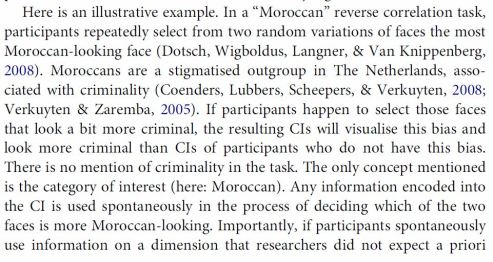
From Brinkman, L., Dotsch, R., & Todorov, A. (In press). Visualising mental representations: A primer on noise-based reverse correlation in social psychology. European Review of Social Psychology.
Apparently the researcher don’t know what a Moroccan person looks like, but they do know what a criminal looks like. Like I said, unfortunate. Imagine if it were the reverse. The researchers ask participants to look for a “criminal” face. They get the composite image. One of them shouts, “Hey, looks just like a Moroccan!”
Posted inDevelopment thinking|Comments Off on What an unfortunate example to use to explain reverse correlation technique in social psychology
Under-vaccination is a significant policy problem. As earlier generations knew, people die of measles, and of whooping cough, and of other diseases that vaccines can prevent. Figuring out how to increase vaccination is a challenge. We often rely on education, but it is hard to change people’s minds on this topic, as doctors and policymakers — as well as any parents who have engaged on an internet message board — know all too well.
From a policy standpoint, these findings offer a ray of hope for vaccine proponents. Maybe changing minds isn’t so important. People may not have altered their attitudes about vaccination, but the fact is that these laws actually changed behavior.
In Oregon, parents can opt out of getting their children immunized by completing a 15-minute online “education” module. Many of them do: The share of people in Oregon counties with kindergarten vaccination rates over 95 percent was close to 100 percent in 2000; in 2015, it was about 30 percent. Perhaps lawmakers there and in other states should consider a more stringent exemption policy before, not after, they have their own measles outbreak.
Posted inUnited States|Comments Off on Great article by Emily Oster and Geoffrey Kocks on vaccination in California
A former student is thinking of going to law school to then become a JAG. He shared with me some thoughts on a book Saving Sandoval, by Craig Drummond. According to the blurb:
Saving Sandoval is the true account of the defense of U.S. Army Specialist Jorge G. Sandoval, Jr. Sandoval, a 22-year old infantry paratrooper deployed to the forward operating base of Iskan during the enemy uprisings of 2007 in Iraq. Iskan was located in the “Triangle of Death,” which at the time was the most dangerous area in Iraq; arguably the world. Sandoval’s unit began to take heavy casualties during the increased violence in the region. As the unit began to respond and regroup from their heavy losses, Sandoval was re-assigned from his regular infantry team to his unit’s most elite group–the sniper section… On one of his first missions he was guided by the sniper section leader, Staff Sergeant Hensley… Sandoval was placed in the shooting position while Hensley served as his observer… Hensley spotted a man serving as a lookout for the enemy who had recently attacked U.S. and coalition units… The man was in civilian clothing, posing as a farmer cutting grass. This was consistent with most of the insurgents and enemy in Iraq, who often wore civilian clothing and were not easily distinguishable from the civilians who resided in the nearby villages….Given all of the information known at the time, Hensley directed Sandoval to take the shot. Sandoval complied… Many of the actions of the entire sniper section came under question, particularly an event two weeks later in which a suspected insurgent was shot at close range with a pistol by another member of Sandoval’s team… Eventually Sandoval faced a court-martial for murder, for his first shooting as a sniper…Saving Sandoval is the story of the trial … The book quotes testimony from both the pre-trial hearings and the trial itself, which took place in a makeshift courtroom on a U.S. military installation just outside of Baghdad.
My reaction was: Having read some summaries of Saving Sandoval… sounds like an interesting book…. I’d probably be more inclined to invest in reading if it were an analysis by someone more removed from the interests of the actors… Drummond as the JAG would seem to have been a full participant…. so it is more primary material than broader analysis it seems…. Newspaper accounts suggest this was not just some kind of anti-war trumped-up charge. It was members of the unit who were concerned about abuses, it seems.
Generals might say “yea, but our culture is better than every other military” and that might indeed be true. I don’t have emotions about it, just impressionistic priors… I think there is much room for principled JAG’s to do good work, and room for reform, and for strong leaders with more integrity, and for more civilian oversight, and for more transparency, and for less hubris and more humility. Unfortunately, a sentence like that (and the whole blog) post, is likely to be taken by some (and perhaps even some relatives) as meaning I am anti-military, America-hater, etc. Nothing could be further from the truth. But people who think that way are rarely concerned about truth and the critical thinking needed to discern truth.
Posted inUnited States|Comments Off on U.S. military… random thoughts
“… research in neurobiology demonstrates that the brain cannot encode all the information contained in a signal. A decision is triggered when “enough” information supporting one alternative is obtained, and the brain uses a variety of biological mechanisms to filter information in a constrained optimal way. In a recent paper we show that these properties of the brain result in a behavioural tendency to confirm initial priors (Brocas and Carrillo 2009). Behavioural data reports precisely that individuals stick too often to first impressions. These confirmatory biases may all emerge from the same set of physiological information processing constraints. Further work in that direction may help uncover the causes of other biases and determine whether they are all related to the same physiological limitations.”
Does schooling change this (for better or for worse)? Acquiring information via oral sources or via reading? Reading fiction and children’s picture books from an early age? Has the “twist ending” of the short story and much of modern storytelling (cliffhanger at the end of every chapter-episode) increasingly conditioned people to prioritize disconfirming information rather than confirming information? When we see shows that confirm, confirm, confirm, don’t we say, inside, “boooooring.”
Posted inDevelopment thinking|Comments Off on Neuroeconomics of limitations of cognitive processing probably where all the action is… “attention” is the byword
The hivemind and Google leads to the answer immediately.
There is an undocumented setting
set excelxlsxlargefile on
which will allow -import excel- to bypass the size checking. But Ricardo should be warned, the library we use to import Excel files has a large memory footprint when dealing with large new xml based xlsx files. Also the library currently has no ability to allow user to break during the middle of loading an Excel file. Hence if Ricardo’s do file attempts to load a large Excel xlsx file, his Stata session will become unresponsive until it finishes. During this time, Ricardo will not be able to break out using the break button.
From a 2016 working paper by Enrico Cantoni. Below are the abstracts to the August and November versions of the paper; I like how the writing was tightened up and extraneous phrases dropped. Fewer words conveying the same information more clearly. The standard deviation of distance is given in the second version, rather than making the reader search for the value in the paper. Also, “turnout” is replaced by the more precise “number of ballots cast, ” which has the extra virtue of eliminating the earlier ambiguity about whether “reduces … by approximately 2% to 5%” referred to turnout percentage points or percent (which the paper did make clear in the text).
August 2016 version abstract: In a sample of municipalities in Massachusetts and Minnesota, I use a novel, quasi-experimental design based on geographic discontinuities to study the turnout effects of voting costs. I compare parcels and census blocks located in close proximity to boundaries between adjacent voting precincts, which determine assignment to polling places. Geographic units that share (on either side) a precinct boundary also share observationally identical attributes. At the same time, the discontinuous assignment to polling places across boundary sides provides quasi-random treatment variation. I find that a 1-standard deviation increase in distance to the polling place reduces average turnout by approximately 2% to 5% in the 2012 presidential, 2013 municipal, 2014 midterm, and 2016 primary elections. I also document a negative but imprecise effect on census block voter registration, which suggests that higher voting costs reduce registration directly, by dissuading eligible voters from registering, or indirectly through the removal of inactive voters from voter rolls. During non-presidential elections, the effects of distance to the polling place concentrate disproportionately in high-minority, low-income, and low-car-availability areas, while no differential impact emerges in the higher-salience 2012 election.
November 2016 abstract: I study the effects of voting costs through a novel, quasi-experimental design based on geographic discontinuities. I compare parcels and census blocks located near borders between adjacent voting precincts. Units on opposite sides of a border are observationally identical, except for their assignment to different polling locations. The discontinuous assignment to polling places produces sharp changes in the travel distance voters face to cast their ballots. In a sample of nine municipalities in Massachusetts and Minnesota, I find that a 1-standard deviation (.245 mile) increase in distance to the polling place reduces the number of ballots cast by 2% to 5% in the 2012 presidential, 2013 municipal, 2014 midterm, and 2016 presidential primary elections.
Cantoni also develops an algorithm that redraws precinct lines; “the algorithm reduces the average parcel-to-polling-place distance by approximately .03 mile.” In case you were wondering, .03 miles is about 158 feet, or about 50 steps in you have a long stride like mine. So the cost of redrawing all lines seems likely to exceed the fairly modest increase in turnout, and one has to wonder whether other, cheaper alternatives to get out the vote, such as SMS messaging and targeted public service announcements or Facebook campaigns would not be more cost-effective (not that Cantoni is advocating redrawing, it is just an exercise). All in all, the paper confirms that relatively inexpensive changes in the implementation of elections can generate more participation, especially for already more-marginalized voters.
A couple quick remarks. I enjoyed the welcome reintroduction of the word “Alas” into mainstream economics on page 10. The last line of the draft paper,
However, the noticeable potential for higher turnout and lower turnout inequality – especially during less salient elections – should be both a memento and a goal for future research on the determinants of voter participation.
has the oddest use of the word memento I have ever encountered. Not really sure what he meant. Some kind of archaic usage?
Posted inVoting|Comments Off on Effect of distance to polling place on turnout by Enrico Cantoni
Reich, Steve: Four Organs (1970) 19′ for four electric organs and maracas
Composer’s Notes: Four Organs is composed exclusively of the gradual augmentation (lengthening) of individual tones within a single (dominant 11th) chord. The tones within the chord gradually extend out like a sort of horizontal bar graph in time. As the chord stretches out, slowly resolving to the tonic A and then gradually changing back to the dominant E, a sort of slow-motion music is created. The maracas lay down a steady time grid of even eighth-notes throughout, enabling the performers to play together while mentally counting up to as much as 256 beats on a given cycle of sustained tones.Four Organs is the only piece I am aware of that is composed exclusively of the gradual augmentation of individual tones within a single chord. From the beginning to the end there are no changes of pitch or timbre; all changes are rhythmic and simply consist of gradually increasing durations. This process of augmentation was suggested by the enormous elongation of individual tenor notes in Organum as composed by Perotin and others in the twelfth and thirteenth centuries in Paris at Notre Dame Cathedral. Tenor notes that in the original chant may have been equivalent to our quarter- or half-notes can take several pages of tied whole-notes when augmented by Perotin or Leonin.Four Organs was composed in January 1970. It was first performed at the Guggenheim Museum in New York City by myself and members of my own ensemble later that same year.




 Michael Kevane