Decline in the labor force participation rate

A short note from the St. Louis Fed suggests that much of the decline is anticipated demographic change and inevitably reversal of the extremely high participation rates in the early 2000s (A Closer Look at the Decline in the Labor Force Participation Rate)

The BLS-projected change in the aggregate LFP rate between 2010 and 2020 can be broken into two components: (1) the change in the age composition of the population, and (2) the change in the LFP rates of different age groups. We found that the change in the age composition of the population accounted for most (2.18 out of 2.20 percentage points) of the decline in the aggregate LFP rate over the period. Specifically, this 2.18-percentage-point contribution to the LFP rate decline was mostly driven by a 3-percentage-point decrease in the population share of those 45-54 years old. In contrast to the 2.18-percentage-point decline in the LFP rate that resulted from changes in the age composition of the population, the change in the aggregate LFP rate due to the changes in the LFP rates of different age groups is almost zero on net. It is important to note that this value is the result of dissimilar dynamics of individual groups rather than consistent behavior of the population. For example, the largest contributions to the increase in the aggregate LFP rate are posted by those 55-64 years old (0.63 percentage points) and 65-74 years old (0.65 percentage points). Yet the increases in the LFP rates of these older workers are almost completely nullified by the decreases in the LFP rates of those 16-19 years old (–0.55 percentage points) and 20-24 years old (–0.44 percentage points).

Elisabeth Jacobs at the Washington Center for Equitable Growth, attributes some of the decline to the stalling and reversal of women’s labor force participation, due to the U.S. not reforming labor market institutions to make them more family-friendly.  (Her prepared testimony is an excellent introduction to the issues.)

Women’s labor force participation was driving the overall upward trend in labor force participation through 2000, so the plateau and then decline in women’s participation in the ensuring years is an important factor for explaining the national trend. Understanding why women’s labor force participation has stalled is key to reversing the downward trends in the national rate. In 1990, the United States had the sixth-­‐highest female labor force participation rate amongst 22 high-­‐income OECD countries. By 2010, its rank had fallen to 17th. Why have other high-­‐income countries continued their climb while the United States has stalled? Research by economists Francine Blau and Lawrence Kahn suggests that the absence of family-­‐friendly policies such as paid parental leave in the United States is responsible for nearly a third of the U.S. decline relative to other OECD economies. As other developed countries have enacted and expanded family-­‐friendly policies, the United States remains the lone developed nation with no paid parental leave.

Jacobs, and others, note how important this issue is.  People who participate in the labor force- who have jobs- pay taxes.  The tax revenue funds lots of incredibly valuable public goods and social services.  Fixes to increase labor force participation are thus often very cost-effective from a public finance point of view.  Too often we neglect this perspective.  To take an obvious example: the United States’ comparatively huge incarceration rate takes out of the labor force hundreds of thousands of potential taxpayers, and adds a large cost (supporting those same prisoners).  How inefficient is that, especially when we know that a large fraction of those incarcerated are no significant danger to the public (minor drug and traffic offenses)?

Moreover, the other group whose participation is declining consists of some of the most marginal and vulnerable (to incarceration and addiction) members of our society. According to the Council of Economic Advisers:

Participation rates by educational attainment, previously quite similar, have diverged since the 1960s. In 1964, 98 percent of prime-age men with a college degree or more participated in the workforce, compared to 97 percent of men with a high school degree or less. In 2015, the rate for college-educated men had fallen slightly to 94 percent while the rate for men with a high school degree or less had plummeted to 83 percent.

So let’s ask our Presidential candidates what they hope to accomplish to increase labor force participation, and decide whether to support them based on their answers.

Posted in Teaching macroeconomics | Comments Off on Decline in the labor force participation rate

IMF projections for growth for Burkina Faso

What I hate about the IMF and World Bank is that very often they report growth rates in aggregate and not per capita. Burkina Faso’s population growth rate is about 2.8%, so these projections of 4%-5.2% are really 1.2%-2.4% growth per capita, which really is miserable.  Moreover, much of the projected GDP growth is coming from gold mining, and the distribution of that income is highly skewed.  So the picture remains one of a really big bulge of poor youth seeing few opportunities for rapidly growing incomes.

Growth is projected to increase moderately from 4 percent in 2014-15 to 5.2 percent in 2016, as the broad-based recovery anticipated in the wake of the November elections has been dampened by the January terrorist attacks. Following almost two years of political crisis and transition, the central policy challenge facing the authorities is to create the necessary fiscal space to deliver tangible improvements in the quality of life of the Burkinabè people.

Source: Burkina Faso : Fourth and Fifth Reviews IMF

Posted in Burkina Faso | Comments Off on IMF projections for growth for Burkina Faso

Harassing the government of Puerto Rico: “I want my money.”

What the hedge funds can do that individual small investors cannot is constantly harass and nip the heels of Puerto Rico, thus possibly securing higher payment eventually.  Bloomberg summarizes the major suits against Puerto Rico that deal with debt repayment:

1. Assured Guaranty Corp. vs. Puerto Rico and its Highways and Transportation Authority: The bond insurer sued late July 21 in a federal court in San Juan, seeking an emergency removal of Promesa’s stay and to stop Puerto Rico from taking toll revenue that repays the agency’s bonds and instead using those funds for other expenses. Assured guarantees repayment on approximately $1.2 billion of Highways debt, according to the compliant.

2. Hedge funds holding general-obligation and commonwealth-guaranteed bonds vs. Garcia Padilla: Aurelius Capital Management, Autonomy Capital, Covalent Partners, FCO Advisors, Monarch Alternative Capital and Stone Lion Capital Partners filed suit July 20 in a federal court in San Juan to stop Puerto Rico from transferring funds away from bondholders. The hedge funds say it violates the Promesa law since the federal legislation prohibits the island from enacting new laws diverting revenue or assets that would violate its constitution.

3. Hedge funds holding 2014 general-obligation bonds vs. Puerto Rico: Aurelius, Autonomy, FCO Advisors and Monarch sued the commonwealth on June 21 in Manhattan federal court, claiming the island cannot use its debt-moratorium law to suspend payments on the 2014 bonds. Puerto Rico’s constitution states that if commonwealth resources are insufficient to meet all of its desired spending, then public debt will be paid first, according to the complaint. Puerto Rico on July 19 filed a notice in the case, claiming the suit falls within Promesa’s stay provision. The court will address that notice. The 2014 general-obligation sale is the only commonwealth bond issuance where creditors can sue in a court off of the island.

4. National Public Finance Guarantee Corp. vs. Garcia Padilla: The bond insurer filed suit on June 15 in a federal court in San Juan, seeking to limit the island’s debt moratorium law. National claims federal bankruptcy law preempts the moratorium legislation. It also violates the U.S. Constitution because it takes the insurer’s property without just compensation and impairs contract rights, National says. The firm insures about $3.8 billion of debt issued by Puerto Rico and its agencies, according to the complaint. Puerto Rico claims Promesa’s stay halts National’s suit.

5. Ambac Assurance Corp. vs. Puerto Rico Highways and Transportation Authority: The bond insurer filed suit on May 10 in a federal court in San Juan, requesting an immediate receiver to manage the Highways agency and claiming that a contract with a third-party operator may divert $115 million away from the Highways authority, which could affect repayment of debt. Ambac guarantees repayment about $472 million of Highways debt, according to the complaint.

6. Hedge funds vs. Puerto Rico’s Government Development Bank: Affiliates of Brigade Capital Management, Claren Road Asset Management, Solus Alternative Asset Management and Fir Tree Partners, which hold Government Development Bank debt, sued the bank on April 4 in a federal court in San Juan. The firms want to stop the bank from directing funds to local agencies as the GDB restructures its debt. The hedge funds on May 20 amended their complaint, seeking to invalidate portions of the island’s debt moratorium law.

7. Bond insurers vs. Garcia Padilla: Assured and Ambac sued the governor on Jan. 7 in a federal court in San Juan to stop Puerto Rico from taking revenue originally used to pay certain agency bonds and using that money instead to cover general-obligation bonds, called a claw back. The insurance companies claim it violates the U.S. Constitution because the action deprives them of their property rights. Financial Guaranty Insurance Co. filed a similar suit on Jan. 19.


Posted in Teaching macroeconomics | Comments Off on Harassing the government of Puerto Rico: “I want my money.”

Awesome complement-correction to Alan Blinder’s rather saccharine assessment in When the Music Stops

But after what seems an exhaustive review of a now voluminous record of transcripts, exhibits and other evidence from multiple official inquiries, Professor Ball concludes there is “no evidence” that the decision-makers “examined the adequacy of Lehman’s collateral, or that legal barriers deterred them from assisting the firm.” Rather, the decision to let Lehman fail reflected a mixture of politics — Mr. Paulson famously said he didn’t want to go down in history as “Mr. Bailout,” and the Bush administration had come under fierce criticism for rescuing Bear Stearns and the mortgage giants Fannie Mae and Freddie Mac — economic policy driven by managing “moral hazard,” and a misguided sense that investors had anticipated a Lehman failure and the consequences would be manageable.

Source: Pointing a Finger at the Fed in the Lehman Disaster – The New York Times

Posted in Teaching macroeconomics | Comments Off on Awesome complement-correction to Alan Blinder’s rather saccharine assessment in When the Music Stops

Helicopter money, by Willem Buiter

But James Hamilton last week provided a nicer, more intelligible, layman’s summary.

A helicopter drop of money is a permanent /irreversible increase in the nominal stock of fiat base money with a zero nominal interest rate, which respects the intertemporal budget constraint of the consolidated Central Bank and fiscal aut hority/Treasury – henceforth the State. An example would be a temporary fiscal stimulus (say a one – off transfer payment to households, as in Friedman’s example), funded permanently through an increase in the stock of base money. It could also be a permanen t increase in the stock of base money through an irreversible open market purchase by the Central Bank of non -monetary sovereign debt held by the public – that is, QE . The reason is that QE, viewed as an irreversible or permanent purchase of non- monetary f inancial assets by the Central Bank funded through an irreversible or permanent increase in the stock of base money, relaxes the intertemporal budget constraint of the State.

Source: E-Journal Article – helifinal.pdf

Posted in Teaching macroeconomics | Comments Off on Helicopter money, by Willem Buiter

Short-run determinants of the euro-dollar exchange rate over period 2011-14

A nice empirical application exercise of augmenting the interest parity approach to try to determine what is driving changes in expected exchange rates that then affect the current spot rate.  Here, the authors emphasize sovereign risk, that is, risk that some euro governments might default and that the euro as a currency might not survive.

We identify the drivers of the movements in the euro-dollar exchange rate during the sovereign debt crisis. In particular, we show that the announcement of outright monetary transactions (OMT) by the Governing Council of the ECB during the summer of 2012 played a major role in the euro’s subsequent appreciation. OMT and the reform efforts undertaken by governments at national and European level saw off the risk of a euro-area break up and prompted net capital inflows. We estimate two models. The first is a reduced form high-frequency model, in which the exchange rate is explained by the differentials between interest rates in euros and dollars at both short- and long-term horizons, the sovereign spread in euro-area countries and an index of volatility. The second is a vector autoregressive (VAR) model including GDP growth differentials, short-term nominal interest rate differentials and inflation differentials between the euro area and the U.S., an average of the sovereign spreads of selected euro-area countries, the bilateral trade balance and the euro-dollar nominal exchange rate. Both approaches suggest that the evolution of the sovereign spread supported the value of the euro following the announcement of OMT in the summer of 2012.

Source: Determinants of the Movements in the Euro-Dollar Exchange Rate During the Sovereign Debt Crisis by Alessio Anzuini, Martina Cecioni, Stefano Neri :: SSRN

Posted in Teaching macroeconomics | Comments Off on Short-run determinants of the euro-dollar exchange rate over period 2011-14

IGEL 2016: Candice Burkett on how readers interpret fiction

At the recent IGEL meetings in Chicago I liked a paper by Candice Burkett about the correlates of more sophisticated interpretations of literary texts.  She and coauthor Susan Goldman measured how often students mentioned three kinds of indicators: basic gestures in writing (repetition, semantic) that indicate when to pay attention; rules of rupture (breaks in story continuity); and prominent placement (“When the King died, a gold ring fell out of his hand onto the floor.  Vasgo picked it up before anyone noticed.”).  They coded answers to a free form thinking aloud session (after first going through a set of questions that evolve to encourage or invite more sophisticated interpretation).  Interpretation progresses, in their schema, from understanding that some elements are symbols (the apple signifies knowledge), to discerning that the text may have a theme that is different from the plot and that involves those symbolic interpretation (knowledge of self implies moral self evaluation), to a more abstract thematic interpretation (we have free will and will make choices among immoral options).  The study had very low power though with just a sample of 40 so is really was just suggestive.  I liked the very straightforward message and the correlational goal. Honestly though I cannot remember any of the correlations!  But I liked the clear presentation and methodology and goal to try to measure something that is quite difficult to measure.

Posted in Reading | Comments Off on IGEL 2016: Candice Burkett on how readers interpret fiction

Illegal immigration in the U.S.

Fact Tank – November 19, 2015 The number of unauthorized immigrants in the U.S. has stabilized in recent years after decades of rapid growth. But there have been shifts in the states where unauthorized immigrants live and the countries where they were born.

Source: 5 facts about illegal immigration in the U.S. | Pew Research Center

Posted in United States | Comments Off on Illegal immigration in the U.S.

What are the facts about crime in the United States?

Presumably we check in with the FBI.  If their statistics, however problematic,  are not “the facts” then I do not know what is. Here is the one paragraph of their latest annual report (yes, a one year lag).

09/28/15  Today, the FBI is releasing the 2014 edition of its annual report Crime in the United States, a statistical compilation of offense, arrest, and police employee data reported voluntarily by law enforcement agencies that participate in the Bureau’s Uniform Crime Reporting (UCR) Program. This latest report reveals that the estimated number of violent crimes reported by law enforcement to UCR’s Summary Reporting System during 2014 decreased 0.2 percent when compared with 2013 data. And the estimated number of property crimes decreased 4.3 percent from 2013 levels.

Source: Latest Crime Stats Released — FBI

Posted in Burkina Faso | Comments Off on What are the facts about crime in the United States?

Someone found macroeconomics at the Republican convention!

About midway through the Republican platform, there appears this statement: “We support reinstating the Glass-Steagall Act of 1933 which prohibits commercial banks from engaging in high-risk investments.” It’s a head-scratcher, because reimposing Glass-Steagall would be an about-face for Republicans. The law, which forced financial institutions to separate commercial and investment operations, was a Democratic, Depression-era creation. The long effort to weaken it started with Republicans. By the time the law was repealed in 1999, revisions had made it toothless; Republicans controlled Congress; and most Democrats, led by the Clinton administration, had embraced their opponents’ anti-regulatory thinking. The platform language is odd in other ways. Some politicians, notably Bernie Sanders, have called for what amounts to a new Glass-Steagall, embodied in a break-up-the-banks bill sponsored in the Senate by Elizabeth Warren and John McCain. Their rationale for the bill is that behemoth banks helped cause the financial crisis, that they still pose a threat, and that breaking them up is the best defense. By contrast, the Republican platform asserts that the crisis was caused not by the banks, but by government housing policies. But if the banks did not cause the crisis, why break them up? The platform doesn’t say. Nor does it say whether the party wants to reinstate the enfeebled version of Glass-Stegall that existed shortly before repeal, or whether it wants a vigorous new law — which seems unlikely given that Republicans have never favored major pro-regulatory bank reform. Calling to reinstate Glass-Steagall gives Republicans a retort, however slippery, to criticism that they have no plan to regulate Wall Street — criticism validated by other parts of the platform that are devoted to tearing down the Dodd-Frank financial reform law of 2010. In effect, the platform pairs the party’s crusade to end Dodd-Frank with a call to reimpose Glass-Steagall. But that would not add up to financial regulation. Even if Republicans were serious about breaking up the banks, Dodd-Frank reforms would still be needed, including the Consumer Financial Protection Bureau and regulation of derivatives.

Source: Donald Trump’s Convention: Day 3 – The New York Times

Posted in Burkina Faso | Comments Off on Someone found macroeconomics at the Republican convention!

Time to Renegotiate Prepa Deal, according to Vicente Feliciano in Carribean Business

Opinion piece by Vicente Feliciano in Carribean Business:

Agreements reached under duress come undone when the power of one party to impose the deal subsides. The agreement between the Puerto Rico Electric Power Authority (Prepa) and its bondholders was reached when there was no legal framework to restructure debt. The Puerto Rico Oversight, Management & Economic Stability Act (Promesa) now brings this legal framework and Prepa should force a renegotiation with bondholders of what is at present a bad deal for Puerto Rico.  The Prepa deal establishes that the majority of bondholders will be paid in full, 100 cents on the dollar. A minority of bondholders will be paid 85 cents on the dollar. This is outrageous in light of the expected discounts on principal on other bonds, the expected fiscal adjustments on the people of Puerto Rico, the expected losses to credit unions and the expected cuts in pensions of government retirees.On July 1, 2016, general-obligation bonds, guaranteed by the Puerto Rico Constitution went unpaid, both principal and interest. However, Prepa bondholders were paid. The Puerto Rico Sales Tax Financing Corp. (Cofina by its Spanish acronym) debt, collateralized with the sales & use tax, or IVU in Spanish, is trading at some 40% discount because this is the discount that the market expects the bonds to take as a result of debt restructuring, but the majority of Prepa bondholders will be paid 100 cents on the dollar.  In order to pay Prepa bondholders, the majority at 100 cents on the dollar, there would have to be a surcharge of 4.4 cents per kilowatt-hour (kWh), or some $750 million per year. This is the equivalent of almost a 3.5 percentage point increase in the IVU. Proposing such a huge tax increase on a weakened economy beset by emigration should bring howls of protest and indignation. However, the Prepa surcharge is discussed as if it would have no impact on the rest of the economy. This is not correct.

Source: Time to Renegotiate Prepa Deal – Caribbean Business

Posted in Burkina Faso | Comments Off on Time to Renegotiate Prepa Deal, according to Vicente Feliciano in Carribean Business

The Puerto Rico Oversight Board

A lot of power to the Puerto Rico Oversight Board.  The Congressional Research Service has a comprehensible survey of the Act.

control board

Posted in Burkina Faso | Comments Off on The Puerto Rico Oversight Board

Puerto Rico Governor Alejandro Garcia Padilla: “Now we have more leverage.”

http://www.bloomberg.com/api/embed/iframe?id=V83mJsOrSAGnLadl5AMRKA

Posted in Teaching macroeconomics | Comments Off on Puerto Rico Governor Alejandro Garcia Padilla: “Now we have more leverage.”

Negative interest rates coming to a mortgage lender near you… seems like the European financial system is adapting

Major beneficiaries include Macroeconomics textbook publishers.

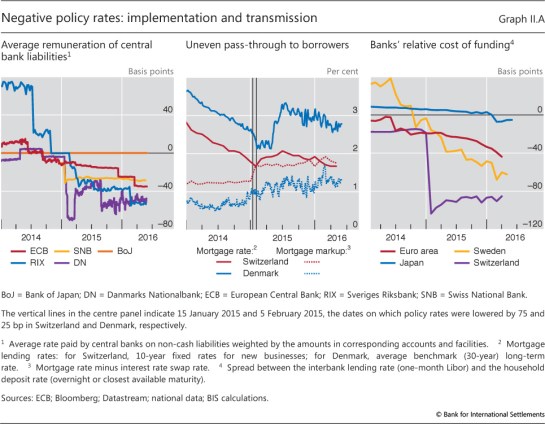
In all jurisdictions, banks, motivated by deposit withdrawal concerns, have been reluctant to pass negative rates through to retail depositors. Partly to limit the resulting impact on their net interest margins, some central banks introduced exemption thresholds for negative remuneration, thereby limiting banks’ average cost of holding central bank liabilities (Graph II.A, left-hand panel). Initially, there was also uncertainty as to how banks would treat their “wholesale” depositors, but some banks are now passing on the costs in the form of negative wholesale deposit rates. In some cases, banks have used exemption thresholds akin to those that central banks have applied to their reserves. In Switzerland, banks adjusted selected lending rates, notably mortgage rates, upwards, even as the policy rate was lowered to -75 bp (Graph II.A, centre panel). The Swiss experience suggests that banks’ ability to cope with the relatively high cost of retail deposit funding (Graph II.A, right-hand panel) without increasing lending rates will affect the technical room to keep interest rates in negative territory. This ability depends, among other factors, on the degree of competition in the banking sector and the share of retail deposits in banks’ funding mix (Chapter VI). In Denmark, where mortgage loans are mainly financed with pass-through bonds rather than deposits, mortgage rates fell alongside money market rates, although mortgage markups edged up throughout 2015 (Graph II.A, centre panel). Yet, as most Danish mortgages have adjustable rates, there was uncertainty about the tax treatment and the mechanics of dealing with negative mortgage bond coupons. Also, some investors, notably insurers, were unwilling or unable to buy negative cash flow securities, creating a demand for instruments with interest payments floored at zero. So far, negative policy rates have not led to an abnormal jump in the demand for cash. However, anecdotal evidence suggests that both financial and non-financial firms have started adapting to the new environment and are seeking to adopt innovations that would reduce the costs associated with physical currency use.

Source: Global financial markets: between uneasy calm and turbulence

Posted in Burkina Faso | Comments Off on Negative interest rates coming to a mortgage lender near you… seems like the European financial system is adapting

Careers in finance: Evaluating MBS and CDO bundles of thousands of mortgages

There is a very nice intro at The Third Way on securitization (in the context of The Big Short).  A nice thing they do is link to the SEC filing for a CDO offered by Long Beach Mortgage (that was mentioned in The Big Short).  The filing is more than 200 pages of detail about the bundle of mortgages.  You quickly see why you need Moody’s or some other service to evaluate.  Probably someone has to rewrite the whole “Structured Finance Workstation” using R.

New York, April 30, 2010 — Moody’s Investors Service has downgraded the ratings of 55 tranches from 19 RMBS transactions issued by Long Beach. The collateral backing these deal primarily consists of first-lien subprime residential mortgages. The actions are a result of the continued performance deterioration in Subprime pools in conjunction with home price and unemployment conditions that remain under duress. The actions reflect Moody’s updated loss expectations on subprime pools issued from 2005 to 2007. For details regarding Moody’s approach to estimating losses on subprime pools originated in 2005, 2006, and 2007, please refer to the methodology publication “Subprime RMBS Loss Projection Update: February 2010” available on Moodys.com. To assess the rating implications of the updated loss levels on subprime RMBS, each individual pool was run through a variety of scenarios in the Structured Finance Workstation® (SFW), the cash flow model developed by Moody’s Wall Street Analytics. This individual pool level analysis incorporates performance variances across the different pools and the structural features of the transaction including priorities of payment distribution among the different tranches, average life of the tranches, current balances of the tranches and future cash flows under expected and stressed scenarios. The scenarios include ninety-six different combinations comprising of six loss levels, four loss timing curves and four prepayment curves. The volatility in losses experienced by a tranche due to small increments in losses on the underlying mortgage pool is taken into consideration when assigning ratings. The above mentioned approach “Subprime RMBS Loss Projection Update: February 2010” is adjusted slightly when estimating losses on pools left with a small number of loans. To project losses on pools with fewer than 100 loans, Moody’s first estimates a “baseline” average rate of new delinquencies for the pool (typically 20% for subprime pools). Once the baseline rate is set, further adjustments are made based on 1) the number of loans remaining in the pool and 2) the level of current delinquencies in the pool. The fewer the number of loans remaining in the pool, the higher the volatility and hence the stress applied. Once the loan count in a pool falls below 75, the rate of delinquency is increased by 1% for every loan less than 75. For example, for a pool with 74 loans from the 2005 vintage, the adjusted rate of new delinquency would be 20.20%. If current delinquency levels in a small pool is low, future delinquencies are expected to reflect this trend. To account for that, the rate calculated above is multiplied by a factor ranging from 0.2 to 2.0 for current delinquencies ranging from less than 2.5% to greater than 50% respectively. Delinquencies for subsequent years and ultimate expected losses are projected using the approach described in the methodology publication.

Source: Moody’s downgrades $5.6 Billion of Subprime RMBS issued by Long Beach

Posted in Teaching macroeconomics | Comments Off on Careers in finance: Evaluating MBS and CDO bundles of thousands of mortgages

Elena Ferrante’s My Brilliant Friend

I am about three years behind the times, but what a phenomenal novel.  Very small in its subject, the childhood friendship of two girls, from about ten to sixteen, growing up in Naples in the 1950s, the book nevetheless feels expansive.  You feel like you could step into the neighborhood and know where the Cerullo shoe store is and what you would see in the window.  Ferrante manages the sociology and psychology of adolescence (of the country, of the characters) very nicely.  The English translation by Ann Goldstein is perfect, not a false phrase in the whole book.  The story is told in the first person, as if a later Lenu were accessing her memories, but filtering them inevitably because she knows what was to come.  (Which the reader does not know.)

The book closes with the wedding of Lila, so here is Lazzarella by Domenico Modugno:

Posted in Book and film reviews | Comments Off on Elena Ferrante’s My Brilliant Friend

Others do the reading so we don’t have to: Critique of the “gender neutral parental leave favors male academics” paper

Regarding the 30% tenure rate, it turns out the key words are “at their first jobs.” This analysis compared people who got tenure at their first job to everybody else — which means that leaving for a better outside offer is treated the same in this analysis as being denied tenure. So the tenure-at-first-job variable is not a clear indicator of whether the policy is helping or hurting a career. What if you look at the effect of the policy on getting tenure anywhere? The authors did that, and they summarize the analysis succinctly: “We find no evidence that gender-neutral tenure clock stopping policies reduce the fraction of women who ultimately get tenure somewhere” (p. 4). That seems pretty important. What about that swing from gender-neutral to a 6-to-1 disparity in the at-first-job analysis? Consider this: “There are relatively few women hired at each university during the sample period. On average, only four female assistant professors were hired at each university between 1985 and 2004, compared to 17 male assistant professors” (p. 17). That was a stop-right-there moment for me: if you are an economics department worried about gender equality, maybe instead of rethinking tenure extensions you should be looking at your damn hiring practices. But as far as the present study goes, there are n = 62 women at institutions that never adopted gender-neutral tenure extension policies, and n = 129 at institutions that did. (It’s even worse than that because only a fraction of them are relevant for estimating the policy effect; more on that below). With a small sample there is going to be a lot of uncertainty in the estimates under the best of conditions. And it’s not the best of conditions: Within the comparison group (the departments that never adopted a tenure extension policy), there are big, differential changes in men’s and women’s tenure rates over the study period (1985 to 2004): Over time, men’s tenure rate drops by about 25%, and women’s tenure rate doubles from 12% to 25%. Any observed effect of a department adopting a tenure-extension policy is going to have to be estimated in comparison to that noisy, moving target.

Source: Don’t change your family-friendly tenure extension policy just yet – The Hardest Science

Posted in Burkina Faso | Comments Off on Others do the reading so we don’t have to: Critique of the “gender neutral parental leave favors male academics” paper

IGEL 2016 conference: Stephen Briner on parody

An interesting paper at the recent IGEL 2016 conference was by Stephen Briner about detecting and reasoning about parody texts.  The question is how easy it is to discern parody in the absence of a referent text or absence of knowledge of the genre.  To me this seemed much harder to get at, because parodies are often idiosyncratic. So first need to ask whether there is a general theory of parody. Does parody always involve taking a text and changing the subject matter to be more trivial? I can think of no parodies of fiction in West Africa.  Maybe Yambo Ouologuem parodying European literature and colonial writing.  And maybe also he is parodying Senghor and Achebe?   Who will be Mabanckou’s first parodist!  That would be fun to write.  Interestingly, I could find nothing scholarly on parody in African literature more generally.  But maybe not so odd, it seems not to be a big area of research generally.  Here though is a very recent dissertation from Przemysław Uściński on The Creative Role of Parody in Eighteenth-Century English Literature (Alexander Pope, John Gay, Henry Fielding, Laurence Sterne).  I just skimmed it, very nicely done.

Posted in African literature | Comments Off on IGEL 2016 conference: Stephen Briner on parody

Sheila Bair’s take on bondholders

As she thinks back on it, Bair views her disagreements with her fellow regulators as a kind of high-stakes philosophical debate about the role of bondholders. Her perspective is that bondholders should take losses when an institution fails. When the F.D.I.C. shuts down a failing bank, the unsecured bondholders always absorb some of the losses. That is the essence of market discipline: if shareholders and bondholders know they are on the hook, they are far more likely to keep a close watch on management’s risk-taking. During the crisis, however, Treasury and the Fed were adamant about protecting debt holders, fearing that if they had to absorb losses, the markets would be destabilized and a bad situation would get even worse. “What was it James Carville used to say?” Bair said. “ ‘When I die I want to come back as the bond market.’

Source: Sheila Bair’s Exit Interview – The New York Times

Posted in Teaching macroeconomics | Comments Off on Sheila Bair’s take on bondholders

Nice profile and interview with Sheila Bair and her role as FDIC chair in 2008 financial crisis

Quite different from Alan Blinder’s portrayal of Bair.

As an observer of the financial crisis and its aftermath, I have frankly admired most of what she tried to do. She was tough-minded and straightforward. On financial matters, she seemed to have better political instincts than Obama’s Treasury Department, which of course is now headed by Geithner. She favored “market discipline” — meaning shareholders and debt holders would take losses ahead of depositors and taxpayers — over bailouts, which she abhorred. She didn’t spend a lot of time fretting over bank profitability; if banks had to become less profitable, postcrisis, in order to reduce the threat they posed to the system, so be it. (“Our job is to protect bank customers, not banks,” she told me.) And she was a fierce, and often lonely, proponent of widespread mortgage modification, for reasons both compassionate (to help struggling homeowners stay in their homes) and economic (fewer foreclosures would help the troubled housing market recover more quickly).

Source: Sheila Bair’s Exit Interview – The New York Times

Posted in Teaching macroeconomics | Comments Off on Nice profile and interview with Sheila Bair and her role as FDIC chair in 2008 financial crisis