A Darker Shade of Magic by V.E. Schwab

After enjoying Jonathan Strange and Mr. Norrell, I was hoping A Darker Shade of Magic by V.E. Schwab, which is similarly pitched, would be a good read. Unfortunately it was not… basically written at the Lightning Thief-level, so fine for 12-14 year olds who can handle a little gratuitous torture, but pretty tedious for adults.  NPR though gave it a favorable review. I disagree, but then you have to decide who to trust, NPR or me?

Posted in Politics | Comments Off on A Darker Shade of Magic by V.E. Schwab

What if they called a war in Burkina Faso, and no soldiers died?

General Gilbert Diendéré’s coup attempt that started September 16 and ended with his presidential guard unit disbanded and himself in jail has produced some head-scratching. What happened was the regular armed forces after several days finally decided not to support the coup. The presidential guard was given an ultimatum. Their camp behind the presidential palace (Kosyam) was surrounded. Shots and loud explosions were heard on September 29. Then it was all over. General Diendéré escaped (?) to the Vatican “embassy” and surrendered on October 1.

The army announced that no one had been killed in the “assault” on the RSP camp. Nobody in the army or government has given an account of what happened to the 1200 or so members of the presidential guard. Where are they? Nobody is saying. Burkina Faso has a lively press, but few publishers willing to support serious investigative journalists. So probably we will never know what actually happened. Maybe General Diendéré actually only had 50 followers in his unit? How embarrassing that he was able to launch the coup in the first place.

I’m sure eventually we will start getting some insider accounts from military sources. But their reliability is always hard to judge. Maybe General Diendéré’s trial will actually make sense, unlike the ridiculous trial organized in 2004 after the last so-called coup attempt against ex Pres. Compaoré (nicely summarized in Vincent Ouattara’s book «Procès des putschistes à Ouagadougou»).

Posted in Politics | Tagged | Comments Off on What if they called a war in Burkina Faso, and no soldiers died?

Not the best audio quality… Trembling Bells is definitely on my list of “Bands so much like Incredible String Band it is uncanny”

Posted in Politics | Comments Off on Not the best audio quality… Trembling Bells is definitely on my list of “Bands so much like Incredible String Band it is uncanny”

Levitt is a really good storyteller… I want him at my campfire! (start at the 5 min mark)

Posted in Politics | Comments Off on Levitt is a really good storyteller… I want him at my campfire! (start at the 5 min mark)

Blattman protests too much, I fear

I think Chris Blattman recent post on “fear” which got a lot of reposts, represents sort of exactly why some people are dubious of the micro-evaluation randomista approach.  The way any normal person reads Chris’s post, is that he is suggesting that poor and marginalized people have a lot of fear and this keeps them down. The production of this fear is all rendered in the passive voice.  Something out there (a fog? really?) produces the conditions for which fear is the correct reaction, debilitating as it may be.  So randomistas need to search for the psychological mechanisms at work and design programs that will empower people and reduce fear… and hence spur development.

Reading Joshua Oppenheimer’s timely oped about the mass killing of Indonesian leftists in 1965, you can easily see what is left out.  Oppenheimer writes (Source: Suharto’s Purge, Indonesia’s Silence – The New York Times):

The purpose of such intimidation is to create a climate of fear in which corruption and plunder go unchallenged.

Chris in his blog post asserts, “The tragedy is that modern social science has very little to say about any of this.”  I think modern social science (and even more broadly, the humanities, including people like Oppenheimer) actually has a lot to say about this.   I know that when I went to Chile, the only destination on my list was the museum established by Michele Bachelet’s government to remember and understand the violence and fear created by Pinochet.  The museum, in my hazy memory, was largely informed by modern social science and humanities.  Yes, there is no randomized control trial telling us whether such museums change the nature of fear for a given sub-group of some population.  But if Chris really does mean “modern social science” = “experimental method with regression analysis” even this comparative neglect by economics can hardly be labelled a tragedy.  He doth protest too much!

Posted in Development thinking | Comments Off on Blattman protests too much, I fear

Geoff Ryman’s Was (a novel)

Geoff Ryman’s Was (a novel) is something that I saw mentioned or eventually linked to from a tweet by Susan Stinson.  From the blurb I knew this was my kind of novel, and it did not disappoint.  A complex overlapping set of stories that veers from the very, very mundane and depressing to the fantastical, the novel follows several characters with ties and obsessions to the Wizard of Oz, including an “original” Dorothy Gael in Kansas, a young Judy Garland, and an actor dying of AIDS in the late 1980s.  The book is poignant, scary, hopeful, revealing and tremendously well-written.  Several themes mix in complex ways: how childhood sticks to us all into adulthood (think Rosebud); how marginalized identities (especially being gay, being orphaned, being a woman, being physically disabled) take up the entire canvas of life for many people; how we search, hide, create, manipulate a past to construct our present; how we select, and lie, as we define our place in the world; and ultimately how we have (or there exists, which is what we want to believe) power, deep within, and by listening and caring for others, we can create and recreate our own reality.  The scenes of Dorothy, living in the psychiatric state nursing home for 60 years, and interacting with Bill, someone who for the first time actually cares enough to listen, are very powerful.  Profoundly pessimistic and hopeful at the same time.  If that is your tone, read this gem.

Icing on the cake: Reading more about Ryman, I discovered he was the author of Have Not Have (eventually published as Air) which was absolutely one of the very best short novellas in realist anthropological sci-fi I have read in the past two years.

Posted in Book and film reviews | Comments Off on Geoff Ryman’s Was (a novel)

Excellent political commentary on the coup attempt in Burkina Faso by Derbié Terence Somé

En attendant, il est évident que ce coup d’Etat mort-né a rendu un grand service aux autorités de la transition. Il faut le redire, elles se sont refait une virginité politique alors que visiblement leur popularité était mise à mal par des dossiers pas très bien gérés. On citera volontiers les revendications syndicales, le continuum éducatif, la reforme du statut du personnel de l’armée, la mise en œuvre des pôles de croissance, etc. Finies ou plutôt oubliées les critiques sur la fausse austérité budgétaire, les émoluments indus de tout ou partie des députés du CNT, les fraudes aux concours de la fonction publique, l’affaire des fausses cartes d’électeurs… Michel Kafando peut boire son petit lait de président réinvesti qui sans « fausse modestie », proclame, urbi et orbi, que la transition burkinabè est un exemple pour l’Afrique et le monde. Il se voit en archange saint Michel en croisade contre « les forces du mal » et pas un président rassembleur, au dessus de la mêlée.

Source: Coup d’Etat du Général Gilbert Diendéré : Les conséquences politiques directes (…) – leFaso.net, l’actualité au Burkina Faso

Posted in Politics | Comments Off on Excellent political commentary on the coup attempt in Burkina Faso by Derbié Terence Somé

New word inspired from Burkina Faso? “to burkinate” – defend freedoms fiercely

Chers amis, la liste du vocabulaire s’allonge de jour en jour. Un de mes amis américain a ajouté “to burkinate”= défendre farouchement ses droits fondamentaux. Bravo à tout le peuple burkinabè qui s’est levé contre les “forces du mal, ces usurpateurs…. et j’en passe!!!!!!!!

On a Facebook page….

Posted in Politics | Comments Off on New word inspired from Burkina Faso? “to burkinate” – defend freedoms fiercely

And soon 3-D printers will solve the logement problem

HT: Brian Lance

Posted in Development thinking | Comments Off on And soon 3-D printers will solve the logement problem

Good to have you back… legitimate leaders of Burkina Faso

One of the images that Burkinabè will never forget: Gilbert Diendéré meeting leaders on the red carpet at the airport.  The bully was allowed his face-saving gesture, knowing all the while he is diminished.

Posted in Politics | Comments Off on Good to have you back… legitimate leaders of Burkina Faso

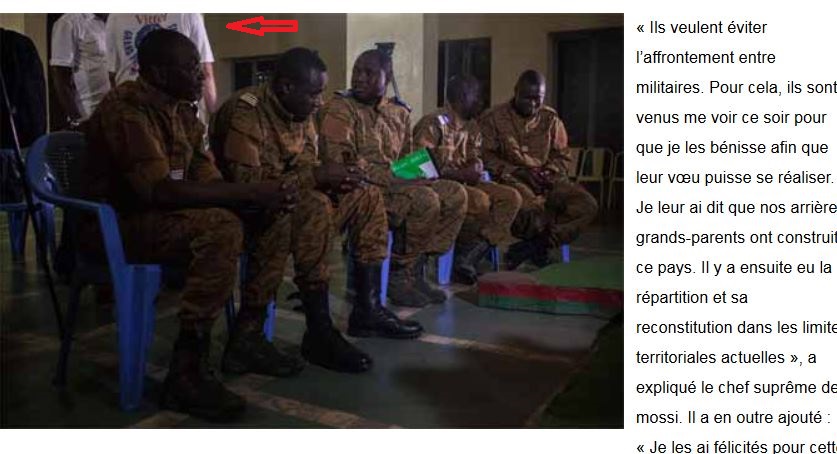
C’est qui SVP chez le Mogho Naba avec les officiers? #lwili

whiteguymoghonaba

Posted in Politics | Comments Off on C’est qui SVP chez le Mogho Naba avec les officiers? #lwili

How can we discern what is happening in Burkina Faso? We can’t.

We can see only some things from among the many that are happening.  We cannot distinguish among a variety of possibilities.

What discerning can we do from what we are seeing?

  • In Texas hold ’em, you do not fold because your opponent acts like he has a strong hand, when you know that you have a strong hand and you know that your opponent is very likely to be bluffing.  The regular army is perhaps a bad or inexperienced poker player, or really does not want to fight right now.  The army has apparently agreed to withdraw 50 km (from where is not clear, there are bases in the center of town, why would they withdraw from those bases?)  That is, they appear to have folded even before raising the ante and seeing if Diendéré would fold.
  • Neither Kafando nor Zida appear willing to put themselves at tremendous risk, and simply lay down on the tracks and say, “you have to use force on me.”  If they did, we would see them tomorrow at the airport physically blocking Diendéré from meeting ECOWAS presidents at the airport.
  • Civil society organizations like Balai Citoyen are not as powerful or organized as they might be. Otherwise they might be organizing a human encirclement of Kosyam, or the airport, literally lying on the streets in civil disobedience and forcing Diendéré and his soldiers to remove them by force.
  • Money is talking?  Ex-President Blaise Compaoré’s private fortune has not been estimated to my knowledge.  Would ECOWAS presidents adopt a very conciliatory tone with Diendéré in return for $10 million each in a private secret bank account?  Must be tempting.
  • Is it all about Salif Diallo?  In interviews after and in the period before his flight from Ouagadougou, Compaoré and CDP allies cast a lot of blame on Salif Diallo, as someone who betrayed the party and the regime.  If the military leaders are of the same mind, then we are in a side show, with the real show down yet to come, when Roch Marc Christian Kaboré possibly wins a Presidential election.  In that showdown, if Diendéré still controls a fully armed and operational RSP, it is clear who will win.
Posted in Politics | Comments Off on How can we discern what is happening in Burkina Faso? We can’t.

Situation in Burkina Faso: Standoff and ECOWAS summit

While families and children huddle in their homes, General Diendéré and General Zagré try to talk it out in Ouagadougou, Diendéré in Kosyam (presidential palace) and attached military base, and Zagré controlling the whole city.  ECOWAS heads of state meeting in Abuja, with nobody representing Burkina Faso, apparently.

Normally, at this point there would have been a straightforward amnesty (of which there have been plenty in West Africa over the years).  The trouble is, Diendéré right now is the living, smiling face of impunity, of y’en a marre.  And he has clearly lost the game that he tried to play.  So amnesty will be very problematic.  Moreover, Diendéré like a clever crocodile has thrashed around in the muddy water so nobody can see clearly.  What is the status of the ECOWAS piece of paper that Macky Sall and the Senegalese government is saying Michel Kafando agreed to?  If Michel Kafando was imprisoned at the time (as he was) why would any international community give such an agreement any credibility?  Michel Kafando is still apparently in the residence of the French embassy in Ouagadougou.  Why have the reasonably legitimate president and the reasonably legitimate prime minister Yacouba Zida not been seen?  Were they poisoned by Diendéré so they are incapacitated?

The ECOWAS meeting has apparently ended, so in a bit of time the page should turn… we do not know how long this novel is going to be, but hope it ends up being a short story.

Posted in Politics | Comments Off on Situation in Burkina Faso: Standoff and ECOWAS summit

Some losses get hidden in the crisis in Burkina Faso” Victor Démé passed away

L’artiste musicien Victor Démé est décédé ce lundi matin à Bobo-Dioulasso des suites d’une courte maladie.

Source: leFaso.net, l’actualité au Burkina Faso – L’information en temps réel du Burkina, Médias, journaux, infos, direct, les dernières nouvelles, politiques.

Posted in Music | Comments Off on Some losses get hidden in the crisis in Burkina Faso” Victor Démé passed away

Babacar Justin Ndiaye critique sévèrement la médiation du président Macky Sall

From Dakaractu 

C’est là que Diendéré a obtenu gain de cause! La caution est là. Et Macky Sall semble perdre de vue qu’en donnant cette caution à Diendéré, ce n’est pas seulement le Sénégal qui la lui donne, mais 15 états africains regroupés dans la CEDEAO. Diendéré, tout ce qu’il a à faire, c’est se frotter les mains, il est content parce qu’il a obtenu ce qu’il voulait. Il a gagné la première manche. C’est la raison pour laquelle je me dis qu’on va vers l’impasse. La médiation, elle est maladroite, quelque part elle est même molle parce que le mot qui sort le plus souvent est l’équilibre entre des pustchistes et des démocrates. Cet équilibre là est maléfique…

Posted in Politics | Comments Off on Babacar Justin Ndiaye critique sévèrement la médiation du président Macky Sall

Interregnum a dangerous time for Burkina Faso

General Gilbert Diendéré has now almost thrown in the towel according to interview with Voice of America, but he never completely agrees, saying repeatedly, “we are in discussions.”  Pointed questions from Idriss Fall. Nice reporting.  Diendéré seems to be hoping that tomorrow’s ECOWAS summit will provide him with an out.

Army chief of staff Pingrenoma Zagré will now have an enormous influence over the remainder of the political transition.  I know nothing about his political (or other) convictions, nor how he will evaluate the underlying tensions that General Diendéré cited as justifications for his coup attempt.

Here’s some points that I presume:

  • Seems unlikely that Diendéré could remain free after himself imprisoning president, prime minister and two ministers.
  • United States embassy might give cover to Diendéré under a realist calculation that have to reinforce credibility of standing by and protecting erstwhile allies even when they commit major mistakes counter to fundamental principles of U.S. policy. I do not envy Tulinabo Mushingi’s decision: go with that realist, military reasoning, and risk a lot of popular support across West Africa that still views U.S. as being a counterweight to Francafrique.  Ideal for U.S. if they could get France to “exfiltrate” Diendéré to Cote d’Ivoire. France reputation cannot go lower, anyway.
  • With Diendéré and Compaoré both in Cote d’Ivoire, Guillaume Soro and Alassane Ouattara will have an even  bigger political headache, especially if civilian authority in Burkina is consolidated.  An extradition request for both by a legitimate government will be tricky.
  • Zagré will need to call a curfew, but too many people out on streets, high risk of course of opportunistic looting that causes confusion about control of the city during interregnum.
  • I am still somewhat surprised at inability or unwillingness of Mali jihadi’s to take advantage of 2014 and now this interregnum.  Given all the attacks in Mali, which seems to suggest they have the ability to roam quite far, you might think they would take some risks to loot banks or carjack or take hostages in northern Burkina Faso or even Ouagadougou.  The logic of desert terrain however (and their relative wealth already) maybe means marginal value of money/cars already low, and their experience with ransoming West Africans may likewise have led them to conclude not very profitable?
Posted in Politics | Comments Off on Interregnum a dangerous time for Burkina Faso

Why “inclusive elections” is more complicated in Burkina Faso than you might think #lwili

Events have been unfolding very rapidly during the day in Burkina Faso.  Who knows what will happen this evening.  I thought it might be useful to clarify an issue that comes up a lots in discussions about the crisis.

One of the key points of the ECOWAS mediators’ proposal released yesterday was to have “inclusive elections.”  (By the way, this was not a negotiated agreement at all, apparently, and President Michel Kafando went on the record today to RFI saying he had not agreed to the text and indeed apparently had not even seen it.)  By “inclusive elections” is meant overturning an amendment to the electoral code that was adopted in April by the transitional parliament (led by Cherif Sy, a long-time opposition journalist).  The new provision read as follows: « toutes les personnes ayant soutenu un changement anticonstitutionnel qui porte atteinte au principe de l’alternance démocratique, notamment au principe de la limitation du nombre de mandats présidentiels ayant conduit à une insurrection ou à toute autre forme de soulèvement ».  Excluded were any person who supported an unconstitutional change that countered the principle of democratic alternance [French word hard to translate meaning peaceful change of power] in particular meaning the Presidential term limits that led to an insurrection or other form of uprising.”  The writing is as unclear as the U.S. Constitution’s second amendment.

There have long been debates in political science and law about when it is legitimate to exclude from elections political parties or individuals that intend to dismantle the democratic process.  This discussion is usually in the context of Islamist political parties.  But of course practically every democracy confronts this issue at one time or another.  The United States, for example, passed the Communist Control Act of 1954.  So the amendment to the electoral law is perhaps not as unusual or unfair on the face of it as some people think.

Why should CDP leaders be subject to such a ban, though? Did they advocate for violence?  The feeling of many of the transition leaders is that they did. Underlying the long hold of power of the CDP (and its predecessors, basically the Compaoré regime) was the threat of violence.  The last clear instance of violence by the CDP was the killing of Norbert Zongo, an opposition investigative journalist and newspaper publisher, in 1998.  But the threat remained after that, and an important unexplained killing of constitutional court judge Salifou Nebie in June 2014 just months before the regime tried to change the presidential term limits law underscored that implicit threat.  Journalists repeatedly stated that they received numerous threats.

The credible threat of violence can make a democracy undemocratic.  Charles Taylor of Liberia famously, or apocryphally, warned Liberian voters that he would resume the war if he did not win (“He killed my ma, he killed my pa, but I will vote for him”).  The transition leaders (the former opposition to the Compaoré regime) believed that the threat was still there, and so the CDP might actually do well in the election, because as a focal point the reasoning that “they are going to have power anyway, so I may as well support them and benefit from the patronage” might be very powerful.  Especially when choosing amongst competing parties that have very limited ideological differences (all of the parties except the small Sankarist parties support the general market and investment friendly economic policies of the past 25 years).  Finally, from the point of view of transition leaders, the main political parties contesting the elections, the MPP and UPC, were led by people who had defected from the CDP (in Roch Marc Christian Kaboré’s case, only in early 2014!) so the ban was on a limited number of personalities who were closely aligned with the previous semi-authoritarian regime, indeed, the ones who held on to the bitter end.

Once the context is properly understood, the intellectual argument against the ban  remains (in general, it is a bad idea for a democracy to restrict rights of citizens who have not actually committed any crimes, determined through some due process), but the emotional appeal of patent “unfairness” or tinge of arbitrariness loses much of its resonance, in my opinion.

Posted in Politics | Comments Off on Why “inclusive elections” is more complicated in Burkina Faso than you might think #lwili

Shangaan Electro from South Africa

Posted in Music | Comments Off on Shangaan Electro from South Africa

Le Monde denounces the coup in Burkina Faso

M. Compaoré a donné un bien mauvais exemple. A sa suite, plusieurs pays (Congo-Brazzaville, Rwanda, République démocratique du Congo, notamment) ont été le théâtre d’une dérive politique autoritariste. Leurs présidents ont concocté des projets de réforme constitutionnelle destinés à leur permettre de rester au pouvoir au-delà des limites (généralement deux mandats) fixées par les textes fondamentaux. Au Burundi, cette question a plongé le pays dans une crise d’une gravité extrême. Au Burkina Faso, la réaction populaire a stoppé ce projet et provoqué le départ du président Compaoré. Quelle sera, un an plus tard, la leçon de Ouagadougou si des militaires peuvent effacer en une nuit les avancées de cet élan démocratique, porté par la jeunesse, dont on sait le rôle-clé qu’elle doit jouer dans une Afrique en pleine transformation ?

Source: Au Burkina Faso, le mauvais coup des prétoriens

Posted in Politics | Comments Off on Le Monde denounces the coup in Burkina Faso

Likely denouement for Burkina Faso?

Popular resistance to the coup d’état attempt of Gilbert Diendéré of the Presidential Guard unit (RSP) seems to be overwhelming.  There are photos from lots of cities and towns of anti-coup demonstrations and mobilizations.  Chérif Sy, president of the transition parliament, has called for popular resistance and asked soldiers to join the resistance.  Sy said that mobilization would be intensified in neighborhoods.

But the regular army seems to not have decided what to do.  Army Chief of Staff Zagré was photographed at the airport, at the same time as Diendéré , while they waited for ECOWAS presidents Yayi Boni and Macky Sall to arrive to mediate.  Apparently they are now in the Hotel Laico, palavering.   Who pays while they have a cappuccino, one wonders?

So Diendéré is in a corner. Maybe the regular army has chosen wisely: at this point the best thing to do is participate in a process where Diendéré can stand down (really, he should just leave the country), the election can proceed, a general amnesty for RSP is signed, with a face-saving agreement to symbolically de-claw RSP.

RSP seems to have been de-clawed de facto.  Balai Citoyen and other civil society groups showed clearly in October 2014 that a few hundred soldiers cannot rule a city of 3 million without consent.  The lesson for future coup leaders is clear: two months of sabotage of utility services (electricity, water, gasoline supplies, market, government) are needed for coup to be welcomed or for population to be indifferent.  If things are working reasonably well and people expect that to continue, they are willing to spend five days on the streets to defend the basic idea of a republic.

Posted in Politics | Comments Off on Likely denouement for Burkina Faso?