Soundtrack for reading about gender inequality in education

Posted in Politics | Comments Off on Soundtrack for reading about gender inequality in education

Great Ted Chiang story, “The Truth of Fact, the Truth of Feeling”

One of my favorite authors.  And now he proves he could be writing for Harpers… a science fiction story in the style of an extended essay.  And you learn more about how to think about the technology of writing than reading Jack Goody’s impenetrable prose.  Oddly, few reviewers mention that the Tiv are a real people, written about extensively, most well known by the anthropologists Laura and Paul Bohannan.

People consult their lifelogs for a variety of reasons—everything from reliving favorite moments to tracking down the cause of allergic reactions—but only intermittently; no one wants to spend all their time formulating queries and sifting through the results. Lifelogs are the most complete photo album imaginable, but like most photo albums, they lie dormant except on special occasions. Now Whetstone aims to change all of that; they claim Remem’s algorithms can search the entire haystack by the time you’ve finished saying “needle.”

via The Truth of Fact, the Truth of Feeling by Ted Chiang — Subterranean Press.

Posted in Book and film reviews | Comments Off on Great Ted Chiang story, “The Truth of Fact, the Truth of Feeling”

John Cochrane podcast… worth a listen

A nice interview with John Cochrane from University of Chicago on Economic Rockstars.  He has good sensible things to say about all sorts of subjects, and you learn he is an avid glider pilot.  Wow!  Highly recommended, but for me one false note.  Towards the end of the interview he is asked about his “conversion moment” from physics to economics.  He talks about a micro class where he first learns about the kinked budget constraint of poor people on welfare.  In his retelling this was a key moment: the objective tools of microeconomics could be used to understand poverty.  No more need poverty be couched in moral subjective blah blah.  He could apply physics/math tools (objective no bullshit reasoning) to address society’s most critical problems.  Except that when you look at his research page, all his research is at a very abstract level of the economy.  Poor people are just not there (poor models are, but not poor people!). Sure, macroeconomics and financial markets matter, but not at the gut level of Cochrane’s conversion story.  What happened, one thinks, is that he used physics/math tools (objective no bullshit reasoning) to address economist’s most critical problems.  Not quite the same thing.  Still, respect, duh.  The guy is brilliant.

Posted in Teaching macroeconomics | Comments Off on John Cochrane podcast… worth a listen

Libraries pass the Pritchett postulates of development test with flying colors!

From Alex Tabarrok at Marginal Revolution:.

After promoting women’s groups in West Bengal as a route to development a West Bengali woman asked Lant Pritchett:

You all are from countries that are much richer and doing much better than our country so your country’s women’s self-help groups must also be much better, tell us how women’s self-help groups work in your country.

Pritchett’s inability to answer the question led him to what I call Pritchett’s postulates of development, four criteria to decide whether factor X is an important determinant of development.

  • More developed countries must have more X than less developed countries.
  • The developed countries must have more X than when they were less developed.
  • Recent development successes must have more X than development failures.
  • Countries that are developing rapidly must have more rapid growth of X than those that are developing slowly.

Since more developed countries don’t have noticeably more women’s self-help groups, this idea fails Pritchett’s postulates.

To which I add, community or public libraries pass this test brilliantly.  Developed countries established them like crazy during the period of rapid growth 1880-1930, and then continued after WWII.  China has seen a similar rise of libraries according to Zhixian Yi.

After the overthrow of the Qing dynasty in 1912, “the New Culture Movement” and “the New Library Movement” were in full swing with the founding of the Republic of China. With “the New Library Movement” and even or dinary people’s participation in the vigorous librarianship construction, libraries developed very rapidly. Especially in 1912, Yuanpei Cai, as Minister of Education, promoted social education and established the popular library as a social institution. With the promulgation of the library regulations, this kind of library, as one of the most important institutions of social education, developed very quickly (Gong, 2011a, p. 3). The total number of the popular libraries was 2492 in 1936 (as cited in Gong, 2011a, p.3).

Posted in Public library history | 3 Comments

The Real Cool Killers by Chester Himes

Got The Real Cool Killers by Chester Himes from the library after reading a Burkinabè author cite him as an influence. I was like, “Who is this guy?” Fascinating and sad story. The fiction is exactly as advertised: lurid hardboiled Harlem detectives and criminals. Lots of action, no character development, impossible stereotypes.  But a fun read, of course.  Not nearly as taut as Elmore Leonard, but broader, more slapstick.  Lots of vocabulary that I am sure Google will enjoy looking up for you.

Posted in Book and film reviews | Comments Off on The Real Cool Killers by Chester Himes

Grammar Girl : “On Accident” versus “by Accident”

I still cringe when my children say “on accident” but I do not correct them… Barratt’s study is dead on, is my personal experience.

According to Barratt’s study, use of the two different versions appears to be distributed by age. Whereas on accident is common in people under 35, almost no one over 40 says on accident. Most older people say by accident. It’s really amazing: the study says that “on is more prevalent under age 10, both on and by are common between the ages of 10 and 35, and by is overwhelmingly preferred by those over 35.” I definitely prefer by accident.

An interesting conclusion from the paper is that although there are some hypotheses, nobody really knows why younger people all over the U.S. started saying on accident instead of by accident.

via Grammar Girl : On Accident Versus by Accident :: Quick and Dirty Tips ™.

Posted in Being a teacher | Comments Off on Grammar Girl : “On Accident” versus “by Accident”

Take 15 minutes to watch The Six Dollar Fifty Man

The Six Dollar Fifty Man  Sukie and I had watched it several times some years ago. We just watched it again.  Wow, great job, Directors – Mark Albiston & Louis Sutherland, Writer – Louis Sutherland, Producer – Wendy Cuthbert

Posted in Book and film reviews | Comments Off on Take 15 minutes to watch The Six Dollar Fifty Man

Why use R instead of Excel or SPSS, for quantitative archaeology or any social science for that matter!

For a long time archaeologists had few options to deal with these problems because there were few alternative programs. The general alternative to using a point-and-click program is writing scripts to program algorithms for statistical analysis and visualisations. Writing scripts means that the data analysis workflow is documented and preserved, so it can be revisited in the future and distributed to others for them to inspect, reuse or extend. For many years this was only possible using ubiquitous but low-level computer languages such as C or Fortran (or exotic higher level languages such as S), which required a substantial investment of time and effort, and a robust knowledge of computer science. In recent years, however, there has been a convergence of developments that have dramatically increased the ease of using a high level programming language, specifically R, to write scripts to do statistical analysis and visualisations. As an open source programming language with special strengths in statistical analysis and visualisations, R has the potential to be a solution to the three problems of using software such as Excel and SPSS. Open source means that all of the code and algorithms that make the program operate are available for inspection and reuse, so that there is nothing hidden from the user about how the program operates (and the user is free to alter their copy of the program in any way they like, for example, to increase computation speed).

via ATOR: Doing quantitative archaeology with open source software.

Posted in R statistics | Comments Off on Why use R instead of Excel or SPSS, for quantitative archaeology or any social science for that matter!

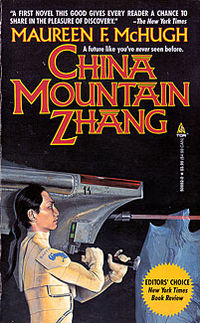
China Mountain Zhang by Maureen McHugh

200px-ChinaMountainZhangI had recently read a short story and then Nekropolis by McHugh, so I ordered China Mountain Zhang.  Great novel.  But not what you think it will be.  As numerous commentators point out, it is an ambitious sci-fi novel about ordinary people living fairly ordinary lives in a sci-fi future that is not too far away (certainly closer than 1992 when the novel was published).   I kept comparing it to Michael Cunningham’s The Snow Queen, another novel about “regular” folks (hey, we’re all special, as we learn in elementary school).   It is quiet, the epiphanies are small but important for the characters lives, and their lives change with a natural flow.

So I have nothing but praise, except for the long lecture by Zhang when he teaches his first class. Read like something McHugh had written elsewhere, or maybe before writing the novel, and she stuck it in at the end.  Just does not work, and not really necessary.

Posted in Book and film reviews | Comments Off on China Mountain Zhang by Maureen McHugh

Michael, can you recommend some fiction podcasts?

Funny you ask, yes I can.  I love going on a long run and listening to someone read and short story and then discuss.  This week I heard three.

Richard Ford reading Raymond Carver’s “The Student’s Wife”.  Pretty sad. OK very sad.  The way Raymond Carver is sad.  You can’t even get pleasure out of the artistry because it services the sadness.

Thomas McGuane reading “The Tree Line, Kansas, 1934,” by David Means.  McGuane more enthusiastic about the story than I was. He reads it well, and I understanding the point. but the story feels (hears) more like an exercise than something authentic. Like a museum diorama.  The craft more on display, compared with Carver.

David Gilbert reading “Leg,” by Steven Polansky.  Any parent of a teenaged boy who is going through a certain period is going to feel an immediate resonance with this story.  In fact, inside your head you’ll probably change the name of your child to Randy.  Triesman and Gilbert have a nice discussion: from a super obvious metaphor you can keep drilling down until you can honestly decide you don’t really know just quite what you get out of the story.  A feeling that can quite be fingered, a sense of ambiguity and mystery.

Michael, don’t you listen to fiction podcasts read by women? Yes I do, that these three were all men and male authors is purely coincidence.


Posted in Book and film reviews | Comments Off on Michael, can you recommend some fiction podcasts?

Something I need to remember…

reading a 100M csv file into R, read.csv takes 61s, and with read_csv in readr just 3s. That’s amazing. #rstats @hadleywickham a great job

via Hadley Wickham (@hadleywickham) | Twitter.

Posted in R statistics | Comments Off on Something I need to remember…

Philip K. Dick, The Man in the High Castle

Found this in the university library.  Realized I had never read Dick.  All books, or just this one, use abbreviated sentences?  Makes for interesting style. Noted.  Light rain falling in San Jose. Just south of setting of novel. San Francisco in alternative history. Nazis and Japan won the big one.  America divided into three occupation territories. Defeated. Insecure. What are we worth: Nothing.  But maybe. Deep inside us.  Like Bourbon.  Consult the I Ching.  Worth reading bad novel?  Can bad novel win prestigious prize? All timelines coexist.

Posted in Book and film reviews | Comments Off on Philip K. Dick, The Man in the High Castle

A glib take on whether Puerto Rico can fix economy from The New Yorker

Surowiecki a bit glib, if you ask me.  Does he have any evidence that the government has not been supporting the tourism sector?  Has the Dominican Republic strategy perhaps generated a lot of environmental spillovers? DR also is five times the size of PR, so why wouldn’t its tourism sector be bigger?  That’s where the low-hanging fruit was in past three decades.  His argument is like saying that Atlantic City needs to focus on gambling, as its low-hanging fruit.  Uh… right, thanks, guess nobody thought of that.  (New York Times and The New Yorker both writing about Puerto Rico this week… why do I sense John Paulson’s publicity machine at work…)

More important, Puerto Rico should pluck its low-hanging fruit. Take tourism. Puerto Rico has glorious beaches, tremendous weather, and wonderfully varied topography. Americans can get there easily and without a passport. English is spoken almost everywhere. It should be a tourist mecca. Yet policymakers neglected tourism for decades, while other Caribbean countries aggressively wooed hotel chains and bolstered infrastructure. (In the past forty years, the number of hotel rooms in the Dominican Republic went from three thousand to more than seventy thousand, while the number of hotel rooms in Puerto Rico rose by just seven thousand.) As a result, Puerto Rico has been eclipsed. In 1980, according to a study by Calero’s company, it accounted for more than a quarter of all the tourist revenue in the Caribbean. By 2012, that number was down to fifteen per cent. And tourism accounted for less than five per cent of Puerto Rico’s G.D.P.

via Can Puerto Rico Fix Its Economy? – The New Yorker.

Posted in Teaching macroeconomics | Comments Off on A glib take on whether Puerto Rico can fix economy from The New Yorker

My sister Bridget Kevane reviews and interviews Thomas McGuane

BECAUSE I LIVE IN MONTANA and because I have always heard Montanans talk about Thomas McGuane, I set myself the task of reading all of his work: 10 novels, several books of essays, and three collections of short stories, including his new one, Crow Fair (Knopf). I now understand why the majority of Montanans claim him. McGuane’s body of literature is like a well-wrought symphony, with all the important parts of a tragicomic concerto, with an overture, crescendos, and requiems. And, taken together, it is almost magical to read the linguistic shifts in style from the psychedelic gonzo style of the ’70s to the meditative and spare tone of his more recent work. And throughout the chaos of his plots, and the chaos of his characters’ inner worlds, McGuane never, ever, loses his comic touch.

via Pushing Along, Pushing Along | The Los Angeles Review of Books.

Posted in Book and film reviews | Comments Off on My sister Bridget Kevane reviews and interviews Thomas McGuane

Wait, what? Really? This is what an “acclaimed” show does?

PG: One of your most memorable moments is Sally’s sleepover at a friend’s house. She’s watching TV and starts masturbating to an actor on “The Man From U.N.C.L.E.” The friend’s mother catches her and sends Sally home to her mother, who is furious.

MW: We don’t have to talk about this. Are you O.K.?

KS: I’m fine with it.

PG: That, alone, is impressive. By the time we’re 40, we know that everyone gets caught in awkward situations. But childhood is isolating. And you were only 9 or 10 when you did that scene. How did you work on it?

MW: I told Erin about it. We always strived not to make Sally a fake TV kid. And the strange thing is, if this were a boy, nobody would care. So, the groundbreaking thing was to show that little girls have sexual feelings, too

Wow, really groundbreaking.  Glad that ground was broken.  Maybe we can start a national conversation about that?  I object mostly to the self-satisfied tone… as if he weren’t just trying to make more money… no no… he’s doing something important for all of us!

via Growing Up on ‘Mad Men’: A Conversation With Matthew Weiner and Kiernan Shipka – NYTimes.com.

Posted in United States | Comments Off on Wait, what? Really? This is what an “acclaimed” show does?

Courtney Barnett – Avant Gardener

Posted in Music | Comments Off on Courtney Barnett – Avant Gardener

Economists being useful

Go James Stock!

CONGRESS long ago established a basic principle governing the extraction of coal from public lands by private companies: American taxpayers should be paid fair value for it. They own the coal, after all. Lawmakers set a royalty payment of 12.5 percent of the sale price of the coal in 1976. Forty years later, those payments remain stuck there, with actual collections often much less. Studies by the Government Accountability Office, the Interior Department’s inspector general and nonprofit research groups have all concluded that taxpayers are being shortchanged.This is no small matter.  In 2013, approximately 4o percent of all domestic coal came from federal lands. A recent study by the independent nonprofit research group Headwaters Economics estimates that various reforms to the royalty valuation system would have generated $900 million to $5.6 billion more overall between 2008 and 2012. This failure by the government to collect fair value for taxpayer coal is made more troubling by the climate-change implications of burning this fossil fuel. Taxpayers are already incurring major costs in responding to the effects of global warming. Coastal infrastructure is being battered by sea rise and storm surges; forests are being devastated by climate-aided pest infestations; and studies are suggesting that temperature rises have increased the likelihood of devastating droughts in California.

via The Real Cost of Coal – NYTimes.com.

Posted in Teaching macroeconomics | Comments Off on Economists being useful

Why can’t I have an opinion about corporate taxes like anyone else?

A colleague here at SCU shared with me this:

“Corporate taxes account for about 10 percent of the total tax take, at $273.5 billion in 2013. Lawrence Kotlikoff, an economist at Boston University, calculates that eliminating the corporate tax, while raising income or consumption taxes to compensate, would produce a dramatic growth spurt in the U.S. It would increase investment, permanently raise wages by 12 to 13 percent and boost gross domestic product by 8 to 10 percent. Eventually, the growth alone would be enough to make up for the lost tax revenue. “Most economists agree this is really hurting workers rather than owners of capital,” says Kotlikoff.”

See whole article here.

I responded with the following thoughts.  I’d be the first to admit that I know almost nothing about this kind of modeling; not something I have ever done.  But I know enough to know that there is more to this kind of modeling than solving the model itself.  Corporate profits have hit all all-time high (nominal and real) in the United States.  Why would one think that this corporate after tax profits were even higher because of an elimination of taxes that somehow that would unleash some kind of growth spurt?  Another point: this is pure macroeconomics hubris, isn’t it? Macro speculation like this is unknowable even to our most basic knowability standard… does Kotlikoff have anything close to an externally valid natural or random experiment (of large wealthy economy in a growth funk that did something like this)? Education economists don’t even know whether class size reduction from 27 to 24 is a net good thing, how could we possibly *know* enough to speak so confidently about an issue like this? I love the rhetoric of “12 to 13 percent” as if the gap were an issue of technical assumptions and the gross were unassailable… neat. I guess my objection is to “would”… reporter should have written “could” or “might”….  A final point: Some people (libertarians I would think) should object to a policy designed to enable the “large corporate” sector to get even bigger. No need to make self-employment and single proprietor businesses even less attractive….

Posted in Teaching macroeconomics | Comments Off on Why can’t I have an opinion about corporate taxes like anyone else?

China Miéville’s The City and the City

I was skeptical before starting China Miéville’s The City and the City.  I had read and enjoyed Embassytown, but he did go on and on towards the end and I found myself skimming a lot.  The City and the City was far more gripping, until the final quarter when it descended into conventional detection (really almost Agatha Christie) genre resolution.  “The old man did it, Scooby!”  I guess, what else can you do?  But until then, an amazing concept of the city and the city unseeing to each other.  You could discuss for hours (well maybe 30 minutes?).  My loss, I stingily read books from the library, years after everyone else has read them, and they no longer remember nor do they care.  The mood of this novel will linger.

Posted in Book and film reviews | Comments Off on China Miéville’s The City and the City

Science fiction round-up: The Year’s Best Science Fiction 1997

I checked this collection by Gardner Dozois out from the library (yes I still do that).  Science fiction generally holds its own: 20 years later most of the stories in the collection read like they could have been written now.  Here are my highlights (and I did not read all of the stories in the collection, and others fell into the “Ugh, what an awful story.” category.).

  • Tony Daniel, A Dry, Quiet War.  This was an exceptional story, I thought.  A line I will remember for a long time: ‘”Don’t you worry, skyfaller,” he said, “I know exactly where I stand now.”‘  A bit heavy-handed on the long time frame angle (billions of years) and the reluctant duty of the soldier.  But I fell for it.  I loved this line too: “In that moment, I spread out, stretched a bit in ways that Bex could not see, but that Marek could…”  I like how he used spread and stretched to try to convey the sense of the ability to “read/see” into multiple dimensions.
  • Maureen McHugh, The Cost to Be Wise.  Blogged about this when I read it, I really enjoyed the anthropological-style immersion.
  • Gregory Feeley, The Weighing of Ayre. A very nice historical sci-fi story, wonderful evocation of Holland in the 17th century and the discovery and uses of the microscope.
  • Michael Cassutt, The Longer Voyage. Very reminiscent of the sci-fi I read as a youth, about taking that voyage.  I guess it is the opposite of Joyce’s Eveline?
  • Nancy Kress, Flowers of Aulit Prison.  I really liked the story, even though there were seeming oddities in internal consistency.  I looked her up, but maybe it was a tawdry covers of her novels, or the plodding plot summaries of Wikipedia, but they did not seem as interesting.  I’ll try something else of hers, just in case.
  • Gregory Benford, Immersion.  A decent read, but the whole psycho-history trope, endlessly looped back to, was a bit risible to a social scientist like me. And pretty stale for sci-fi I would think.
Posted in Book and film reviews | Comments Off on Science fiction round-up: The Year’s Best Science Fiction 1997