Some notes on criminal justice reform in the U.S.

  1. Vox’s German Lopez reviews Locked In: The True Causes of Mass Incarceration and How to Achieve Real Reform, by John Pfaff.
    1. Prison population growing because violent offenders being incarcerated at state and local level, not Federal.  Pfaff: “In reality, only about 16 percent of state prisoners are serving time on drug charges — and very few of them, perhaps only around 5 or 6 percent of that group, are both low level and nonviolent,” he writes. “At the same time, more than half of all people in state prisons have been convicted of a violent crime.”
    2. Forgotten locus of incarceration is prosecutors, “More than 90 percent of criminal convictions are resolved through a plea agreement.”
      1. Pfaff : “No major piece of state-level reform legislation has directly challenged prosecutorial power (although some reforms do in fact impede it), and other than a few, generally local exceptions, their power is rarely a topic in the national debate over criminal justice reform.”
    3. Confusion of stock and flow. Great graph from Brookings.
    4. “Hiring a police officer is probably about as expensive as hiring a prison guard, for example, but investing in police has a much bigger deterrent effect and avoids all the capital expenditures of prisons,” Pfaff argues. “Steven Levitt has estimated that $1 spent on policing is at least 20 percent more effective than $1 spent on prisons.”
  2. Heritage Foundation’s John Malcolm, a very clear overview of criminal justice issues and policies.
    1. “In my opinion, under our current system, too many relatively low-level drug offenders are locked up for 5, 10, and 20 years when lesser sentences would, in all likelihood, more than satisfy the legitimate penological goals of general deterrence, specific deterrence, and retribution.”
    2. “To those who fear that reforming mandatory minimum laws will invariably lead to increases in crime, I would note that over 30 states have taken steps to roll back mandatory sentences, especially for low level drug offenders, since 2000.[41] Crime rates have, for the most part, continued to drop in those states. For example, Michigan eliminated mandatory minimum sentencing for most drug offenses in 2002 and applied the change retroactively (nearly 1,200 inmates became eligible for immediate release), yet between 2003 and 2012, violent crime rates dropped 13 percent and property crime rates dropped 24 percent. Texas has implemented a number of changes, including reduced sentences for drug offenders,[42] and crime rates are their lowest level in that state since 1968.[43]
    3. “develop a robust, scientifically-sound and statistically-valid, post-sentencing risk and needs assessment tool that incorporates both static and dynamic factors”
  3. William A. Galston and Elizabeth McElvein of Brookings have a nice piece that reviewed legislative proposals in 2016, none of which passed.
    1. “If lawmakers are serious about reducing the federal prison population, reforms that target low-level drug offenders and certain weapons offenders will have the greatest impact.”


Posted in United States | Comments Off on Some notes on criminal justice reform in the U.S.

Roadblocks for Project Loon delivering Internet over Puerto Rico

Seems like a lot of technical glitches still have to be worked out. See what happens next month!

La esperanza de que los globos de Project Loon pudieran conectar a Puerto Rico tan pronto como esta semana -como se había anticipado- se desvaneció ayer al conocerse que X, una de las empresas de Alphabet, aún no ha podido culminar los trabajos de reparación de su estación terrestre en la antigua base Roosevelt Roads en Ceiba, luego del paso del huracán María.El equipo de X, compañía hermana de Google, se encuentra en estos momentos en el proceso de reparar la grúa de lanzamientos de los globos conocida como “Chicken Little” y preparando los detalles para que el proyecto experimental pueda iniciar lo antes posible, así lo confirmó a El Nuevo Día, Luis Arocho, principal oficial de informática del Gobierno de Puerto Rico, quien dijo que el proceso podría demorar otras dos semanas.

Source: Demoran el lanzamiento de Project Loon en la isla | El Nuevo Día

Posted in Burkina Faso | Comments Off on Roadblocks for Project Loon delivering Internet over Puerto Rico

Long analysis by El Nuevo Día on cost of restoring electric grid in Puerto Rico; close to $2 billion…. and likely not until December

Ante el colapso financiero y operacional de la Autoridad de Energía Eléctrica (AEE) y la incapacidad fiscal del gobierno de Puerto Rico, los estragos causados por el huracán María al sistema eléctrico de la isla se han convertido en una factura para la Agencia Federal de Manejo de Emergencias (FEMA, en inglés) y el Cuerpo de Ingenieros del Ejército de los Estados Unidos (Usace, en inglés) que ronda -por el momento- los $1,680 millones.  Esta cifra de nueve dígitos, que surgió ayer durante una entrevista con el gobernador Ricardo Rosselló Nevares, no es parte de la línea de crédito por $4,700 millones que el gobierno puertorriqueño solicitó a FEMA para lidiar con su crisis de liquidez.

Source: Rosselló reafirma que su plan es restablecer el sistema eléctrico | El Nuevo Día

Posted in Burkina Faso | Comments Off on Long analysis by El Nuevo Día on cost of restoring electric grid in Puerto Rico; close to $2 billion…. and likely not until December

Dramatic story of struggling to make do in Puerto Rico… slightly undermined

It is a great story and dramatic photo, residents of Charco Abajo (“the puddle underneath”) whose bridge washed away, using a supermarket cart and pulley system to get stuff more easily across the river.  But wait, what is that in the background?  A backhoe and a dump truck?  Maybe the government hasn’t forgotten them… maybe it takes a long time to repair a washed out bridge, and repairs have indeed started?  Maybe goldminers are looting the river in the post-hurricane chaos? The reporter (Caitlin Dickerson) does not say… it would have been nice to have a short paragraph about who has organized the recovery (or looting!?) underway in the background of the photo.

NY times photo

Posted in Development thinking | Comments Off on Dramatic story of struggling to make do in Puerto Rico… slightly undermined

Why I think simple narratives of Thomas Sankara need to approached critically #lwili

From my review of Thomas Sankara Speaks: The Burkina Faso Revolution 1983-87:

There is no doubt that Sankara’s heart was in the right place. But the DOP speech and others illustrate three features of Sankara’s rule that I find troubling: (1) a readiness to substitute abstraction and jargon when specificity was called for; (2) an impatient and wishful understanding of the world; and (3) a tone of false modesty. For example, in one speech Sankara discussed the state’s nationalization of land. There was no entertaining the prospect that perhaps the regime had little idea of the effects of such a hasty and broad-stroked legal change. In another speech, Sankara derided the formal legal system of Upper Volta, proposing an informal and possibly oral-based people’s justice. But he did not explain how this justice was to be applied without written rules, or how such written rules would not once again quickly become the mechanism by which the powerful evaded…

And see more of my thoughts here.

Posted in Burkina Faso | Comments Off on Why I think simple narratives of Thomas Sankara need to approached critically #lwili

Traditional son jarocho from Veracruz, “El Colas”

Posted in Music | Comments Off on Traditional son jarocho from Veracruz, “El Colas”

Sharp criticism of Ricardo Ramos, head of Puerto Rico electric authority

De entre el aluvión de mentiras hay unas que irritan más que otras. El pueblo las identifica todo el tiempo y deja pasar la mayoría. Entre las que se quedan alimentando la ira son las relacionadas con la Autoridad de Energía Eléctrica, ahora dirigida por un embustero patológico llamado Ricardo Ramos. Al otro día del huracán este señor dijo urbi et orbi que ya mismo llegaría desde Estados Unidos un torrente de brigadas de técnicos diestros a ayudarnos a reparar el sistema eléctrico. Luego resultó que era falso, que ni siquiera había solicitado tal ayuda. Ahora sabemos que estábamos y estamos solos, que la AEE no estaba ni mínimamente preparada y que no tenía los materiales necesarios para reemplazar lo que el viento se llevó.

Source: Claridad / Acciones que despejan la mentira

Posted in Burkina Faso | Comments Off on Sharp criticism of Ricardo Ramos, head of Puerto Rico electric authority

Sea of Bees with live (and animated) version of “Test Yourself”

Posted in Music | Comments Off on Sea of Bees with live (and animated) version of “Test Yourself”

Books not worth reading. Seveneves by Neal Stephenson and The Miniaturist by Jessie Burton

I actually enjoyed, somewhat Anathem by Neal Stephenson, but Seveneves was flat out bad after about 300 pages… and it continued until 800 something.  I slogged, skimming.  Burst out laughing at the explanation for genetic engineering of Neanderthals in cramped outer space: They were strong and could punch hard!  Could anything be more idiotic?  Selection pressure would be to genetically engineer for smallest size possible.  Food, oxygen, waste disposal, space for living were the real constraints in the setting.  Punching?

The Miniaturist by Jessie Burton had a good premise, and some nice description of 17th century Amsterdam, but bizarrely remained incomprehensible about the main idea, the miniaturist.  and I mean, really, incomprehensible.  Over the last 100 pages I was just shaking my head… “Really, you wrote this book, and the publisher printed, and the editor edited, and you all thought to yourselves, it doesn’t really matter if we don’t actually figure out what the miniaturist is…. nobody will get past the first 100 pages anyway.”

Posted in Book and film reviews | Comments Off on Books not worth reading. Seveneves by Neal Stephenson and The Miniaturist by Jessie Burton

R’s remarkable growth: Python is growing just as fast and is more used among data scientists, but for economists/social scientists I think R is right language

Source: R’s remarkable growth | R-bloggers

Posted in Burkina Faso | Comments Off on R’s remarkable growth: Python is growing just as fast and is more used among data scientists, but for economists/social scientists I think R is right language

Productivity growth during WWII in the United States, Alex Field version

My colleague Alex Field presented a working paper on productivity growth legacy of WWII.  Robert Gordon has argued that war production led to huge learning by doing that carried over into manufacturing.  Alex strongly disagrees, amassing lots of data suggesting that most of the total factor productivity growth and innovations that lead to post-war prosperity happened in the 1930s rather than during the war.  The war, if anything, slowed and delayed the application of those productivity innovations, rather than generate a new set.  Some of my colleagues pushed back a little: the social, organizational, and political changes (e.g. wage compression norms in industry) may have been more important in enabling the rapid growth of the 1950s and 1960s.  Those effects are harder to measure.  but it did make me think of the great post-WWII movie, “The Best Years of Our Lives” which ends precisely on this theme.  As the former pilot works out his demons in the huge airfield of mothballed planes being melted down by “the junkman”, he realizes life must go on, and asks for a job:

“We’re using this material to build prefabricated houses.”

“Do you know anything about building?”

“No. But I know how to learn. Same as I learned that job up there.”

“Up there” meant when he was flying bombing runs.  I notice he didn’t say, “I learned how to learn up there.” His productivity potential was already in place, before the war!


Posted in Development thinking, Teaching macroeconomics, United States | Comments Off on Productivity growth during WWII in the United States, Alex Field version

Measuring attitudes towards gender norms, pilot results from Save the Children

In Sierra Leone and Cote d’Ivoire, data on gender attitudes have been used as a discussion point with community members who have volunteered to be Gender Champions – leading their communities in identifying gender disparities and developing their own strategies to work towards gender equality. In Niger, these data suggest that parents want to send their girls to school. Thus, rather than trying to build demand for girls education, in this context the most effective strategies will likely be those that help parents address the logistical and financial obstacles to sending girls to school, and ensure that learning environments are safe and gender inclusive.In terms of measurement, these pilots are informative, but they are only the beginning. For one thing, the data we have does not allow us to differentiate between what respondents thinks they “should” say, versus what they actually believe and do in practice. However, it is worth mentioning that both are important. Knowing what respondents think is the “appropriate” response is a good indication of which norms are most salient to a given population group. Mackie, Moneti, Shakya and Denny (2015) offer an excellent description of how to isolate these constructs.When we first started piloting these tools a little over a year ago there were very few examples of open-source tools that we could draw from. Recently a team of researchers at Johns Hopkins Bloomberg School of Public Health and the World Health Organization have made available a suite of tools to measure gender norms among adolescents aged 10 to 14. These tools have been rigorously piloted through an iterative qualitative and quantitative process in 15+ sites globally, as part of the Global early Adolescence Study. There are also alternatives ways to ask adults about gender norms, such as notions of masculinity (for example, the International Men and Gender Equality Survey by Promundo and partners).

Source: Measuring attitudes towards gender norms to improve education policy and programs | Global Partnership for Education

Posted in Burkina Faso, Development thinking, Gender | Comments Off on Measuring attitudes towards gender norms, pilot results from Save the Children

I agree wholeheartedly with this sentiment expressed by colleague Bill Sundstrom

Granddad had a gun

He died when I was still a kid, but his memory is vivid to me. He fished, and he hunted. He had German shorthaired pointers – sleek, nervous, beautiful dogs that might, or might not, help with the pheasant hunting: Pip, as I recall, was “gun-shy” and apparently useless for hunting– but no less loved for that. Fishing was something he wanted me to do– he gave me a beautiful lightweight fly rod, which was snapped by the car door closing, a strange sad fleeting memory. I’m not sure he ever wanted me hunting… was it that he had mixed feelings himself, or that Mom didn’t approve, or that he respected Pip’s misgivings, or that I was just too young? What I know now is that I still have no strong moral objection to hunting, given proper restrictions. But what I also know is that 2/3 of gun deaths are suicides, that wildlife are better appreciated through the lens of a camera or a pair of binoculars, that we have enough trouble with living that we don’t need to facilitate killing. So, basically, fuck the 2nd Amendment. Let’s get civilized.

I note that Bill also seems to be agreeing with Kieran Healey, on this issue, Fuck Nuance.  Source: Bill Sundstrom’s Blog

Posted in United States | Comments Off on I agree wholeheartedly with this sentiment expressed by colleague Bill Sundstrom

Kazuo Ishiguro -Nobel Prize in Literature

“Never Let Me Go” is an amazing novel.  Poignant and urgent.  From The New York Times:

Mr. Ishiguro, 62, is best known for his novels “The Remains of the Day,” about a butler serving an English lord in the years leading up to World War II, and “Never Let Me Go,” a melancholy dystopian love story set in a British boarding school. In his seven novels, he has obsessively returned to the same themes, including the fallibility of memory, mortality and the porous nature of time.“If you mix Jane Austen and Franz Kafka then you have Kazuo Ishiguro in a nutshell, but you have to add a little bit of Marcel Proust into the mix,” said Sara Danius, the permanent secretary of The Swedish Academy. “Then you stir, but not too much, then you have his writings.”Ms. Danius described Mr. Ishiguro as “a writer of great integrity.”“He doesn’t look to the side,” she said. “He has developed an aesthetic universe all his own.”

Posted in Book and film reviews | Comments Off on Kazuo Ishiguro -Nobel Prize in Literature

Puerto Rico water authority says water established for 45% of customers, but fluctuating

The director says everyone is filling up their tanks etc, so demand is overwhelming the system.

En cuanto al restablecimiento del servicio, Díaz sostuvo que se sitúa en un 45% de los abonados.“Esto está fluctuando. A veces hay unos generadores que paramos. Por ejemplo, ayer se hizo la interconexión del superacueducto. Había unos clientes que no estaban recibiendo agua”, dijo Díaz.Los clientes del superacueducto se mantenían recibiendo servicio de manera intermitente porque dos de los motores estaban averiados. Díaz dijo que finalmente se arreglaron y ahora servirá a abonados de Arecibo, Manatí, Dorado, Guaynabo, Caguas, San Juan y algunos de Bayamón.“Ya tiene que estar funcionando, pero va a tardar uno o dos días en lo que se restablece los niveles de todos los tanques en el sistema. Recuerda -ahora (con la reparación)- hay tanques que no cogían (agua) que ahora les va a llenar. Y el consumo está más alto que nunca. Está tres veces lo que era. Todo el mundo está llenando cisterna, envases”, precisó.

Source: Fema le entrega a la AAA tres de los 150 generadores solicitados | El Nuevo Día

Posted in United States | Comments Off on Puerto Rico water authority says water established for 45% of customers, but fluctuating

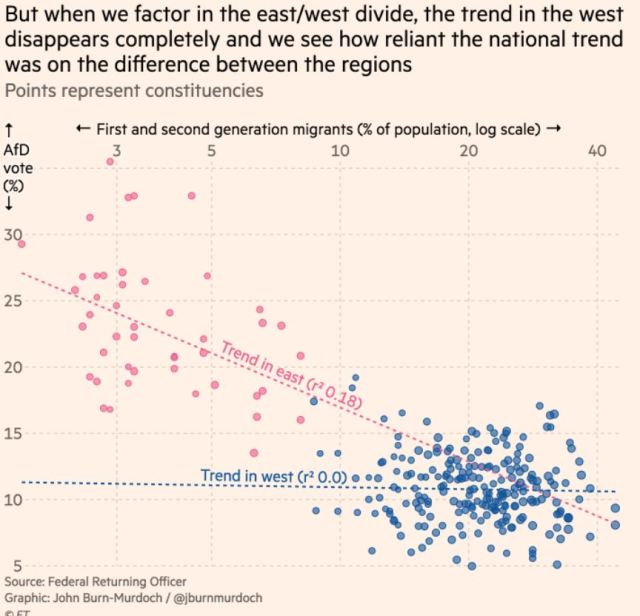
The perfect graph for every undergraduate statistics class, from Financial Times

Afd vote in Germany 2017

I object to usage of “trend” to indicate “relationship” (for me “trend” implies over time) but that is just a quibble.  Perfect illustration of importance of visualizing data.

PS. Doug Campbell reminded me of importance of a title for the graph, and suggested “Relationship between support for the German AfD party and the % of 1st and 2nd generation migrants.”

Posted in Development thinking, R statistics | Comments Off on The perfect graph for every undergraduate statistics class, from Financial Times

Interesting rhetoric from Rising Academies (part of the private school movement in developing countries), on the WDR2018 report

From Paul Skidmore of Rising Academies:

The report strikes a surprisingly cautious note on the potential contribution of private schools. Surprising in part because I had been reliably informed that the World Bank was secretly a vast conspiracy to push the privatization agenda of its paymasters in Big Edu(TM), but more because this seems to be one area where the Report seems to depart from what the evidence actually says. For example, the Report claims “there is no consistent evidence that private schools deliver better learning outcomes than public schools” and that such evidence as exists “may conflate the effects of private schools themselves with the effects of the type of students who enroll in private schools.” Far be it from me to question the authors’ interpretation of the literature (he says, preparing to do precisely that) but on the first claim it would seem that there is at least moderate evidence that private schools out-perform public schools, and that this performance advantage is mediated but not wholly eliminated when you control for observable student characteristics. But anyway, this minor quibble just goes to show that those of us who believe there is a complementary role for non-state school operators need to do a better job of building our evidence base. And the central claim of this part of the report – that “overseeing private schools may be no easier than providing quality schooling” – speaks to the fact that whether as a partner in initiatives like Partnership Schools for Liberia, or just as a regulator of private schools, we are talking about government as an enabling state, not a smaller state.

About the claim: “there is at least moderate evidence that private schools out-perform public schools.” I wish there had been more contextualization (all over the world? in developing countries? when private are for-profit? when private are parochial? are Islamic madrasas and Koranic schools also “private education”? do they out-perform public education? on all/most dimensions of learning?).  Why not just say, “In Liberia the private schools supported by Rising Academies seem to be performing as well as public schools, at similar costs to the government.”

On these general claims about private education, I sometimes also wonder whether the costs include the overhead costs and outside funding… or is it like Grameen, where the cost accounting sometimes excluded all the grants and implicit subsidies?  And the future costs of the private owners someday trying to cash in on their investment.  At FAVL for example when we report (as we do occasionally) costs of establishing and operating community libraries in Burkina Faso, we never include the opportunity cost of my own time, as volunteer director, and yet that could be important for scalability.  As others have pointed out, this is akin to the tongue-in-cheek Duflo-Banerjee problem… lots of the non-profits evaluated in Poor Economics are/were run by high-performing “friends of DB.”

Obviously it is just a blog post so I am not saying Skidmore should have a 200 page report instead with footnotes.

I have no particular dog in the private-public education race in developing countries.  Houndé, in Burkina Faso, has an pretty good government lycée and also a good private secondary school.  Burkina Faso has seen a huge growth in private post-secondary institutions that is responding to a demand for higher education, and delivering good quality. There is room for both.

Posted in Development thinking, Education effects | Comments Off on Interesting rhetoric from Rising Academies (part of the private school movement in developing countries), on the WDR2018 report

Should you read the 2018 World Development Report? Not if you care about libraries and reading books (fiction and picture books)

Public and school libraries and reading books (fiction and picture books) get not a single mention in the 200 page WDR report that proclaims it is “the first ever devoted entirely to education.”

The report is full of analysis of reading test scores, without a mention of a single book that an elementary school student might read. For the authors, kids need to learn to read so that they can read the instructions that come packaged with a new thermometer, not so they can read the best children’s books of their country in their language, and then the best of the world.  No mention of ANY library support programs.  Not even a mention of Worldreader!  C’mon education researchers… really?

Well, there is one small box on page 118 that gives a little shout-out to the Literacy Boost program of Save the Children: “Across Africa and Asia, the Literacy Boost program has implemented community reading activities to leverage the many hours that learners spend outside school. These include pairing struggling readers with stronger readers (“reading buddies”), implementing read-a-thons (in which all the books that children read during a specific period are recorded), and providing mini-libraries.”  The box basically repeats the summary of a NY Times article from 2012.  There is no follow-up.  In World Bank-ese, a small box means: “Marginally interesting and good for filler and to break the pace of our relentless analysis of reading test scores where we never ask the question that maybe kids don’t learn to read well because there is nothing interesting for them to read because we assume they should just wait for the thermometer instructions that will be very useful reading when they are sick with fever.”

Has The World Bank made no attempt in the last five or ten years to even try to learn a little bit about the impact of community and public libraries and how to effectively deliver a wide selection of picture books, pre-teen chapter books, young adult novels, and regular novels?  The answer seems to be: “No.”  Why not?  My guess is the researchers at the World Bank know that kind of research will not likely lead to any publications in prestigious economics journals.  Public and school library functioning is messy, costs are hard to measure, impact hard to evaluate, sample sizes are small. Not the kind of research that academic journals like.

Maybe I’m wrong. Maybe the education research community “knows” that reading books is entirely irrelevant to improving reading test scores, without ever studying the question.  As a reality check though, go ask any elementary school teacher in the U.S. or Europe whether they think that is likely to be true.  Ask them how much they think reading outcomes would change if books were removed from all classrooms, from school libraries, from public libraries, from garage sales, from home bookshelves, and from book stores (OK books could still be sold, but you would be required to travel 50 kilometers to get to the store- no delivery by mail- and the minimum price would be $50 per book).

So let’s hope for a revised WDR that takes seriously the issue of improving the quality of education, and so spends at least a chapter doing a cost-benefit analysis of a best(reasonable)-practice example that improves access to quality books for children and pre-teens and teens.  And if all the reasonable-practice examples (including simply distributing books) suggest low benefit-cost ratios (compared to other interventions), then let’s have some creative researchers work with communities to come up with better practices that can be evaluated.

We don’t test reading in order to declare that people are educated.  We help kids read in school… so that people can read.


Posted in Development thinking, Education effects, Reading | Comments Off on Should you read the 2018 World Development Report? Not if you care about libraries and reading books (fiction and picture books)

Economics of affordable housing in Bay Area

Santa Clara County Housing Authority finalized the purchase of a Palo Alto mobile home park in 2017.

In 2012, the owners of the park, the Jisser family, announced their intention to close and sell the 4.5-acre site to a private developer, a move that threatened to displace as many as 400 low-income residents. A years-long effort to preserve the park followed with the Jissers finally agreeing in May to accept a $40 million purchase offer from the Santa Clara County Housing Authority, the city of Palo Alto and Santa Clara County.

Source: Purchase of Palo Alto mobile home park finalized

So $40m for 400 units equals $100,000 per unit.  At current interest rates, insurance, normal property tax, etc. that implies about a rental change of about $1000 a month.  Some of the economics depends on the funding for ongoing repair and maintenance. Normally that would be the owner’s responsibility.  With the county as owner, we have a classic agency problem.  The implementing partner and the tenants have incentives to get as much maintenance and upgrades as they can if they are reimbursed on a cost-plus type contract.  But an experienced staff and good oversight should be able to keep those costs reasonable.  With that proviso, this seems like a reasonable cost-effective way to provide affordable housing. The county trades $40m in cash for $40m in property, and if rents cover basic maintenance costs and opportunity cost of earning interest on the $40m, there is no “cost” to the county.  The county is the owner of the property and so benefits from future property price appreciation.

But… the economist in me wonders about opportunity cost.  Suppose a private developer put in a mixed use complex that ultimately generated $4m a year of tax for the city or county.  That $4m then would be equivalent to what the city is “paying” for the affordable housing.  Now the county keeps $40m as cash (or in some other investment), receives tax equivalent to the benefit it is offering annually to the 400 families (so it could give the families a $12,000 a year housing voucher), and county residents and developers benefit from the value created by the development (whatever it is, housing for wealthier people, offices, bowling alleys).

Posted in San Jose, United States | Comments Off on Economics of affordable housing in Bay Area

Where to donate to for Puerto Rico? Center for a New Economy

An institution on the island I respect a lot is the Center for a New Economy, and right after the hurricane they set up a relief fund.

I think they will be very wise stewards of donated money. One can never be sure, but I think they have a good track record of caring a lot about economic development on the island and good public policy.

CNE has championed the cause of a more productive and stable Puerto Rico for over 20 years, as an independent, non-partisan think-tank with a reputable track record. As one of the most credible and influential voices on Puerto Rico’s economy, we are ready to tackle this new challenge. We’re here, on the ground, amidst the destruction, and so we know where the need is greatest and where your donations will achieve the most good.

Posted in Development thinking | Comments Off on Where to donate to for Puerto Rico? Center for a New Economy