Photography of David Pace: One Day in Bereba

Posted in Politics | Comments Off on Photography of David Pace: One Day in Bereba

International Education Statistics: A very depressing sentence

In Burkina Faso, men and women 25 years and older completed on average less than one year of schooling

via International Education Statistics.

Posted in Politics | Comments Off on International Education Statistics: A very depressing sentence

Reading Elechi Amadi

Before I went off to Puerto Rico for a too-short winter vacation, I randomly grabbed a couple of African novels at in my university library.  As usual my criteria was shorter novels.  No point investing a lot of time… so I look for books in the 150 page range.

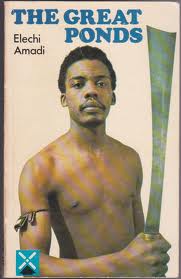
indexElechi Amadi had a few novels of the shelf, so I picked The Great Ponds and The Slave.  I had never heard of Amadi.

Amadi is a tremendous writer.  The two short novels are close to perfection, in my view.  The writing style is the kind I really like (Alan Garner, Beppe Fenoglio). Short, direct sentences.  Description is short and pertinent. Most of each novel is action and especially dialogue.  The first sentences suggest the rhythm.  For The Slave it is: “Olumati reached the main road and turned right.”  Olumati is the central character, and the novel, without giving too much away, is a study in how he returns to his natal village.  His return is complicated, for a whole set of reasons. Fate is at work, but he makes lots of choices.  You have little idea what the enigmatic title means, “the slave” until the very last sentence.  The characters (full disclosure: in both novels women are definitely second-order characters) are well-drawn: believable, complex, nuanced, ambiguous… they confront difficult choices and do not respond like cardboard cutouts.

The Great Ponds features a wonderful novelistic device that I also very much appreciate.  The book starts off as an insightful exploration of conflict between villages.  (All of the structural forces are there, as well as the personal dimensions.  Should be required reading for peacemakers!)  But then, halfway through the novel, attention shifts.  Something else is going on, far bigger than the inter-village struggle. Amadi let’s the reader slowly realize what is happening.  The last sentence then is practically shocking: this was true!

Both novels are set in pre-colonial Nigeria.  No British people in sight.  No Christianity.

I highly recommend. And if you don’t like one, hey, they are really short and fast reads, both.

Posted in Book and film reviews | Comments Off on Reading Elechi Amadi

Burkina Faso: Salif Diallo comes roaring back…

« Attendez qu’on crée notre parti et on va vous donner les grandes lignes de notre action. Que ce soit le président Comparoé ou les autres camarades qui sont restés là-bas, on était sur une plateforme politique, idéologique. J’estime qu’ils ne respectent pas la plateforme démocratique sur laquelle on a créé le CDP. Et pour moi, le Sénat devait se faire dans un cadre de régime parlementaire, comme un contre-pouvoir. Mais je n’ai jamais dit de construire un Sénat dans le régime présidentiel d’aujourd’hui. Pour quoi faire ? », s’interroge Salif Diallo qui a fait partie des premiers à quitter le parti au pouvoir.

via Burkina Faso: les dissidents du parti au pouvoir s’organisent contre le Sénat – Burkina Faso – RFI.

Posted in Politics | Comments Off on Burkina Faso: Salif Diallo comes roaring back…

Grosses démissions au CDP

This is pretty amazing news.  of course the pundits and ordinary population are already asking whether it isn’t some kind of complex ploy.  One way for President Compaoré to “enable” modification of the constitution is if the “opposition” agrees to modify.  So by artificially creating an opposition, the constitution might be modified legitimately.  of course, that’s is the Machiavellian interpretation.  The more likely possibility is the troika have been maneuvered out by the clan Compaoré and Assimi Kouanda, and they finally realized they are not getting back in.

En plus de Roch Marc Christian Kaboré, l’ancien édile de la capitale, Simon Compaoré ne fait plus partie des effectifs du CDP.  A ces deux s’ajoutent, « la bête politique » du Burkina, Salif Diallo. Si le CDP en souffrira, le chef de l’Etat ne le sera pas moins, car, Roch, Simon et Salif ont longtemps été les têtes pensantes de Blaise Compaoré. Les observateurs ne se seraient donc pas trompés.Le coup serait encore plus dur car, au trio démissionnaire, Sa majesté le Larlé Naba Tigré, député du CDP et l’un des porte-paroles les plus officiels de sa majesté le Moro Naba Baongo, pourrait suivre cette première vague.

via Grosses démissions au CDP « Alertes 24H/24 « Burkina24 – L’Actualité du Burkina 24h/24.

Posted in Politics | Comments Off on Grosses démissions au CDP

Wow things might get better…

The Senate confirmed Janet L. Yellen as the chairwoman of the Federal Reserve, marking the first time that a woman has led the country’s central bank in its 100-year history.  As a Fed official, Ms. Yellen, 67, has been an influential proponent of the Fed’s extraordinary measures to revive the economy, even though interest rates are already close to zero. But as chairwoman, Ms. Yellen’s arduous task will be to oversee the gradual unwinding of those extraordinary measures, despite an uncomfortably high unemployment rate of 7 percent and subdued inflation.

via Senate Confirms Yellen as Fed Chairwoman – NYTimes.com.

Posted in Politics | Comments Off on Wow things might get better…

So everything in my macro class about secular stagnation was… wrong?

The United States economy grew at a surprisingly robust 4.1 percent annual pace in the third quarter, the Commerce Department said Friday. That is the strongest growth in nearly two years and only the third time the economy has expanded that quickly since 2006.

via Revision Shows U.S. Growing at Fastest Rate Since 2011 – NYTimes.com.

Posted in Politics | Comments Off on So everything in my macro class about secular stagnation was… wrong?

Note to self: Useful for Microsoft Office Word how to put hat on a letter

Type this EQ \o(ˆ,p) Select what you just typed, press Ctrl+F9 to make a field out of it, and press Alt+F9 to switch between display of field codes and field results. You make the ˆ by pressing Alt+0136 (that is, press and hold the Alt key, and type the numbers 0136 from your numeric keypad, not the number
keys on the top row of your keyboard). Looks okay with a lower-case p, but not so good with an upper-case P.

If you need a hat over an upper-case P, then you can type Pˆ and then experiment with multiple Advance fields to move the hat to the left and above the P and then move the cursor back to a normal position after the hat. In 12-point Times New Roman, you might try P{ ADVANCE \l 5 \u 3 }ˆ{ ADVANCE \r 1 \d 3 }

If you often use this symbol, you can create an autotext or autocorrect entry for it.

via Putting a hat over a consonant – Microsoft Office Word.

Posted in Politics | Comments Off on Note to self: Useful for Microsoft Office Word how to put hat on a letter

Wow lots of reading from Africa!

Carmen McCain reviews Words Without Borders which features African women writing in indigenous languages:

Closest to home is Ibrahim Malumfashi’s translation of the first chapter of Nigerian author Rahma Abdul Majid’s massive Hausa novel Mace Mutum. This timely English translation comes close on the heels of the “child marriage” debate in Nigeria. [I’ve previously reviewed Balaraba Ramat Yakubu’s novel Wa Zai Auri Jahila, which also deals with the theme of young marriage.] In the opening of the novel, which is set in a rural village, an eight year old girl Godiya narrates, “My father, a farmer, has three wives. The only difference between our compound and others is that our household is not a kid factory; my father has only three children, while most of his compatriots boast a complete Barcelona team against Real Madrid, excluding the reserve.” Godiya tells her sister Lami’s story in this opening chapter, a girl who at fourteen is considered by gossips to be “old goods” until her father bestows her on a “haggard old” itinerant Qur’anic teacher. By the end of the chapter Godiya is nine and has seen girls die in childbirth and aunties divorced for being late with the cooking. What will she do when she hears her parents talking about marrying her off as well?

via Words Without Borders features African Women writing in Indigenous Languages | A Tunanina….

Posted in Reading | 1 Comment

More music from Congo…

Posted in Politics | Comments Off on More music from Congo…

No best intentions go unpunished: South Sudan falls apart?

The security situation in Juba is very tense. There is open fighting throughout the entire city, with occasional heavy fighting flaring up in certain areas. The house of the sacked ex-VP, Riek Machar, was assaulted with heavy artillery for several hours in mid morning of the 17th of December: no figures of casualties but all inside presumed dead. There is a 6pm to 6am official curfew, but most people are staying home at all times. There are also unconfirmed reports of civilians being armed, as well as of government forces warning civilians not to accept arms.

via South Sudan – #JubaCrisis sitrep | AID LEAP.

Posted in Politics | Comments Off on No best intentions go unpunished: South Sudan falls apart?

Lionel Shriver “Kilifi Creek” in The New Yorker

I frankly had no idea who Lionel Shriver is, so I read the story completely cold. I quite enjoyed it. The theme, of the way we become aware of our adult selves emerging, and awareness of our life-projects emerging, is a bit heavy-handed. But the characters are very nicely drawn, as is the slightly skewed understanding they have (the two Kenyan hosts and their young risk-taker), and I liked how as a “middle” woman, she still has a hard time “reading” her friend. Indeed, the causal chain is almost too direct: she isn’t sure quite how to read him, so she tries to send a non-verbal signal – both to him and to herself (she does it because this is the kid of person she thinks she is) – and the result is… well you have to read the story.  Over at Mookse, plenty of Shriver-haters (I guess she wrote We Need to Talk About Kevin), and some great analysis of the story.

Posted in Politics | Comments Off on Lionel Shriver “Kilifi Creek” in The New Yorker

ICC Prosecutor Criticizes UN Over Sudan Inaction

The prosecutor of the International Criminal Court is accusing the U.N. Security Council of prolonging the conflict in Darfur by failing to take action to arrest Sudan\’s President Omar al-Bashir and others accused of war crimes.Fatou Bensouda said the council\’s inaction and paralysis in the face of increasing violence against civilians has emboldened al-Bashir to ignore council resolutions and left victims with no hope for justice.

via ICC Prosecutor Criticizes UN Over Sudan Inaction – NYTimes.com.

Posted in Politics | Comments Off on ICC Prosecutor Criticizes UN Over Sudan Inaction

Continuing irony versus sarcasm exploration

Irony:

Famously, when opening his club, The Establishment, in Soho in 1961, Cook remarked that he was modelling it on ‘those wonderful Berlin cabarets which did so much to stop the rise of Hitler and prevent the outbreak of the Second World War’.

Sarcasm:

[Eggers] is so passionate, and his passion has such rhetorical momentum, that it is almost possible to overlook the fact that the literal proposition he’s putting forward, in the name of large-heartedness and honesty, is bogus and insulting. Do not dismiss … a movie? Unless you have made one? Any movie? The Internship? The Lone Ranger? Kirk Cameron’s Unstoppable? Movie criticism, Eggers is saying, should be reserved for those wise and discerning souls who have access to a few tens of millions of dollars of entertainment-industry capital. One or two hundred million, if you wish to have an opinion about the works of Michael Bay.

via Dave Eggers, Tom Scocca, and Why It’s Not Awful to Be Nice : The New Yorker.

Posted in Politics | 2 Comments

Peer evaluation in small group work in a flipped classroom

When an instructor uses class time for student work, rather than lectures, very often the active learning is structured around activities that can be done in small groups (from 2-5 persons).  There are a number of good reasons to do small group work as opposed to individual work.  (Another possibility is to structure individual work in the form of competitions, where using clickers can be very useful.)

The members of small groups have to be motivated, and one technique for ensuring motivation is to use low-stakes peer evaluation.  This can become a logistics nightmare for the instructor.  Imagine in a semester 15 small group activities, in a class of 40 students.  Each class will generate 40 students writing peer evaluations of three other students, if they are in groups of four.  This is 120 scores to enter, in a complex way (the scores are organized by pair rather than just one name).  Also, the groups have to be assigned, class time is taken up with students re-grouping into their groups, and contingencies (what if people are absent and a student is left solo?) have to be dealt with.  I believe strongly in random assignments each session for the group work.  Students then get to meet most of the other students in the class, and are not stuck in a bad group for a whole semester, which can be very demoralizing.

Fortunately, there are some online free tools available to make things run smoothly.  They demand a little bit of investment, but will pay off nicely.  Students generally love small group activities, and they understand how low-stakes peer evaluation keeps people focused (on the work and not on their smartphones).

One of the best online tools for managing peer evaluation appears to be TEAMMATES, a resource developed at the National University of Singapore, and distributed online as an open-source tool available to everyone.  Here is there introductory video:

Another similar peer evaluation tool is PEAR from the University of Guelph.  Here is their introductory video:

There are many peer assessment tools that measure more complex aspects of group participation.  Here is a nice one with a business school orientation.  Here is another document with numerous good examples of peer assessment tools.

A number of sources post excellent resources for thinking about best practices in peer evaluation processes.  A resource from the Foundation Coalition gives a clear overview with many pertinent examples.

Posted in Politics | Comments Off on Peer evaluation in small group work in a flipped classroom

Flipping the classroom

All the rage these days is the idea of “flipping” the classroom.  The idea is simple.  Technology has made it very easy to record and distribute (through Youtube etc.) anything that a teacher might do in a lecture.  A lecture is just talking and writing.  Very easy to record that, whether in the classroom or on a tablet.  Students can then see that part of the lecture online, at any time.  In class time, then, there can be more attention to “doing” or active learning, rather than sitting and watching.

Flipping isn’t for every teacher, nor for every subject matter, nor for every moment of the class.  Listening and watching a live human may be valuable .  There are many things that happen in the classroom in a lecture (being mesmerized, having eye contact made, seeing the instructor respond to a raised eyebrow, a stifled yawn… seeing instructors make mistakes…) that can’t be duplicated when seeing a recording online.

But many parts of many classes involve an instructor going through a set of steps (constructing a graph, solving a problem, listed a set of factors) to arrive at a conclusion.  Many times this part of a lecture is completely standard.  Every instructor in the country is doing the same thing (supply and demand diagram, for instance).  The textbook does it. Hundreds of existing online resources do it.  In these cases, very little is gained from “doing it” one more time, live.  There is little room for feedback to change the manner in which the idea is presented.  Instead, probably a better way to encourage student learning is to have THEM do it, at least once, by doing it in the classroom.

Posted in Politics | 2 Comments

Blaise Compaoré very articulate on RFI…

He’s articulate in an unassuming way… in this extract the reporters unfortunately do not ask the right questions.  For example, for a semi-authoritarian democracy, you have to ask the question: “Is the lack of alternance not likely to lead to political instability, and shouldn’t you as president be planning to step down after 27 years, as many of your colleagues have done in other West African countries?”  You have to be firm in getting a reply.  You should be asking about transparency, and should those in the presidential circle not be obliged to be more forthcoming in their affairs?

Blaise Compaoré, président du Burkina Faso, était l’invité de l’émission Internationales ce dimanche 8 décembre sur RFI. Interrogé sur sa succession, alors qu’il est au pouvoir depuis 1987, le chef de l’Etat burkinabè n’a pas écarté de se représenter pour un nouveau mandat, malgré la Constitution qui le lui interdit actuellement.

via Burkina Faso: Blaise Compaoré n’écarte pas la possibilité d’un cinquième mandat – Burkina Faso – RFI.

Posted in Economy, Politics | Comments Off on Blaise Compaoré very articulate on RFI…

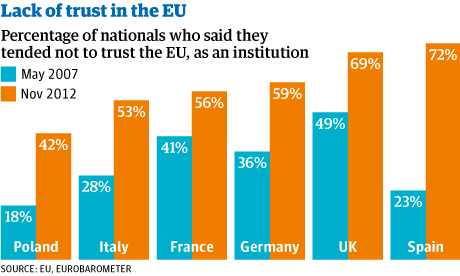
Deep decline in trust in EU as an institution in Europe’s big countries

Figures from Eurobarometer, the EU’s polling organisation, analysed by the European Council on Foreign Relations (ECFR), a thinktank, show a vertiginous decline in trust in the EU in countries such as Spain, Germany and Italy that are historically very pro-European.

The six countries surveyed – Germany, France, Britain, Italy, Spain, and Poland – are the EU’s biggest, jointly making up more than two out of three EU citizens or around 350 million of the EU’s 500 million population.

“The damage is so deep that it does not matter whether you come from a creditor, debtor country, euro would-be member or the UK: everybody is worse off,” said José Ignacio Torreblanca, head of the ECFR\’s Madrid office. “Citizens now think that their national democracy is being subverted by the way the euro crisis is conducted.”

via Crisis for Europe as trust hits record low | World news | The Guardian.

Posted in Politics | Comments Off on Deep decline in trust in EU as an institution in Europe’s big countries

What does stagnation look like?

From FRED, a graph of four big, rich countries.  Notice how Japan and Italy utterly stagnated starting in the early 1990s.  By 2012 GDP was only about 10% higher after twenty years!  By contrast, GDP per capita in the U.S. rose by about 50% over the same time period, and GDP per capita rose by more than 100% in Korea.

realgdppercapita

The big question now is whether the U.S. on the cusp of 2014 is entering a Japitaly twenty-year slow growth period.  And the two of the usual suspects of slow growth in those two countries are present in the U.S.: (1) an aging population, and (2) fiscal and monetary dysfunction (despite the goodwill of Yellen and Bernanke, why would anyone think the Fed will not be “captured” by the big financial institutions it works hand in glove with, and whose personnel rotates in and out of the Fed?… oh right, “this is America and we don’t do that…”).  Unlike Japitaly, though, the U.S. has very flexible labor, stakeholders, managers, entrepreneurs… so lots of room for the creative destruction that might be associated with innovation.


Posted in Politics | Comments Off on What does stagnation look like?

Eboulement d’une mine d’or à Bagassi au Burkina Faso

Quatorze morts et quatorze blessés dont un dans un état traumatique, tel est le bilan de l’éboulement d’un site minier survenu dans la nuit du samedi 30 novembre au dimanche 1er décembre 2013, aux environs de 1 heure du matin, dans le département de Bagassi, province des Balé. Selon le préfet dudit département, Tingandé Néhémie Zoundi, ce drame est consécutif à une explosion de dynamite dans un trou d’une profondeur de 70 à 80 mètres, provoquant quelque temps après, la chute d’une roche située à deux mètres du fond. A l’entendre, toutes les victimes étaient dans le trou, d’où le nombre élevé de pertes en vie humaine. Mobilisés, les orpailleurs ont pu extraire les blessés et les corps qui ont été inhumés sur place.

via Eboulement d’une mine d’or à Bagassi : 14 morts, autant de blessés – leFaso.net, l’actualité au Burkina Faso.

Posted in Politics | Comments Off on Eboulement d’une mine d’or à Bagassi au Burkina Faso