Ted Chiang’s “Liking What You See: A Documentary”  Perfect speculative fiction for a philosophy class!

I could not agree more with Tinkoo Valia’s very positive appreciation.  Great speculative fiction (in the form of a non-fiction reportage).

Ted Chiang’s “Liking What You See: A Documentary” (novella, thought experiment): What if we could switch off perception of beauty of a human face? …  Among the best of Chiang; perhaps of the genre too. And with a bit of philosophical bend.  There is a certain amount of notoriety associated with this story. It was withdrawn from Hugo nominations on author’s request because he didn’t think it was good enough.

Posted in Book and film reviews | Comments Off on Ted Chiang’s “Liking What You See: A Documentary”  Perfect speculative fiction for a philosophy class!

If you like anime, see Your Name while still in theaters

I went with my daughter to see Your Name a couple weeks ago, and we both liked it.  Somewhat flawed, and not close to Miyazaki-quality, but still plenty good.

Posted in Book and film reviews | Comments Off on If you like anime, see Your Name while still in theaters

Leisure reading from 2016 that I forgot to write about

Golden Sun and Gold Rising by Pierce Brown.  Leslie picked these up at the library.  Brown has mastered the genre.  Excellent writing and especially dialogue.  Lots of intriguing ideas.  The whole thing has been carefully “lifted” from the best of other books in the genre.  And then, after several hundred pages, the dawn comes, and you realize, that this genre can get pretty boring.  Even a masterful effort remains bound by the constraints.  Calling Alan Moore, Alan Moore please come to table 9….

Kingkiller Chronicles.  My brother-in-law recommended The Name of the Wind many years ago, and I read it and enjoyed it.  When Elliot read it a few weeks ago, he of course learned there is a sequel (and the final installment of the trilogy is expected… 2020?) Patrick Rothfuss, the author, apparently is something of a fantasy superstar.  Anyway, I am not averse to a good fantasy novel even if it is 1000 pages.  The second book The Wise Man’s Fear was pretty good. Somewhat formulaic.  Fickle, prideful, fairies?  But enjoyable.  A short novella, The Slow Regard of Silent Things, was terrible.

Francis Hardinge. Cuckoo’s Song.  Well, I guess this quasi-horror story might appeal to some.  Not to me.  Also read The Lost Conspiracy.  Fairly juvenile fantasy.


Posted in Book and film reviews | Comments Off on Leisure reading from 2016 that I forgot to write about

Light science fiction reading

Over the last few weeks I’ve been reading short stories and novellas collected in the annual anthology by Gardner Dozois (for 2013 and 1995).  Here’s a few recommendations:

2013

  • Indraparamit Das, “Weep for a Day” A really nice “classical” tale of a child slowly coming of age as her society explores/conquers the wild and those who live there.
  • Paul McAuley, “The Man” Bittersweet tale of our common yearning for connection, somehow.  I did not like, however, his other story in the collection, “Macy Minnot’s…’
  • Megan Lindholm, “Old Paint” A sort of sweet tale, again about coming of age.  I did not know she was author of one of my sons favorite fantasy books, Assassin’s Apprentice.
  • Eleanor Arnason, “Holmes Sherlock” A good description  like Le Guin of a matriarchal world, but the story ultimately not that compelling.  (I see now that Wikipedia also makes the Le Guin comparison.)
  • Robert Reed, “Katabasis” Actually my favorite story in the collection.  About dealing with the past.  A nice review with spoilers is here.  But his story in the 1995 volume, “A Place with Shade” was underwhelming.

1995

  • Ursula K. Le Guin.  Her two stories, “A Woman’s Liberation” and “Coming of Age in Karhide” were both quite enjoyable.
  • Maureen McHugh, “The Lincoln Train” is a nice alt-history, quite short and to-the-point.
  • Geoff Ryman, “Home” strikes a nerve I am sure for people over a certain age as the younger generation casts you aside.
  • Paul McAuley, “Recording Angel” Very interesting even though I could barely figure it out!  The link has an afterword that is worth reading.  Notice his story in 2013 was also one of my favorites.
Posted in Book and film reviews | Comments Off on Light science fiction reading

Nice reporting from 2016 on koglweogo, the informal militias popping up in Burkina Faso

Posted in Burkina Faso | Comments Off on Nice reporting from 2016 on koglweogo, the informal militias popping up in Burkina Faso

Are you joking here New York Times? So what if it is James Heckman… the sample size is 37!

When the boys reached age 30, they earned an average of $19,800 more a year than those in the control group and had half a year more education. (The small sample size — 37 boys in the programs who stayed in the study — means the difference was not very precisely estimated.) When the girls reached 30, they had two more years of education and earned about $2,500 more, the study found.

OK this is probably a worthwhile and well-done study of the small sample.  And as the truism in economics says, “the smaller the sample the harder the methods.”  But writing an article as if this had really convinced someone of the second-generation effects of childcare?  And just based on this paragraph, why not tout a different result, “Heckman finds education useless for raising earnings of women!”

Posted in Education effects, United States | Comments Off on Are you joking here New York Times? So what if it is James Heckman… the sample size is 37!

Trump’s “America First” rhetoric? William Wyler had it pegged back in 1946.

Posted in United States | Comments Off on Trump’s “America First” rhetoric? William Wyler had it pegged back in 1946.

For everyone who served on a committee that had to write a report

Bottom line? I express as gender female at the university.

Gender Differences in Accepting and Receiving Requests for Tasks with Low Promotability Linda Babcock, Maria P. Recalde, Lise Vesterlund and Laurie Weingart

Gender differences in task allocations may sustain vertical gender segregation in labor markets. We examine the allocation of a task that everyone prefers be completed by someone else (writing a report, serving on a committee, etc.) and find evidence that women, more than men, volunteer, are asked to volunteer, and accept requests to volunteer for such tasks. Beliefs that women, more than men, say yes to tasks with low promotability appear as an important driver of these differences. If women hold tasks that are less promotable than those held by men, then women will progress more slowly in organizations.

Source: [AEA] eTOC for American Economic Review Vol. 107, Issue 3 — March 2017 – mkevane@scu.edu – Santa Clara University Mail

Posted in Gender | Comments Off on For everyone who served on a committee that had to write a report

Maybe you studied abroad in Spain? Then you should watch El fin de ETA!

Posted in Book and film reviews, Development thinking | Comments Off on Maybe you studied abroad in Spain? Then you should watch El fin de ETA!

Economic justice and basic income

Last week at our student economics discussion group we had a nice exchange about  universal basic income.  I suggested that wouldn’t everyone (right, left, libertarian and socialist) agree that in a wealthy society few would object to a program of minimum income?  So nobody would end up living under a bridge through a series of unfortunate events; rather everyone could afford reasonable accommodation (maybe not on the Sausalito waterfront, but certainly in Stockton), access to communication (clearly Internet access is essential in our society for fostering a community and engaging in commerce), and basics of living (Adam Smith’s linen shirt).

My colleague Bill Sundstrom has a nice podcast covering some of the basics of economic justice and how they lead to a basic social safety net.  The Catholic Council of Bishops has a statement about economic justice.  Some libertarians favor a basic income guarantee.

And Tyler Cowen over at Marginal Revolution has had numerous blog posts on this topic.  Here is a good post, focusing on the practicalities and (in his view) likely inevitable evolution of the simple concept into a complex, rent-seeking-riddled government bureaucracy!

Back of the envelope calculation?  Let’s say the guarantee was $10,000 per person in the U.S. per year.  Let’s say it only applies to adults.  250 million adults means transfers of $2.5 trillion per year.  U.S. GDP is about $17 trillion.  So this is less than 10% of GDP.  And remember, for maybe 70% of the adults the tax and transfer just wash out (if you are a working adult paying $30K in taxes, you get a $10K transfer, so on net you are paying $20K taxes the same as you might be paying now.)  So this is certainly feasible or possible.  Now if the basic income were $30,000 per adult, then we are talking about possibly very distortionary taxes to raise that much revenue.  Incentives matter!

Any economist of course right away puts on their “one hand, other hand” hat… in regions of the country where the cost of living is extraordinarily low (houses for $25,000, nothing to do on Saturday night) should not the transfer reflect that?  Might not a geographically uniform transfer generate a lot of unanticipated migration across states and cities?  And we’re off!

Posted in Development thinking, United States | Comments Off on Economic justice and basic income

Gregory Mankiw, tax reform, and the carbon tax

Republicans are proposing and are excited about the possibilities for a huge overhaul of the U.S. tax system.  Here is Mankiw, probably the most prominent and well-respected Republican economist in the US, in January:

Consider the following tax reform:

1. Impose a retail sales tax on consumer goods and services, both domestic and imported.
2. Use some of the proceeds from the tax to repeal the corporate income tax.
3. Use the rest of the proceeds from the tax to significantly cut the payroll tax.

Before moving on, ask yourself: Do you like this plan?  As I understand it, this plan is, in effect, what the Republicans in Congress are proposing.

Here is Mankiw on a carbon tax:

First, the federal government would impose a gradually increasing tax on carbon dioxide emissions. It might begin at $40 per ton and increase steadily. This tax would send a powerful signal to businesses and consumers to reduce their carbon footprints.

Second, the proceeds would be returned to the American people on an equal basis via quarterly dividend checks. With a carbon tax of $40 per ton, a family of four would receive about $2,000 in the first year. As the tax rate rose over time to further reduce emissions, so would the dividend payments.

Third, American companies exporting to countries without comparable carbon pricing would receive rebates on the carbon taxes they’ve paid on those products, while imports from such countries would face fees on the carbon content of their products. This would protect American competitiveness and punish free-riding by other nations, encouraging them to adopt their own carbon pricing.

Finally, regulations made unnecessary by the carbon tax would be eliminated, including an outright repeal of the Clean Power Plan.

Here are links to news stories from Science and the Washington Post.  Older commentary (from pre-Trump era, 2009!) is here.  Economic Rockstar Podcast with Mankiw is here.

I hope we do have a debate on these big picture issues and good legislation gets passed.  Don’t we all?  But I guess I am pretty pessimistic that Republicans, despite their  majorities, are not going to be (extremely?) influenced by the carbon emitters lobby.

P.S.  Sundstrom adds:  …the loosening of other regulations “made unnecessary” needs to be done judiciously, for a variety of reasons. For one thing, pollution pricing is problematic when there are large local effects. This turns out to have been true for SO2, it appears… http://billsundstrom.blogspot.com/2015/07/was-cap-and-trade-for-so2-actually.html   …  A carbon-tax-plus-revenue-neutral-rebate proposal not unlike Mankiw’s was actually on the ballot in Washington state this past fall, and failed. It was championed by Yoram Bauman, known as the stand-up economist (he is a professional economist-comedian, and a friend of Shin’s). The story is fascinating and, to me, a little depressing.  http://www.vox.com/2016/10/18/13012394/i-732-carbon-tax-washington 

Posted in United States | Comments Off on Gregory Mankiw, tax reform, and the carbon tax

I guess Trump team is consistent about one thing: They really would rather have coal than advanced 21st century batteries

James J. Greenberger, the executive director of NAATBatt International, a trade group for the advanced battery industry, said ARPA-E had been of enormous benefit to the industry. “We’re absolutely stunned by it,” Mr. Greenberger said of the agency’s potential elimination, which he announced to industry leaders gathered at his group’s annual conference in Arizona. “I don’t know what’s going through the administration’s head. It’s almost surreal.”

Full story from The New York Times is here.

Posted in United States | Comments Off on I guess Trump team is consistent about one thing: They really would rather have coal than advanced 21st century batteries

Great trenchant essay on reading from Hisham Matar

Nothing we read can import new or foreign feelings that we don’t, in one form or another, already possess. “Every reader,” as Marcel Proust writes in “Time Regained,” “is actually the reader of himself.” Books can’t install unknown feelings or passions into us. What they can do is develop our emotional, psychological and intellectual life, and, by doing so, show us how and to what extent we are connected. This is why literature is the greatest argument for the universalist instinct, and this is why literature is intransigent about its liberty. It refuses to be enrolled, regardless of how noble or urgent the project. It cannot be governed or dictated to. It is by instinct interested in conflicting empathies, in men and women who are running into their own hearts, in doubt and contradictions. Which is why, without even intending to, and like a moon to the night, it disrupts the totalitarian narrative. What it reveals about our human nature is central to the conversation today.

Read the full essay here.

Posted in Reading | Comments Off on Great trenchant essay on reading from Hisham Matar

Can students record me in class?

Turns out in many states there is only a “single party consent” needed to record a conversation, and so students could record me in class.  They are limited in what they can do, since the cannot “sell” my intellectual property. But certainly they could make fun of my mistakes, tics, physical attributes.  But you know, they could do that anyway, with a crude drawing and verbal description.

In California, one of a dozen states (it seems) where “two party consent” is required,  the students cannot legally record me without consent.   And of course they cannot then use the recording for any purpose if I have not consented.

Some schools simply make it a policy (as part of the student code of conduct) to prohibit recording, regardless of legality.  Here is the policy of Georgetown Law School.   I wonder if such policies would be enforceable?  Courts might say the university cannot circumscribe a legal right.

The ethics here are interesting.  As an academic, aren’t I committed to sharing of knowledge and open discourse?  Why would I have a default position to not let students record me sharing knowledge?

In practice, my classes are recorded and available to students, so possibly that is an implicit consent on my part, so if I do something stupid that goes viral, tough luck for me.  At this point in the Internet’s short history, it clear that the effects for a relatively anonymous person of going viral are probably short-lived.  Does anyone remember the professor who threw the cell phone against the wall?  Does anyone know the identity of the policeman who manhandled the student who refused to leave?  Sure it is embarrassing.  But you will go back to being anonymous relatively soon.  And in my Economics classes, will I really go viral because I mixed up the IS curve with the LM curve (not happened yet, but who knows)?

But what if my subject matter were white privilege? Or understanding masculinity?   These are hot-button topics where haters abound.  Easy for dry academic discussion to be misinterpreted and go viral.  Even easier for a charismatic, opinionated, pugnacious classroom performance to go viral.  Why would I enable that?

Anyway, these debates are tied into issues of the meaning of academic freedom, and a good place to start on that is this excellent review of the work of Stanley Fish.

Posted in Being a teacher, Santa Clara University, United States | Comments Off on Can students record me in class?

Awe-inspiring study from Ancestry.com

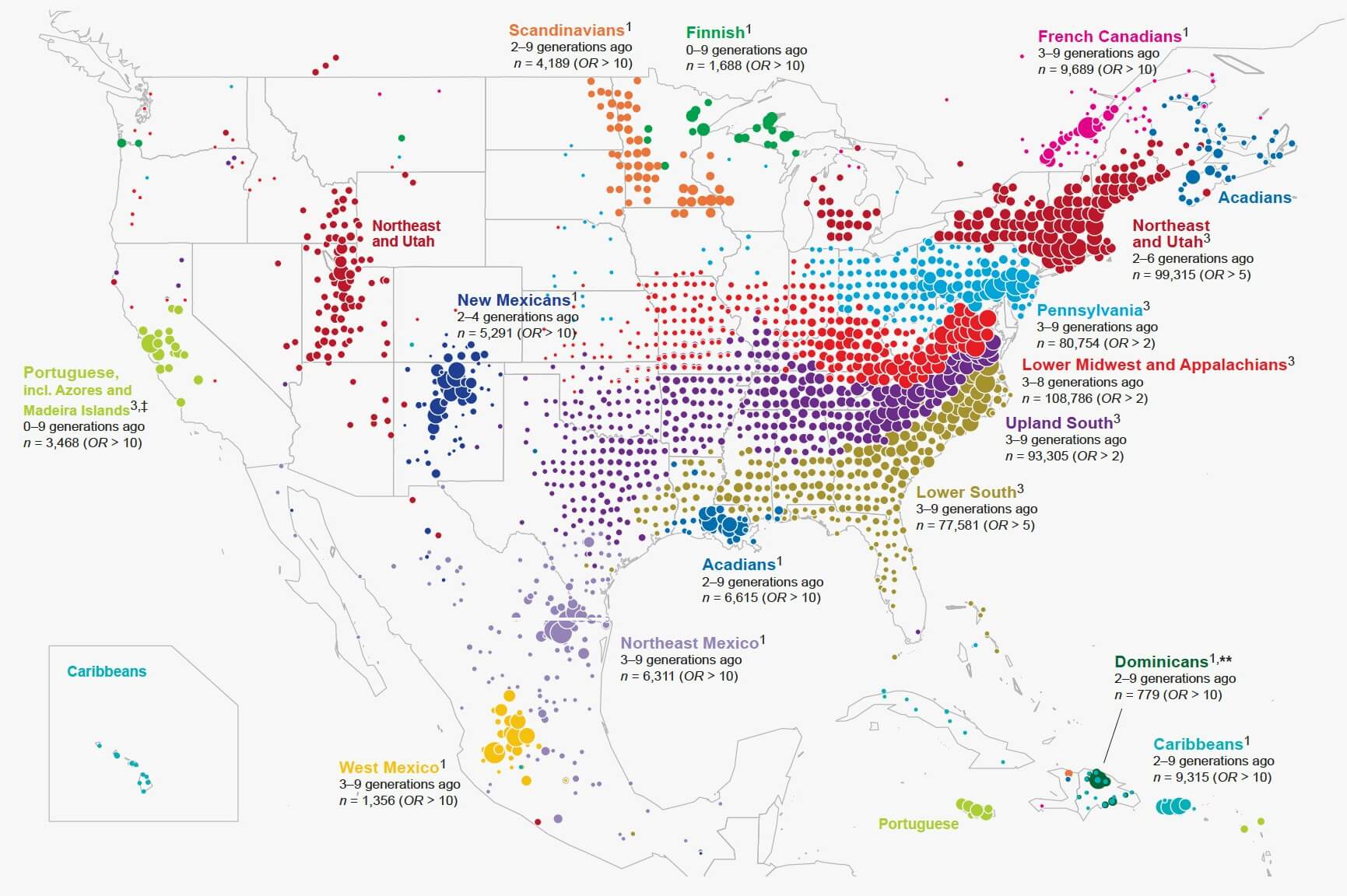
People moved east to west, less so north to south. See how the differently colored clusters form distinct horizontal bands? The red, blue, purple, and green dots fan out from right to left. This pattern means DNA confirms the descendants of immigrants to the East Coast moved westward.While people certainly moved back and forth from the north to south as well, if people had moved in the same volume from north to south, you’d see the bands fanning downward and not just from east to west.But instead you can see powerful forces pushed people westward, even showing that the Mason-Dixon line separates some of the clusters.  Catherine Ball, chief scientific officer at Ancestry and the leader of the study, commented to Wired: “I have to admit I was surprised by that. This political boundary had the same effect as what you’d expect from a huge desert or mountain range.”

Source: What 770,000 Tubes of Saliva Reveal About America – Ancestry Blog

Posted in United States | Comments Off on Awe-inspiring study from Ancestry.com

Leading a non-profit that supports village libraries is a lot of work!

I like to share parts of my life with you, readers, but mostly I write to share stuff with my future self.  As you may know, I started back in 2001 and continue to direct a small non-profit Friends of African Village Libraries.  FAVL currently supports 34 libraries in Burkina Faso (though three have been closed for many months now because of issues with the mayor’s offices, and we are struggling to have them re-opened).  Our director in Burkina Faso is Sanou Dounko, an amazing country director who started as a village librarian.  We also support three libraries 3 in Ghana (under the able management of Paul Ayutoliya), and the Kitengesa Community Library in Uganda (shout-out to our dear colleague Kate Parry to whom we wish a full recovery) as well as the Uganda Community Library Association.

Anyway, work for me guiding our Burkina Faso and Ghana programs was piling up, so I had to take a day off from the university and get things right.

  • Had to take a difficult decision and not renew contract of one of our program officers.  That meant many emails with our staff and partners at Catholic Relief Services in Burkina Faso.  We are looking forward to working with them to recruit an excellent replacement.
  • Finished a draft and did corrections to our monthly “local” newsletter for librarians and partners in Burkina, Echos des Bibliothèques.  Started a draft for the March edition.
  • Authorized Paul in Ghana to buy a new motorcycle.  How could I not after he went to the market, took pictures of all the motorcycles available, sent me price list and key features?
  • DLG and MK boxes booksWorked with Deb Garvey, FAVL treasurer, to get another box of books sent to Burkina Faso.  Over the past couple months, Deb and I have shipped eight boxes of books (a couple to Ghana – great books donated by network of friends of Sue Frey, and some extremely high quality French books coming from the Peninsula French international School parents and librarian).  Of course, when these books arrive, in the Ghana case, the customs agent at the post office wanted payment of about $200!  So that involved letters, mobilization of some key community members… got the payment down to $5 to release the books.  In Burkina , by contrast, we have never been hassled by customs agents.
  • Some friends of FAVL in Ouagadougou, the capital of Burkina, approached us to organize a reading camp in a local school.  We decided this might be a good opportunity for training reinforcement for the staff, so we have agreed, and I spent an hour working with Dounko to develop a plan for having a good number of staff participate in the reading camp, and learn new “animation” techniques.
  • Worked with FAVL intern yesterday (the great Maria Khouri-Haddad), to bring Burkina accounts up to date, and continued that today.  Accounting is very time-consuming, but absolutely necessary.  We pretty much put every transaction into our Quickbooks software… 13 years of expenses!
  • Maria also helped us develop some Algerian short stories for reproduction for use in library reading clubs, along with promotional posters.  So I finalized those today and sent off to Burkina.
  • We have eight staff in Burkina, and they all report regularly to Dounko and copy me.  I try to read their daily reports and occasional longer reports, and send back feedback and encouragement.  That is the part of the job I love!  They all come from very humble roots… first generation to get educated, first generation to have “office” jobs, first time to be using computers, first time to write a report, first tie to offer “constructive criticism”… watching their skills evolve over the years is fascinating.  I like to say that they can all skin and gut a pig, or boil, pluck and prepare a chicken… or grind corn into cornmeal, or ferment mash and make homemade beer, or walk into a forest and make a chair… and now they are sitting in front of Microsoft Publisher.
Posted in Burkina Faso | Comments Off on Leading a non-profit that supports village libraries is a lot of work!

Growing incidents and threats of jihadist violence in northern Burkina Faso

FAVL-supported  libraries in several provinces in northern Burkina Faso have had to close as the security situation has deteriorated.

À cet effet, dans les provinces martyres de Soum et de l’Oudalan, la mesure semble quelque peu radicale : « La circulation est interdite aux motos, tricycles, véhicules et charrettes de 17h à 6h du matin sur la bande de la frontière (Markoye-Oursi, Tin Akoff-Nassoumbou, Koutoubou-Baraboulé). » Au-delà de la simple menace terroriste, plusieurs attentats ont été commis de part et d’autre de la frontière malienne. Par ailleurs, les enseignants de cette région survoltée ont également décidé de déserter les lieux. À en croire une source bien introduite : « Beaucoup d’enseignants ont déjà fait leurs valises. » Avant d’ajouter, avec ce constat tout aussi triste : « A Foubé, un village qui relève de la province du Sanmatenga, et à quelques kilomètres de Djibo, c’est la même chose : Salles de classe fermées et départ des enseignants. » La psychose est donc généralisée, et personne ne voudrait tomber aux mains de ces jihadistes. Surtout que ces hommes sans foi ni loi ont déjà menacé ces dispensateurs de savoir de changer leur programme pour le remplacer par des cours arabes. Même si un directeur d’école a été abattu, vendredi dernier, à Kourfael, ses autres collègues tentent de dissuader les fuyards. Mais jusque-là, rien n’y fit, car plusieurs préfèrent d’ores et déjà se mettre à couvert et éviter tout risque. « Avec ses terroristes, l’on ne sait jamais d’où peut surgir le danger », se justifient-ils. C’est à juste titre que le président Kaboré a nommé un nouveau ministre de la Défense pour combattre les terroristes. D’aucuns espèrent donc que les efforts du gouvernement vont déboucher sur une sécurisation entière des personnes et des biens.

Source: Burkina Faso : Face à la menace terroriste, des écoles fermées au nord

Posted in Burkina Faso | Comments Off on Growing incidents and threats of jihadist violence in northern Burkina Faso

Noujain Mustaffa is the right drop of bittersweet sunshine for a cloudy day

Posted in United States | Comments Off on Noujain Mustaffa is the right drop of bittersweet sunshine for a cloudy day

If you want to know what racially motivated terrorism looks like in the United States

The episode occurred in the summer of 2015, when Ms. Norton, Mr. Torres and other members of a group called Respect the Flag drove around Paulding and another county, flying the Confederate flag, pointing guns at black residents and threatening to kill them.

From the New York Times.

Posted in Burkina Faso | Comments Off on If you want to know what racially motivated terrorism looks like in the United States

First Amendment Experts React to White House Press Briefing Ban, from Just Security

The actions on Friday restricting certain news organizations from a briefing by the White House Press Secretary raise significant concerns. The D.C. Circuit almost forty years ago held in no uncertain terms that access to White House press facilities cannot be arbitrarily denied to credentialed reporters. Courts routinely have held that government press briefings are the type of public forum to which press access may never be restricted based on objections to the content of a journalist’s reporting. The Supreme Court itself has made clear that, above all else, the First Amendment means that government has no power to restrict expression because of its message, its ideas, its subject matter, or its content. Friday’s actions appear to be a highly dangerous and improper effort to do just that.

Source: 9 Top First Amendment Experts React to White House Press Briefing Ban on CNN, NYT, others | Just Security

Posted in Burkina Faso | Comments Off on First Amendment Experts React to White House Press Briefing Ban, from Just Security