Helping farmers to grow new crops for export in Kenya: Lessons from failure?

For my African Economic Development class we are reading a paper that uses the randomized control trial methodology to evaluate a program to encourage farmers to produce crops for export.  The presumption is that new crops like french beans, passion fruit, and baby corn could be sources of higher incomes for farm households.  The paper is “Finding Missing Markets (and a disturbing epilogue): Evidence from an Export Crop Adoption and Marketing Intervention in Kenya” by Nava Ashraf, Xavier Giné, Dean Karlan and appeared in American Journal of Agricultural Economics in 2009.

The RCT involved randomly allocating “self-help” groups of farmers into three categories: control, those receiving extension services about export crops, and those receiving extension and also credit.  The program was offered by a Kenyan outfit known as DrumNet (for profit? non-profit? unclear to me!).  There were 12 groups in each arm, and each group consisted of about 30 farmers, so there were about 370 farmers in each treatment arm and control group.  Overall, then, a total of about 1,200 farmers were involved.  If, however, the farmers in the self-help groups were very homogeneous (their characteristics are closely correlated), then the sample size was in effect just 12 in each arm.  So that clustering of the treatment into possibly very homogeneous farmer groups has to be taken into account in the analysis.

Interestingly, and not explained in the paper, is that fewer than half of the self-help groups and only 27% of the farmers selected chose to actually participate in the treatment arm that was just “expert advice” and marketing assistance.  That is a low take-up rate.  It seemed that middle income farmers (and not low or very high income farmers) were more likely to participate in the program.  But the researchers apparently did not actually ask farmers why they did not avail themselves of the project.

To evaluate the impact of the program, the researchers conduct a regression difference-in-difference analysis using baseline values of certain variables and seeing how the outcomes were different after a year, according to which treatment the farmers received.  The researchers estimate what is sometimes called the “intent to treat” effect, and seemed not to incorporate the knowledge that many farmers refused to participate into the analysis (by estimating an average treatment effect using the treatment assignment as an instrumental variable for the actual participation variable).  The researchers also do no adjustment for the fact that they are examining the intent to treat effect on ten different outcome variables.  Usually one might set a tighter standard for concluding that an effect is statistically significant at conventional levels.

In any case, here is the researchers summary conclusion from the regression analysis: “We find that the program succeeds in getting farmers to switch crops, and that the middle income farmers were the most likely to take-up (relative to low-income and high-income). Comparing members that were offered credit to those that were not, we find that credit increases participation in DrumNet but does not translate into higher income gains relative to the non-credit treatment group. This suggests that access to credit is not necessarily the primary explanation for why farmers are not accessing these markets on their own. We find a significant increase in household income but only for farmers who were not previously accessing export markets.” [emphasis added]

I do not like that last heterogeneous treatment effect.  After they find no effect on household income in the main regression analysis, they decide to look for interaction effects.  How does the reader know they did not try a dozen different interaction effects, and have only reported the one that was significant?

The paper could prompt a lot of hypotheses and interesting research projects.  For example, at one point the authors mention that the farmers generally rejected the passion fruit technology. The only reason offered is that passion fruit is “challenging” even though “profitable.”  Gee, isn’t everything that is profitable challenging?  It is only the lucky entrepreneur who says, “Making money is easy!”  But actually when you read the passion fruit success stories, like this one from Nzaui and this one from Murang’a, it does sound easy.  Another example is that the entire export promotion effort by DrumNet (a spinoff of something called Africa Pride), apparently collapsed and farmers lost a lot of money.  The authors allude to this in their “epilogue” but offer few details.  None of them seemed to have that investigative reporter instinct to follow a story.  The more I web-search DrumNet and Africa Pride, the more suspicious I get of the organization.  It would be nice for someone at the World Bank and the Gates Foundation to clarify just how much concessional funding (grants? loans?) they channeled to the organization.

Incidentally, a replication study by 3iE using the original data found the original analysis to be basically replicable, though the replicated estimated impacts were smaller than the original.  But the replication study authors did note that the study was very under-powered (the sample size was much too low): “In terms of the statistically insignificant increases to  household income, our analysis suggests future evaluation would need to substantially increase sample sizes, on the order of quadrupling the original sample size, to be able to detect a statistically significant difference  between treatment and control groups in this regard.”

Posted in Development thinking | Comments Off on Helping farmers to grow new crops for export in Kenya: Lessons from failure?

Best music for driving at night on H 5 Los Angeles to San Jose: Bon Iver 22 (OVER S∞∞N)

Posted in Music | Comments Off on Best music for driving at night on H 5 Los Angeles to San Jose: Bon Iver 22 (OVER S∞∞N)

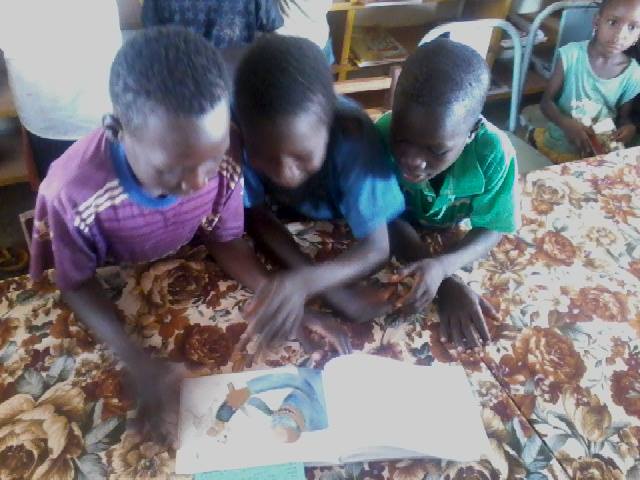
Dounko shared this picture… kids in the library reading Où est ma poule, book I did with Ezequiel Olvera…

reading-ou-est-ma-poule-2016

Posted in Reading | Comments Off on Dounko shared this picture… kids in the library reading Où est ma poule, book I did with Ezequiel Olvera…

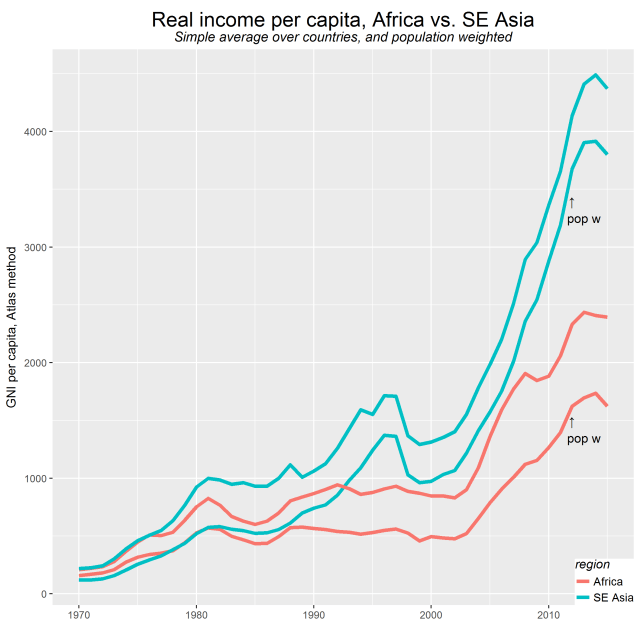
African real per capita income over time, compared with countries of southeast Africa

africa_seasia

Posted in Burkina Faso | Comments Off on African real per capita income over time, compared with countries of southeast Africa

The Hamar in southern Ethiopia

I am teaching African Economic Development this quarter, and I like to have students watch films and read novels to get a more humanistic understanding of the people behind the numbers.  If you have never spent any time in any African country, or only spent time in African cities, for that matter, it is easy to “other” rural folk.  So I assigned a nice documentary called Duka’s Dilemma, by Jean Lydall and Kaira Strecker.  What I like about the documentary is it focuses on just four people, and after 80 minutes you feel like you can recognize a little bit of their personalities, and the interpersonal relations among them.  They are no longer other.

What I didn’t realize is that the Hamar occupy a kind of voyeuristic status that precisely contributes to the othering.  And they seem to be comfortable with selling their othering to “primitive people” photographers.  Sigh.  makes me wish I were in the humanities and could spend all day talking and thinking about those kinds of issues.

This is a decent, unnarrated, video showing what a typical market day is like in the “town” presumably like the one mentioned in Duka’s Dilemma.

As always, once you get to know people, you start doing a little digging, and you are more sympathetic to how big, forces (but always individuals making choices) are changing their world.  From Survival International:

A massive hydroelectric dam and associated land grabs for plantations threaten the tribes of the Lower Omo River.  The tribes have lived in this area for centuries and have developed techniques to survive in a challenging environment. They have not given their free, prior and informed consent for the dam or the plantations and have already started to lose their livelihoods based on the river’s natural flood cycle.

Posted in Development thinking | Comments Off on The Hamar in southern Ethiopia

On Voix d’Amerique (VOA- Afrique) français today

Gaby Dorcil called, and who can resist his voice, to ask me to speak on the OPEC decision to limit production and effectuate an increase in oil prices.  Volontiers, of course, though I cringe when I hear my American-inflected French.  But it is fun to do the background reading.  A nice article in Le Figaro helped, excellent reporting by Hayat Gazzane.  And as usual, nobody is better for understanding oil markets than James Hamilton at Econbrowser.

Posted in Teaching macroeconomics | Comments Off on On Voix d’Amerique (VOA- Afrique) français today

Constitutional conference in Burkina Faso

Alpha Blondy was also in Ouagadougou meeting with the President.  Opération coup de poing banned in the new constitution?

Le président burkinabè Roch Marc Christian Kaboré a installé jeudi à Ouagadougou les membres d’une Commission constitutionnelle qui doivent produire dans les “60 jours” prochains une nouvelle Constitution pour le passage du pays à la Vè République. Cette nouvelle constitution vise à mettre fin à la IVe République que l’on identifie au régime du président Blaise Compaoré, balayé le 31 octobre 2014 par une insurrection populaire après 27 ans de règne. La Constitution de la IVe République actuellement en vigueur a été adoptée le 2 juin 1991. Elle avait permis de mettre fin à une décennie de régimes d’exception dans ce petit pays d’Afrique de l’Ouest abonné aux coups d’Etat. Composée de 92 membres, la Commission constitutionnelle comprend des représentants du chef de l’Etat, des partis politiques, de la société civile, des forces de défense et de sécurité, du monde rural et économique ainsi que des juristes et des défenseurs de l’environnement.

Source: Burkina: début des travaux pour une nouvelle Constitution et une Ve République | Slate Afrique

Posted in Burkina Faso | Comments Off on Constitutional conference in Burkina Faso

One of the strangest stories of West Africa: Yacouba Isaac Zida se fait discret

Very similar to ATT’s disappearance after the Mali coup d’état.  Hard to even get a handle on how an important public personality can suddenly turn everything off.  Is he reading a French translation of Trollope’s The Way We Live Now?

Plus les charges s’accumulent, plus Yacouba Isaac Zida se fait discret à Ottawa (Canada), où il vit avec sa famille depuis janvier. À lire aussi Burkina : le président Roch Kaboré somme Isaac Zida de revenir au pays Burkina : le président Roch Kaboré somme Isaac Zida de revenir au pays Burkina : Zida fait la sourde oreille et reste à Ottawa Soupçonné de corruption lorsqu’il dirigeait la transition, l’ex-Premier ministre promu général est désormais visé par une procédure disciplinaire pour « désertion en temps de paix et refus d’obéissance ». Il est aussi sous la menace d’un mandat d’arrêt international de la justice burkinabè, qui souhaite l’entendre sur son rôle durant la répression de l’insurrection populaire des 30 et 31 octobre 2014 – Zida était alors le chef des opérations du régiment de sécurité présidentielle. Refusant de répondre à ses différentes convocations, il a coupé les ponts avec ses anciens collaborateurs et avec les ministres dont il était proche. Seuls quelques intimes – des évangéliques, comme lui – distillent de ses nouvelles au compte-gouttes : il va « bien », est « serein » et attend « que la justice se fasse ». En revanche, ils refusent de se prononcer sur son éventuel retour à Ouaga.

Source: Burkina : Yacouba Isaac Zida se fait discret – JeuneAfrique.com

Posted in Burkina Faso | Comments Off on One of the strangest stories of West Africa: Yacouba Isaac Zida se fait discret

Randomized control trials and participant responses to treatment probabilities

As more and more development economists conduct randomized control trials (RCT), rather than inferring the answer to an economics question from observational data, some researchers are drawing attention to unmentioned assumptions underlying interpretations of RCT results.  One such implicit assumption concerns participant response to the expectation of treatment, rather than response to the actual treatment. The response is relevant for “blind” RCTs where the treatment and control groups do not know which group they are in.  The expectation of a probability of receiving the treatment may change behavior, and this leads to a different outcome (a different difference between the treatment and control group) compared with an experiment that is not blind (so the control group knows it is not getting the treatment).  Likewise, there might be differential estimates of the treatment effect in experiments where the probability of receiving the treatment is higher or lower.  Chassang et al in a paper  “Accounting for Behavior in Treatment Effects: New Applications for Blind Trials” show that randomizing the probability of treatment assignment in a blind trial (and letting participants know the different probabilities) can then enable inference of the importance of the effect of behavioral response interacted with treatment.

A paper I have assigned for my African Economic Development class made the headlines (OK maybe not headlines but a couple of blog and Twitter commentaries) back in 2012 and 2014 for using the Chassang et al result to measure and use this kind of respondent behavior in a typical development and agricultural economics setting.    The paper is “Behavioural Responses and the Impact of New Agricultural Technologies: Evidence from a Double-Blind Field Experiment in Tanzania” by Erwin Bulte, Gonne BeekmanSalvatore Di FalcoJoseph Hellaand Pan Lei, in AJAE 2014.

Bulte et al run two experiments: one where farmers know which variety of cowpea seed they are given (traditional or improved) and one where farmers do not know (they are “blind” but can infer that the probability of getting the new improved variety is about 50%).  In the first experiment, where farmers know the variety, the improved variety has about 25% more  yield (9.87 vs 7.24).  In the blind experiment, the two seeds have about the same yield (9.91 vs 9.40).  Notice that in the blind experiment the yield is about the same as in the open experiment where farmers use the improved variety (all about 9.5).  Bulte et al interpret this to suggest that all of the increase in yield in the open trial is likely due to changed cultivation methods (better weeding, spacing, planting, thinning, pest control, etc.) and very little to the seed itself.  What seems to have happened is that when farmers knew they had the traditional variety, they farmed it in a way that generated lower yield (and note that lower yield may have been the profitable way to farm cowpea; Bulte et al can say very little about the costs of cultivation practices that increased yield).

This result is very reasonable.  It suggests that the effects estimated by open RCTs are likely a combination of behavioral and mechanical (i.e. laboratory) effects.  One development wag suggested the paper was “a torpedo aimed straight at H.M.S. Randomista.”  But I think their paper is more constructive than destructive.  What Bulte et al show is that running two trials (an open and a blind trial) enables a researcher to make an inference about how much of an effect is behavioral and how much is mechanical.  In their case, the results suggest that most of the new seed effect is behavioral.  (Berk Ozler pointed out in comments on the 2012 draft that the Bulte et al paper has lots of other problems, but here I set all those aside.)

Many economists will probably respond with something like, “But none of our interventions could ever be done blind; the subject always knows whether they are in treatment or control.”  But the more you think about it, the more examples you can think of where that is not true.  Two come to mind.  Any parent of schoolkids knows that school testing relies precisely on this not knowing.  The teachers strongly suggest to students that school tests are high stakes, and matter.  Parents obfuscate when their middle schooler asks.  So many students think they matter.  Once students mature and start to figure out and share with others that tests do not matter, performance changes.  The perceived probability of being in a high stakes experiment affects the outcome.  So you are measuring an interaction of knowledge and belief that demonstrating knowledge matters.  The same goes for many experimental games.  One could imagine an experiment designed to measure competitiveness (by placing respondents into absolute performance pay or relative performance pay arms) vary the probability of being in one of the two arms.  Then the behavioral response (“Oh I am in the competitive pay situation I am supposed to behave this way”) can be perhaps separated from the (semi-unconscious?) psychological response.

Posted in Development thinking | Comments Off on Randomized control trials and participant responses to treatment probabilities

Sango Malo by Bassek ba Kobhio

Spoilers in this review.

Sango Malo by Bassek ba Kobhio is one of my favorite films from Africa to use for introducing African economic development issues.  The film was released in the heady days of 1991 when a new generation thought there might be a possibility of transition from the one-party dictators who had taken over after independence and stifled the aspirations of the earlier generations.  Late in the film a narrator recites a poem by Charles Ngandé, Indépendence, about the uncertain promise of the end of the colonial era.

In the film, Malo, a young radical teacher, tries to apply a Paolo Freire pedagogy of the oppressed to the schoolchildren of his class in Lebamzip.  Sango, the headmaster, was also once young and idealistic and stubborn, but has seemingly turned into everything that Malo despises: selfish, authoritarian, uninterested in the well-being of the next generation, unwilling to change.  The results of Malo’s experiments are predictable in the context.  At the end of the film the village chief (represented almost as a caricature) defeats the upstart Malo, who is taken off to prison.  What I like along the way is that all of the characters eventually get represented as humans, with complicated personalities and lives.  Sango’s wife turns out to be quite wise, and their children, it seems, turned out to have gone astray. Sango is bitter for personal reasons.  Vois-tout (See-all) turns out to be the village drunk because his entire family was killed in an accident.  Even the chief is humanized: he is feared and ridiculed all at the same time, sometimes right in front of his face.  And he knows he is also just a pawn in a larger, national stage.  Towards the end of the film ba Kobhio nicely illustrates in a series of vignettes how the political is personal.  The villagers especially remind Malo that his self-righteousness (“You think we are children?”) is often counter-productive.  When his father-in-law commits suicide after Malo insists on not paying any dowry and not seeking approval for his marriage, the viewer is reminded, in a tiny scene, of the legitimate role of the chief (someone needs to decide what to do), the complexity of change, and the autonomy of the village deep in the forest where important things are local.

Don’t get me wrong.  Sango Malo is not a great cinematic experience.  Too didactic, little real acting.  Too many B roll shots of people walking in the landscape.  But it is an authentic cinematic experience, in the sense that a good storyteller has crammed a lot of interesting ideas into 90 minutes.  My favorite line?  Sango rebukes Malo: “You sound like Sekou Touré in 1958.”  If only Stokely Carmichael had seen the film, somehow, back in 1971.

Posted in Book and film reviews | Comments Off on Sango Malo by Bassek ba Kobhio

Fairly recent viewing on Netflix

Look Who’s Back – Excellent first hour, as Hitler suddenly reappears in contemporary Germany.  It grinds on as commentary on the media.

Victoria – Two hour film, all one take, of a robbery gone awry. Technically it is wonderful to watch.  Grinds on as conventional Breathless….

Hinterland – Moody police procedural.  Let me go lock my windows before one of the many dozen serial killers who roam TV land attacks me.

About Elly – Awesome Iranian movie about a group of friends who rent a seaside villa for a short holiday.  It goes awry.  Never grinds on.  Beautiful movie-making.

To the End of the World – You need a period drama fix?  This overlooked gem does excellently through three long episodes and only fails at the very very end.  Benedict Cumberbatch or whatever his name is leads an excellent cast in the confined quarters of a ship making its way to Australia.

Posted in Book and film reviews | Comments Off on Fairly recent viewing on Netflix

Micro-biotics in Burkina Faso

Thanks Andrew Passet for the link!

A 2010 study in the Proceedings of the National Academy of Sciences compared the microbiots of children living in rural Burkina Faso in West Africa to the microbiots of urban, city-dwelling children in Italy. The African children ate a high-fibre diet of vegetables, grains and legumes, with no processed foods, whereas the diet of the European children was full of sugars, animal fats and refined grains. The gut microbes of the children from Burkina Faso were very different from — and much more diverse than — those of the Italian kids.We wouldn’t want to say that children in Burkina Faso have a healthier lifestyle than Italian children. They are more likely to suffer severe infections and malnutrition, and they have a lower life expectancy than children born in Western Europe. But they also have a decreased risk of suffering from the immune diseases that are epidemic in the Western world.In an ideal world, children would harbour a rich and diverse community of microbes without the threat of severe infectious diseases, but our current practices only address half of this equation. Given how well bacteria respond to diet, eating a variety of foods is perhaps the best way to increase microbial diversity, and there’s no better time to do this than during the first few years of life.As a practical matter, this means that we shouldn’t feed a baby only rice cereal for weeks until the package is finished. We should offer a variety of grains, including oats, rice, barley and quinoa. It’s also important to offer whole grains instead of refined ones. The Western diet is extremely low in fibre, and refined grains contain very little of it.Protein-rich legumes, such as lentils, beans and peas, have an abundance of fibre and can be easily mashed for babies. Also try non-traditional starchy vegetables such as sweet potatoes, parsnips or cassava (tapioca) rather than just sticking to low-fibre veggies such as potatoes. For older children, add fermented foods, such as yoghurt, kefir, sauerkraut and other pickled vegetables.

Source: Get your children good and dirty

Posted in Burkina Faso | Comments Off on Micro-biotics in Burkina Faso

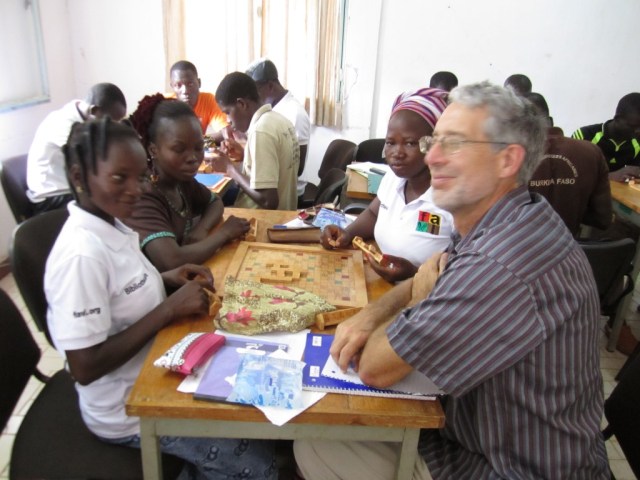
Did a FAVL librarian just challenge my French Scrabble word?

seven-letter

Posted in Burkina Faso | Comments Off on Did a FAVL librarian just challenge my French Scrabble word?

Rencontre des bibliothécaires a Béréba dans le Tuy

bibliothecaires tuy

Posted in Burkina Faso | Comments Off on Rencontre des bibliothécaires a Béréba dans le Tuy

Puerto Rico’s fiscal oversight board named

I kept waiting for the call, but someone must have told them my expertise was rural libraries in Burkina Faso, not really the skill-set needed?

The White House said it had chosen seven experts in finance and the law to supervise Puerto Rico’s fiscal affairs in the coming months under a law enacted this summer intended to help the island restructure its $72 billion debt. Four of the supervisory board members are Republicans and three are Democrats, chosen from lists provided to the White House by the party leaders of both houses of Congress. And four of the members are Puerto Ricans, which is three more than required under the new debt-restructuring law. The Republicans named to the board are:

Andrew G. Biggs, a resident scholar at the American Enterprise Institute. José B. Carrión III, president of Hub International, an insurance brokerage in Puerto Rico. Carlos M. García, founder and chief executive of BayBoston Managers, a private equity firm. David A. Skeel Jr., a University of Pennsylvania law professor with expertise in bankruptcy. The Democrats are: Arthur J. Gonzalez, a senior fellow at the New York University School of Law and a former chief judge of the United States Bankruptcy Court for the Southern District of New York. José Ramon González, president and chief executive of the Federal Home Loan Bank of New York. Ana J. Matosantos, president of Matosantos Consulting and a former director of the California Department of Finance.

In addition, the governor of Puerto Rico, Alejandro García Padilla, will hold a position on the board. He is not seeking a second term as governor, so whoever is elected to succeed him in November will take his seat on the board.

Source: Puerto Rico’s Fiscal Affairs Will Be Overseen by 7 Experts in Finance and Law – The New York Times

Posted in Burkina Faso | Comments Off on Puerto Rico’s fiscal oversight board named

All the way to Ouagadougou to participate in meetings!

They are good meetings…. but still.  From 8am-2pm working with Dounko, our FAVL director here in Burkina, covering all the issues, planning, and budgeting.  Then 3pm-5pm excellent meeting with our partner team at Catholic Relief Services over in Gounghin.  Great to meet Myriam Dems and Abdoulaye Barry, and get feedback from the project director Neda Sobhani.  The meeting just flew by.  Then back to Zogona, for dinner and conversation with Alain Sissao.  New Korean restaurant.  Pricey but good.

Posted in Burkina Faso | Comments Off on All the way to Ouagadougou to participate in meetings!

Pre-Ouagadougou culture

I arrived here last night, but so far all I have done for one day is talk about FAVL for about eight straight hours, and that is pretty boring for you blog readers, so instead I will give brief report of cultural experiences (reading and watching movies) in the weeks leading up my trip.  Then tomorrow I can actually start posting about the trip.  So in reverse order.

Movie on the plane: A Bigger Splash a remake of a 1960 French film. Ralph Fiennes is irresistibly watchable as the over-the-top charismatic friend who intrudes on the quiet vacation of his former lover and her current, quiet, partner on a beautiful rustic villa on an island near Sicily.  The soundtrack is great, and so are the long silences.  Gorgeous cinematography.  Tilda Swinton is her usual creepy self-absorbed film presence.  The film itself is average; some clear mistakes (too many revving engines on country roads, an almost laughably predictable tourist shot of the “natives” having their village religious parade, a seemingly unstaged moment with some migrants intruding into a scene) but the script at the end is a mess that left me scratching my head, and includes unforgivably a police detective who apparently has never himself watched a television police procedural, and so happily lets a global celebrity get away with murder (I’m not giving anything away here, actually).

Movie on the plane: The Hateful Eight.  Exactly what I expected from Quentin Tarantino.  For me, he specializes in making movies that you are happy to watch for free on an airplane when you have nothing else to do and want a break from reading.  I think I have seen Jackie Brown and Kill Bill on planes.  He is having fun making the films, and so are the actors.  As long as I am not paying anything, I am enjoying it.  When it is over my brain calmly presses the “delete all memories of this film” button.  I watched so many of these movies as a kid growing up in Puerto Rico… westerns dubbed in Spanish, Mexican films with masked wrestlers, Godzilla, etc.  Enjoy (on a plane).  Good soundtrack.  And chiasmus. “You only need to hang mean bastards, but mean bastards you need to hang.”

Novel last week.  Don Delillo Americana.  Really in my humble opinion this novel was awful.  I started skipping after 50 pages, and skipped all the way to the end.  Overblown writing, pointless humor, grating experimentation.  I know there is an audience for this kind of writing (and filmmaking) but I can never figure out why people like this stuff.  I was intrigued by the thought that Chimamanda Ngozi Adichie may have somehow been riffing off this, but I think it was just coincidence (or good marketing) that the titles ended up so close.

Novel last week.  Girl on the Train.  It was lying around.  I. am. not. proud.  Quite depressing to turn the pages as it struggles to conclude… the killer telegraphed midway through. A long “we know he is a killer but let’s be alone with him anyway” scene.  Help! I am being bored to death by this thriller novel!

Novel two weeks ago.  The Root: A Novel of the Wrath & Athenaeum by Na’amen Gobert Tilahun.  A young adult fantasy sci-fi novel.  Could have used more editing, but there is lots of imagination.  I found it oddly captivating as it careened off to an ending that merely sets stage for volume two.

Posted in Book and film reviews | Comments Off on Pre-Ouagadougou culture

J.L Carr’s A Month in the Country

Bill already gave this short novel by J.L. Carr the perfect short review, so there is not much I can add.  Makes you want to learn the names of plants and also become an art restorer, in your spare time.  If you like it, try Alan Garner, whose Stone Quartet chisels away at a similar vein.  George Worsley Adamson illustrated at least one of J.L. Carr’s book covers, and also illustrated a couple children’s novels of Alan Garner.  Others (well, a few) active on the web have drawn similar comparison:

I felt an acute mixture of nostalgia, sadness and glee as I read these four linked novellas. The only book I have read in recent years that has given me a similar feeling in this particular mode was A Month in the Country by J.L. Carr.

Here is Carr’s short autobiography from Alchetron:

In 1986 Carr was interviewed by Vogue magazine and, as a writer of dictionaries, was asked for a dictionary definition of himself. He answered: “James Lloyd Carr, a back-bedroom publisher of large maps and small books who, in old age, unexpectedly wrote six novels which, although highly thought of by a small band of literary supporters and by himself, were properly disregarded by the Literary World”.

And Carr’s map of Yorkshire:


Posted in Book and film reviews | Comments Off on J.L Carr’s A Month in the Country

Whatsoever you do, to the “at least as successful as you,” so you shall do unto me?

“We’ve shown that over time, evolution favors strategies to help those who are at least as successful as themselves.” In their study, the team used computer modelling to run hundreds of thousands of simulations, or ‘donation games’, to unravel the complexities of decision-making strategies for simplified humans and to establish why certain types of behaviour among individuals begins to strengthen over time. In each round of the donation game, two simulated players were randomly selected from the population. The first player then made a decision on whether or not they wanted to donate to the other player, based on how they judged their reputation. If the player chose to donate, they incurred a cost and the receiver was given a benefit. Each player’s reputation was then updated in light of their action, and another game was initiated. Compared to other species, including our closest relatives, chimpanzees, the brain takes up much more body weight in human beings. Humans also have the largest cerebral cortex of all mammals, relative to the size of their brains. This area houses the cerebral hemispheres, which are responsible for higher functions like memory, communication and thinking. The research team propose that making relative judgements through helping others has been influential for human survival, and that the complexity of constantly assessing individuals has been a sufficiently difficult task to promote the expansion of the brain over many generations of human reproduction. Professor Robin Dunbar, who previously proposed the social brain hypothesis, said: “According to the social brain hypothesis, the disproportionately large brain size in humans exists as a consequence of humans evolving in large and complex social groups.

Source: Large human brain evolved as a result of ‘sizing each other up’ — ScienceDaily

Posted in Burkina Faso | Comments Off on Whatsoever you do, to the “at least as successful as you,” so you shall do unto me?

Burkina Faso tries to raise revenue

$17m in new taxes on housing and imported vehicles, and raising taxes on beer and other beverages, and on lottery winnings.

Il est attendu des mesures fiscales annoncées, qu’elles contribuent à l’augmentation des recettes fiscales. Globalement elles devraient contribuer à hauteur de 8,5 milliards de francs au budget de l’Etat. En partant des données de l’enquête réalisée dans le cadre de la loi portant règlementation des loyers d’habitation, les rentrées possibles d’argent au niveau des taxes foncières sont estimées à 1,5 milliards de francs CFA par an. Les recettes fiscales attendues des taxes sur les boissons alcoolisées et boissons non alcoolisées sont estimées à 3 milliards de francs CFA par an. Les taxes sur les gains des jeux du hasard devraient rapporter au budget de l’Etat 2 milliards de francs CFA par an. Il en est de même pour les taxes à l’importation des véhicules de tourisme.

Source: Tout sur les taxes foncières : personnes assujetties, valeurs… impacts attendus | Burkina Demain

Posted in Economy | Comments Off on Burkina Faso tries to raise revenue