Burkina Faso… Alizéta Ouédraogo lists her losses

Apparently, no sense of shame at all for never having questioned the legitimacy of the regime.

“J’ai perdu deux tanneries avec un stock important de marchandises. Les machines ont été détruites par les flammes, les bâtiments ont été mis à sac, les magasins où étaient stockés les produits finis ont été pillés et incendiés, énumère-t-elle. Les manifestants se sont aussi rendus dans ma carrière de granulats routiers et ont détruit une centrale d’enrobage, une centrale de concassage. Ils ont même détruit le siège d’Azimmo, ma société immobilière.” Les dégâts, selon elle, se chiffrent à 20 milliards de F CFA 30,5 millions d’euros. “J’ai été obligée de renvoyer chez eux mes 1 287 salariés. Quiconque veut gouverner un pays aussi pauvre que le nôtre devrait se préoccuper de préserver les acquis économiques.”

via Burkina Faso | Burkina Faso : Alizéta Ouédraogo, la chute de la “belle-mère nationale” | Jeuneafrique.com – le premier site d’information et d’actualité sur l’Afrique.

Posted in Economy, Politics | Comments Off on Burkina Faso… Alizéta Ouédraogo lists her losses

The October 30 uprising that ousted Pres. Blaise Compaoré

Posted in Politics | Comments Off on The October 30 uprising that ousted Pres. Blaise Compaoré

Quick presentation on the U.S. financial crisis

http://prezi.com/embed/tcqs22vdvkm1/?bgcolor=ffffff&lock_to_path=0&autoplay=0&autohide_ctrls=0&features=undefined&token=undefined&disabled_features=undefined

Posted in Teaching macroeconomics | Comments Off on Quick presentation on the U.S. financial crisis

Why the 2% inflation target?

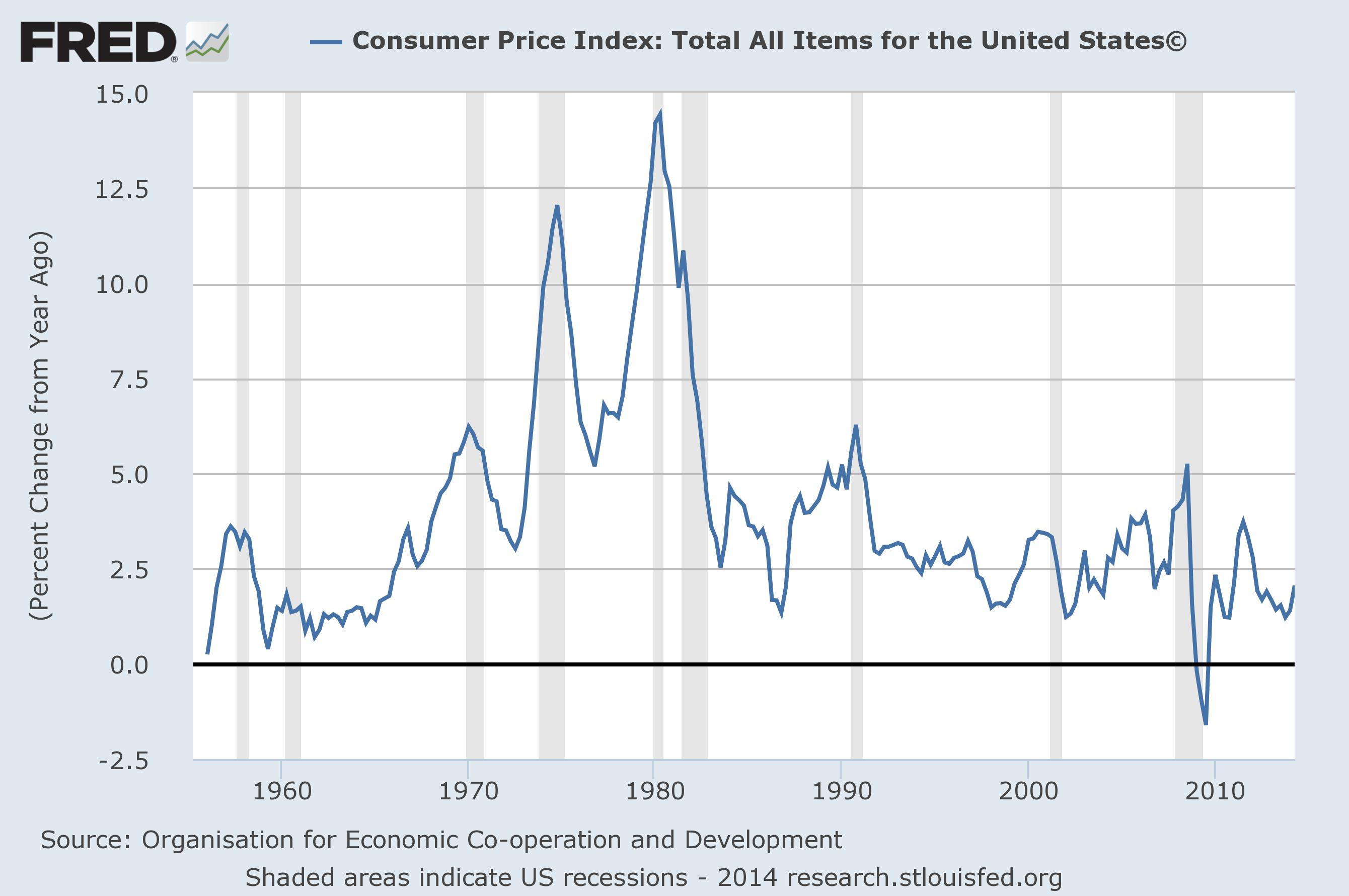
Look at the FRED graph of inflation.  U.S. has only had inflation lower than 2% basically once (early 1960s) in last 50 years.  The economy has done pretty well in that whole time period.  So why mess with success?  I think that is the intuition.
fredgraph

Posted in Teaching macroeconomics | Comments Off on Why the 2% inflation target?

Do you care about student teaching evaluations? Read the 2nd to last sentence (and the whole article)

From “Does Professor Quality Matter? Evidence from Random Assignment of Students to Professors” by Scott E. Carrell and James E. West.

Results show that there are statistically significant and sizable differences in student achievement across introductory course professors in both contemporaneous and follow‐on course achievement. However, our results indicate that professors who excel at promoting contemporaneous student achievement, on average, harm the subsequent performance of their students in more advanced classes. Academic rank, teaching experience, and terminal degree status of professors are negatively correlated with contemporaneous value‐added but positively correlated with follow‐on course value‐added. Hence, students of less experienced instructors who do not possess a doctorate perform significantly better in the contemporaneous course but perform worse in the follow‐on related curriculum.Student evaluations are positively correlated with contemporaneous professor value‐added and negatively correlated with follow‐on student achievement. That is, students appear to reward higher grades in the introductory course but punish professors who increase deep learning introductory course professor value‐added in follow‐on courses. Since many U.S. colleges and universities use student evaluations as a measurement of teaching quality for academic promotion and tenure decisions, this latter finding draws into question the value and accuracy of this practice.

via JSTOR: Journal of Political Economy, Vol. 118, No. 3 June 2010, pp. 409-432.  HT: Bill Sundstrom

Posted in Santa Clara University | 2 Comments

Pensions protected in Stockton bankruptcy though city workers agree to “voluntary” cuts

Stockton, California, won court approval of its plan to exit bankruptcy by paying bond investors pennies on the dollar while shielding public pensions, in a case watched by other cities facing heavy retiree costs.“This plan, I’m persuaded, is the best that could be done in terms of restructuring the city’s debts,” U.S. Bankruptcy Judge Christopher Klein said at a hearing today in Sacramento, the state capital.Bankruptcy lawyers and pension advocates nationwide have been following the case to see whether pensions administered by the California Public Employees’ Retirement System would be protected from cuts.  Klein ruled earlier that Calpers doesn’t deserve special protection, the first time the biggest U.S. public pension fund was found vulnerable to cuts in a bankruptcy. Calpers and public-worker groups decried the decision. A bankruptcy judge in Detroit ruled has against pension funds in a similar situation.

via Stockton’s Pension-Protecting Bankruptcy Plan Approved – Bloomberg.

Posted in Teaching macroeconomics | Comments Off on Pensions protected in Stockton bankruptcy though city workers agree to “voluntary” cuts

How big was the Fed’s lending to banks during the financial crisis? Very big!

The amount of money the central bank parceled out was surprising even to Gary H. Stern, president of the Federal Reserve Bank of Minneapolis from 1985 to 2009, who says he “wasn’t aware of the magnitude.” It dwarfed the Treasury Department’s better-known $700 billion Troubled Asset Relief Program, or TARP. Add up guarantees and lending limits, and the Fed had committed $7.77 trillion as of March 2009 to rescuing the financial system, more than half the value of everything produced in the U.S. that year.  … Bankers didn’t disclose the extent of their borrowing. On Nov. 26, 2008, then-Bank of America BAC Corp. Chief Executive Officer Kenneth D. Lewis wrote to shareholders that he headed “one of the strongest and most stable major banks in the world.” He didn’t say that his Charlotte, North Carolina-based firm owed the central bank $86 billion that day.

via Secret Fed Loans Gave Banks $13 Billion Undisclosed to Congress – Bloomberg.

Posted in Teaching macroeconomics | Comments Off on How big was the Fed’s lending to banks during the financial crisis? Very big!

Bad macroeconomic news out of Europe

The U.S. economy finally seems to be climbing out of the deep hole it entered during the global financial crisis. Unfortunately, Europe, the other epicenter of crisis, can’t say the same. Unemployment in the euro area is stalled at almost twice the U.S. level, while inflation is far below both the official target and outright deflation has become a looming risk.Investors have taken notice: European interest rates have plunged, with German long-term bonds yielding just 0.7 percent. That’s the kind of yield we used to associate with Japanese deflation, and markets are indeed signaling that they expect Europe to experience its own lost decade.

via Being Bad Europeans – NYTimes.com.

Posted in Teaching macroeconomics | Comments Off on Bad macroeconomic news out of Europe

Testing of the “exit” at the Federal Reserve

The Federal Reserve awarded $334.714 billion 213 billion pounds of eight-day term deposits to banks, a record amount, at a test auction held on Monday, it said in a statement on Tuesday.  The U.S. central bank allotted them to 90 banks which will receive an interest rate of 0.29 percent.  This was higher than the $316.020 billion in seven-day deposits awarded a week earlier to 85 banks which received an interest rate of 0.28 percent.  [.01% of $300b is $30m at an annual rate, or about $1 m for the 8 days.]  The Fed has ramped up testing of its term deposit facility after the 2008 financial crisis to help policymakers drain cash from the banking system when they decide to tighten monetary policy.On Sept. 4, the Fed said it plans to conduct a series of eight seven-day TDF operations starting in October. These tests will have an early withdrawal feature in which banks can enter the TDF and pull the money out before the maturity date if they pay a charge.

via Fed Awards $335 Billion of Term Deposits in Test Auction – NYTimes.com.

Posted in Teaching macroeconomics | Comments Off on Testing of the “exit” at the Federal Reserve

Ethics of everyday life

Will David Carr tell his readers how much money he made for his puff piece on Bill Cosby, and give that to a good charity?

I was one of those who looked away. Having read the Philadelphia magazine story when it came out, I knew when the editors of the airline magazine called that they would have no interest in pursuing those allegations in a short interview in a magazine meant to occupy fliers.  My job as a journalist was to turn that assignment down. If I was not going to do the work to tell the truth about the guy, I should not have let him prattle on about his new book at the time.

via Calling Out Bill Cosby’s Media Enablers, Including Myself – NYTimes.com.

Posted in Teaching macroeconomics | Comments Off on Ethics of everyday life

Paul Krugman on the Zero Lower Bound

What do I mean by saying that everything changes [at the so-called zero lower bound]? As I wrote way back when, in a rock-bottom economy “the usual rules of economic policy no longer apply: virtue becomes vice, caution is risky and prudence is folly.” Government spending doesn’t compete with private investment — it actually promotes business spending. Central bankers, who normally cultivate an image as stern inflation-fighters, need to do the exact opposite, convincing markets and investors that they will push inflation up. “Structural reform,” which usually means making it easier to cut wages, is more likely to destroy jobs than create them.This may all sound wild and radical, but it isn’t. In fact, it’s what mainstream economic analysis says will happen once interest rates hit zero. And it’s also what history tells us. If you paid attention to the lessons of post-bubble Japan, or for that matter the U.S. economy in the 1930s, you were more or less ready for the looking-glass world of economic policy we’ve lived in since 2008.

via The Inflation and Rising Interest Rates That Never Showed Up – NYTimes.com.

Posted in Teaching macroeconomics | Comments Off on Paul Krugman on the Zero Lower Bound

Bad newspaper writing: NY Times on Texas textbooks

The article headline and first paragraph  tease us: Texas has approved textbooks for use in public school that say negative things about Muslims…

Texas’ State Board of Education has approved new history textbooks, but only after defeating six and seeing a top publisher withdraw a seventh — capping months of outcry over lessons that some academics say exaggerate the influence of Moses in American democracy and negatively portray Muslims.

But then in the article, not a single quote from one of the disputed textbooks, so that the reader could evaluate whether “some academics” (who are not cited) are reasonable or not.  So we should decide: Stop reading the New York Times.

via Texas Approves Disputed History Texts for Schools – NYTimes.com.

Posted in United States | Comments Off on Bad newspaper writing: NY Times on Texas textbooks

Beautiful words from Michel Kafando new President of Burkina Faso, but they ring hollow

These words sound so true and heartfelt, but they are coming from a man who chose not to go into exile and fight the terrible system he now decries.  Instead, he chose to represent that very same system and regime as ambassador to the United Nations.  And the man he just selected to be Prime Minister, just three weeks ago was the number two man in that terrible system’s presidential guard.  In college we used to call this a “snow job.”

Le message du peuple est clair et nous l’avons entendu. Plus jamais d’injustice, plus jamais de gabegies. Plus jamais de corruption. Tout nous conduit donc à prendre nos responsabilités pour répondre à cet appel.  C’est dire que les actions que nous engageons dès l’entame de notre mandat, seront essentiellement centrées sur ce que nous considérons comme un mandat impératif. Toute ma vie, je me suis toujours fait une idée du respect du bien public, de militer pour l’avènement d’une vraie justice sociale. L’on comprendra pourquoi, avec ceux qui ont méprisé cette justice et qui pensent qu’ils peuvent impunément dilapider les deniers publics, nous règlerons bientôt les comptes.

via Le discours de prise de fonction de Michel Kafando.

Posted in Politics | Comments Off on Beautiful words from Michel Kafando new President of Burkina Faso, but they ring hollow

E.C.B. sees significant risk of deflation in eurozone

Mario Draghi, the European Central Bank president, strongly signaled on Friday that he and his colleagues were preparing a new round of powerful monetary stimulus to jolt the flagging eurozone economy at a time when the risk of deflation is growing.  Speaking at a conference in Frankfurt, Mr. Draghi said the central bank would “do what we must to raise inflation and inflation expectations as fast as possible, as our price stability mandate requires of us.”If the bank’s current policy did not end the threat, Mr. Draghi added, “we would step up the pressure and broaden even more the channels through which we intervene, by altering accordingly the size, pace and composition of our purchases… While Mr. Draghi on Friday did not actually say much that was different from previous utterances, there was a significant new emphasis on the risk of deflation in the eurozone.

via Mario Draghi Says E.C.B. Will ‘Do What We Must’ to Stoke Inflation – NYTimes.com.

Posted in Teaching macroeconomics | Comments Off on E.C.B. sees significant risk of deflation in eurozone

Goldman Sachs say: We want to make a lot more money and do not care about the risk to the macroeconomy

A report released this week by the Senate Permanent Subcommittee on Investigations found that banks had built up enormous holdings of commodities and infrastructure that allowed the banks to monitor and influence the price of these materials.One potential danger for banks holding commodities infrastructure, like coal mines, is that the infrastructure could be involved in environmental disasters that would expose the banks to significant legal liability.Mr. Tarullo, the Fed governor who oversees regulatory policies, is expected to testify that “physical commodities activities can pose unique risks to the safety and soundness of financial holding companies.”

via Federal Reserve Set to Propose Stricter Rules for Banks in Commodities Markets – NYTimes.com.

Posted in Teaching macroeconomics | Comments Off on Goldman Sachs say: We want to make a lot more money and do not care about the risk to the macroeconomy

China lowers interest rates

China’s central bank on Friday announced a surprise cut to interest rates, in the clearest sign yet that policy makers are growing increasingly concerned the country’s economic slowdown.Despite numerous signs that growth has been flagging, China’s leadership for months has refrained from any broad-based economic stimulus measures as policy makers tried to push through a package of ambitious financial overhauls. Instead, they opted for piecemeal efforts like injecting money into big banks.

via China, in Surprise Move to Prop Up Economy, Cuts Interest Rates – NYTimes.com.

Posted in Teaching macroeconomics | Comments Off on China lowers interest rates

Rapping in Moré from Burkina Faso, Joey Soldat – Burkin Bâ

Posted in Music, Politics | Comments Off on Rapping in Moré from Burkina Faso, Joey Soldat – Burkin Bâ

Truer words never spoken: Newton Ahmed Barry

In an interview with Radio Omega he tells it like it is.  And he is right.  When the top echelons of Blaise Compaoré’s regime effectuate a palace coup taking advantage of a popular uprising, how likely is it that the longer term will end well?  The new leaders say “Trust us, we are different, we are serious.”  Ironically, that is exactly the line that Blaise had been using fairly successfully for past 16 years.   Meanwhile, the basic foundations of the rule of law are being dismantled, with summary dismissals and dissolution of rural and municipal councils and mayors.  That is being replaced by executive, centralized rule (by Zida!).  The proverb at the end: When the hyena comes to the village and eats the children of the poor, and nobody does anything… soon he will come for the children of the rich.

Radio Oméga : Dites-nous ce que vous pensez du cas de limogeage de l’ancien Directeur général de la SONABEL, de la SONABHY et de l’ancien Directeur générale de la douane Ousmane GUIRO que vous citez dans votre blog?

Newton Ahmed Barry : Je dis simplement que j’ai peur parce que ces attitudes assez spectaculaires dans un état de droit, ça ne marchent pas. Je sais simplement que ça flatte le petit peuple. Certains sont très contents sauf qu’ils oublient que lorsque les choses ne se sont pas passer dans le cadre de l’ordre, ce sont les gens aujourd’hui, des gens qu’on n’aiment pas et vous savez très bien que moi pendant près de 20 ans j’ai combattu ces gens-là, donc je suis très à l’aise pour pouvoir parler avec beaucoup plus de latitude ; donc aujourd’hui si on ne les aime pas et qu’on les jette en pâture demain c’est nous contre que ça va se retourner vous savez le proverbe : si l’hyène vient dans un village, il mange les enfants des pauvres et que les gens ne disent rien, quand il aura fini avec les enfants des pauvres c’est les princes qu’il va attaquer parce que il aura l’habitude de manger la chair fraiche.

via Nomination du Lieutenant-colonel Zida : “On n’a pas été surpris” Newton Ahmed Barry.

Posted in Politics | Comments Off on Truer words never spoken: Newton Ahmed Barry

Three months jail time for massive financial fraud in Iceland?

The former chief executive of Landsbanki of Iceland was sentenced to prison on Wednesday, the third of the top executives of the country’s three largest banks that the government has successfully prosecuted and jailed for misconduct during the financial crisis.  Sigurjon Arnason was ordered jailed for a year at a hearing at the Reykjavik District Court on Wednesday, but nine months of his sentence were suspended and will be served as probation.

via Ex-Chief of Iceland Bank Sentenced to Jail for Role in 2008 Crisis – NYTimes.com.

Posted in Teaching macroeconomics | Comments Off on Three months jail time for massive financial fraud in Iceland?

Fed releases minutes from meeting 3 weeks ago: Not much new

Fed officials have described the statement as indicating that the central bank is most likely to begin raising short-term rates in mid-2015. The account of the October meeting, released after a standard three-week delay, said a couple of officials wanted the Fed to signal that rates might rise sooner, and a couple wanted the Fed to signal that rates might rise later. But the intentions of a majority have not appeared to shift in recent months.The sluggish pace of inflation is displacing unemployment as the primary reason the Fed is not ready to start raising interest rates. The unemployment rate, which fell to 5.8 percent in October, is getting close to the level Fed officials regard as normal. If inflation were rising at the Fed’s preferred pace of 2 percent a year, it is unlikely that they would wait much longer before starting to raise interest rates.

via Fed Sees Limited Impact From Overseas Weakness and Market Turmoil – NYTimes.com.

Posted in Teaching macroeconomics | Comments Off on Fed releases minutes from meeting 3 weeks ago: Not much new