GiveDirectly program evaluation… rant!

Wow, you mean they give $1000 to poor people in Kenya and it really, really helps them!  Amazing!  All that time I was donating to dumb NGOs who didn’t do anything; I mean, they didn’t even evaluate rigorously what they were doing… I bet they weren’t doing anything. Just sitting on their asses.  Probably a bunch of dumb lazy liberals running those organizations, I bet.  Ripping us off.  Cripes, I feel had.  I definitely am only going to give to GiveDirectly from now on. Plus, my dollar will go further because Zuckie and the Gatester really like them. Together, we can eliminate poverty forever.  Yup, that’s my generation’s big challenge.  You old people had your challenges… but you didn’t really work very hard. I mean, maybe you worked hard. But not smart like us!  We figured out it was better to just give the money away.  And best thing is you don’t even have to take it by force from the rich people … they are happy to give it away, because all rich people now are smart like us. How do you think they got rich!?  They’re smart!  Took you long enough to figure it out Einstein.  They even got rich precisely so they could give it away. How cool is that.

What’s that? Little libraries in villages for kids to read.  Wait… you want me to donate so you can pay some village librarian to open the library?  Yeah right, I’m not a sucker.  How do I know the library is even open?  They’ll just take the money and waste it.  Bet they don’t even help their own village.  I’m not getting ripped off again.  Anyway, people in villages don’t even want to read.  Better to just give my money to randomly selected people in Kenya.  They proved that could work.

Posted in United States | Comments Off on GiveDirectly program evaluation… rant!

New York Times on Inflation

Nice article on inflation and monetary policy.  Sometimes incoherent, in that occasionally mistakes private benefit for public gains… (but rarely mistakes private losses for public losses)…

The Fed, in a break from its historic focus on suppressing inflation, has tried since the financial crisis to keep prices rising about 2 percent a year. Some Fed officials cite the slower pace of inflation as a reason, alongside reducing unemployment, to continue the central bank’s stimulus campaign.  Critics, including Professor Rogoff, say the Fed is being much too meek. He says that inflation should be pushed as high as 6 percent a year for a few years, a rate not seen since the early 1980s…. All this talk has prompted dismay among economists who see little benefit in inflation, and who warn that the Fed could lose control of prices as the economy recovers. As inflation accelerates, economists agree that any benefits can be quickly outstripped by the disruptive consequences of people rushing to spend money as soon as possible. Rising inflation also punishes people living on fixed incomes, and it discourages lending and long-term investments, imposing an enduring restraint on economic growth even if the inflation subsides.. Low inflation is not good for the economy because very low inflation increases the risks of deflation, which can cause an economy to stagnate,” the Fed’s chairman, Ben S. Bernanke, a student of Japan’s deflation, said in July. “The evidence is that falling and low inflation can be very bad for an economy.”  There is evidence that low inflation is hurting the American economy.

via In Fed and Out, Many Now Think Inflation Helps – NYTimes.com.

Posted in United States | Comments Off on New York Times on Inflation

Lou Reed’s music, the fun way…. watch him off-stage at the beginning

Posted in Politics | Comments Off on Lou Reed’s music, the fun way…. watch him off-stage at the beginning

I always have to be reminded of this!

Posted in Politics | Comments Off on I always have to be reminded of this!

Kaiser Permanente (my health care provider) apparently decides to make a move responding to ACA

If 3 million people signed up to Kaiser, who otherwise didn’t have insurance, we’d be a better country with happier people (having insurance and a doctor available is very reassuring… and not having your neighborhood host fundraisers for insurance-less musicians who have cancer is also a good thing)… of course, there might be lower profits for all those businesses that currently cater to that category of people, those without insurance.  I’m OK with that.

Our great Kaiser Permanente plans are available through Marketplaces. In fact, if you or friends qualify for financial help, you will need to buy coverage through your Marketplace. Kaiser Permanente members outside of Washington, D.C. who purchase individual plans can still buy from Kaiser Permanente directly. In D.C., all individual and small group plans must be purchased through the Marketplace. Call 1-800-245-3181 toll free and we can help you figure out which Kaiser Permanente plan may work best for you before you go to the Marketplace. This way your Kaiser Permanente selection can be made more quickly.

via Kaiser Permanente Partners In Health – You ask about health care reform, we answer.

Posted in United States | Comments Off on Kaiser Permanente (my health care provider) apparently decides to make a move responding to ACA

I was wondering whether any female presidents of Jesuit-Catholic colleges in U.S.? Answer seems to be: No

But those challenges aren’t insurmountable. The ranks of women in the presidency — as well as top administrators, including many in business positions — continue to grow. Women now lead half of the Ivy League, including universities that didn’t admit women as students until the 1970s. In contrast, no Catholic college that began as a men’s institution has a woman as president.

via Catholic colleges worry as number of female presidents falls | Inside Higher Ed.

Posted in United States | Comments Off on I was wondering whether any female presidents of Jesuit-Catholic colleges in U.S.? Answer seems to be: No

I cannot wait to read Gene Luen Yang’s new graphic novel

via ‘Boxers & Saints’ & Compassion: Questions For Gene Luen Yang : NPR.

Posted in Reading | Comments Off on I cannot wait to read Gene Luen Yang’s new graphic novel

Very interesting documentary about street musicians in Kinshasa, Congo

Posted in Music | Comments Off on Very interesting documentary about street musicians in Kinshasa, Congo

Are you a liberal who reads the Republican talking point of healthcare.gov disaster, and worries they might be right?

Well, don’t believe their baloney. I just went to Cover California, and in about 30 seconds I could see health insurance plans available for me.*  The premium plans for family of four costs about $1800 per month.  Expensive, but actually this is less than what my employer and I together currently pay.  So, the only conclusion I can draw as an economist: excellent that now anyone, no matter whether they have an employer, are self-employed, have a pre-existing condition… they can get very similar coverage to what I have.  They just have to earn enough to buy it.  And that’s what we want, right?  Your identity no longer matters, just your purchasing power.  So for people who don’t earn enough, as a society we can make the decision whether to subsidize them enough for the bronze plan…

I wonder if the Republicans will turn populist, and eliminate the union working class, professional class (me!) and middle-class tax-subsidy (where health insurance is pre-tax through employer) and use the proceeds to pay down the deficit and subsidize the bottom 40% of the population.  Woah, what rabbit hole did I go down there for a second.

*And you know what… think about it for a second.  Emusic regularly fails when I try to download a song for $.49.  Even the mighty itunes often fails.  Amazon… are you kidding… you can go in circles there.  And one of the main arguments against the healthcare exchanges is that insurers will collude… well guess where some of the examples of that collusion come from? amazon.com!  Have you ever really tracked your frequent flyer miles?  Impossible on those “professional” websites.  I just spend 20 minutes trying to figure out why an ipad app just wouldn’t work.  All I’m saying: for-profit corporations have websites that have problems pretty regularly.

Posted in United States | 1 Comment

Weekend music (and dancing) from Congo… Fally Ipupa… what a show!

Posted in Politics | Comments Off on Weekend music (and dancing) from Congo… Fally Ipupa… what a show!

Pirates… just what West Africa needs

With growth comes well-organized crime?

“Pirates, often heavily armed and violent, are targeting vessels and their crews along the Nigerian coast, rivers, anchorages, ports and surrounding waters. In many cases, they ransack the vessels and steal the cargo, usually gas oil,” the International Maritime Bureau IMB reported on Thursday.Countries on the Gulf of Guinea, including Nigeria, Ghana and Ivory Coast, are major sources of oil and cocoa and increasingly metals for world markets.

via Pirate Attacks by Heavily Armed Gangs Surge Off Nigerian Coast – NYTimes.com.

Posted in Economy | Comments Off on Pirates… just what West Africa needs

Appreciations of Thomas Sankara often marred by bad economic analysis

26 years ago, on October 15 1987, Thomas Sankara was killed by soldiers loyal to current president Blaise Compaoré.  Mr. Compaoré’s regime has never allowed a full truthful process of accounting for exactly what happened.  Most of Sankara’s companions in the Conseil d’Entente, the office building where the killing took place, were also killed.  So there are many witnesses amongst the killers, few amongst the victims.  And most of the killers are not very open about what happened.

Mr. Compaoré says he was not there, and as far as I know nobody disputes this.  So he has always claimed it was a kind of regrettable accident.  It should be remembered that the Sankara regime itself killed, in the coup of 1983, Colonel Yorian Gabriel Somé , by all accounts the top threat to Sankara and Compaoré when they took power.  That’s not to justify, just to contextualize.

Sankara’s legacy is complex. As a symbol he is unparalleled.  And goodness knows, unemployed African youth need powerful symbols of integrity, justice, empathy, love of learning, simple living, and all the good things.  He stands right up there with Bob Marley (and more dubiously with Haile Selassie!) as an aspiration.

But when it comes to his economic policy legacy, many Sankara admirers do him a disservice with exaggerated hyperbole (often qualified with a sentence or two, for sure).  But the picture they paint is of someone who might have transformed Burkina Faso.  We cannot know what would have happened, had he stayed in power another 4 years.  (Would there have been the same calls for alternance, one wonders, if Sankara had been in power 7 years?)  The 1990s and 2000s of Ghana are probably the best counterfactual.  Just like nobody thinks Jerry Rawlings was God’s gift to Ghana, but all-around probably the best of a bad lot,  I think Sankara would be regarded similarly.  The best kind of person who could emerge and lead in the highly unstable and fractured polities that are African states.

What prompted this reflection was an article by Peter Dorrie.  He has a good sense of the politics of Burkina Faso, but I often disagree with him on the economics.  And today he writes:

Prices for the most important household goods – basic food stuffs and natural gas for cooking and petrol – are rising constantly. Burkina Faso relies on imports for practically all goods consumed in the country, which makes it highly vulnerable to changes in world market prices. The little money generated through the export of gold, cotton and sesame benefits mostly external investors and the corrupt elite.

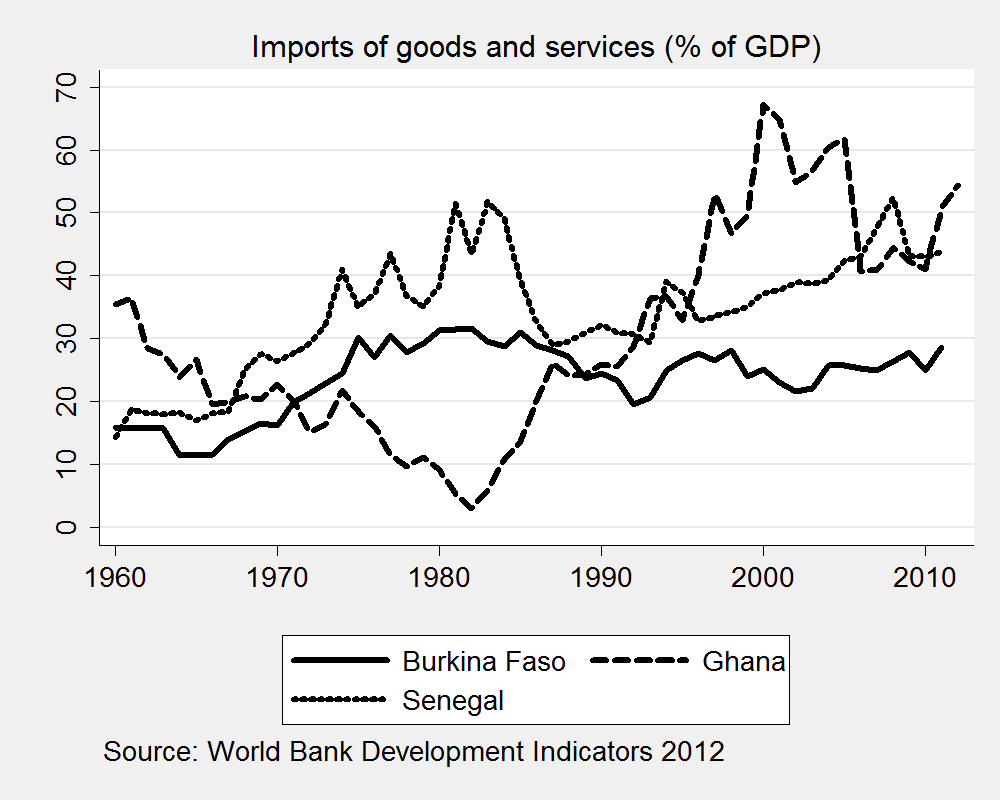
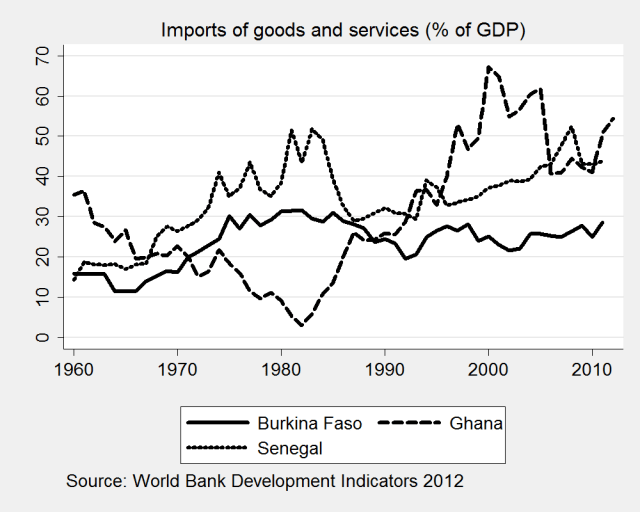
But what can this mean, really?  Here is the share of imports in GDP for Burkina, compared with Senegal and Ghana.  The share is actually relatively low, about 25%.  Most consumption in Burkina Faso is produced locally.  The vast majority of Burkinabè are rural dwellers, and their share of imports in consumption is probably less than 10%.
imports_gdp

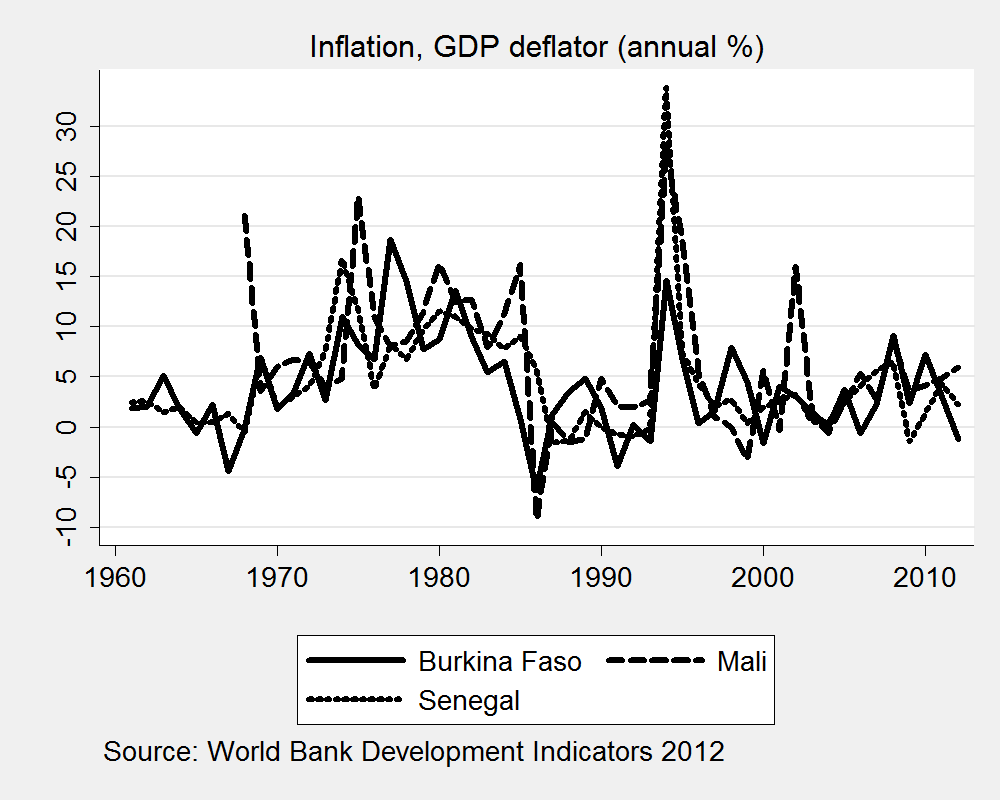
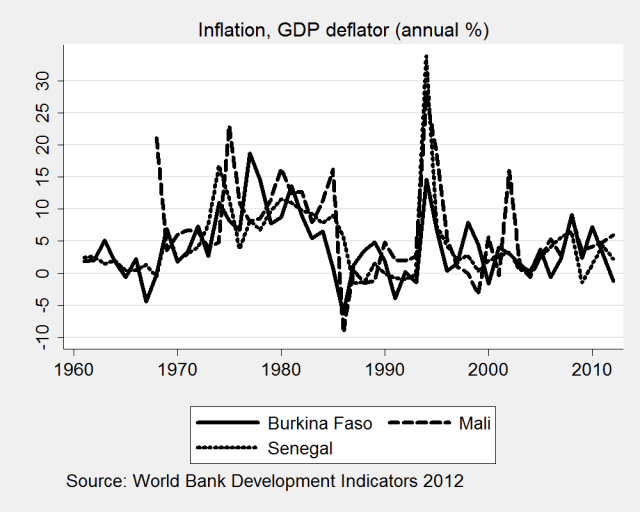
And here is the evolution of inflation for Burkina Faso and Ghana, over the same time period.  The sharp inflation following the FCFA devaluation of 1994 is evident.  Otherwise inflation is quite moderate, certainly nothing at all compared with Ghana, which has regularly had years of 20%+ inflation
deflator_gdp

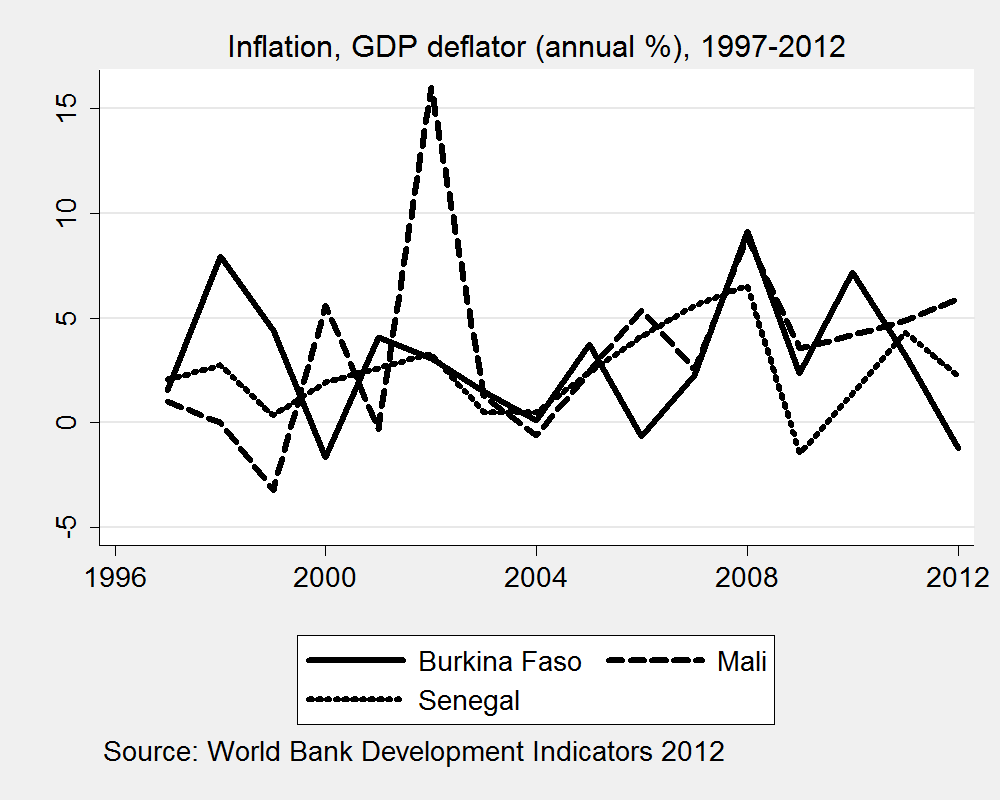
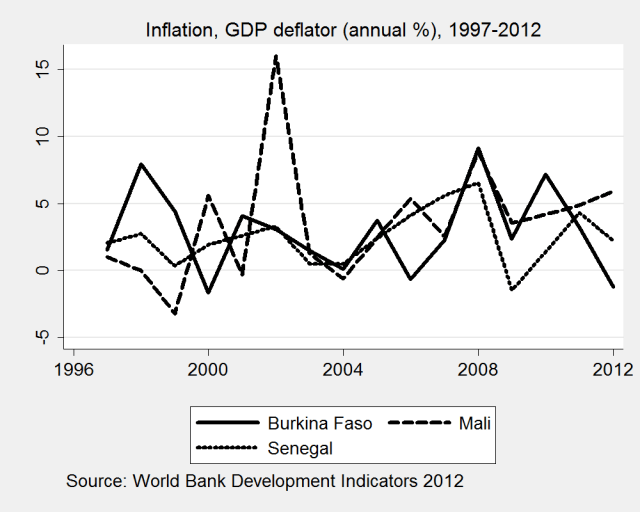
Here is a chart for the more recent 15 years.  Inflation has been generally around 5%.
deflator_gdp90

Burkina Faso has a significant poverty problem, and growth has been highly unequal.  Part of la vie chère has been the rapid urbanization concentrated in Ouagadougou.  When people leave villages and live in shantytowns, indeed life becomes more expensive.  But incomes rise too (that is why many people move to Ouagadougou).  It is a complex social process.  There is no need to obscure the very legitimate grievances of the vast poor population of Burkina Faso, vis-à-vis the small elite capturing a very large share of the benefits of economic growth, by making arguments that either (1) are not backed by data, so that we trade anecdotes or (2) are not stated clearly, so that we trade “that’s not what I meant and everyone knows what I meant even if I could not say precisely what I meant.”

Posted in Burkina Faso, Economy, Politics | Comments Off on Appreciations of Thomas Sankara often marred by bad economic analysis

Ghana’s Black Stars 5-1 so far against Egypt…

A rout, it seems.

Posted in Politics | Comments Off on Ghana’s Black Stars 5-1 so far against Egypt…

Bad, bad Mankiw…

I’m teaching using Mankiw’s Macroeconomics 8th edition and on page 138, Chapter 6, he uses an example to illustrate and develop intuition of what is always a problem for students, that capital flows have to equal current account (NX = S – I).  The trouble is, in his example Mankiw writes as if an exporter who obtains currency represents one capital outflow and then when she trades yen currency for yen stocks or bonds is another capital outflow.  But that is just transforming the financial asset… the outflow happened already with the obtaining of currency.  Students might be terribly confused.

Posted in United States | Comments Off on Bad, bad Mankiw…

Budget negotiations… let me get this straight…

At present, according to news reports, the only sticking point is what to do about the medical devices tax (2.3%) which is estimated to raise about $3 b a year, how long the deal should be for (Jan? Feb?), and whether 600 people in Congress/Executive should get employer match (OK that is just grandstanding, because Darrel Issa said he would match everyone out of his personal fortune, natch.)  So, the whole negotiation is over $3b a year.

Since government shutdown is paying workers anyway, the value of services lost over two weeks probably exceeds 10 years of the medical devices tax.  So this is all pure loss, with nothing except political posturing at stake.  Let me say that again: neither side actually gets anything really valuable (in terms of a policy change) for all the drama of these negotiations.  I could see negotiating to the brink over a $400 billion reduction in defense spending, or a major revision of Affordable Care Act… but $3 b a year?  Really?

Will be interesting to see how share prices of medical device makers move when final deal announced.

Posted in United States | 2 Comments

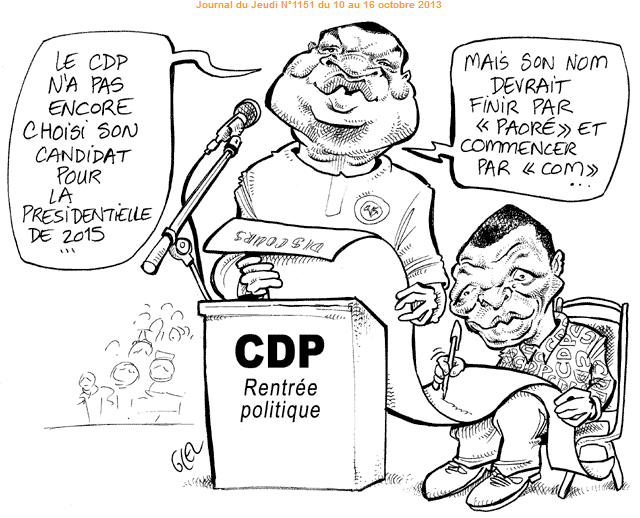
Burkina 2015…

compaore

Posted in Politics | Comments Off on Burkina 2015…

Burkina Faso education policy mistake

Government announces 100,000 solar lamps.  These cost about $10 each, so the is $1 million.  That could have been used to establish and operate for 5-10 years 50 community libraries.  I think effect of that would have greatly exceeded effect of distribution of solar lamps. Our study of distribution of solar lamps found very small effects on reading, nowhere near the effects of access to books through a library.

Dans les jours à venir, le gouvernement va doter les écoles de 100 000 lampes solaires dont les objectifs sont entre autre l’amélioration des conditions d’apprentissage des élèves, l’alphabétisation des adultes et l’amélioration de la fréquentation et de la réussite scolaire dans les écoles. La qualité de l’éducation repose en grande partie sur un bon encadrement de proximité des acteurs de terrains que sont les enseignants/es.

via Année scolaire 2013-2014 : une rentrée sous le signe du changement – leFaso.net, l’actualité au Burkina Faso.

Posted in Reading | Comments Off on Burkina Faso education policy mistake

‘Duplex’ by Kathryn Davis

Wow… Lynda Barry, one of my favorite cartoonists when I was a young adult, like totally agrees with me.  It’s like I’m in Duplex right now, reading this, because Lynda Barry could be standing inside me.

When I finished “Duplex” I had the unshakable feeling that I’d only read half of the book, and the other half was still in there and if I wanted to finish it, I’d need to read it again. I wasn’t wrong. By then I’d fallen in love with Davis’s writing, what it did to me, that combination of horror and excitement that spilled out of the book, into my past, into the now, into everything around me. The novel is packed with ordinary things (tuna casserole, skinned knees, hot water heaters, red barrettes) and extraordinary things (robots the size of needles, “dactilo ports” in restrooms, those flying scows), and then there are things that fall somewhere in between: the word “aquanaut,” a purse-shaped thing called a “Mary bean” that can drift across the ocean to other continents, a convent named after a girl who was roasted on a brazier.

via ‘Duplex,’ by Kathryn Davis – NYTimes.com.

Posted in Book and film reviews | Comments Off on ‘Duplex’ by Kathryn Davis

Quiggin doth protest too much

He doesn’t like the Nobel Prize for Economics.

Overall, economics is still at a pre-scientific stage, at least, as the idea of science is exemplified by Physics and Chemistry. Economists have made some important discoveries, and a knowledge of economics helps us to understand crucial issues, but there is no agreement on fundamental issues. The result is that prizes are awarded both for “discoveries” and for the refutation of those discoveries.

I liked this comment over at Crooked Timber:

JW Mason 10.15.13 at 1:31 am

I don’t disagree with this post. But I’m curious why the alternative to “science” is “pre-science”. Aren’t there valid forms of knowledge that are neither science nor on their way to becoming science?

Actually, I think Mason is too polite.  He disagrees very nicely with Quiggin’s premise.  As Mason supposes, economics has lots of knowledge… it is a rich and vibrant social science enterprise.  The world would be much poorer place without it (intellectually; as China shows, you don’t need much advanced academic economics to have rapidly rising standard of living).

That’s true for social sciences generally.  Can you imagine talking about social choice without understanding Arrow?  And many others.  I can still remember my shock when I understood the simple example of how setting the agenda order changes the outcome of social choice.   Imagine not understanding marginal thinking in economics (you’d be a very intelligent person running around in circles with C-M-C and other Marx stuff, and Bill don’t say it was better)?  Or not being able to articulate in a clear way the logic of comparative advantage?  Or not being able to think about causality in statistics?  More recently, imagine not understanding self-selection?  Adverse selection?  Moral hazard?  Isn’t the Revelation Principle like beautiful physics?  Or not knowing the Nash equilibrium concept?  It’s amazing to think that 100 years ago most people, even paid intellectuals, had no ability to think coherently about these things, and 100 years later Malcolm Gladwell can make millions selling them in plain prose at airport bookstores.  Finally, of course, to argue that Keynes is worthless because it isn’t really science… well like JW Mason said, it’s another valid form of knowledge.  Notice how Keynes became an it there.  I believe there is a discipline that studies that.  Lots of knowledge, little science.  Just fine.

Maybe they can rename the prize the Nobel Social Knowledge Prize.

HT: Bill Sundstrom. via Why do we *still* have a Nobel Prize in economics? — Crooked Timber.

Posted in Being a teacher | Comments Off on Quiggin doth protest too much

Impending calamity in Puerto Rico, analysis from Reorg Research

From Reorg Research.

As a heavily levered U.S. Territory, Puerto Rico has nearly $70 billion worth of debt to which numerous U.S. and foreign financial institutions have heavy exposure. Tangentially connected banks and companies too have suffered from the current economic turmoil pervading the territory, as the territory’s municipal debt has been downgraded to near-junk and has been in a continuous spiral throughout the year. The duress has driven up the cost of debt and stoked concerns about Puerto Rico’s future access to capital markets – factors that have caught the attention of an increasing number of distressed investors and funds.

Given that the municipalities of a U.S. territory cannot file for chapter 9 protection – the specifics of which Reorg Research outlined earlier – the type of workout or restructuring for the region is uncertain if it reaches the point at which it simply cannot meet its obligations.

Puerto Rico Governor Garcia Padilla, who took office in January, has been taking urgent measures to put off what many market participants see as an impending crisis: In a presentation regarding the 2014 budget, the Puerto Rican government has suggested several initiatives in an attempt to balance the budget over the next two years, which mentioned the recent measures of overhauling the territory’s pension system, raising utility rates, and passing new tax measures.

Currently, 34% of Puerto Rico’s public debt pertains to the general fund and the remainder with public corporations, sales tax debt and municipalities. Separate from outstanding debt, the country also has a significant amount of underfunded pension liabilities. As of September, the public pension fund liabilities amounted to approximately $33 billion with only $4 billion of assets to cover such obligations.

Puerto Rico’s securities meanwhile have failed to keep pace with the broader U.S. muni market. For one, Puerto Rico’s $632 million in 5% general obligation bonds due 2041 traded at 61.83 today the $459.3 million 5.5% notes due in 2039 last traded at 68.5, according to trade data, down from the 90s and par, respectively, as late as June.

See more Breakdown of Puerto Rico Cap Structure on Reorg Research

Posted in United States | Comments Off on Impending calamity in Puerto Rico, analysis from Reorg Research