
 Friends of African Village Libraries (I post regularly here)
- Animation de l’animateur de ABVBF à la bibliothèque de Béréba, Burkina Faso
- Encouragement des élèves de l’école Sainte Thérèse de Houndé à la lecture
- Organisation d’une séance de lecture à voix haute à la bibliothèque de Koho
- Visite du coordonnateur et de l’animateur de ABVBF à la bibliothèque Lumière pour enfants à Houndé
- Une sortie d’animation de la BMP à l’école E de Houndé
- Compte-rendu d’une visite à Bougnam
- Monthly libraries newsletter, Burkina Faso
- Weekly Activities in Sumbrungu Community Library in Ghana
- Résumé d’une sortie de distribution de livres dans le village Lonkuy, Burkina Faso
- Night Activities At Gowrie-Kunkua Community Library
Make America great? Let’s have more of “El Colás” in our restaurants!
Posted in Music
Comments Off on Make America great? Let’s have more of “El Colás” in our restaurants!
Jill Lepore on Rachel Carson in The New Yorker, March 2018
A fantastic writer paying homage, so gracefully, to a writer of another generation. Lepore uncovers for the modern reader enough about Carson’s life, but mostly about her writings on the sea (as opposed to her more well-known book on DDT) that the reader is truly humbled. Here is an abstract from an academic article with a similar theme. I am very intrigued to think more about ways to quantitatively measure the persuasion that so many commentators assume was substantial. How do we “know” in the quantitative sense that the book had a big impact? Both Clinton memoirs sold millions of copies, does anyone think they had an impact on anything? Implied here is that paradoxically (from Carson’s perspective) her impact may have been on “persuading” people to purchase more disposable consumer goods!
Recent scholarship on the work of the great nature writer, Rachel Carson, posits that her landmark book, Silent Spring (1962)—often credited with igniting the modern environmental movement—is best understood in the context of her earlier, extraordinarily popular publications on the natural history of the oceans, which helped establish her as a talented and trustworthy translator of scientific concepts into literary prose. This essay builds upon that idea, showing how Carson’s The Sea Around Us (1951) and The Edge of the Sea (1955) not only shaped public understandings of ocean ecology, but also spurred a public passion for all things oceanographic, best embodied in a wave of “Carsonalia”—consumer items and experiences ranging from hats, to Book of the Month Club editions, to liner notes for the NBC Symphony’s recording of Debussy’s La Mer. While these items inspired and expressed the “sense of wonder” that was critical to Carson’s ecological aesthetic, I argue, they also subsumed the new “frontier” of the world’s oceans into the technological imperialism of the post-World War II United States. As new technologies allowed military and scientific researchers to see deeper into the oceanic depths than ever before, images of the open ocean were domesticated through consumer markets into viewable, readable, and even wearable forms. This commodification of the ocean, and of Carson’s ecocentric message, both enabled and frustrated her attempts to promote ecological literacy. Yet they also reveal much about our contemporary relationship to the world’s oceans, which remain sites of both enduring wonder and extraordinary exploitation.
Wonders with the Sea: Rachel Carson’s Ecological Aesthetic and the Mid-Century Reader
Amanda Hagood, Environmental Humanities (2013) 2 (1): 57-77.
Posted in Book and film reviews, Development thinking, Reading
Comments Off on Jill Lepore on Rachel Carson in The New Yorker, March 2018
National Bookmobile Day April 11 2018
At FAVL we are working on it tha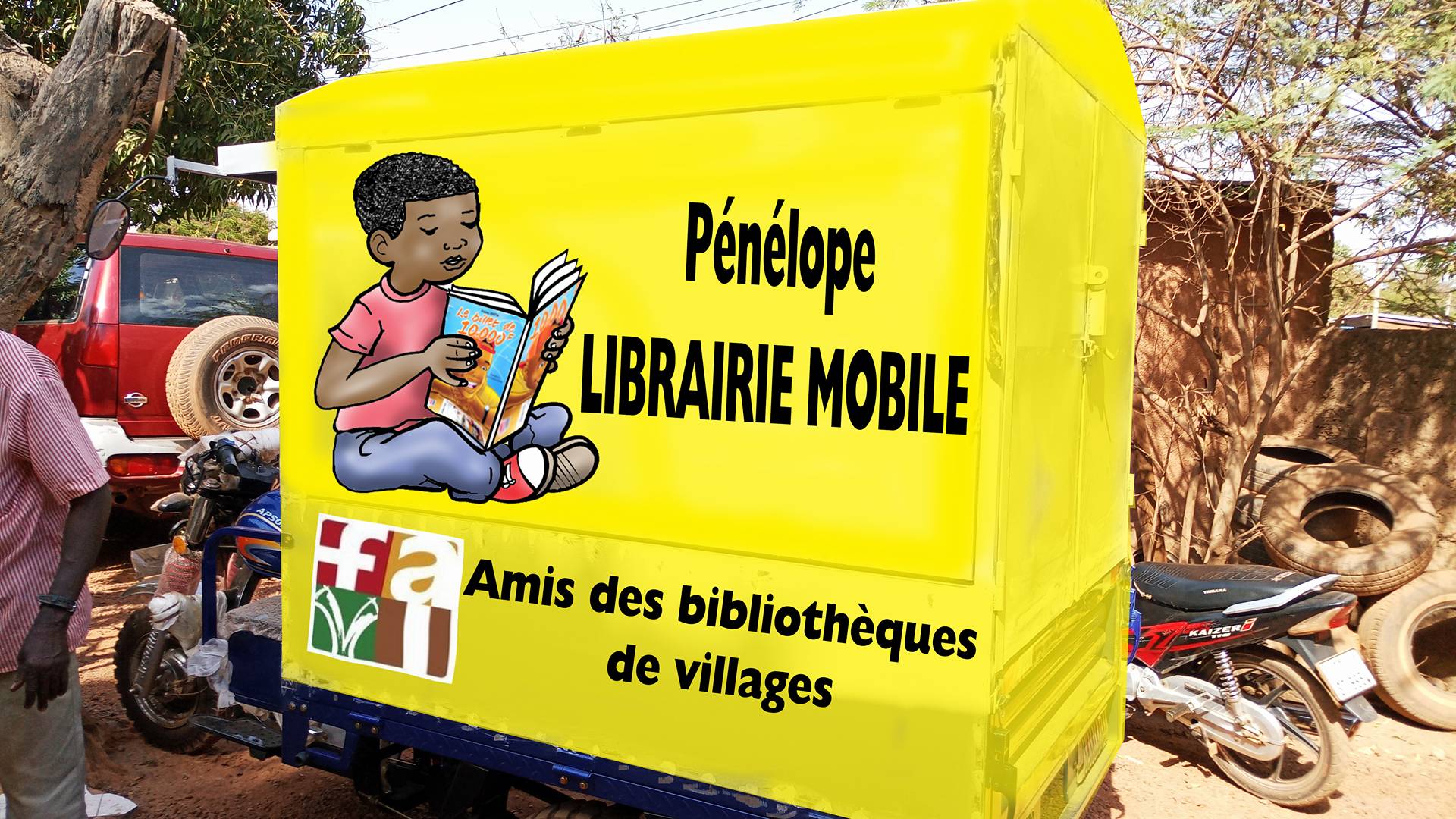 nks to generous donation from Penelope Hartnell!
National Bookmobile Day celebrates our nation’s bookmobiles and the dedicated library professionals who provide this valuable and essential service to their communities every day. Each year, it is celebrated on the Wednesday of National Library Week. In 2018, National Bookmobile Day will be Wednesday, April 11.National Bookmobile Day is an opportunity for bookmobiles fans to make their support known—through thanking bookmobile staff, writing a letter or e-mail to their libraries, or voicing their support to community leaders.
Posted in Burkina Faso
Comments Off on National Bookmobile Day April 11 2018
Camille Bordas short story “The State of Nature” in The New Yorker
I was flummoxed by Camille Bordas short story “The State of Nature” in April 9 2018 The New Yorker. It is clearly a very formal exercise. There is something about the syntax or the paragraph construction that could be understood by writing experts. But not by a non-expert. The story is meta; the narrator directly addresses the reader here and there. Simmons’ girlfriend is initially K. The cat is Catapult. Rape is hinted at. The protagonist is an ophthalmologist. So “seeing” correctly is a concern. But in the end, the Malian flea market seller says, “It must be hard, not being able to speak, in moments like these.” And the narrator is given a whistle. Her father is a silent hermit. At the end as she walks through the silent empty street, she blows the whistle, and no one comes.
Clearly (to me) an elaborate and complex metaphor. If you are an English major or need a paper topic, study this story! I bet there are connections to Signs and Symbols.
Unusually, the comments at Mookse were not very illuminating.
Posted in Book and film reviews
Comments Off on Camille Bordas short story “The State of Nature” in The New Yorker
My favorite picture of the month from FAVL library: The reading club of Barsalogho in #Burkina

Posted in Burkina Faso
Comments Off on My favorite picture of the month from FAVL library: The reading club of Barsalogho in #Burkina
Howard French pulls no punches in review of new bad book about African history
On his very first page, James concedes that “change” driven by European imperialism generated conflict in Africa, but he never returns to dwell upon this at length. Instead, he immediately offers what seems like a pat, exculpatory defense: Europeans “believed [change] would benefit them and their African subjects.” This passage sets the tone for much of what follows. “Strange as it may seem, Charles de Gaulle, Mussolini, Cecil Rhodes and Nikita Khrushchev believed that their countries had something of value to offer Africans.” He calls the slicing up of different parts of the continent by its new colonial masters “a dual partnership of physical and spiritual regeneration [that] was appropriate for Africa, which in the popular imagination was depicted as a ‘dark’ continent.”
Source: A History of Denial | by Howard W. French | The New York Review of Books
Posted in Burkina Faso
Comments Off on Howard French pulls no punches in review of new bad book about African history
That “Are Men Smarter at Science? They Certainly Think So” study…. don’t even bother
Young men in a biology class were somewhat more confident about how smart they were compared with young women. A sample of one class from one university, with who knows how much p-hacking and forking paths, nevertheless goes viral because lots of people think that it likely to be generally true.
While the study was based on students in a single class, it underscored how differently men and women in science perceive their abilities. Such self-perceptions can have cascading effects on motivation, participation and confidence.
Notice the journalist’s clever “can” there… self-perceptions can also leave to non-cascading effects….
And way at the bottom of the article:
The researchers cautioned against overgeneralizing the findings until the study could be replicated in different classes and schools.
Posted in Burkina Faso
Comments Off on That “Are Men Smarter at Science? They Certainly Think So” study…. don’t even bother
Gaida Hinnawi sings Ilak Shi
Ilak Shi from Brian Wengrofsky on Vimeo.
Posted in Music
Comments Off on Gaida Hinnawi sings Ilak Shi
Great summary of World Bank report on restrictions on women’s equality around the world
The Women, Business and the Law report is out, and here is a nice summary from PS magazine:
A major barrier raised in the report is women’s right to work at night. Women are prevented from working the same night hours as men in 29 countries, including India, which prohibits them from working in factories between 7 p.m. and 6 a.m. India’s female labor participation rate is one of the lowest in the world at 24 percent. In Sri Lanka, women are not allowed to work after 10 p.m. in the retail sector—a restriction, Iqbal said, that employers aren’t happy with. “It should be a matter of choice—women should be allowed to get the jobs that they are qualified for,” she said. The report notes that many of the most restrictive laws—including those that require a woman to have her husband’s permission to work or restrict the kinds of work a woman can do—come from old European legal codes that were introduced to sub-Saharan Africa, Latin America, and Asia under colonization.
…
Of the 87 legal reforms enacted across the world since the last survey, property rights improved in only one country. Ecuador repealed a law that favored husbands’ decisions in cases of disagreement between spouses on marital assets. A trend that we’ve noticed is that property laws are much slower to change than labor laws and gender-based violence laws,” Iqbal said. “These issues are very slow to change because they affect asset allocation.” But, she said, that might not be such a bad thing in the long run. “If you reform property law too quickly you can engender a backlash that can work against women’s rights.”
Posted in Gender
Comments Off on Great summary of World Bank report on restrictions on women’s equality around the world
Is there a good way to download the coordinates of a path or route on google map into a file?
The folks at stackoverflow just dismissed this question. But is an honest and useful question to have answered, for some applications. And here is a good ttip from fentonsrule:
This is something I learned on my own. If you create a path, it shows up under places on the left side of your screen. If you will select that path on the left side (mine highlights blue), perform a ctrl c to copy data to the clipboard, open excel or word or any text editor and perform a ctrl v to paste into the editor. All of the gps points from that route are now in the text editor. You will have to perform cleanup on the data, i.e. delete multiple lines of html (I think) that you don’t need and separate the coordinates as needed, but all of the points are there. I sincerely hope this helps as it helped me numerous times.
Source: Can I create a path and export the Lat/Lon series as a text file? – Google Product Forums
Posted in R statistics
Comments Off on Is there a good way to download the coordinates of a path or route on google map into a file?
Wonderful. I want to watch 2001 again now.
Wait, I thought, the broken wine glass! Or could it be a water glass? At any rate, it is one of the movie’s more famous riddles. The moment is so deliberate and messy and startling — the hotel sequence is for the most part hushed and austere — and yet so arbitrary. In other words, it reeks of symbolism. What was Mr. Kubrick’s point in punctuating his visionary film with something so quotidian?
This is something many critics have chewed over — and me too. I have read that the broken glass was meant to echo the splintered animal bones that become weapons of war in the prehistoric “Dawn of Man” sequence that begins the movie, or that it symbolizes the fragility of existence, or the shattering of the “subject-object” rationality with which homo sapiens traditionally view the world. One essayist divines a reference to “the broken glass of the Judaic marriage ceremony,” a symbol of “the end of one way of life and the beginning of a new one.”
Posted in Book and film reviews
Comments Off on Wonderful. I want to watch 2001 again now.
One of my mother’s favorite songs
It seems to have been written originally by James Bland.
And the Bob Dylan and The Band version is here.
HT: Sue Kevane
Posted in Music, Personal Kevane life
Comments Off on One of my mother’s favorite songs
Conversations every family has
Thanks NYTimes and Luis Ferré-Sadurní for an honest and difficult job of reporting a universal (not just Puerto Rican) truth. I have heard the exact same conversation in Burkina Faso.
“I see it as a safety issue,” Magaly said from behind the wheel. “I don’t care about my father’s will. He’s going to fall.”
“He falls here,” José answered.
“But we’re here to rescue him and keep him safe,” she said.
“They’re sitting in that hotel room crying, wanting to be home,” he said.
Magaly fired back: “So we’re just dumping them in Puerto Rico?”
One of the biggest threats Enrique and Emma faced right after the hurricane was the collapse of the health system. Hospitals lacked power and the sweltering heat could be deadly to the sick and the elderly. Concerned for her parents’ poor health, Omaira, who lived with them in Puerto Rico, flew with them on one of the many humanitarian flights ferrying Puerto Ricans to the mainland.
Posted in Burkina Faso
Comments Off on Conversations every family has
Excellent summary of Ansaroul Islam and terrorism problem in Burkina Faso
Ansaroul Islam has carried out at least 78 attacks in northern Burkina Faso since December 2016, according to a dataset compiled from open-sources by the authors, which provides a picture of the group’s TTPs. The group’s primary targets are civilians and civilian infrastructure. This includes kidnappings, assaults, and assassinations of local elders, mayors, or other prominent civilians across the Sahel region. Administrative buildings, houses, and schools have also been burned down by Ansaroul Islam militants.At least 30 attacks targeted defense and security forces and members of self-defense groups,r which resulted in at least 40 fatalities. IEDs were used in five of these attacks. Ansaroul Islam members also carried out 35 targeted killings, assassination attempts, and abductions that resulted in 45 fatalities. At least 11 of the individuals killed were notables, including village chiefs, local councilmen, imams, and marabouts. Education and government infrastructure was targeted on at least 13 occasions, 12 of these attacks targeted schools. However, the group has threatened civil servants, including teachers, mayors, judges and court officers, on a much larger scale, but were not added to the overall count as these were only threats of violence.Ansaroul Islam has also routinely targeted Burkinabe security forces, including the regular military, police officers, and gendarmerie personnel. A large portion of these assaults have been against fixed positions such as checkpoints and buildings. However, Burkinabe patrols have also been the focus of its attacks.Ansaroul Islam is more than just a terrorist group. It has acted as a self-defense group, protecting communities from whom it enjoys support,46 as well as herders and livestock in a region where banditry, cattle rustling, and intercommunal violence is rife. At the same time, the group itself engages in activities such as localized robberies and cattle rustling.47 The group’s involvement in both terrorist activity and banditry means that it is best described as a hybrid terrorist-criminal group. The group’s second in command and military commander, Oumarou Boly, was himself a highwayman. That said, the group’s terror agendas have so far outweighed its criminal agendas.
Posted in Politics
Comments Off on Excellent summary of Ansaroul Islam and terrorism problem in Burkina Faso
Replacing battery in 2005 Prius
I used the Internet before, but had to replace again after 3-4 years. Same excellent explanations. Thank you, and to make your public service even more available, here are the links for future battery-replacers. I have one piece of advice to add: hold onto your tools carefully…. if they fall into the battery well after you have replaced everything… well, you have to under the entire apparatus to retrieve the socket wrench. Not saying it happened to me.
Opening trunk is first mystery when battery is dead.
Excellent instructions.
And video:
Posted in Personal Kevane life
Comments Off on Replacing battery in 2005 Prius
Baloji feat. Klody Ndongala – Peau de Chagrin/Bleu de Nuit
HT: @PieterRemes
Posted in Music
Comments Off on Baloji feat. Klody Ndongala – Peau de Chagrin/Bleu de Nuit
Le président Roch ne reçois pas le REN-LAC? Quel avenir donc pour #Burkina?
Nous avons une demande d’audience qui a souffert et qui souffre toujours à la présidence du Faso. Depuis le 22 janvier (2018), nous avons introduit une demande d’audience pour rencontrer le président du Faso pour une interpellation que notre organisation a adoptée à l’occasion de la célébration de ses 20 ans d’existence, célébrés au mois de décembre (2017). C’était non seulement pour lui faire le bilan de la corruption pendant ces 20 ans d’existence du REN-LAC, mais également faire des sortes de propositions qui sont en conformité avec le programme du président du Faso lui-même en matière de lutte contre la corruption. Cette lettre est restée sans suite…. Nos rappels n’ont pas produit d’effets, jusqu’à ce jour. On a relancé plusieurs fois et on nous a dit, à chaque fois, de rester à l’écoute. Ce qui nous oblige d’ailleurs à nous déterminer à envoyer l’interpellation sans avoir l’audience et à poursuivre notre chemin autrement.
Posted in Burkina Faso
Comments Off on Le président Roch ne reçois pas le REN-LAC? Quel avenir donc pour #Burkina?
Menaces terroristes au Nord : Inquiétude et consternation à Kaïn
Excellent article de Yann Nikièma sur lefaso.net:
L’insécurité grandissante dans la zone frontalière met à rude épreuve le fonctionnement du système éducatif. Selon les statistiques de la Direction Provinciale de l’Education Préscolaire, Primaire et non formelle du Yatenga (DPEPPNF/Y), la commune de Kaïn compte 13 écoles primaires publiques, 03 écoles coraniques et 75 enseignants dispensent des cours au profit de 2428 élèves. L’ouverture du lycée départemental depuis quelques années et qui compte six classes actuellement contribue à la résolution de la problématique de l’enseignement dans cette localité. Malheureusement, lors de notre premier séjour dans la commune, aucun établissement n’était ouvert à cause de la grève des enseignants et de l’assassinat du professeur. A l’heure même où les évaluations des élèves ont commencé sur le territoire provincial (12 février 2018) pour sauver l’année scolaire, les écoles du territoire communal de Kaïn lors de notre second passage restent toujours fermées.
Cette situation est déplorée par cet instituteur de l’école du village de Nénébourou qui se confie : « C’est avec regret que les enseignants ont déserté les classes pour sauver leur vie. Nous n’avons aucune garantie de protection face à la menace des forces du mal. Nous savons que nous sommes dans une zone dite « rouge », la barbarie de la nuit du 26 Novembre 2017 est venue tout confirmer. On va faire comment ? Que feriez-vous à notre place ? Il faut que l’Etat prenne ses responsabilités pour sauver l’école ».
Posted in Burkina Faso
Comments Off on Menaces terroristes au Nord : Inquiétude et consternation à Kaïn
Makala, documentary by Emmanuel Gras
Follows a charcoal maker, Kabwita, through several months of arduous physical labor. The Guardian has no idea what to make of it. Great for teaching.
Posted in Book and film reviews, Development thinking
Comments Off on Makala, documentary by Emmanuel Gras
Recent reading…
La Tabla Esmeralda, by Carla Montero. I wanted to read a big fat novel in Spanish, and this one certainly did the trick. A rehash of Possession.
Vie et ensignement de Tierno Bokar, by Amadou Hampate Ba. Tremendously interesting short biography of Ba’s teacher. Great insight into how conflict can arise over whether there should be eleven or twelve beads in bracelets for counting prayers…
Alfred Diban: Premier chrétien de Haute-Volta, by Joseph Ki-Zerbo. Gripping account of his enslavement around 1895 and subsequent attempts to escape.
What Hetty Did, by J.L. Carr. Wonderful writing, but the plots sags at various points. Carr capturing a way of speaking, a way of being. Hard not to appreciate his love for the character.
Revelation Space, by Alistair Reynolds. Wanted to read a sprawling space opera but found this quite disappointing. I guess I wanted to read a really good sprawling space opera.
Consider Phlebas, by Iain M. Banks. Another space opera that was disappointing. Both of these may as well have been written by Heinlein in 1965.
Posted in Book and film reviews
Comments Off on Recent reading…
 Michael Kevane