Sinkane – Favorite Song… heard this on Air France on way to and back from Burkina…. ya zool, ya zein…

Posted in Music | Comments Off on Sinkane – Favorite Song… heard this on Air France on way to and back from Burkina…. ya zool, ya zein…

Interview with Liu Cixin (English subtitles)

Posted in Development thinking | Comments Off on Interview with Liu Cixin (English subtitles)

Are you a social scientist or historian who disdains the idea of counterfactuals? Get thee away, Satan.

A nice summary of a general problem in the social sciences, from Eric Hilt:

The historians of capitalism would also have benefitted from incorporating counterfactuals into their analysis. These are, of course, thought experiments in which some condition is changed, contrary to fact, and the consequences considered. Many historians apparently have a strong distaste for counterfactual histories … Yet the reason economic historians think about counterfactuals is not due to an interest in specifying alternative histories. Rather, it is because all statements about causal relationships contain counterfactuals. To say that the gold standard caused the Great Depression is to say that absent the gold standard, the Great Depression would not have happened; these two statements are equivalent. There is of course no way to know exactly what the international monetary system of the late 1920s would have looked like in the absence of the gold standard without making strong assumptions, but thinking about that world helps identify forces unrelated to the gold standard that may have contributed to the Great Depression. Economic historians typically investigate counterfactuals not by specifying counterfactual histories, but by comparing cases where a condition is present to cases where it is absent.

For it is written, Thou shalt do homage to the counterfactual, at least a little bit, and a little bit explicitly (not poetically).

Source: Economic History, Historical Analysis, and the “New History of Capitalism”

Posted in Development thinking | Comments Off on Are you a social scientist or historian who disdains the idea of counterfactuals? Get thee away, Satan.

Reestablishing electricity grid looks like a tremendous problem in Puerto Rico; main plant flooded

El director ejecutivo de la Autoridad , Ricardo Ramos, informó que el 80% del sistema de transmisión y distribución de la Autoridad de Energía Eléctrica (AEE) colapsó tras el azote del huracán María. Dijo que el reto para energizar Puerto Rico está en la transmisión y distribución y que la central Cambalache fue una de las unidades de generación más afectadas porque se inundó. “El reto es que no tenemos transmisión para poder sacar la energía de esas plantas, por lo menos traerlas acá, al área norte, que es donde está la mayor parte de la demanda. Por lo tanto, la decisión que hemos tomado es operar a nivel separado. No es un sistema integrado.

Source: Minuto a minuto: ¿Cómo está la isla a una semana del azote de María? | El Nuevo Día

Posted in Burkina Faso | Comments Off on Reestablishing electricity grid looks like a tremendous problem in Puerto Rico; main plant flooded

Robin Einhorn’s review of Walter Johnson on slavery and cotton in the South

It is a decent review, but she doesn’t finish the thought in the review…

If all we mean by “capitalism” is exploitation for profit, then Kenneth Stampp’s The Peculiar Institution (1956) might have put an end to the discussion by demonstrating the profit-driven exploitation and cruelty of slavery. Johnson, however, has more in mind. Before turning directly to the production of cotton on plantations, he describes the violence of territorial conquest, the savagery of white responses to real and imagined slave revolts, and the ecological destruction of turning diverse natural landscapes into grids of cotton fields.

We never learn what the “more in mind” actually is!  I don’t think he actually has anything “more in mind” that is coherent.  Why interesting to me? Because in places like Burkina Faso, mining is booming, industrial and artisanal.  Academic writers always seem to have “more in mind” when they discuss mining in West Africa but in the end mining is like selling plastic buckets imported from China or growing cashew trees.  It is what it is, not something “more.”  Academic writing often specializes in creating the illusion that there is something more (and coining or deploying special jargon to describe the more, rather than using ordinary words, is part of the mystification).

Posted in Burkina Faso | Comments Off on Robin Einhorn’s review of Walter Johnson on slavery and cotton in the South

Stories from The New Yorker

On the flight back from Burkina Faso I got to read three short stories from old issues of The New Yorker that I found in the FAVL office, leftovers from 2014!

“Story with Bird” by Kevin Canty is an amazing 2 page exercise in capturing a relationship with remarkable style.  I am not sure the “animal eyes in the dark” bit worked.  But much of the writing was like seeing a master technician at work! Tremendous review by Betsey over at Mookse.

“Rosendale” by Paul La Farge.  I was less taken with this story.  Very deliberate writing about writing, this time a horror story.  Stops and starts and breaking of boundaries, and pretty interesting.  But I did find myself skipping about.  She’s writing a book but she’s also a crack-addicted pole dancer?  Trevor did not like it either, over at Mookse, and he has reasonable reasons.

“Ordinary Sins” by Kirsten Valdez Quade.  Really this one went over to Raymond Carver territory big time (or to go the other direction, Breaking the Waves), and was just too much setup for a brief, quiet moment of two people holding each other. Mookse commentators and I part ways on this story.


Posted in Book and film reviews | Comments Off on Stories from The New Yorker

What libraries are for! Reading in Sumbrungu

reading in sumbrungu

Posted in Reading | Comments Off on What libraries are for! Reading in Sumbrungu

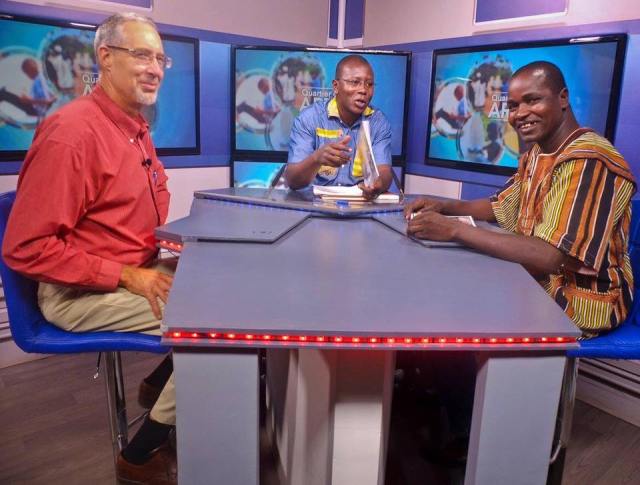
Evariste Meda from BurkinaInfo TV interviewed Dounko and I about FAVL

It was fun to do a studio interview.  Evariste Meda was a great interviewer.  FAVL-BF director Sanou Dounko did a fantastic job.

BurkinaInfo sept 17

Posted in Burkina Faso | Comments Off on Evariste Meda from BurkinaInfo TV interviewed Dounko and I about FAVL

Long, depressing opinion piece on hospital services in Ouagadougou

La situation est plus préoccupante au Centre hospitalier universitaire Yalgado Ouédraogo (CHU-YO), le plus grand centre hospitalier du pays. L’on se rappelle que lors de la visite du Premier ministre Paul Kaba Thiéba, le 6 juin dernier, le scanner était en panne et il fallait la somme de plus de 188 millions de F CFA pour le réparer. Et ce jour, le directeur général Robert Sangaré s’est voulu on ne peut plus clair : « nous fonctionnons avec certains vieux équipements qui nécessitent des interventions fréquentes de maintenance. Et les maintenances sont aussi protégées et soumises à des contrats avec les fournisseurs. Par exemple, la maintenance du scanner se fait par la Sogemab (la Société de gestion de l’Equipement et de la Maintenance Biomédicale, Ndlr). Maintenant, la Sogemab dit qu’elle n’a pas eu les moyens que l’Etat devrait mettre à sa disposition pour nous accompagner. Cela nous l’avons posé à qui de droit. La réparation du scanner nécessite 188 millions de F CFA, somme que nous n’avons pas. Il faut que le ministère de la Santé et l’Etat interviennent exceptionnellement pour nous permettre de réparer le scanner ».Après ce cri de cœur, le scanner avait été réparé mais malgré tout d’autres appareils continuent d’être hors services. Selon une de nos sources au sein de l’hôpital, Yalgado est tout simplement dépassé.« Les équipements sont vétustes sinon inexistants. Les consommables et les réactifs sont le plus souvent en rupture. Actuellement (l’interview a été réalisée le 7 aout 2017, Ndlr) la bactériologie ne fonctionne pas depuis plusieurs semaines parce qu’il n’y a pas de réactifs. Pour un CHU, c’est vraiment impensable ». Tel est le triste constat dressé par Hamadi Konfé, le responsable de la sous-section du Syntsha à Yalgado Ouédraogo.

Source: Hôpitaux publics burkinabè : Ce que le RAME a découvert – L’Actualité du Burkina Faso 24h/24

Posted in Burkina Faso | Comments Off on Long, depressing opinion piece on hospital services in Ouagadougou

Solari board at a train station, takes you into the past

My sister reminded me of what these are called.  We had been talking about flying on the upper deck of 747 or Airbus… how for our generation that was “the future” and then of course these are “the past.”

Posted in Personal Kevane life | Comments Off on Solari board at a train station, takes you into the past

Feersum Endjinn by Iain Banks

Last year I start to read Wasp Factory by Iain Banks but I could not finish it: too bleak, too violent, too disturbing.  But I saw a mention of Feersum Endjinn somewhere, and so requested it through interlibrary loan.  What a great book.  Four narratives overlapping a central event in the far future where the humans who remained on Earth after the singularity have renounced AI’s and permanent virtuality, and so exist in “base reality” where they are essentially quasi-immortal since their brains are linked through implants in continuous time to a giant database (the crypt) and so it they die they can be restarted at last moment of consciousness.  Like Robert Reed’s Greatship.  Anyway, Earth is under threat.  One narrative is a “chief scientist” and the rulers, another a recently deceased member of the ruling class who exists only in the crypt, another the asura, a program that emerges from the crypt as a failsafe, and finally Bascule, written in phonetic Dickensian-English.  The four narratives come together in a reasonably satisfying way (it is a novel, so things have to be tidied up at the end).  The Bascule narrative is what makes the novel special.  The phonetic English forces the reader to slow down.  I found I could only read one section at a sitting.  So Banks manipulates reader time, which is a nice and relevant effect.

Posted in Book and film reviews | Comments Off on Feersum Endjinn by Iain Banks

Understatement of the year, but so true: Supervision matters for effective public services

This is obvious and true, but well worth the experiment because it has to be reinforced over and over again for NGOs and government:
We conclude that sustained supervision is crucial for achieving persistent improvements in contexts where the lack of external competition fails to create incentives for the adoption of effective managerial practices.
After 15 years of running Friends of African Village Libraries, if there is one lesson from experience that is reinforced over and over again it is this: a community librarian that is not enmeshed in a network of supervision and support will quickly become a “sleeping librarian” if he or she even shows up at all.  Effectively delivering public services in scattered locations is very expensive for this reason, but few donors want to recognize this issue.
Many NGOs keep waiting and hoping that technology will help with the problem.  Many NGOs are still waiting for Duflo to deliver those promised inexpensive tamper-proof digital cameras that send (for free!) pictures to a central server and automatically flag absences (and then deduct from paycheck according to rule) and then automatically respond (with compassion but firmness) when librarian sends in four page handwritten letter explaining absences as due to funeral of great-aunt.
The sentence is from a sobering paper “Management, Supervision, and Health Care: A Field Experiment” by Dunsch, Eze-Ajoku, @MMacis, & @tukopamoja.
Posted in Development thinking | Comments Off on Understatement of the year, but so true: Supervision matters for effective public services

Recent fiction reading

Arcadia, by Iain Pears.  Superb sci-fi/fantasy novel.  If you liked The Magicians by Lev Grossman, or Jo Walton’s Among Others, then good news: this is much better!  It really is almost perfect.  And it deliberately mashes in As You Like It and George Smiley.  So fun!  Straightforward style, complex and convoluted story.  Often these time-travel and rabbit-hole tales have trouble with the last third, but Pears does a remarkable job of tying up the loose ends and not disappointing.  As a Goodreads reviewer put it, “The most entertaining Shakespearean time-travel dystopian science fantasy spy thriller romance I’ve read in that terribly overcrowded genre.

The Emperor’s Children, by Claire Messud.  I could not slog my way through to the end after about a third. I have a well-known bias against “American” novels featuring people like my peers living “exciting” lives in New York City.

Big Sur by Jack Kerouac.  See above. Messud is in good company. At least I learned the name of the bridge we sometimes drive over when going down to Garrapata.

Posted in Book and film reviews | Comments Off on Recent fiction reading

Mamdani defines decolonising the mind as critical thinking in a liberal arts education

From a nice summary of a recent lecture in South Africa.  Saying that decolonizing education is critical thinking strikes me as a trite observation dressed up with a raised fist. Good tactic? Deep thought? Amazing metaphor? Silly? Dismissive of people everywhere who teach critical thinking every day?

5. What does it practically mean, then, to decolonise education?

Mamdani answered this question with a practical example of how he teaches at Uganda’s Makerere University. He requires his PhD students to identify a colonial text that was a foundation and reference point that Western academics would draw from. His students have to understand the language of whom the text spoke of, and are not allowed to graduate unless they have research proficiency in two other languages besides English. He then asks his students to analyse and describe the author’s assumptions in deciding what information is relevant.

“What categories is he/she utilising to validate certain information and invalidate other information? And then I say to them, now you use the same information and give me a different narrative than the author. That’s decolonisation,” he said.

Posted in Burkina Faso | Comments Off on Mamdani defines decolonising the mind as critical thinking in a liberal arts education

Listening to LCD Soundsystem’s new song, “American dream” and reading Garth Greenwell’s “An Evening Out” in The New Yorker

Let’s just say that in my opinion they are a perfect pairing.  If you like your New York global-cosmo gay scene nostalgic, melancholy, aging, incredibly perceptive, excellent writing and music…  It is the 2017 version of the 1970s Manuel Puig (Kiss of the Spider Woman) – Joan Baez (The Altar Boy and the Thief) pairing maybe?  Not a great discussion of Greenwell’s story over at Mookse, but I have to admit while I enjoyed listening to the author read the first half on the podcast (and then reading the ending in print later) I probably won’t read to much more by him. I can’t bring myself really to deliberately choose these rather banal stories of Americans struggling with meaning in fairly ordinary lives.  No matter how insightful and craft-filled.

Posted in Book and film reviews, Music | Comments Off on Listening to LCD Soundsystem’s new song, “American dream” and reading Garth Greenwell’s “An Evening Out” in The New Yorker

Sharp words from a police officer about the lack of anti-terrorist strategy in Burkina Faso

Un gendarme, qui a participé à l’assaut de dimanche, se montre tout aussi critique envers les autorités du moment : « Nous n’avons pas du tout tiré les leçons de l’attaque du 15 janvier 2016. Il y a eu des menaces avant l’attaque. On était sur le qui-vive. Ces derniers mois, la fréquence des attaques dans le Nord avait augmenté. Des attaques ciblées. Mais personne n’a pris ses responsabilités. Personne ne s’est posé la question de savoir pourquoi ces attaques avaient lieu. L’Etat n’a pas de stratégie antiterroriste. Les autorités ne font que boucher les trous. »

Source: Pourquoi le Burkina Faso n’est plus en sécurité

Posted in Burkina Faso | Comments Off on Sharp words from a police officer about the lack of anti-terrorist strategy in Burkina Faso

‘The Violin Player’ review from Hollywood Reporter

On Netflix.  Interesting.  I think OK to fast-forward through the beginning, which indeed is very slow.

On his way home, the unexpected happens. At the train station, on the other side of the tracks, a distinguished looking man in glasses (a coolly aloof Adil Hussain) keeps staring at him and his violin case. Surprised and embarrassed, the violinist can’t avoid his steely gaze. This goes on for quite a while, far longer than necessary in fact, until finally the man comes over and makes a proposal he can’t refuse. The stranger claims that only live music will do, and the pay is suspiciously good.From this point on, the story becomes riveting, if no less mysterious. The violinist follows the stranger through the back alleys of the city and up the stairs of a sprawling, completely deserted building shot like a haunted house. Mukherji recounts what follows next with sure-footed artistry, while his hero plays up an emotional storm composed by Bhaskar Dutta and Arnab Chakraborty.

Source: ‘The Violin Player’: Mumbai Review | Hollywood Reporter

Posted in Book and film reviews | Comments Off on ‘The Violin Player’ review from Hollywood Reporter

Panda Bear – Boys Latin

Posted in Music | Comments Off on Panda Bear – Boys Latin

The Greenville Eight – Integrating American libraries in the South

On the afternoon of July 16, 1960, eight African-American students bravely filed into the whites-only Greenville County (S.C.) Public Library and sat down in the reading room to look at newspapers and books. One of those students was a young Jesse Jackson—later to become famous as a civil rights activist and minister—who was home in Greenville on summer break from the University of Illinois.Joan Mattison DanielJoan Mattison DanielAnother of the students was Joan Mattison Daniel, a then-18-year-old freshman at Morris Brown College in Atlanta, who recently told American Libraries that “Jesse Jackson was responsible for our getting together to stage the sit-in. He had come home in January and needed a book to write a paper. The book was not at the colored branch library, a small, one-room house on East McBee Avenue.” Librarian Jeanette Smith told him it would take another six days to get the book he wanted, which would have been too late. “So Jackson went to the main library to look for it,” Daniel said. “He was told he could not use that library, and that was the beginning of it.” He vowed to come back in the summer.

Source: The Greenville Eight | American Libraries Magazine, by George M. Eberhart

Posted in Public library history | Comments Off on The Greenville Eight – Integrating American libraries in the South

Wayne Wiegand’s short article on the struggle of young people like Joseph Jackson to desegregate libraries in the South in 1961

Read the full article here, “Desegregating Libraries in the American South”
Forgotten heroes in civil rights history” by Wayne A. Wiegand in American Libraries.

At 11 a.m. on March 27, 1961, nine students from the historically black Tougaloo College walked into the all-white Jackson (Miss.) Public Library. Joseph Jackson Jr., their leader, approached the circulation desk. With heart thumping, he stammered a message he had memorized: “Ma’am, I want to know if you have this philosophy book. I need it for a research project.”

“You know you don’t belong here!” the library assistant yelled, proceeding to call the library director.

“May I help you?” the latter asked, coming out of her office.

“We’re doing research,” the students responded.

“There’s a colored library on Mill Street,” she said. “You are welcome there.”

Almost immediately, Jackson later reported, police entered the building and told the students to get out of the library. No one moved. The chief of police then told them that they were under arrest.

Six officers placed the students into squad cars and at the station charged them with breach of the peace because they failed to leave the library when ordered. They were booked into the local jail, where each was held on $500 bond.

Posted in Public library history | Comments Off on Wayne Wiegand’s short article on the struggle of young people like Joseph Jackson to desegregate libraries in the South in 1961