Permission to bloviate now granted: No scholarship on popular resistance to coup attempts #Burkina

pop res to coup attempts

Posted in Politics | Comments Off on Permission to bloviate now granted: No scholarship on popular resistance to coup attempts #Burkina

Was the exclusion of the CDP a strategic mistake that led predictably to the coup?

The transition parliament voted in April 2015 a new electoral code that had a new clause (that read as if written by a 20 year old) excluding persons from running for office who had supported modification of Article 37 of the constitution that limited the presidential term.  President Compaoré was ousted in October 31 2014 precisely because of his, and his party’s (CDP), plan to change the constitutional and permit him to legally run for office again.  An ECOWAS court ruled in late July against the transition parliament’s change to the electoral code.   But the transition government decided to ignore the ECOWAS decision.  The Constitutional Council ruled that specific individuals could be excluded from the election. So in late September the CDP candidate for president Eddie Komboigo and former foreign minister Djibril Bassolé (running under the banner of a new party, Nouvelle alliance du Faso (NAFA)) were excluded.  A few weeks earlier, CDP candidates for the legislature had been excluded.

The coup leaders today apparently cited this exclusion as the main justification for the coup.  The coup leader Gilbert Diendéré is closely tied to the CDP: he has been a close ally of ex-President Compaoré, his wife was second on the CDP national list for the chamber of deputies in the October election.

But I think the coup would have been organized regardless of the exclusion of CDP candidates.  For three reasons:

  1. I think Komboigo or Bassolet winning was likely to be a low-probability event.  There might have been a run-off, and they might have been able to pick off Roch or Zeph.  But seems pretty unlikely.  Seems more likely that Roch or Zeph would have joined together.
  2. The transition was likely to try to restructure the RSP regardless as a last act before the election, and that would have been perfectly legal under the transition authority. That certainly would have provoked a coup.
  3. If the CDP did not win the election, judicial inquiries into the killings of Thomas Sankara and Norbert Zongo and possibly others would have proceeded, and Gilbert Diendéré and others from the RSP would have been implicated.
Posted in Politics | Comments Off on Was the exclusion of the CDP a strategic mistake that led predictably to the coup?

L’appel de Cheriff Sy, Président du CNT

Des éléments du RSP ont fait irruption dans la salle du Conseil des ministres aux environs de 14h30 et ont pris en otage le Président du Faso, Chef de l’Etat, président de la transition, SEM Michel Kafando, le Premier ministre Yacouba Isaac Zida, le ministre de la fonction publique, du travail et de la sécurité sociale, Pr Augustin Loada et le ministre de l’habitat de l’urbanisme Réné Bagoro. Cette énième irruption d’éléments du RSP, est une atteinte grave à la République et à ses institutions. J’appelle tous les patriotes à se mobiliser pour défendre la mère patrie. Des tentatives de dialogue sont en cours entre la Haute hiérarchie militaire et les éléments du RSP. Le devoir de mémoire et le souvenir des fils et filles tombés pour que naisse une nation burkinabè réconciliée avec l’histoire, commande que chacun de nous se mobilise pour la libération immédiate du Chef de l’Etat, du Premier ministre et des ministres arrêtés Nous en appelons au devoir de solidarité des forces vives, des forces politiques et de la société civile, et de la communauté internationale avec tout le peuple burkinabè pour faire échec à cette opération. Moumina Cheriff Sy Président du CNT

Source: Situation au Burkina : L’appel du Président du CNT

Posted in Politics | Comments Off on L’appel de Cheriff Sy, Président du CNT

Early hours of coup attempt in Burkina Faso, the morning is crucial

Elements of the Presidential Security Force (Régiment de sécurité présidentielle, or RSP) attempted a coup in the afternoon in Ouagadougou at the Presidential Palace in Burkina Faso.  They have taken President Marcel Kafando and Prime Minister Yacouba Isaac Zida (who used to be the number two man in the RSP) prisoner, and possibly many of the ministers in government.  They have apparently released the four female ministers. (What can you say about that?  One of the ministers, Josephine Ouédraogo, was an ally of Thomas Sankara and went into exile in 1987 after the Blaise Compaoré coup against Sankara.. presumably she’ll be on the front lines tomorrow.)

It is likely that tomorrow morning there will a massive popular mobilization against the RSP.  There is virtually no segment of the population of Burkina Faso in favor of this coup attempt, except possibly some members of the old presidential party (the CDP… and apparently the number 2 guy in CDP, Léonce Koné, openly supported the coup on France24).  But those members of the CDP deluded into thinking that somehow the return of the Blaise order might be as easy as his ouster, should view this coup attempt with trepidation.

Coups have an internal logic that is relatively easy to understand in theory but very hard to implement in practice: all the coup leaders, and their potential opponents, have to come to a realignment of expectations very quickly.  In November 2014 (which could be interpreted as a coup, since RSP number 2 Isaac Zida ended up taking power) the coordination was easy because all the opponents simply fled after the second day of the uprising, so the only coordination was to fill the vacuum (rather than choose a side to fight for).  In this coup attempt, it is very clear there will likely be a lot of resistance by that same mobilized youth, so sides will have to be chosen and hence coordination will be quite hard.  The coup in its present form seems to me very unlikely to succeed.

Either the coup will fail rapidly (i.e., tomorrow the RSP soldiers will negotiate for a large sum of money and safe passage to Côte d’Ivoire) or it will lead to a violent interregnum (tomorrow the RSP will shoot a lot of civilians, and that might lead the army to group itself in Bobo-Dioulasso, leading to a Côte d’Ivoire-ish standoff, with low level violence for some and penury for many).

I hope that U.S. Ambassador Tulinabo Mushingi takes the high road, and rejects likely RSP efforts to somehow link their coup to “war on terror” issues.  He will of course do that publicly, but it is what he and the embassy (as well as France) do behind the scenes that matters.  What do they communicate directly to the coup leaders to cause them to reverse course?  What intelligence and logistics support do they give to the pro-democracy opposition (elections were scheduled for next month, October 11!).

The situation in Burkina Faso is messy.  The leading contenders for the Presidential election were both former members of Blaise Compaoré governments; Roch Marc Christian Kaboré only left the CDP in February 2014.  The transition regime rather arbitrarily ruled last week that former CDP ministers and deputies could not run for office.  The youth mobilization that ousted President Compaoré also destroyed the National Assembly.  They were not “elected” by anyone to oust the president.  President Compaoré also had taken power in a military coup in 1987.  His predecessor and friend Thomas Sankara had taken power in a coup in 1983.

Messy notwithstanding, the elections scheduled for October 11 were the best option among many bad transition options.  There was widespread consensus that the elections would mark alternance, which is what most Burkinabè (in my opinion) hoped for: change in leadership, more accountability, less corruption, no privileged oligarchy.  So that democratic moment has to be restored.

Posted in Politics | Comments Off on Early hours of coup attempt in Burkina Faso, the morning is crucial

Jonathan Strange and Mr. Norrell by Susanna Clarke

Leslie grabbed Jonathan Strange and Mr. Norrell by Susanna Clarke by chance at the university library’s pop reading shelves.  I remember seeing it and thinking, “Far too long.”  Leslie got several hundred pages into it and then stopped.  Idly, because I had nothing else to read, I started it.  Perfect.  I like Trollope. I like his long digressions.  I like how his books are about 400 pages that carefully build to one scene.  I like how he gives you character through repetition. The same person, in the same setting, doing the same thing, over and over again.  Clarke pulls it off wonderfully.  It was for me the perfect blending of several genres: the Trollope novel of manners and personality (Mr. Norrell is so interesting), the Alan Garner novel of mystical England (why do they think there is so much special about their place, anyway?), and the sappy “I will find you” novel of … hmm… is there an archetypal novel or writer for that?  And the three are blended, so that you really are not sure that Jonathan Strange really thinks about Arabella all that much.  It is not clear whether he even remembers her, because mystical England is such an overwhelming presence.  Another nice review (there are many) is here.

Because these things need to be said, I should say it: all the main characters in Clarke’s novel are men.  The women are pretty, and passive (Arabella in particular).

Posted in Book and film reviews | Comments Off on Jonathan Strange and Mr. Norrell by Susanna Clarke

Djibril Bassolé and Yacouba Ouedraogo are now out, apparently, so it is between Roch and Zéph, with Bénéwendé maybe, maybe. coming out of nowhere?

//cdn.thinglink.me/jse/embed.js

Posted in Politics | Comments Off on Djibril Bassolé and Yacouba Ouedraogo are now out, apparently, so it is between Roch and Zéph, with Bénéwendé maybe, maybe. coming out of nowhere?

Puerto Rico trying to claw its way out of the fiscal and economic crisis

Gov. Alejandro García Padilla of Puerto Rico has offered a comprehensive proposal for reversing the territory’s downward spiral. Unlike prior proposals, which focused solely on restructuring Puerto Rico’s debt or cutting its spending, the new plan recognizes the urgent need for both. It could actually work, but only with a major assist from Congress. Although the Puerto Rico Fiscal and Economic Growth Plan released last week outlines a wide range of proposals, its essence lies in two key features: Puerto Rico would establish a financial control board with broad budgetary authority, and it would restructure much of its $71.1 billion debt burden.

Source: How Congress Can Help Puerto Rico – The New York Times

Posted in Development thinking | Comments Off on Puerto Rico trying to claw its way out of the fiscal and economic crisis

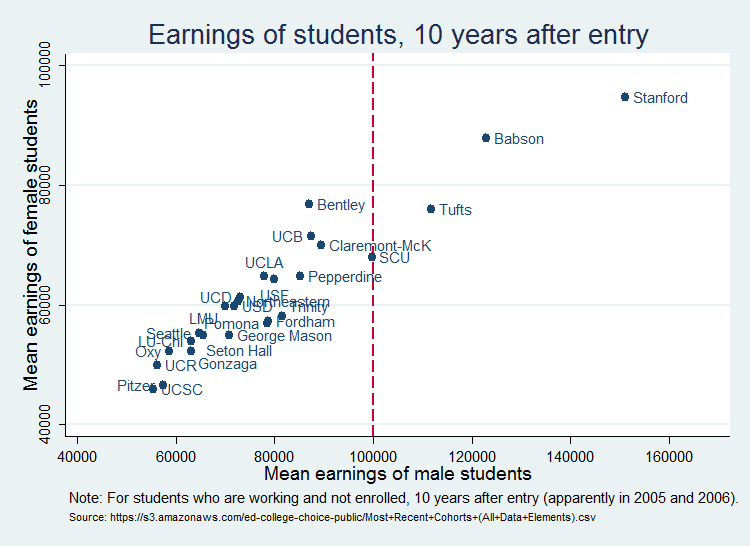
What does the Federal government’s CollegeScorecard say about the earnings of SCU students in comparative perspective?

We do very well, thank you.  Here is the summary article from Kevin Carey at The New York Times.  The data is here.  Of course, our students are much more likely to come from wealthier and well-educated families, compared with most universities, and our students are likely to stay in the Bay Area, one of the highest earnings places in the world (and that comes with high housing costs, so real earnings are probably about $20,000 lower per year than many places in the U.S.).

earnings by univ

Posted in Santa Clara University | Comments Off on What does the Federal government’s CollegeScorecard say about the earnings of SCU students in comparative perspective?

Valère Somé names a torturer in a book just published, « Les nuits froides de Décembre, l’exil ou… la mort »

Valere Somé says that Jean-Pierre Palm tortured him and others while he was imprisoned after Thomas Sankara was killed.  Somé also accuses Salif Diallo of having tortured Saran Sérémé.  Very serious accusations.  The only other occasion I can think of when someone in Burkina Faso has actually directly accused a specific individual, was when Marcel Kafando, Edmond Koama and Ousseni Yaro were found guilty of the killing of David Ouédraogo (though they were subsequently released on appeal) and possibly also killing Norbert Zongo and three companions.  The ex-President Blaise Compaoré’s brother, Francois Compaoré, was widely accused in public of having ordered the killings of both David Ouédraogo and Norbert Zongo.   The gloves are coming off, but unfortunately the transition government has not put in place and kind of truth commission.

« Les nuits froides de Décembre, l’exil ou… la mort » est un livre d’histoire. En 92 pages, l’ancien compagnon du président Thomas Sankara raconte les horreurs inhumaines subies par lui et ses camarades à la gendarmerie. « Je persiste et signe : c’est le Capitaine Jean-Pierre Palm, commandant de la gendarmerie nationale, qui à l’époque, a ordonné et supervisé les tortures que mes camarades (Salvi Charles Somé, Firmin Diallo, et Basile Guissou) et moi avons subies lors de notre détention » peut-on lire dans le document.

Source: « Les nuits froides de décembre, l’exil ou… la mort » : Valère Somé, ses années (…) – leFaso.net, l’actualité au Burkina Faso

Posted in Burkina Faso, History, Politics | Comments Off on Valère Somé names a torturer in a book just published, « Les nuits froides de Décembre, l’exil ou… la mort »

Four great movies on Korean Air that you should watch

On the flight to and back from Korea I saw some excellent films that I highly recommend.  Airplane film choices are now so excellent (for people like me who like obscure movies) that I am starting to look forward to long-haul flights where I can watch two or three films.

Ode to My Father (Korean: Gukjesijang) by Yoon Je-kyoon:  This melodramatic tear-jerker is from South Korea and apparently is the second highest grossing film there.  I cried, rather embarrassingly, pretty much throughout the movie (when you are sitting along on a dark airplane at 30,000 feet it is easy for emotions to surge).  The “finding dispersed families” scene was so poignant.  I was not aware of that particular phase in the North-South conflict.  Even though the film is somewhat hokey, the ambition and scale lingers.  The acting is often phenomenal, and the combination of nostalgia, respect, and admiration for “the lives of our parents” is quite powerful.  The director Yoon Je-kyoon has a sharp eye for letting the audience know that the personal is always political, especially under the authoritarian regimes of the 1960s and 1970s, but the film lets the viewer fill in the politics.  A nice video review with scenes from the film is here.

Marshland (Spanish: La isla mínima) by Alberto Rodríguez:  From the opening credits I thought to myself, “This is where True Detective got its style,” but I see on returning it was released in 2014, so maybe the influence was in the other direction (Wikipedia says filming began before True Detective, but the resemblance is quite striking).  The film is a standard crime/political thriller. Two detectives investigating a disappearance uncover a dark underbelly in rural Spain in the late 1970s.  Great cinematography and acting, and a tight story.  Javier Gutierrez is really great.  Here is the trailer.

Un homme idéal by Yann Gozlan: A straight ripoff or variation on Patricia Highsmith’s “The Talented Mr. Ripley,” this is a film to enjoy as implausible complications pile up for the young man who has stolen the diary of a dead man whose house he is cleaning, and published it as his own novel of the war in Algeria.  Good not great.  Trailer is here.

True Story by Rupert Goold: The film dramatizes the book by former journalist Michael Finkel, who was fired by The New York Times for basically making up key elements of a magazine cover story about African minors working in cocoa plantations.  Finkel, in disgrace, finds out that a now apprehended murderer-on-the-run Christian Longo, had been using his name while in Mexico.  The two men begin the kind of symbiotic journalist-evil person relationship that is a trope all its own.  Longo is on death row in Oregon.  Jonah Hill in a twist I think is perfectly cast; he is infuriating to an intelligent viewer, which is what Finkel in real life must have been.  James Franco’s sleepy eyes used to great effect.  You never get inside him.  Trailer is here.

Posted in Book and film reviews | Comments Off on Four great movies on Korean Air that you should watch

Heading off to The 9th International Symposium on Library Services for Children and Young Adults in South Korea

The 9th International Symposium on Library Services for Children and Young Adults is hosted by the National Library for Children and Young Adults (NLCY) in South Korea. The conference starts on Tuesday Sept. 8 in Seoul and Buyeo Island.

Lots of distinguished librarians have attended in the past. Kate McDowell from the ischool at University of Illinois, and Sarah Flowers who blogs at YALSA. The program this year looks really interesting, on the theme of “Libraries Building Future and Presenting Pleasure for Young Adults.” That is very aligned with FAVL, where we try to see libraries more as place for leisure reading and “getting lost in a book” than as the “information center” model where farmers are going to learn how to build compost pits. Of course, we’d like to do both, but energies and resources are more directed towards the leisure reading.

Posted in Reading | Comments Off on Heading off to The 9th International Symposium on Library Services for Children and Young Adults in South Korea

Nice profile of Balai Citoyen in Burkina Faso

http://www.dw.com/embed/480/av-18680759

Posted in Politics | Comments Off on Nice profile of Balai Citoyen in Burkina Faso

Can I go back to school and get a PhD in Economics?

A career in Economics…it's much more than you think from American Economic Association on Vimeo.

Posted in Teaching macroeconomics | Comments Off on Can I go back to school and get a PhD in Economics?

Photographs of me from college

Thinking about today’s selfie generation.  There are very few of me at college until the final semester of senior year and the summer that followed.  I actually do not think I have ever seen a photo of myself during the first three years of college, except when I visited my family for Christmas, or a trip to New York in 1980 when someone had a camera.  Not a single photo as far as I know of myself in a dorm room.  No, Mapplethorpe did not approach me, ever.  No photos of me standing outside the PiL show at Rosegarden Ballroom in 1982.  (But I know I was there because I got Martyn Atkins to sign something which is in a scrapbook somewhere and I asked him a question but was mixed up and he said, “No! you mean Martin Hannett!  I’m not him!”)  Or with Chip at the PiL show at University of Maryland a few months later.  So what?  Well, all of the memories exist in my brain.  I’m OK with that.

Posted in Personal Kevane life | 1 Comment

IFLA Day # 4

Started to morning bright and early at 8am with colleagues at the Section for Children and Young Adults.  The chair of the IFLA section was passed from Viviana Quinones to Ingrid Bon.  Ingrid turned straight to me: What about this satellite meeting in San Jose.  Yes, get ready, IFLA invades San Jose and Santa Clara in a joint SJSU-SCU satellite workshop on youth and reading and the transition to a digital culture.  August 11.  Mark the date.  A call for papers will come out soon.

The section meeting continued with lots of other issues.   We are going to organize an off-site panel in the meetings in Columbus, Ohio, probably Wednesday August 17.  Brooklyn librarian Karen Keyes and I were tasked with organizing that, and it was so easy.  I just walked down to the exhibition hall and there was Wendy Ramsey, Team Leader in the Outreach Services division at the Columbus Metropolitan Library and the CEO, Pat Losinski, and they both readily agreed.

After the section meeting, went to a Literacy and Reading section panel, to hear Air Katz of Beyond Access talk about their new training manual for librarians, and Chiristine Nel talk about reading competitions at the libraries she manages in Greater Tzaneen Municipality in northern South Africa.  At Christine’s, and a bunch of other talks, it was always like, “Wow, we should try that at FAVL!” and that is the benefit of IFLA.

After that I played hooky and went for a long walk.  I had seen a small restaurant called Bread, Milk and Honey, and was intrigued.  They offered a lunch buffet.  It was delicious, and moreover a wonderful, fully integrated (well, for upper-class Capetonians, it seemed), very lively café.  Great ambiance of professional urban Cape Town downtown at midday.  Then I walk around the Company Gardens, all the way up to the Jewish Museum.  After viewing the interesting exhibit (and later I had to Wikipedia Barney Barnato, amazing!), I spent an hour in their lovely café. Riteve, named after a town in Lithuania.  I continued my walk, through Company Garden’s.  Table Mountain in the background, a cool crisp Fallish day.  Happened upon a delightful café tucked into the gardens, full of wicker sculptures that children could climb into and around.  Decided to have an early (and quite delicious) dinner there.

And then I went back to hotel, worked for awhile, and went to bed!  Dutch Manor Inn is really a very nice hotel.

Posted in Reading | Comments Off on IFLA Day # 4

Lithuania in South Africa

I visited the museum today. Spooky to think that somewhere in South Africa are distant relatives of mine.  One of our grandmother’s uncles (something like that) emigrated here in the 1880s, along with 30,000 others from Kaunas.

The Jewish Museum in Cape Town offers visitors a journey back in time. Most museums do. The striking feature of this museum, however, is that the journey to the past also brings us to a completely different part of our world, from Africa’s southern tip to a seemingly modest little country far to the north, to a country where around 90% of South Africa’s Jewish population has its roots (there are today about 80,000 Jews in South Africa).

The museum’s basement is dominated by a village environment (shtetl) from the late 1800s. A few houses are reconstructed in full scale, and you can clearly see how people lived and co-existed at the time. The village is called Riteve. It was recreated in the museum on the basis of entries made in the 1990s by a group of experts who went from South Africa to Lithuania to find traces of the family of the museum’s founder, Mendel Kaplan.

via Lithuanian footsteps in South Africa.

Posted in Personal Kevane life | 1 Comment

Day #3 IFLA: Evidence skirmishes

After another delicious and friendly breakfast at Dutch Manor Inn (I feel sorry for all of you delegated staying at the Westin!), I headed down to catch the long morning session on evidence and library impacts.

Got to hear the tail end of Fiona Bradley’s talk on the Sustainable Development Goals.  Then David Streatfield and Sharon Markless, a team of Global Libraries impact assessment consultants, gave an overview of their work.  Unfortunately, appears that Global Libraries did not build in any randomized trials for evaluating their ICT buildout to whole library systems.  Maybe Global Libraries was not really sure what to be measuring.  or maybe worried that conclusion might be: “public access to Internet in every library in Chile enabled lots more people to play online poker and surf you-know-what.”  Probably though, since digital/Internet access is framed in rights-talk, then cost-benefit really did not matter, and there was no compelling reason to waste resources in measurement.  That is, there probably was not going to be any likely measurement, after a pilot, that would have led Gates Foundation to say: “Let’s NOT help libraries have Internet access.”

Jessica Dorr of the Bill & Melinda Gates Foundation then spoke on the Global Libraries data portal Global Libraries Atlas.  This is a very worthy effort and the site is fantastic.  But I am of two minds about data visualization work like this.  Very expensive, I imagine, to build the interactive website.  And since no measurement of benefits (either) of usage of such a website, not really clear that money is well-spent.  How do we know this is better than just posting the an Excel file and letting researchers write R scripts to visualize?  Is this data visualization really going to help in advocacy?  Is advocacy really more successful because the advocate has a great infographic?  Does the Gates Foundation itself make funding decisions based on infographics?  And while we are on that subject, I wish glatlas.org would just have a button to download the whole dataset.  Seems like that should be gold standard for transparency and open data.

Finally Karin de Jager spoke about ISO standard for measuring library impact.  She gave a nice overview of the issues, and it sounds like a very good resource.

The questions and discussion that followed rehashed some basic debates about what should library advocates be looking for. To an economist, I hate to say this, the debate sounded like something from 50 years ago.  Yes, data does tell the story, and the best impact evaluation studies in the social sciences do indeed let the statistics talk.  Good impact evaluations do not need anecdotes.  Indeed, since we know just how powerful story-anecdotes are, we should be extra careful about using them, because they easily lead us to bias.

Part of me prefers to be explicit: If you want a warm-glow story to make people feel good about donating, or convince people to allocate tax dollars to the purpose, just say so, and don’t call that impact evaluation.  But don’t say that a set of non-randomly selected stories (chosen by you to resonate with donors and advocates) is impact evaluation.  I support libraries and reading because I like libraries and reading.  Libraries enable lots of people to read a lot more than they would otherwise (though surprising how little we know about that basic effect, but all the small-scale studies we have done in Burkina Faso find large increases in reading).  Does reading more books then do something else, other than increase vocabulary?  There is little social science research to answer that question.

The “Beyond Access” and “libraries for development” thrust is trying to build an evidence-base and rhetoric that can shout an enthusiastic YES to that question.  It would be great if more research funding comes along so that the claims can be evaluated and replicated.  But social scientists cannot even agree on measuring the effects of deworming pills…. and extra reading is quite different from a pill.

Got a tweet from Sarah Jaffe, Senior Manager of Research at Worldreader, so we had a nice chat over coffee.  They are expanding rapidly, soon to be putting Kindles (not sure exactly how many- sounds like 10 or 20) in every Kenyan public library (there are about 50).  Would be neat to explore whether availability of e-readers turns out to be complementary to paper book sales.

After that I heard a great presentation by Bookdash.  Wish we could do something like that in Burkina Faso, but it sounds like something for a rich country… costs about $10,000 for the event itself, where 30 illustrators, editors and authors come together for an all day session to make 10 children’s books.  I am very partisan to that approach: make them quickly and get them printed and available.  In Burkina Faso, the problem is we have absolutely no institutional buyers or sponsors.

Then walked around downtown Cape Town with Hui-Yun Sung, a library science researcher from National Chung Hsing University in Taiwan.  Found the tourist market and had fun bargaining a bit.  Lots of the usual stuff: beaded elephants and masks.

Had dinner later at Bocca near my hotel. Very good Neapolitan pizza!

Posted in Reading | Comments Off on Day #3 IFLA: Evidence skirmishes

Gossip and publicity about the Caine Prize and ‘African Literature’ |

A very fine article Acts of mutiny: the Caine Prize and ‘African Literature’ by Ranka Primorac.  In the end, labeling is marketing.  A writer can object to labeling, and refuse to be labelled: but then they have to be prepared for the consequence that their book might not sell.

Serpell went on to win the Caine prize – the first Zambian ever, and the only Zambian this year on a strong shortlist populated by representatives of literary superpowers Nigeria and South Africa. In a congratulatory speech at Oxford, the Chair of the judging panel, Zoe Wicomb, advised prospective readers to read the winning story, ‘The Sack’, very slowly. She had good reason to do so. ‘The Sack’ is an accomplished textual achievement: using a pared-down narrating style, the story sets out a complex interplay of emotions among its characters by deliberately delaying, suppressing and defamiliarising the information it provides about how they are all related to one another. At one point, one of the narrators says: ‘I wonder at the dwindling of our cares. We began with the widest compass, a society of the people, we said. But somehow we narrowed until it was just three. Jacob, Joseph, Naila.’ Readers who rush over these simple sentences will miss a key inflection: Zambia once aspired to be an African humanist society, and this political and ethical outlook arguably infuses every line of Serpell’s story.

On winning, Serpell made history by a further, more radical intervention. In her acceptance speech, she said she wanted to reconfigure the competitive structure of the prize (which, for her, had unwelcome resonances with American Idol), and that she would be sharing the prize money equally with the other four participants. She is the first prize winner to have done this. It was, for her, a long-overdue ‘act of mutiny’, she said.


Posted in Reading | Comments Off on Gossip and publicity about the Caine Prize and ‘African Literature’ |

IFLA day #2 in Cape Town South Africa

As with any conference, the fun part is time between sessions when you get to have more in-depth chats about library stuff.  This afternoon I had coffee with Ari Katz from Beyond Access, who is now based in Thailand working on a multi-year capacity building project with libraries in Myanmar, Bangladesh, Philippines and Thailand.  There were so many commonalities between the work he is doing and our work at FAVL, and of course having the same questions (how effective is this?) and concerns (can we succeed in sharing a culture of innovation and creativity with staff of library service providers?).  He shared with me a great Android app, Com Phone, that I am going to have the staff in Burkina Faso test.  He also suggested using surveymonkey as a way to have librarians (if they can connect to the Internet) update library usage statistics at the end of every month.  Great idea!  Finally, he promised to share a bunch of training tools (and a lengthy manual) that was developed for the program.  Would be fantastic to use for our upcoming training of 20 librarians!  We both agreed that library enabling legislation needs to be updated from the 1960s

Later this evening I got to finally sit down for 30 minutes with Viviana Quinones, children’s library section at the Centre national de la littérature pour la jeunesse, Bibliothèque nationale de France.  Viviana is so wonderful, and produces the fantastic resource Takam Tikou, which for Francophone Africa is an essential service, and she also edited and brought to publication Faire vivre une bibliotheque de jeunesse, a great guide for library activities.  We’re both optimistic about a likely resurgence of interest in Francophone countries in promoting reading and libraries.  (being in South Africa you cannot help but be optimistic: the country now have almost 2000 libraries for 50 million people… Burkina Faso has maybe 50 for 17 million people.  So the library per person ration of South Africa to Burkina Faso is like 40:3 or 13:1…. while GDP per capita ratio is about 10:1.  If Burkina grows at 7%, it will get to South Africa level in about 30 years… and libraries will grow from the present 50 to about 600 libraries (and more if population keep growing).  That is a lot of libraries!  They will be more effective if Burkina Faso starts investing now, and learns (institutionally) from the investments and experiments that are made early on.

Oh, my talk went well, I think.  Hard to tell when you are up at the podium and there are 250 people scattered in the hall that is built for 1,000!  I really enjoyed presentations by Carole Bloch, Jane Meyers, Ahiauzu Blessing  who spoke of reading programs they operate in libraries in Africa.

Posted in Reading | Comments Off on IFLA day #2 in Cape Town South Africa

First day at IFLA in Cape Town

Worked on my presentation all morning… realizing audience will probably be like 300 people…. and they strictly enforce time limits, so have to say everything in 15 min, so have to practice a dozen times…
Walked down to convention center… Capetown like a post-apocalyptic novel… Saturday afternoon, everything closed, barely a single pedestrian, cars rushing by in the misty rain, security guard in front of each building… why am I the only person walking?
Convention Center amazing and new.  Wow!  Registered in like 30 seconds.  Had a delicious (but small) Middle Eastern plate for 50 rand (about $4).  And then a cappuccino for $1.50.  I think I’ll be drinking a lot of higher end coffee drinks here; I can never justify paying $3.50 for a latte in the States.
Went to Libraries for Children and Young Adults section meeting.  Good to see some familiar faces.  Viviana Quinones as usual ran the meeting like clockwork, getting through a very long agenda right on schedule.
Walked back to hotel, now raining a bit more, but still very nice.  A note from a fellow IFLA delegate at the desk, so I got to eat dinner with librarian Christina Nell, who supervises five libraries in northern South Africa.  We went to The Africa Cafe, very nicely decorated with lively art and colors, a bit touristy, but the food was fine. They offer a fixed-price “buffet” of a variety of African food.  Music and singing by the wait-staff.  Could have been a Greek restaurant in Carmel… Opa!  All the vegetarian selections were great.  Talking library shop all evening was fun, too!

Posted in Reading | Comments Off on First day at IFLA in Cape Town