Burkina Faso and Civilian Control of the Presidential Guard (RSP)

In The Dilemma of Getting to Civilian Control,  Dart-Throwing Chimp comments on a post by Alex Thurston at Sahel Blog, summarizing:

In a recent briefing, the International Crisis Group (ICG) surveyed that landscape and argued in favor of deferring any clear decisions on the RSP’s status until after the elections. Thurston sympathizes with ICG’s view but worries that deferral of those decisions will produce “an atmosphere of impunity.” History says that Thurston is right to worry, but so is ICG. In other words, there are no obvious ways to climb down from the horns of this dilemma.

Admittedly this is indeed a tough dilemma if options are disband or not disband.  There are, however, other strategies to pursue, including mixes of strategies.  Here are five:

  • Mobilize and prepare Balai Citoyen and Radio Omega and other civil society organizations etc. now to energize anticipatory civilian resistance to military coup.  As we saw in October 31 2014, civilians have a huge role to play in controlling the RSP.  Burkina Faso population is ready for deepening of the meme that RSP is fundamentally illegitimate, and the regular army is the legitimate guarantor (the word the military guys like to use).  Civil society groups have been doing this, but of course they can always do a lot more with more help from transition government.
  • Along the same lines, it was clear in October 31 2014 that the regular army and RSP had fundamental differences.  Gen. Nabéré Traoré and others presumably stood down because it was made clear to them that they were going to lose, the RSP having far superior firepower and unit cohesion.  (Or maybe a large cash transfer was involved, who knows!)  In any case, if the firepower and cohesion was the issue, then the regular army’s firepower and cohesion need to improved in the remaining four months, as they act as the credible counterweight to RSP.  Presumably Cote d’Ivoire is key here in the strategic planning (offering logistics support etc in southwest, because that would be the likely scenario, with RSP taking over Ouagadougou and regular forces taking over Bobo-Dioulasso).
  • Move the Presidency.  This would be a huge symbolic move, for Kafando to say he is not confident that the RSP will respect the democratic process, therefore he is moving the Presidency (maybe just his office) to (say) Nongremasson.  Then he would be farther from the U.S. Embassy in case he needs to jump the fence, and the matching armchair photos would not be so nice.  But at least it would shake things up.  Along those lines, taking some voluntary hostages (i.e. prominent internationals who agree to stand by Kafando and civilian presidency in the event of a coup) would bring huge media attention to the coup (Robert Nozick argued that the time for heroism was when you are pretty old and have little lifespan left, so I guess I’m going for Jimmy Carter and George Bush father here.)
  • Unleash the dogs of humor.  Getting shot by an RSP soldier is no laughing matter, but the RSP soldier is maybe less likely to want to shoot in the first place if all the people in the frontline of a demonstration against RSP are wearing t-shirts with cartoons that make fun of him.  Achille Mbembe and many others have written about the important role of satire and humor in resisting autocrats.  That same humor can prevent the autocrat in the first place.
  • Scaffolding.  Not the hanging kind, but the elementary teacher kind.  In primary school, teachers learn that kids need to be scaffolded.  They need to start with easy, participatory questions where they can successfully demonstrate knowledge. Then the teacher builds on that positive experience and goes up a small level.  Then a little bit higher.  The RSP needs to be scaffolded into more and more acquiescence to civilian rule.  Maybe they should attend some town meetings with ordinary civilians for some nice “not so bad” question and answer sessions.

I think Burkinabè political opposition leaders are well-aware of all of these strategies.  Bénéwendé Sankara, Roch Marc Christian Kaboré and Zépherin Diabré, however, have been keeping a low profile on these matters (well, at least it seems to me, the latter two especially).  Hard to know whether they should step out more and be more assertive, perhaps even agree to a unified anticipatory no-coup stance. A different dilemma.

Posted in Politics | Comments Off on Burkina Faso and Civilian Control of the Presidential Guard (RSP)

I hate the phrase “saving lives” and unfortunately this otherwise excellent Boston Review debate is replete with that usage

If you can get past the deadline induced sloppy writing, there is a lot worth reading.

It is almost criminal to have this as a topic.  A great example of the difference between writing technically (where author and reader share understanding) and writing for a newspaper… Look at the first sentence here, for example.  When I eat breakfast, have  I excluded a poor person?  If I advocate for being humble, am I really encouraging a savoir complex?  If I encourage people to think about the global poor rather than the nearby poor, am I being insular?  If my actions are directed at a goal like winning a soccer match, then do I also fail to meet a normative criteria of democracy?

By excluding poor people and encouraging a savior complex and insularity among its members, the effective altruism movement fails to meet normative criteria of democracy and equality. A supporter of this movement might respond that democracy and equality are less important than improving individual welfare. Yet in the medium-to-long term, the movement will likely fall short in this regard as well. As the low-hanging fruit of basic health programs and cash transfers are exhausted, saving lives and alleviating suffering will require more complicated political action, such as reforming global institutions. Undertaking this action will require outsiders to work with, and follow the lead of, activists in poor countries. Yet the effective altruism movement as Singer describes it does not cultivate the expectations, attitudes, or relationships necessary for this kind of work.

via The Logic of Effective Altruism | Boston Review.

Posted in Development thinking | Comments Off on I hate the phrase “saving lives” and unfortunately this otherwise excellent Boston Review debate is replete with that usage

Two excellent discussions of Greece for economists…

John Cochrane discusses an oped by Charles Calomiris and Willem Buiter and colleagues at Citi have a sketch of a proposal for breaking the cycle.  Time commitment problem, seems to still be there.

Posted in Teaching macroeconomics | Comments Off on Two excellent discussions of Greece for economists…

The drachma option for Greece, very simple

Since I am teaching intermediate macroeconomics, yesterday we reviewed what the drachma option was for Greece, very simple version.  Journalism and blogosphere seem bifurcated between (1) audience that looks at pictures of crowds in Greece with caption “something wrong” and (2) audience that goes bonkers over a spreadsheet of banks that hold Greek bonds even though the spreadsheet has no authenticity, contextual information, or really any real relevance because then they can comment about same.  So seems to be a need for simple version of what is going on.

So the drachma scenario.

Before the drachma, the banks.  (Assertions here are suppositions.) Greek banks would be insolvent (assets worth less than liabilities) if loans and government bonds held in portfolios were properly valued (marked-to-market).  In order to continue to function, in an economy that is rule-based (i.e. makes an effort to follow basic rules of accounting and requires audits of banks and other firms to be public), the banking regulator has to insist that the banks be recapitalized.  Otherwise the bank should be shut down and liquidated.  “Hope” is not a good reason to trick new depositors into depositing money into an insolvent bank.  That means some entity (a solvent international bank, for example) has to be willing to buy the insolvent Greek bank and “give” to the bank their own capital so that the bank is then solvent in the accounting sense.  Such a buyer hopes that the assets (loan portfolio and government bonds) will turn out to be worth much more than the mark-to-market current values.  In the Greek case, there is no such buyer.

The buyer of last resort is the government.  So the Greek government “nationalizes” the banks.  Often this kind of process works by creating another entity called a “bad bank” or a “resolution bank” that takes all the bad loans that are not repaying, and tries eventually to collect something on them.  The government commits new capital to the “good banks” so that they can be trustworthy solvent banks (to depositors and other actors).  That is, the government basically says, “Your deposits in this bank from now on will always be redeemable at face value.”  If it works, the banking system returns to normal and the government eventually sells its stake in the bank (it privatizes the bank).  The United States basically did something like this in 2009 during the financial crisis.

Unfortunately the whole problem for the Greek government is that the currency is the euro, and the Greek government does not actually have euros to recapitalize the banks, and other European banks and governments will no longer lend euros to the Greek government to recapitalize the banks.  (And neither will the Greek public.)  Also, probably (sorry, not my field) there are eurozone regulations that prohibit this kind of nationalization.

Just to be clear, you really need banks to have growth… imagine being a Greek business with no access to a local bank…  So the idea that, “Do they really need banks when they have the Internet?” is a non-starter.

The Greek government, then, to recapitalize (“save”) the Greek banks, and thus have a chance at returning to economic growth, will choose to leave the eurozone and instead adopt its own currency, let us call it the drachma (same as the old currency).  Since the new currency is “issued” by the Greek central bank, it can “inject” as much capital as desired into the nationalized banks.  Imagine the government says each nationalized bank will start out with a “credit” or capital of one billion drachma, courtesy of the central bank.  The government will fix an exchange rate (say 2 drachmas for every euro) and each bank will re-denominate all the accounts, loans, and other financial stuff in terms of the drachma.  The government might take the opportunity, as it takes over the banks, to also levy a tax on all deposit holders, of, say, 20% of the value of their deposits.  Remember, the problem for the government is that it pays more for services- army salaries, pensions, public swimming pools- than it collects in revenue, so a deposit tax is a very convenient way for the government to suddenly have a lot more revenue.  Obviously, deposit holders are not going to be happy at this confiscation.

Now when the banks open for business, there will be limits on withdrawals, otherwise everyone will anticipate a drop in value of their drachma (they have seen what happens in other countries), and will try to withdraw all their drachmas and trade them for euros.  There will also likely be controls on exchanging drachmas for euros.  And if the exchange rate isn’t “reasonably right” the drachma might immediately depreciate on a black market.

Some countries have “successfully” (they survived and eventually started growing again, sometimes rapidly) done variants of the above, possibly with less economic downturn than continued bailout-austerity (Iceland, Argentina, Malaysia, Mexico).  For some countries a crisis like the Greek crisis leads to a decade of poor economic performance.  It is hard to claim knowledge about the counterfactual for any given country.  The short-term austerity (cuts in government services and pensions etc.) of the drachma-ization is likely to be just as bad for Greeks as bailout-austerity.  Opinion is divided about medium-term effects.  Greece could see significant increases in tourism, and thus might resume growth fairly quickly.  But a global downturn at the same time (or a resurgence of tourism to Puerto Rico…) might mean the Greek economy does not grow, and instead the government resorts to increasing the drachma money supply, leading to ever-rising inflation.

Glad I do not have to make the choice.

Posted in Teaching macroeconomics | Comments Off on The drachma option for Greece, very simple

Airport workers try to explain their incompetence to president of Benin…

Posted in Development thinking | Comments Off on Airport workers try to explain their incompetence to president of Benin…

Artisinal gold mining in Burkina Faso: Nice short report from Fanny Noaro

Posted in Economy | Comments Off on Artisinal gold mining in Burkina Faso: Nice short report from Fanny Noaro

leFaso.net expresses the current opaque tensions well in Burkina Faso

Yacouba Isaac ZIDA

Premier miinistre

Le chef du gouvernement de la Transition a de nouveau maille à partir avec ses frères d’armes du Régiment de Sécurité Présidentielle. Pour la troisième fois depuis sa prise de fonction, le Premier ministre Zida et ceux qui l’ont fait roi sont devenus comme chien et chat. Jusqu’à quand durera ce jeu ? Surtout qu’on ne sait pas vraiment qui est le chat et qui est le chien dans cette histoire!

via leFaso.net, l’actualité au Burkina Faso.

Posted in Politics | Comments Off on leFaso.net expresses the current opaque tensions well in Burkina Faso

Pure snark: He is a doctor who uses a Rotary phone, and wants to put you in a hyperbaric chamber to treat your concussion?

concussion

Posted in United States | Comments Off on Pure snark: He is a doctor who uses a Rotary phone, and wants to put you in a hyperbaric chamber to treat your concussion?

Wait, Kafando asked Diendéré to head the commission on the Régiment de sécurité présidentielle?

Faut-il dissoudre le RSP ou pas ? Une question qui passionne beaucoup d’acteurs de la scène socio-politique depuis l’insurrection populaire. On ne compte plus le nombre de sorties d’organisations de la société civile réclamant à cor et à cri sa dissolution immédiate. Pour y voir clair, les autorités de la Transition ont décidé de mettre en place une commission de réflexion. Interrogé sur le sujet il y a quelques semaines, le président Michel Kafando a reconnu qu’il avait sur la table le rapport de ladite commission mais attendait de le rendre public. Lefaso.net vous propose l’essentiel des conclusions de la commission présidée par le général Gilbert Diendéré.au moment où il est question d’un nouveau mouvement d’humeur au sein ou autour de ce regiment.

lefaso.net has the kinl the the report.  via Régiment de sécurité présidentielle : Le rapport tant attendu – leFaso.net, l’actualité au Burkina Faso.

Posted in Politics | Comments Off on Wait, Kafando asked Diendéré to head the commission on the Régiment de sécurité présidentielle?

Why are Supreme Court justices unable to do basic anthropology?

“The court invalidates the marriage laws of more than half the states and orders the transformation of a social institution that has formed the basis of human society for millennia, for the Kalahari Bushmen and the Han Chinese, the Carthaginians and the Aztecs,” he [Roberts] wrote. “Just who do we think we are?”

via Gay Marriage Supporters Win Supreme Court Victory – The New York Times.

Leslie and I always remember a wonderful ethnography Nisa, by Marjorie Shostak, from the Kalahari, where women routinely called each other “Big Vagina!”  I wonder if Roberts also likes that social grace?  If Roberts did read and understand Nisa, a standard introductory anthropology book, I do not see how he could have written that sentence.  More generally, citing anthropology and history, picking and choosing… well, one wonders who does he think he is, anyway? And he appears not to appreciate the irony that one could substitute slavery for marriage and the sentence would remain quite intact.  Well, who do we think we are?  Abraham Lincoln, is who we aspire to be.

Does an intelligent person, writing for the ages, write like Roberts?  I am sorry, but I am saddened to have such a person sitting on the Supreme Court.

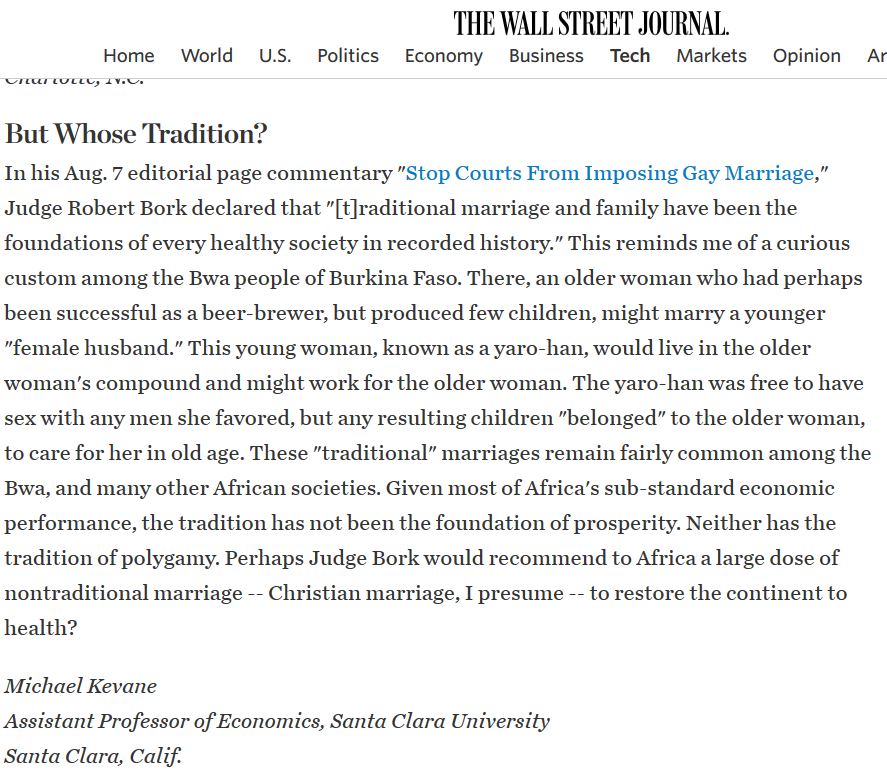
His sentence about other cultures reminds me of a letter I wrote published in the Wall Street Journal (scroll down) almost 15 years ago:

whose tradition

Posted in United States | Comments Off on Why are Supreme Court justices unable to do basic anthropology?

I liked “Please Look After Mom”… but now Shin Kyung-sook admits plagiarism

I read “Please Look After Mom” and had intended to blog a few words about it.  For me it was hard to know how the novel would read in Korean, but the English translation made it come across as quite good. A moody reminiscence, nostalgia and regret infused, all framed in the most basic of human stories of the 21st century, who shall and how do we look after our aging parents, and what should be the new norms of respect and duty that we observe.  Our parents raised us to be self-centered: we owe it to them to rise above that.  So kind of a let down, for her millions of Korean readers and some of her American ones, that she plagiarized part of a short story.

Breaking her silence on allegations that she partly plagiarized the Korean translation of a Japanese short story, renowned novelist Shin Kyung-sook admitted she plagiarized and apologized to her readers Tuesday.

The apology came a week after novelist Lee Eung-jun wrote in an article published on Huffington Post Korea that Shin’s “Legend,” a short story collection published in 1996, included plagiarisms of the Korean translation of “Patriotism” (1961) by the late Japanese writer Yukio Mishima.

via Novelist Shin Kyung-sook admits plagiarism.

Posted in Book and film reviews | Comments Off on I liked “Please Look After Mom”… but now Shin Kyung-sook admits plagiarism

Short video summary of my research on reading in Burkina Faso

Posted in Economy | Comments Off on Short video summary of my research on reading in Burkina Faso

South African Court Said to Block Sudan Leader’s Departure

Is it finally happening?

A South African court issued an interim order on Sunday to prevent President Omar Hassan al-Bashir of Sudan, the only head of state wanted by the International Criminal Court on genocide charges, from leaving South Africa.

The International Criminal Court in The Hague had called on South Africa to arrest Mr. Bashir, who was attending an African Union summit meeting here in Johannesburg. It demanded that the South African authorities “spare no effort in ensuring the execution of the arrest warrants” issued by the court against Mr. Bashir, who is suspected of having ordered atrocities in the conflict in the western Sudanese region of Darfur.

via South African Court Said to Block Sudan Leader’s Departure – NYTimes.com.

Posted in Sudan | Comments Off on South African Court Said to Block Sudan Leader’s Departure

More inflammatory language in Burkina Faso: poor communication or code messages?

En prenant la parole, le vice-président de la Fédération de la région du Centre, Yamba Malick Sawadogo, a salué ses camarades pour cette initiative, car si les élections sont transparentes, la victoire sera éclatante, et il n’est pas question de se laisser voler une victoire. «Préparez vos fusils, vos munitions, vos couteaux pour accompagner Roch à Kosyam», a-t-il affirmé, pour inviter ses camarades des marchés et yaars à se préparer à toute éventualité.

via Election présidentielle: « Préparez vos fusils, munitions, couteaux… pour accompagner Roch à Kosyam » (Yamba Malick Sawadogo, vice-président de la Fédération du Centre du MPP).

Posted in Politics | Comments Off on More inflammatory language in Burkina Faso: poor communication or code messages?

Gosh, just like San Francisco!

“You have groups which are as genetically distinct as Europeans and East Asians. And they’re living side by side for thousands of years.”

via DNA Deciphers Roots of Modern Europeans – NYTimes.com.

Posted in Development thinking | Comments Off on Gosh, just like San Francisco!

Ablassé Ouédraogo sets off a firestorm in Burkina Faso

In an interview with Jeune Afrique he says two of the “assets” he has that will make him a winner in the Presidential elections in October 2015 are… he is Muslim and he is Mossi.  And the #lwili sphere now also says he is a loser.

Il y’a-t-il une ethnie supérieure au Burkina ? Il doit se retrouver derrière les barreaux pour les mêmes causes qui ont porté Salia Sanou en prison, sinon on ne peut plus parlé de justice. Je suis Mossi, mais je ne cautionne pas le fait que l’on pense que pour gouverner le Burkina Faso il faut être de cette ethnie. Dans ce beau pays, il y a aussi des samo, des gourounsi, des bissa, des peulh, des dagara, des bobo ou bwaba, des dioula, etc.… Donc, lancer de tels propos c’est ne pas considérer les autres et en plus c’est créé la division. Chaque Burkinabée est égale aux autres burkinabés, quelle que soit son ethnie. Le pays appartient à tous, et tout le monde contribue à son développement. NON, il n’y a pas d’ethnie supérieure monsieur Ablassé, comment veux tu avec cet état d’esprit accéder au pouvoir le soir du 11 octobre 2015 ? ?

via Ablassé Ouédraogo sur Jeune Afrique : les trois atouts pour accéder à (…) – leFaso.net, l’actualité au Burkina Faso.

Posted in Politics | Comments Off on Ablassé Ouédraogo sets off a firestorm in Burkina Faso

Fuckmemories: Michael Cunningham reading Harold Brodkey

Recently on Twitter:

Michael Cunningham reads “Dumbness Is Everything” by Harold Brodkey suggests the answer may be yes, and it was even in the pages of The New Yorker.  Take an hour out of your day, and listen, preferably while taking a long walk.  You may lie down on the grass.  And as Cunningham and Triesman later suggest, “Was it good for you?” is probably not the right question.

Posted in Book and film reviews | Comments Off on Fuckmemories: Michael Cunningham reading Harold Brodkey

Best song and video about being a guttersnipe… Bhi Bhiman

Posted in Music | Comments Off on Best song and video about being a guttersnipe… Bhi Bhiman

Elechi Amadi Sunset in Biafra

sunsetinbiafraHe is such a good writer, his omissions can be forgiven, maybe?  I loved reading the book. It is short, sentences are well-crafted, anecdotes from his experiences told with gusto.  He experienced awful stuff.  But the omissions… I loved this excellent analysis by Richard Shain comparing Sunset in Biafra (published in 173 shortly after the war) with Ken Saro-Wiwa Sozaboy (which I shall have to order from the library, sounds like a precursor to Allah N’est Pas Obligé that I was unaware of).  Shain has interesting take on the final sentence, “I picked up my father the next day just four miles from home. Clad in a tattered ancient black overcoat, and with a white beard, he was pushing his bicycle along with steps made remarkably steady by his proximity to his ancestral home. He did not weep as he hugged me, but I knew he felt more than everybody else.”  But I interpreted it as typical Amadi: he loves to have a last sentence encapsulate the whole novel.  The Biafra war, from Amadi’s experience, is almost unintelligible; there is nothing to say about it, about how the world was upended in a non-sensical way.  For people like Amadi’s father, there were no words for the folly, just feeling.

Posted in Book and film reviews | Comments Off on Elechi Amadi Sunset in Biafra

Stromae – Papaoutai

Posted in Music | Comments Off on Stromae – Papaoutai