Blaise Compaoré proposes referendum to revise the Constitution to permit another term in Burkina Faso

If the referendum passes and he wins the presidential elections in 2015, another 5 years term would mean he will have been president from 1987-2010, a total of 33 years.

There are two legal obstacles, that I hope the opposition will vigorously pursue (and this is where the mysterious killing of constitutional judge Salifou Nebie was important)… First, the constitution cannot be amended if the amendment undermines the republican character of the state.  Second, the current Constitution of Burkina Faso has provisions for a bicameral parliament, but the senate was never implemented (elections were help, results announced and then… black hole…).  but neither was the constitution amended.   So the current constitution says a Parliament must decide to hold the referendum, but only one chamber of parliament actually exists.

Le gouvernement burkinabè « a adopté un projet de loi portant révision de la Constitution, qui sera soumis à l’assemblée nationale en vue de la convocation d’un référendum, conformément à l’article 163 de la Constitution», a révélé à la presse le ministre de l’Administration territoriale et de la Sécurité, Monsieur Jérôme Bougouma, ce mardi 21 octobre 2014, sur le perron du palais présidentiel de Ouagadougou.Cette décision, en conformité avec les dispositions des articles 161 à 165 du titre XV de la Constitution a été prise à l’issue d’un conseil extraordinaire des ministres, réuni sous la présidence de Son Excellence Monsieur Blaise Compaoré, Président du Faso, Président du conseil des ministres. Le ministre Bougouma a ajouté que la date du référendum sera fixée à l’issue du vote du parlement.

via Presidence du Burkina Faso » Blog Archive » Le gouvernement burkinabè adopte un projet de loi portant révision de la Constitution.

Posted in Politics | Comments Off on Blaise Compaoré proposes referendum to revise the Constitution to permit another term in Burkina Faso

Why monetary policy is hard

We are in October 2014, and unemployment already down to 5.9%, a full percentage point below the March 2013 projections.

According to the most recent projections available at the time of this response (March 2013) most FOMC meeting attendees do not expect the unemployment rate to reach the 6.5% threshold until 2015. The central tendency of the projections for the unemployment rate ranges from 7.3 to 7.5% at of the end of 2013, 6.7 to 7.0% at the end of 2014, and 6.0 to 6.5% at the end of 2015.

via SF Fed | Recently the Federal Open Market Committee...

Posted in Teaching macroeconomics | Comments Off on Why monetary policy is hard

Nice perspective on Janet Yellen’s speech on inequality

For the last five years of economic expansion, Congress has been unwilling to use fiscal policy to try to encourage faster growth. That has left the Fed as the only game in town, and the Bernanke Fed again and again turned to quantitative easing and ultralow interest rate policies to try to shock the economy into speedier expansion. Ms. Yellen was the No. 2 official at the Fed for most of this time, and helped engineer the policies.But this has contributed to an imbalanced form of growth in the United States. Many of the first-order effects of the Fed’s bond buying have been, for example, to drive up the stock market and to help lower mortgage rates. Because stocks are disproportionately owned by the wealthy and the upper middle class have been in best position to refinance their mortgages, the benefits of Fed policy for middle and low-income workers have been more indirect.

via What Janet Yellen Said, and Didn’t Say, About Inequality – NYTimes.com.

Posted in Teaching macroeconomics | Comments Off on Nice perspective on Janet Yellen’s speech on inequality

Neil Irwin tries to summarize last week…

There are two problems when I read the very nice summary:  (1) If the stock market rises 3% this week, does that mean his analysis of last week is wrong?  Always a bad idea to theorize about the longer term in order to explain short-term stock market fluctuations.  (2) He does not explain why deflation is going to be a bad phenomenon… do his readers know?

The world economy still hasn’t recovered from the last recession. Moreover, investors lack confidence that policy makers have the tools they would need to avert a new slide into recession after years of throwing everything they have at it to try to encourage recovery and prevent deflation, or falling prices. Coincidentally, commodity prices are declining largely because of supply, but the timing of that decline is bad: It makes the risk of deflation that much more severe.  Add it all up, and the markets aren’t betting on catastrophe per se; if they were, stock prices would be down more. But they are betting that central banks and other policy makers aren’t going to be able to get a handle on global deflationary forces that have been unleashed. That means we could be in for a slow grind in which global growth and inflation both stay below where people across the advanced world would like it to be.

via The Depressing Signals the Markets Are Sending About the Global Economy – NYTimes.com.

Posted in Teaching macroeconomics | Comments Off on Neil Irwin tries to summarize last week…

More on the TPP trade talks from WikiLeaks

Two of the more contentious areas in the IP area relate to copyright and pharmaceuticals.For example, current patent law allows drug companies a monopoly on drugs they have created for a defined period, meaning other companies are not allowed to copy and sell the drug formulations as “generics” for that period. This is considered reasonable as it rewards the company for the initial research investment, which can be costly. Once the patent period ends, cheaper drugs flood the market, bringing down the price for consumers.Yet the text would suggest that the agreement could extend the patents. If Australia agrees to an extension of patents, the government would allow drug companies to keep the price inflated for a longer period, making the drug less affordable.The US and Japan, the largest holders of intellectual property, have been keen to pursue stronger laws for breaches of copyright, including criminal penalties for non-commercial copyright infringements. That could cover internet downloads of television shows or music, where people do not make any money out of the product.The leaked document suggests that opposition among the smaller countries to criminal penalties for non-commercial breaches is waning.

via WikiLeaks’ free trade documents reveal ‘drastic’ Australian concessions | Australia news | theguardian.com.

Posted in International trade issues | Comments Off on More on the TPP trade talks from WikiLeaks

TPP trade talks are making the news

Over the last year or two, critics of trade agreements have stepped up their attacks on the “secrecy” of trade negotiations. Discussing these agreements behind closed doors, or only with corporate advisers, they argue, undermines democracy and the rule of law.In the past, I have suggested that an emphasis on transparency is misplaced. A bit of secrecy is necessary for trade negotiations, I said; and anyway, we know much of the substance, and that’s where the debate should be. I called on critics to focus on the policy issues covered by these agreements, rather than obsess about transparency.But continued leaks of draft chapters of the Trans Pacific Partnership TPP agreement have changed things. As these leaks have come out, critics have engaged with the substance in great detail. While some of their rhetoric is inflammatory and over the top, they clearly understand the issues and they make strong arguments against some of the current language, particularly in the area of intellectual property.Unfortunately, the U.S. government is not responding in kind. That’s not to say it is being completely silent. However, the explanations of U.S. negotiating objectives are sometimes very superficial. The result is a one-sided debate. Critics are criticizing; the government is mostly keeping its head down.

via Time for Real Transparency in Trade Talks | Simon Lester.

Posted in International trade issues | Comments Off on TPP trade talks are making the news

More volatility in the global economy

Investors flocked to the relative safety of government bonds on Wednesday, pushing yields on United States Treasuries and on German bunds sharply lower. The yield on the 10-year United States Treasury note — a benchmark for many interest rates — fell the most since March 2009, slipping below the psychologically important 2 percent level for the first time in many months. Bond yields and prices move in the opposite directions from each other.Much of the selling in United States stocks, traders said on Wednesday, was being driven by hedge funds unloading big positions in benchmark stocks that for most of the year have shown strong returns. With the end of the year approaching and markets falling fast, these momentum investors have turned tail.

via Stocks Turn Volatile on Global Growth Worries – NYTimes.com.

Posted in Teaching macroeconomics | Comments Off on More volatility in the global economy

Trustees ignoring faculty? Nah, why would they do that?

But a restive faculty [at Catholic University] has made it clear that not everyone is satisfied with his tenure. In May, at the beginning of a scheduled performance review, 42 full professors wrote a letter to the board that raised complaints about his leadership. Last month, weeks before the vote, more than 70 percent of faculty members who responded to an informal survey “strongly agreed” that Mr. Garvey should not stay on as chief.”We don’t have any personal animosity, but we worry about the future of the university,” said a professor who responded to the survey. “He may not be the right person to lead us into the future.”The informal poll was taken after the Board of Trustees surveyed faculty, staff, and students about Mr. Garvey’s performance. Faculty members felt the board’s solicitation of feedback didn’t “get to the heart of the matter,” so they created a survey their own. Both documents were passed on to the board, according to John C. McCarthy, dean of the School of Philosophy, who was one of two academic administrators on the presidential-review committee. Nevertheless, Mr. Garvey was reappointed.

via As a President Gets 5 More Years, a Faculty Gets Nervous – Leadership & Governance – The Chronicle of Higher Education.

Posted in Santa Clara University | Comments Off on Trustees ignoring faculty? Nah, why would they do that?

Mixed messages on role of head of World Bank and Ebola

On the one hand, the reporter sings the praises on Dr. Jim Yong Kim.  On the other hand, there are passages like this:

In July, as the epidemic was worsening, Dr. Kim fired off emails to other global health leaders. Dr. Thomas R. Frieden, director of the Centers for Disease Control and Prevention, had visited West Africa in August and returned saying the situation was “like we were using a peashooter against a rampaging elephant,” Dr. Kim recalled, adding, “It hit me like a ton of bricks.”

So… wait… you were hit like a ton of bricks… in August?  Pretty late in the game for a doctor, head of the world’s largest development organization, that has a focus on Africa, and especially on the most vulnerable countries of Africa… which are… where ebola has hit.  Was he not reading?  Did he think it would just go away by itself?  I dunno… I expect more acknowledgment of failure, rather than celebration of leadership. Not Dr. Kim’s fault, perhaps, but rather the reporter’s.

The article overall weird to be on frontpage of NY Times…Case in point: writer seems unaware the song Dr. Kim “raps” in for Dartmouth is will.i.am and Black Eyed Peas’s mashup of “Time of My Life,” and not the original!

via Head of World Bank Makes Ebola His Mission – NYTimes.com.

Posted in Development thinking | Comments Off on Mixed messages on role of head of World Bank and Ebola

Petting a wallaby is a great way to end a Saturday evening

Leslie and I and neighbors Alan and Ken had a great time at the Congo gorilla benefit at the Happy Hollow Zoo in San Jose.  How great a time?  Let’s say “petting wallaby” kind of time….  And BTW, FAVL and San Jose, the countdown to “a shower with two giant anteaters” will begin soon, watch this site for official announcement.

mk and wallaby

Posted in Personal Kevane life | Comments Off on Petting a wallaby is a great way to end a Saturday evening

Economics stand up comedy

By the time Bauman takes the stage, the packed house — looks like at least 200 people — are cheering and clapping for the world’s first stand-up economist. He grabs the mic and starts his set by admitting just how strange his profession is. When he told his dad that he wanted to use his Ph.D. in economics as the basis for a comedy career, his dad was unsure.”He didn’t think there would be enough demand.”On a Monday night, in the basement auditorium of a development bank, this is the kind of joke that kills. Bauman tries another.”I told him not to worry. I’m a supply-side economist. I just stand up and let the jokes trickle down.”I’m not so sure about these economics puns myself, but the crowd is eating it up

HT: Ken Durso!  via So A Global Economist Walks Into A Comedy Club … : Goats and Soda : NPR.

Posted in Teaching international trade, Teaching macroeconomics | Comments Off on Economics stand up comedy

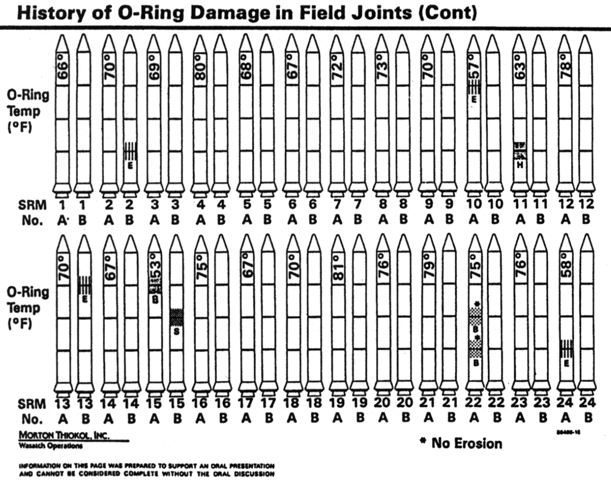
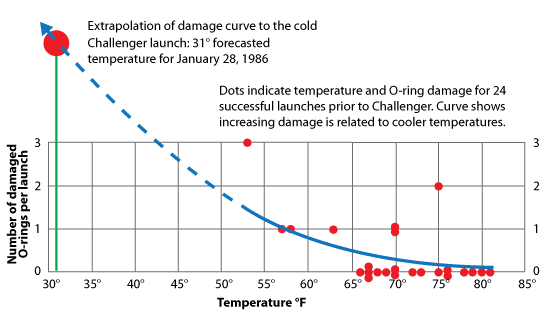
Data, asking questions, and disaster (the Thiokol graph)

The following two graphs are well-known; I was talking about them in class today.  The Thiokol engineer’s ‘chart” was unreadable, and so symptomatic of a culture of not really asking questions that challenged higher-ups.

32803-o-ring_damage-history_morton-thiokol


Here is a version of graph (there are now many) that might have stopped the launch.

challenger-disaster

Posted in Teaching international trade, Teaching macroeconomics | Comments Off on Data, asking questions, and disaster (the Thiokol graph)

This is when reporters get me upset

So you lazy reporter (Jad Mouawad, the friggin “airline correspondent”), you can’t actually name a single member of Congress  or the administration who wants a travel ban.  Why write the article?  Why push to get it on the front page?  The more coverage you give this ludicrous idea, the more some enterprising right-wing Congressperson says “Hey I can get publicity for myself by being outrageous, just like Bobby Jindal… I’ll be interviewed by Jad Mouawad no less!”

So far, only one case of Ebola has been diagnosed in the United States, but pressure is coming from some members of Congress and from elsewhere for the administration to adopt a more forceful posture.

via Health Officials Promise Extra Airport Screening for Ebola – NYTimes.com.

Posted in Development thinking | Comments Off on This is when reporters get me upset

One of my distant relations centrally involved in an important controversy at Catholic University

I think I would have been on the other side of the issue.  But I guess he gets props for standing his ground?  What if his ground was bad ground? No honor in sinning, is there?

In 1958 Monsignor Kevane left Iowa to join the faculty of The Catholic University of America in Washington. In 1960, he was awarded a Licentiate in Philosophy Ph.L. with a major in Philosophical and Social Foundations in Education, and Doctor of Philosophy Ph.D. with emphasis and dissertation on Foundations of Education, and Education for Development. Both were earned at the Catholic University of America in Washington.  From 1964 to 1968, he served as Dean of the School of Education at Catholic University, where he established a prominent faculty and an updated curriculum, which included leading specialists in programs for Educational Technology, International and Comparative Education, and Exceptional Children. He also founded the Center for Community Development and organized the first program for International Development.In 1966, Monsignor Kevane was the only Dean at the Catholic University to support the dismissal of Father Charles Curran and did not support the strike called to force rehiring the controversial theologian, as was noted by Father Franklyn M. McAfee in special ceremonies honoring Monsignor Kevane, president emeritus of the Notre Dame Apostolic Catechetical Institute, “This position of conscience and courage eventually brought Monsignor Kevane’s career at the Catholic University to an end, but his stand was vindicated by the later action against Father Curran by the Holy See and the university.”

via Rev. Msgr. Eugene Kevane – In Memoriam M. Fitzgerald : hebrewcatholic.net.

Posted in Santa Clara University | Comments Off on One of my distant relations centrally involved in an important controversy at Catholic University

I.M.F. Lowers World Growth Forecast

The fund brought its estimate for global growth down to 3.3 percent from 3.7 percent, and reduced its forecast for 2015 to 3.8 percent. The fund pointed to weaker growth in China, Europe, Japan and Latin America Brazil in particular as the main culprits behind the broad retrenchment.  By contrast, the outlook or the American economy, fresh off its very strong jobs report last week, was revised sharply upward, to 2.2 percent this year from 1.7 percent.  In an interview on Friday, Christine Lagarde, the managing director of the fund, said global growth risked being stuck in a rut for a long time. “If nothing gets done in a bold way, there is a risk of new mediocre” level of growth for the global economy, she said. “And that’s particularly clear now, because growth potential has already gone down.”Numerous countries, especially in Europe, have still not shed problems from the financial crisis and continue to face high government and household debt as well as persistent unemployment, Ms. Lagarde said. In addition, divergent monetary policies between the United States and Europe appeared likely to perpetuate a growth gap on both sides of the Atlantic, in which the American economy forged ahead while much of the Continent lagged behind.

via I.M.F. Lowers World Growth Forecast, Pointing to U.S. as a Bright Spot – NYTimes.com.

Posted in Teaching macroeconomics | Comments Off on I.M.F. Lowers World Growth Forecast

Thanks Jimmy Baldwin, you’re no help

I have not been able to track down the source of this quote attributed to Baldwin: “You write in order to change the world … if you alter, even by a millimeter, the way people look at reality, then you can change it.”   Aside from being a near tautology (altering that way people look at world then leads to change in the world), but self-evidently just getting them to read rather than do something also changes the world… from the counter-factual world of what might have been had you not read the book.

I wish he had been more skeptical… “Maybe reading a book can lead some people to change their actions by a millimeter or more, sometimes, but it is really hard to know whether it does, and to know whether those changes are large enough to matter, in the scheme of a background of constant change.”

Posted in Politics | Comments Off on Thanks Jimmy Baldwin, you’re no help

Feenstra and Taylor fail? (in context of big success)

I am using Rob Feenstra and Alan Taylor’s International Trade (Worth McMillan, 3rd ed) for my International Trade class.  It is a super book… they do trade exactly the way I have been teaching it.  So happy.

But you still notice all these little biases creeping into the text.  For example, chapter three on the specific factors model starts off by motivating the issue of trade and income distribution with a discussion of Bolivia’s exports of natural gas.  Their powerpoint slide (inelegantly) summarizes the argument:

The fact that some people are harmed because of trade sometimes creates social tensions that may be strong enough to topple governments. A recent example is Bolivia, where the citizens in the early 2000s cannot agree on how to share the gains from exporting natural gas.

In the text they write: “The difficulty of sharing these gains among Bolivia’s citizenry makes the export of gas a contentious issue.”  But, perhaps it was the multinational corporations who “could not agree” on how to share the gains?  And those multinational corporations were not “citizens” of Bolivia (the U.S. Supreme Court has not ruled yet that they are also citizens of Bolivia, thank heavens).   The gist of the paragraph is that the citizens actually overwhelmingly agreed on how to divide up the gains from exporting natural gas.  The losers were foreign capital owners.

It does not seem like just a lapse of even-handed, judicious, balanced point of view. The chapter opens with two quotes juxtaposed: the first from Evo Morales celebrating the nationalization, the second from John F. Kennedy decrying “self-defeating expedients.”  Was the reader supposed to draw the conclusion that nationalization was a “self-defeating expedient”?  If they do not like the nationalization, why not just out and say so?  In a different chapter, on FDI?  (In the small section on FDI, there is no mention of nationalization…)

Anyway, the example is a poor one, because the issue was property rights, not liberalization.  NAFTA would have seemed like a far better motivating example.

Posted in Teaching international trade | Comments Off on Feenstra and Taylor fail? (in context of big success)

Using quotes in local and global macros in Stata

For some reason I spent a lot of time yesterday doing this: turn a list of variables into a list with doublequotes for each variable, then separated by commas.  I confess I still do not really understand the logic of Stata quotes… and numerous websites suggest they are indeed thinks to be wary of…  Anyway, the reason I did this is because I then wanted to pass ttpcomma into an inlist function, but I could never get it to work (and no, it did not exceed the 10 string variables).  The inlist would not “read” the local, even though it would when I created what I thought was the exact same content separately.

    clear
local p “v1 v2 v3 v4”
local i=1
foreach var in `p’ {
if “`i'”==”1” {
local ttp “`””`var'””‘”
local ttpcomma “”`””`var'””‘””
}
else if “`i'”~=”1” {
local ttp  “`ttp'””`” “`var'” “‘”
local ttpcomma `”`ttpcomma’,”`””`var'””‘” “‘

}
local i=`i’+1
}

display “`p'”
display `ttp’
display “`ttpcomma'”

At SSCC are some Stata programming essentials.

via Nick Cox

1. You want to look for ” as a literal character, not a delimiter.
2. Therefore compound double quotes `” “‘ must be used as delimiters.
replace tags = subinstr(tags, `”””‘, “”, .)
The awkward argument is
`” left compound double quote
” double quote to be taken literally
“‘ right compound double quote
A trick to avoid all this is to note that ” is char(34) [see
-asciiplot- from SSC for a cheat sheet] so that
replace tags = subinstr(tags, char(34), “”, .)

via Econometrics by Simulation: Remove a subset from a global – Stata.

local xyz a b c d e f g a b c d e
local a a b c
local b: subinstr local xyz  “`a'” “”, all word
local c : list retokenize b // not necessary but removes excess spaces
disp “`c'”

From Jeremy Nighohossian is a useful cheat sheet for macros:

I have split the commands into two types – cmd and oper. cmd is a command on a single macro while oper requires two macros.

local/global macname : list cmd macname
cmd       description         Example
uniq       Extracts the unique elements of the macro         uniq “A B C B” returns “A B C”
dups      Extracts the repeated elements of the macro     dups “A B C B” returns “B”
sort        Alphabetizes the elements of the macro              sort “A B C B” returns “A B B C”
retokenize
sizeof    Returns the number of elements

local/global macname : list macro1 oper macro2
oper      description         Example
|              Returns the union of both macros            “A B C” | “A C D” returns “A B C D”
&             returns the intersection of both macros                “A B C” & “A C D” returns “A C”
–              returns elements of macro1 less the elements that are present in macro2            “A B C” – “A C D” returns “B”
==           tests whether macro1 is identical to macro2 regardless of order                “A B C” == “A C B” returns 1
===        tests whether macro1 is identical to macro2 including order         “A B C” == “A C B” returns 0
in            tests whether all elements of macro1 are present in macro2       “A B C” in “A C D E B” returns 1

Posted in R statistics | Comments Off on Using quotes in local and global macros in Stata

Coding Stata and listening to The Format, On the Porch, over and over…

Posted in R statistics | Comments Off on Coding Stata and listening to The Format, On the Porch, over and over…

How do néré and karité trees change sorghum yields in Burkina Faso?

A nice study reminding agricultural experts to be modest about what is known and unknown about complex cropping systems in West Africa.

Parkia biglobosa and Vitellaria paradoxa are known to improve soil fertility and redistribute water under their crowns in parkland systems. A field experiment was conducted to separate above and below-ground interactions between these species and associated Sorghum bicolor using root trenching and crown pruning during three cropping seasons. Trenching increased soil water availability because Sorghum plants displayed higher leaf water potential -0.73 ± 0.11 MPa in the trenched plots than control plots -1.32 ± 0.14 MPa. There were no significant differences in grain 315 ± 80 kg ha-1 versus 217 ± 48 kg ha-1 and straw biomass 1639 ± 295 kg ha-1 versus 1307 ± 278 kg ha-1 yields between trenched and control plots. Crown pruning increased sorghum grain yield in the trenched plots in 2008 and 2009 under P. biglobosa while the opposite happened under V. paradoxa. Better performance of Sorghum in the trenched plots under unpruned V. paradoxa trees than pruned trees could be an indication that light was less limiting under this species as previously thought but also that crown removal induced soil water evaporation and decreased soil water content under this species. An implication of this is that recommendations for including trees in cropland, or for management of existing trees within cropland, must be context and species specific.

via African Journal of Agricultural Research – competition and facilitation-related factors impacts on crop performance in an agro-forestry parkland system in burkina faso.

Posted in Economy | Comments Off on How do néré and karité trees change sorghum yields in Burkina Faso?