Putting it bluntly: Catholic universities and health care

I don’t follow the issue that closely, but this “open letter” to the president of Notre Dame University seems to me to be very provocative, in a “critical thinking” way…

Two highly respected and influential Catholic women, Catherine Kaveny and Margaret O’Brien Steinfels, have pointed out that the Catholic hierarchy’s litigation opposing mandated reproductive health care rights for women is clearly not about Vatican II’s teaching regarding religious freedom, nor the First Amendment’s religious freedom provisions. Nor is it about the merits of Catholic birth control doctrine. It’s about bishops’ attempts to enforce a role as the sole and infallible authority on Catholic doctrine. The U.S. bishops continue to attempt to link Catholic “identity” — what you must believe to be considered a Catholic— to discredited teachings that deal with matters far outside the bishops’ experience and understanding, matters like marriage, children and sexual ethics. If you support the health care legislation that the bishops fought, it’s not that you have sinned — you are simply not Catholic.

via Catholic contraception lawsuit: Notre Dame alumnus questions case.  HT: Stephen Diamond.

Posted in Politics | Comments Off on Putting it bluntly: Catholic universities and health care

Tabu Ley

Le roi de la rumba congolaise s’est éteint ce week-end à Bruxelles. Le musicien Tabu Ley Rochereau, né à Bandundu en République démocratique du Congo s’était fait connaître en introduisant la batterie dans la rumba. Le chanteur et compositeur n’a pas seulement marqué la musique de son pays. Tabu Ley Rochereau a aussi influencé de très nombreux jeunes artistes, notamment à Abidjan, où il avait séjourné plusieurs fois.

via Tabu Ley: à Abidjan, les mélomanes pleurent «Seigneur Rochereau» .

Posted in Politics | Comments Off on Tabu Ley

Atanga Matilda, a young reader in Gowrie-Kunkua library in Ghana, supported by FAVL

P1220570

Here is what she said about the after-school reading program, supported by Chen Yet-Sen Foundation from Hong Kong.

My name is Atanga Matilda I am 12 years. I come from Kunkua, I am in class 6. I want to be a teacher in future. I read 10 books during the reading program. My favorite books are “Maria’s wish” and “The strange bird”. I like Maria’s wish because when I have a crop seedling I can know how to plant it and feed it. I like “The strange bird” because if your friends do something don’t follow them, because one day you will also be in trouble. I like the ASR program because when I started, I don’t know how to read or say the words but now I can know how to read and say the words I can also get the meaning of words in the dictionary.

More about Friends of African Village Libraries is here.

Posted in Politics | Comments Off on Atanga Matilda, a young reader in Gowrie-Kunkua library in Ghana, supported by FAVL

Low productivity growth: China’s Shenzhen airport Terminal Three, Italy’s slowdown

In macroeconomics we talk a lot about total factor productivity.  Tyler Cowen in Marginal Revolution points today to two good productivity related articles.  The first is on a pretty expensive infrastructure project whose depreciation may make the NPV negative.  Shenzhen’s  airport Terminal Three can (via Shenzhen airport Terminal Three: – The Independent):

handle 45 million passengers a year, 30 per cent more than Terminal Five. It cost $1bn £612m, just one-seventh the cost of the Heathrow project.

The problem, according to the article, is that few airlines are using the terminal. It appears to have been constructed because it “could” be constructed, not because there was pent-up demand for an enormous terminal in Shenzhen.

In Italy, meanwhile, Fadi Hassan and Gianmarco Ottaviano blame poor management practices for Italy’s apparently quite large productivity slowdown since the 1990s.

The types of management practices Italian firms get wrong are precisely those that Bloom, Sadun, and Van Reenen (2012) have shown to hinder ICT penetration and exploitation. Combined with the prominent role that ICT had on productivity growth in the last 20 years, this can be a relevant explanation for the Italian stagnation. Reducing labour-market rigidity is not enough in the presence of rigid non-meritocratic management practices. Italy is unlearning to produce because it seems not to manage change properly.

Posted in Politics | Comments Off on Low productivity growth: China’s Shenzhen airport Terminal Three, Italy’s slowdown

Is it sarcasm or irony when you nastily make fun of people who want to profit (financially, and morally) from not being mean?

Finally, in an online world of gratuitous snark, one courageous editor has displayed the vision to give thumbs down to thumbs down. You read that right: no negative reviews.  “Why waste breath talking smack about something?” the recently hired book editor Isaac Fitzgerald [at BuzzFeed ] rhetorically wondered in an interview with the Poynter Institute. “You see it in so many old media-type places, the scathing takedown rip.” Yeah, that. Not just the smart-aleck Gawker crowd — those too-cool-for-school types who think a potty-mouth crack-using mayor in Canada is somehow a natural object of ridicule — but the entire mob of vandals: Harold Bloom. Margaret Atwood. Umberto Eco. Don Rickles. Saddam Hussein. So superior, the whole lot of them.

via Banning the Negative Book Review – NYTimes.com.

Posted in Politics | Comments Off on Is it sarcasm or irony when you nastily make fun of people who want to profit (financially, and morally) from not being mean?

Gee who knew academia could be so… weird… Trivers banned from Rutgers… fraud… retractions…

The retraction part is here.

A long-simmering feud between the prominent evolutionary theorist Robert Trivers and a colleague at Rutgers University took a strange turn last month, when Mr. Trivers revealed that he had been banned from the New Brunswick campus for five months last year for violent and threatening behavior.He says the accusations were trumped up, prompted by his efforts to bring an alleged academic fraud to light. Mr. Trivers says he was allowed back on the campus last fall, provided that he stay at least 20 feet from the office of a colleague he’d argued with.  In “Fraud at Rutgers,” an angry post on his Web site last month, he explicitly contrasted his treatment with that of the men’s basketball coach, Mike Rice, who—at first—received a mere three-game suspension when the university became aware of his beaning players with basketballs and shouting slurs at them.

via Prominent Scholar Was Banned From Rutgers Campus – Research – The Chronicle of Higher Education.

Posted in Politics | Comments Off on Gee who knew academia could be so… weird… Trivers banned from Rutgers… fraud… retractions…

[French] Aghion defends self against Krugman

L’exemple suédois est particulièrement illustratif : une dette publique élevée (proche de 85 % du PIB), un chômage élevé, et une production en stagnation en 1990 ; ensuite une réforme radicale de l’Etat, avec en particulier les effectifs dans le secteur public qui sont passés de 1,7 million dans les années 1990 à environ 1,3 million aujourd’hui, tandis que l’emploi dans le secteur privé est passé de 2,8 millions à 3,25 millions. Ainsi, le surcroît d’activité du secteur privé a plus que compensé la contraction du secteur public.

Ces réformes ont permis à la Suède de devenir l’un des pays les plus performants de l’OCDE, avec un taux de croissance annuel de plus de 3 % en moyenne sur les trois dernières années, et des finances publiques rééquilibrées tout en demeurant le deuxième pays le moins inégalitaire au monde.

Plus généralement, les comparaisons internationales montrent que les ajustements reposant sur les réductions de dépenses publiques ont permis de rétablir la croissance, tandis que l’ajustement basé sur des chocs fiscaux a entraîné des récessions fortes et prolongées.

Pourquoi une réduction des dépenses publiques améliore-t-elle le climat au sein des entreprises ? Tout simplement parce qu’elle permet de relâcher la pression fiscale, notamment sur le capital, ce qui encourage l’investissement et par conséquent l’activité économique. Dans le même temps, si supprimer des emplois publics peut avoir un effet négatif sur la demande, cet effet demeure limité si le secteur privé prend le relais. Au contraire, une augmentation des impôts réduit le pouvoir d’achat à la fois des ménages et des entreprises, d’où son impact récessif prolongé.

via Perte du AA+ : pourquoi Paul Krugman a tort.

Posted in Politics | Comments Off on [French] Aghion defends self against Krugman

The Larry Summers “we got a real problem” speech at IMF

Posted in Politics | Comments Off on The Larry Summers “we got a real problem” speech at IMF

Parody and irony taken to new levels… that the Supreme Court can decide…!

But the original is a parody of sexist music… so is this new video an un-ironic self-important humorless “parody” of a misinterpreted rap? Can you do a parody if you have no sense of humor?  Or maybe it is a  meta-ironic parody of a parody, made more parodic because it sells stuff and so in its ultimate capitalist intent a parody on non-capitalist social norms?

Some of our readers may be familiar with this video by San Francisco start up toymaker, GoldieBlox, which recently went viral. The company develops science and engineering-related toys for girls. In the video several young girls build a Rube Goldberg machine to turn off a television. The soundtrack is a version of the Beastie Boys song \”Girls,\” but with new, female-positive lyrics. The Beastie Boys were not pleased about the use of their song. When the band attempted to confront GoldieBlox about use of the song, GoldieBlox rapidly filed a lawsuit in U.S. District Court for the Northern District of California seeking declaratory judgment that their use of the Beastie Boys song was parody, and accordingly fair use, not copyright infringement.

via Art and Artifice: “Girls” Parody or Just Infringement?.

Posted in Politics | Comments Off on Parody and irony taken to new levels… that the Supreme Court can decide…!

Maalouma from Mauritania… great story here, nuanced, that was not aware of

Posted in Politics | Comments Off on Maalouma from Mauritania… great story here, nuanced, that was not aware of

Nice introduction to “moral hazard”

In financial markets the mechanism for avoiding moral hazard is a bit different, but the principle is the same. The key is to make sure that those who are making the decisions about how to invest other people’s money face consequences if they make bad investments. If the government simply bails out too big to fail firms and makes them whole again whenever they take too much risk, the individuals won’t face large consequences for their actions and they will have no incentive to attenuate their risky behavior.The Dodd-Frank financial reform law, enacted in 2010, attempted to solve this problem by giving regulators what is known as “resolution authority.\” Under this authority, large, systemically important banks must have plans drawn up in advance for an orderly resolution should they get in trouble. Thus, unlike in the past these banks will not be saved if they are in danger of failing. Instead, the orderly resolution plans will be executed, the banks will be allowed to fail and the bank managers who made the decisions that led to the trouble will be out of a job.There is some question about whether the government will have the will to exercise this power when a giant bank is in trouble — what if the orderly resolution plans don\’t work after all? But bank executives certainly face larger personal risks today from taking on excessively risky investments than they did in the past.

via Explainer: What is “moral hazard”? – CBS News.

Posted in Politics | Comments Off on Nice introduction to “moral hazard”

Why would a Reuters reporter say that 7.75% overnight repo from India’s Central bank is “low-cost”?

Because it is, except you’d have to know that inflation in India is running about 7%… mentioned nowhere in the article…

Having become accustomed to unlimited low-cost cash, the shift to market-based funding has led to some volatility as banks adjust to the new environment.The Mumbai Inter-Bank Offer Rate, or MIBOR, an overnight rate that determines the pricing of short-term debt such as commercial paper, is moving in a range of about 100 basis points, compared with 10 to 20 basis points in mid-July.Last week, MIBOR was at 8.80 percent, higher than even the 8.75 percent the RBI charges for emergency funding. But bankers acknowledge the long-term benefits of creating a yield curve.

via The End of Easy Money – India Pushes to Develop Money Markets – NYTimes.com.

Posted in Politics | Comments Off on Why would a Reuters reporter say that 7.75% overnight repo from India’s Central bank is “low-cost”?

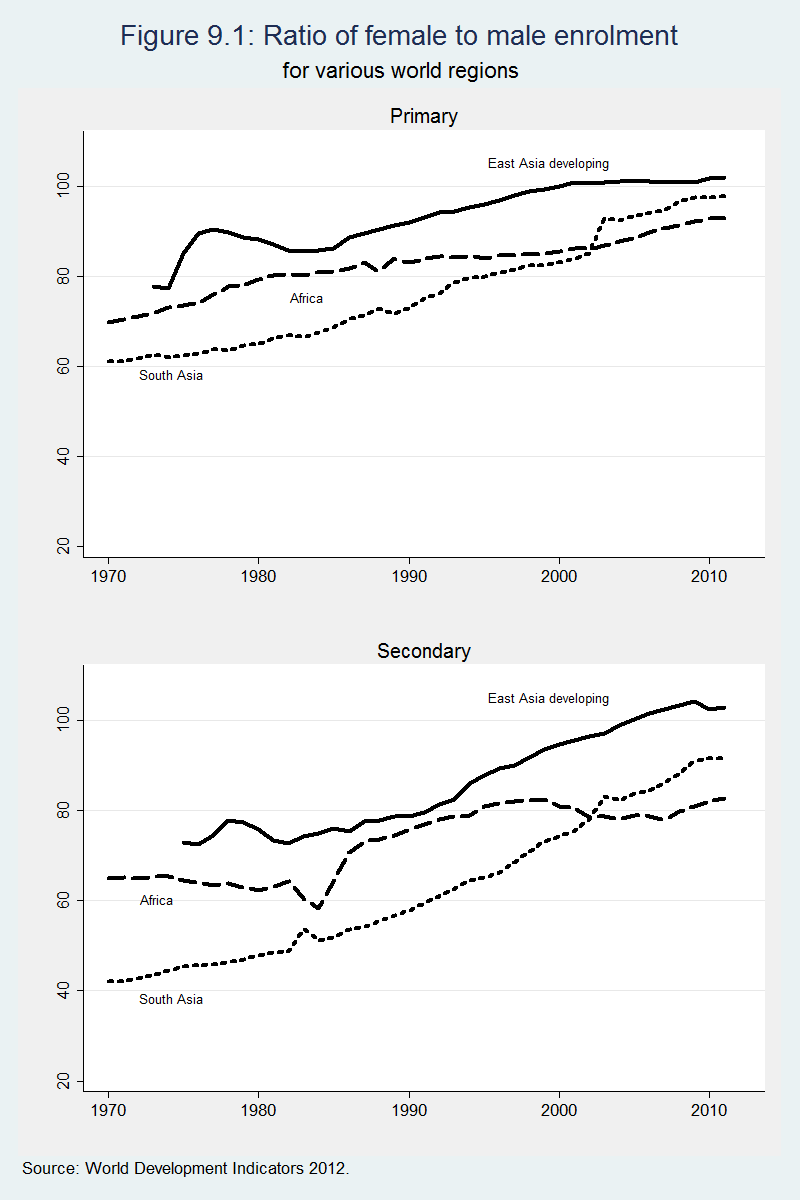
Why did gender equality in secondary schooling in Africa stall after 2000?

Just an artifact of the statistics, or did something actually happen across the continent?  I confess I have no idea.  Do you?

fig9-1

Posted in Development thinking, Gender | Comments Off on Why did gender equality in secondary schooling in Africa stall after 2000?

How upset are Santa Clara University faculty?

Upset enough that:

Pursuant to Article X.A of the By-Laws of the Faculty Senate of Santa Clara University (“Senate”), we the undersigned members of the Faculty Senate call for the immediate convening of a Special Meeting of the Senate.   The purpose of the Special Meeting is to discuss and, if appropriate, take action in response to the recent announcement by the President of the University regarding the reduction in insurance coverage of abortions.

I think the issue is really about governance, and is far more general than the specific decision on abortion taken.  Many faculty (at present 114 out of maybe 300 have signed the petition after less than 24 hours) are  very concerned at an apparent lack of communication and transparency and clear direction from the university president.  By default, the abortion insurance cancellation is the only “tea leaf” available.  The tea leaf appears to signal a move away from the more open shared governance and gradual movement toward secularization.  For many faculty, this shared governance and secularization is inevitable: the Jesuit order is declining rapidly in numbers and aging rapidly in population.  The pool of Jesuit talent is shrinking at a fast clip.  I think generally faculty looking 20 years ahead want to maintain a clear mission emphasizing the moral imperative of social justice (in its many forms) and concern with the spiritual dimensions of human life, with a very strong privileging of Catholic teachings (a questioning privileging, natch).  A rearguard attempt to buck the inevitable seems, to many I think, to be counterproductive.  No university wants to ride a Ted Cruz horse to notoriety, I think.

Posted in Personal Kevane life | Comments Off on How upset are Santa Clara University faculty?

Boxers and Saints by Gene Luen Yang

I do not normally link to the Amazon page for buying books, but I do think it worth promoting Boxers and Saints (not just because Gene and I shared a panel, and coffee, last year at a conference).  it is a tremendously compelling graphic novel, complex and entertaining at the same time.  Lots of sly humor intrudes into the tale of horrific violence of the Boxer uprising of 1898 China.

maybe-she-should-be-a-priest-500x485

The two books overlap; not necessarily in expected ways.  I read Boxers first, and was delightfully surprised by the ending of Saints.

My kids (15 and 10) LOVED this set.  They read them both instantly… gobbled them up.  They noticed plenty of technique… a graphic novel is an excellent way to build that awareness and appreciation of craft.  They both enjoyed grappling with the moral/ethical/historical problem at the heart of the novel. 

Posted in Book and film reviews | Comments Off on Boxers and Saints by Gene Luen Yang

Santa Clara University’s insurance spat hits Inside Higher Ed

Juliana Chang, associate professor of English and president of Santa Clara’s Faculty Senate, presented a statement of concern to the university’s Board of Trustees last week.

“I am hearing about a loss of faith in the mission, vision, and values of the university,” she said. “How can we educate citizens and leaders of competence, conscience, and compassion, some ask, if we are not deemed worthy of exercising our own consciences or if we find this decision uncompassionate? How can we welcome and respect other religious and philosophical traditions if we ourselves do not feel welcome and respected?”

Also last week, a high-profile faculty member broke ties with the university’s Markkula Center for Applied Ethics, saying it was acting as an arm of the administration in organizing a forum for faculty to discuss the decision after it had been made.

“I appreciate that there are deeply held differences within the [Santa Clara] community over the question of abortion,” Stephen Diamond, associate professor of law, said in his resignation letter, noting that he, like Pope Francis recently said in separate statements, had concerns over its being a byproduct of today’s “throwaway” culture.

“However,” Diamond said, “I firmly believe that the question of whether an abortion is acceptable is a question to be resolved by a woman after receiving appropriate medical advice from her doctor.”

via Some professors fear Catholic colleges are ignoring call by the pope to focus less on abortion and homosexuality | Inside Higher Ed.

Posted in Personal Kevane life | Comments Off on Santa Clara University’s insurance spat hits Inside Higher Ed

Ghana Must Go by Taiye Selasi

This book has gotten a tremendous amount of good word of mouth, and after reading it I can see why.  It is a contemporary sprawling family saga, with a little bit of magical realism sprinkled in.  Full of nostalgia, melancholy, sadness and redemption, like any unhappy family, troubled in its own way.  And way troubled… the twins Kehinde and Taiwo, troubled. The older son Olu, troubled, and the youngest, Sadie, quite troubled.  Mother Fola, very troubled.  And Dad Kweku… well it isn’t a spoiler to say that he’s in plenty of trouble, because the whole first part of the book is his set of flashbacks as he dies of a heart attack.  Benson, the family friend (a sly nod to Benson the White House butler?) is the only competent person around.  Well, there is also the mysterious carpenter.So there is plenty of plot; lots of soap opera to keep you reading.

The writing I found quirky.  Selasi mixes third person narration with first person self-interrogation.  There is loads of cultural commentary on the upper-class expat African “identity” and reflection of “those still there” … commentary that runs from the glib to profoundly lyrical to quietly insightful.

It isn’t a real novel, for me, in the way these sprawling semi-fantastic Eggers-Franzen style novels never are: too much happens, the characters are too big…. the lives are too self-important.  People feel a lot all the time.  Or they feel nothing all the time.  Big events of their own making are always happening.  Different I suppose from the quieter novels I tend to prefer where big events happen to people.  (In Alan Garner’s Stone Quartet, none of the characters are ever aware, really, that they are doing anything: the reader has to construct something profound out of the mundane.)

So I guess I recommend… depends on your taste.   Fiction with Africa-related themes continues to mature and expand beyond the niche audience of people like me, which is a nice thing to see.  Here’s a decent review of Ghana Must Go by Nell Freudenberger in the New York Times:

The Africans who left their countries in the 1960s and ’70s, the “brain drain” Selasi refers to in her 2005 essay “Bye-Bye Babar,” were dutiful immigrants who sought out secure careers in medicine, banking and law. Their accomplished and glamorous children, whom Selasi calls “Afropolitans,” are doing all sorts of other things. I think there is a large audience eager to hear their stories — so eager that agents, editors and publishers may have rushed a young writer’s book into print before it was ready. That’s a shame, because Selasi’s ambition — to show her readers not “Africa” but one African family, authors of their own achievements and failures — is one that can be applauded no matter what accent you give the word.

Posted in Book and film reviews | Comments Off on Ghana Must Go by Taiye Selasi

Guys only at my meeting…

guys only

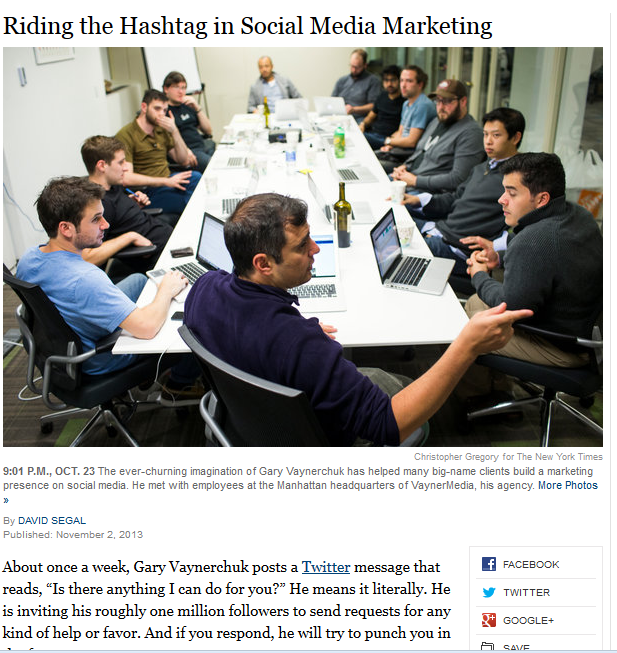
About once a week, Gary Vaynerchuk posts a Twitter message that reads, “Is there anything I can do for you?” He means it literally. He is inviting his roughly one million followers to send requests for any kind of help or favor. And if you respond, he will try to punch you in the face.

This foto really was too good to pass up.  Stark.  I know there’s a Tumblr somewhere on this theme.   via Riding the Hashtag in Social Media Marketing – NYTimes.com.

Posted in Politics | Comments Off on Guys only at my meeting…

Google Drive a fail compared with Dropbox

Just saying, from an ordinary user’s perspective. Dropbox did not fail in a year of use. Even from Burkina Faso to Dropbox server. Google Drive can’t even correctly sync from San Jose to Santa Clara.

Posted in Politics | Comments Off on Google Drive a fail compared with Dropbox

[French] Nice report about youth training for artisanal gold mining workers

Posted in Economy | Comments Off on [French] Nice report about youth training for artisanal gold mining workers