Wait… who is the first-year undergraduate? Dawkins? Or Michael Ruse…

Like every first-year undergraduate in philosophy, Dawkins thinks he can put to rest the causal argument for God’s existence. If God caused the world, then what caused God? Of course the great philosophers, Anselm and Aquinas particularly, are way ahead of him here. They know that the only way to stop the regression is by making God something that needs no cause. He must be a necessary being. This means that God is not part of the regular causal chain but in some sense orthogonal to it. He is what keeps the whole business going, past, present and future, and is the explanation of why there is something rather than nothing.

I thought “appealing to authority rather than reasonable argument” was the mistake every first-year philosophy major made?  I love that sentence that starts, “They know…”  It really reads: They knew (through reasonable argument) that Dawkins’s argument was right, so (desperately) they simply asserted what they wanted… without any reasonable argument.  And they stuck their tongues out and said “nyah nyah.”

via Does Evolution Explain Religious Beliefs? – NYTimes.com.

Posted in United States | Comments Off on Wait… who is the first-year undergraduate? Dawkins? Or Michael Ruse…

Teaching macroeconomics: Great profile of Scott Sumner and explanation of monetary policy debates 2014-style

With QE3, which started in late 2012 and continues today, the Fed took a different approach. Instead of announcing a time limit, the Fed made the program open-ended, promising to buy tens of billions of dollars of assets per month for as long as it took for the economy to start growing again. The Fed said it was willing to tolerate inflation as high as 2.5 percent — above its 2 percent target. And the bank said it would keep interest rates at 0 percent for an extended period even after the economy began picking up.

via Why printing more money could have stopped the Great Recession – Vox.

Posted in Teaching macroeconomics | Comments Off on Teaching macroeconomics: Great profile of Scott Sumner and explanation of monetary policy debates 2014-style

Fixer: The Taking Of Ajmal Naqshbandi

After teaching in the evening MBA program, I usually come home and decompress watching something.  Over the last several weeks, I watched the over-the-top police drama Luther, with Idris Elba.  It was pretty good for decompression candy.  Last night though I watched Fixer: The Taking Of Ajmal Naqshbandi.  Depressing, sad, and compelling.

Posted in Politics | Comments Off on Fixer: The Taking Of Ajmal Naqshbandi

Teaching macroeconomics: The money multiplier

It is a staple of every macroeconomics textbook.  Essential to any understanding of the money supply in a modern economy (that the banking system creates money).

Here is an excellent blog post on the Indian money multiplier.  Notice that India Reserve Bank uses the reserve requirement (called the cash reserve requirement) as a policy tool, and lowered the ratio in 2008, so the money multiplier rose sharply.

A nice post from Financial Times on the money multiplier. As most textbooks point out, while the money multiplier is a good theory, and very insightful about the process of money supply creation, in practice the excess reserves and currency-deposit ratio are endogenous, and so Central Banks generally no longer target the monetary base and money supply, and instead target short term (and sometimes long term) interest rates.

A nice article on monetary policy and the money multiplier in the euro zone.

One last short note on the money multiplier in the United States.

Posted in Teaching macroeconomics | Comments Off on Teaching macroeconomics: The money multiplier

Crime in the Bay Area

They copied my San Jose graphs (here and here) to show that crime has also been declining in San Francisco.  Because after all, I really am the first person ever to use the FBI crime statistics.

Every time a city reports a big drop in crime, someone sends me a link to a story about it. San Francisco is the latest: During the first half of the year, the city saw 14 killings — a 36 percent drop from the 22 recorded at the midpoint last year and a 63 percent decrease from the 38 in 2012. ….”The best guess one can make is that they’re associated with a national trend of lowered homicide rates over the last 20 years,” said Robert Weisberg, a law professor who co-directs the Stanford Criminal Justice Center. “They have settled a bit, but they have gone down in some places.” Weisberg said one big factor in the national drop in killings is “just smarter policing, which requires more police and smarter police, and that includes the use of technology, the targeting of hot spots and CompStat-style policing and gang intervention.”

HT: Bill Sundstrom.  via Murder Is Down 63% in San Francisco. Lead Probably Isn’t the Reason

Posted in San Jose, United States | Comments Off on Crime in the Bay Area

More on crime in California

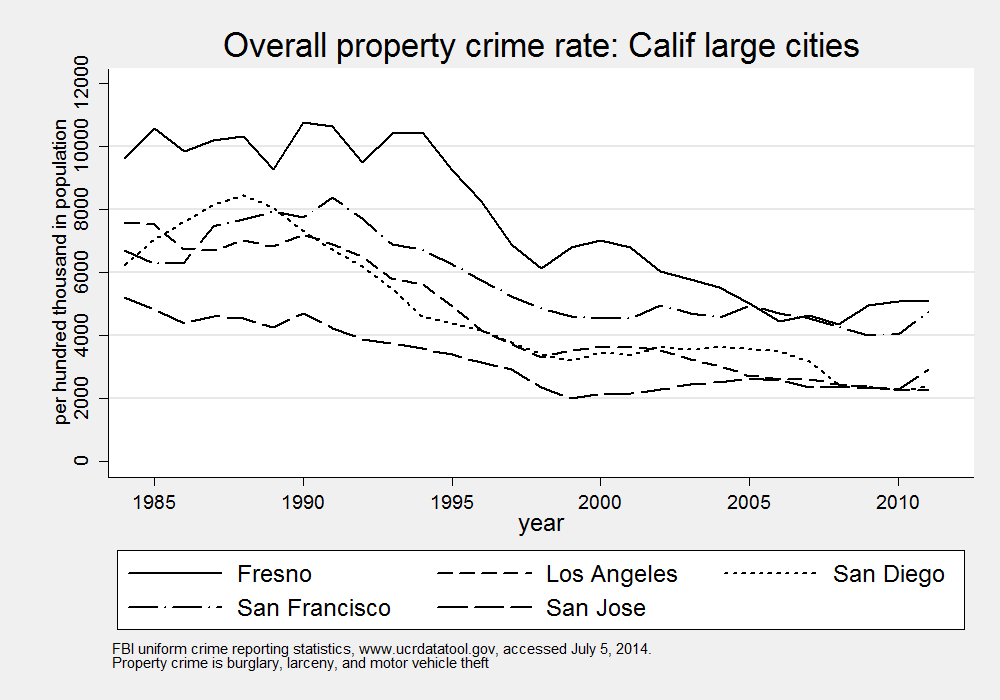
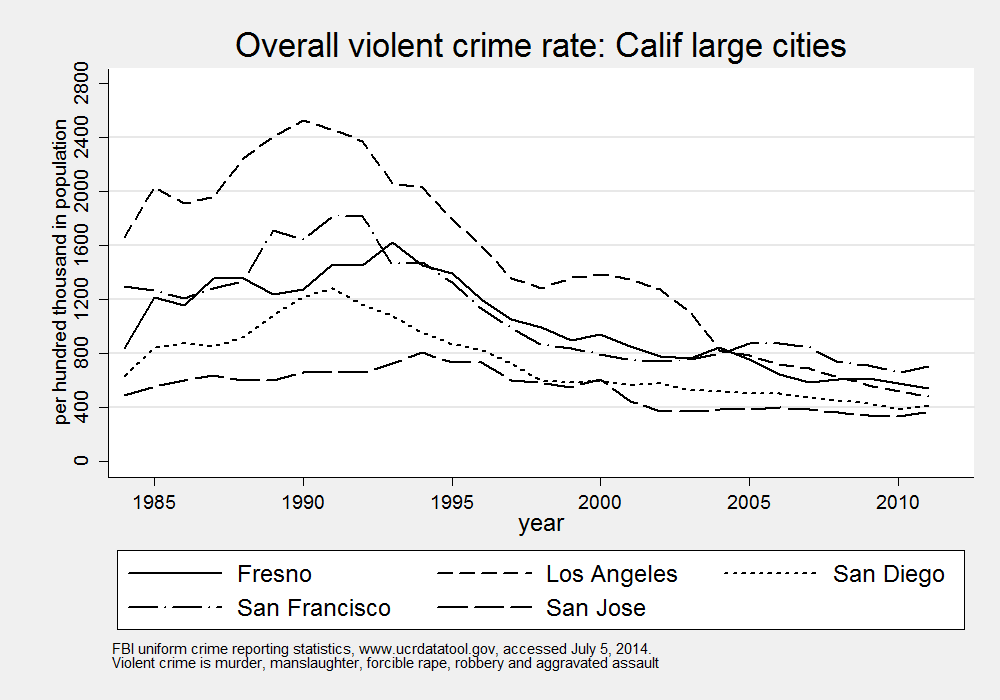
From the FBI uniform crime reporting statistics, the levels and trends of violent and property crime for the five cities in California about 500,000 in population that are in the database.  I was a little bit surprised to see them trending so closely together (police departments in all five cities seem to be doing decent work) and gratified to see that San Jose was lowest in violent and almost lowest in property crime.  (Right click on the graphs to open in new tab.)

crimeCA_violcrimeCA_prop

Posted in United States | 1 Comment

Timely reminder of controversies over money and inflation from Paul Krugman, just in time for my MBA macro class

Some background: On the eve of the Great Recession, many conservative pundits and commentators — and quite a few economists — had a worldview that combined faith in free markets with disdain for government. Such people were briefly rocked back on their heels by the revelation that the “bubbleheads” who warned about housing were right, and the further revelation that unregulated financial markets are dangerously unstable. But they quickly rallied, declaring that the financial crisis was somehow the fault of liberals — and that the great danger now facing the economy came not from the crisis but from the efforts of policy makers to limit the damage.Above all, there were many dire warnings about the evils of “printing money.” For example, in May 2009 an editorial in The Wall Street Journal warned that both interest rates and inflation were set to surge “now that Congress and the Federal Reserve have flooded the world with dollars.” In 2010 a virtual Who’s Who of conservative economists and pundits sent an open letter to Ben Bernanke warning that his policies risked “currency debasement and inflation.” Prominent politicians like Representative Paul Ryan joined the chorus.Reality, however, declined to cooperate. Although the Fed continued on its expansionary course — its balance sheet has grown to more than $4 trillion, up fivefold since the start of the crisis — inflation stayed low. For the most part, the funds the Fed injected into the economy simply piled up either in bank reserves or in cash holdings by individuals — which was exactly what economists on the other side of the divide had predicted would happen.

via Conservative Delusions About Inflation – NYTimes.com.

Posted in United States | Comments Off on Timely reminder of controversies over money and inflation from Paul Krugman, just in time for my MBA macro class

Bitter Bread of Exile – Sir Edward Mutesa II

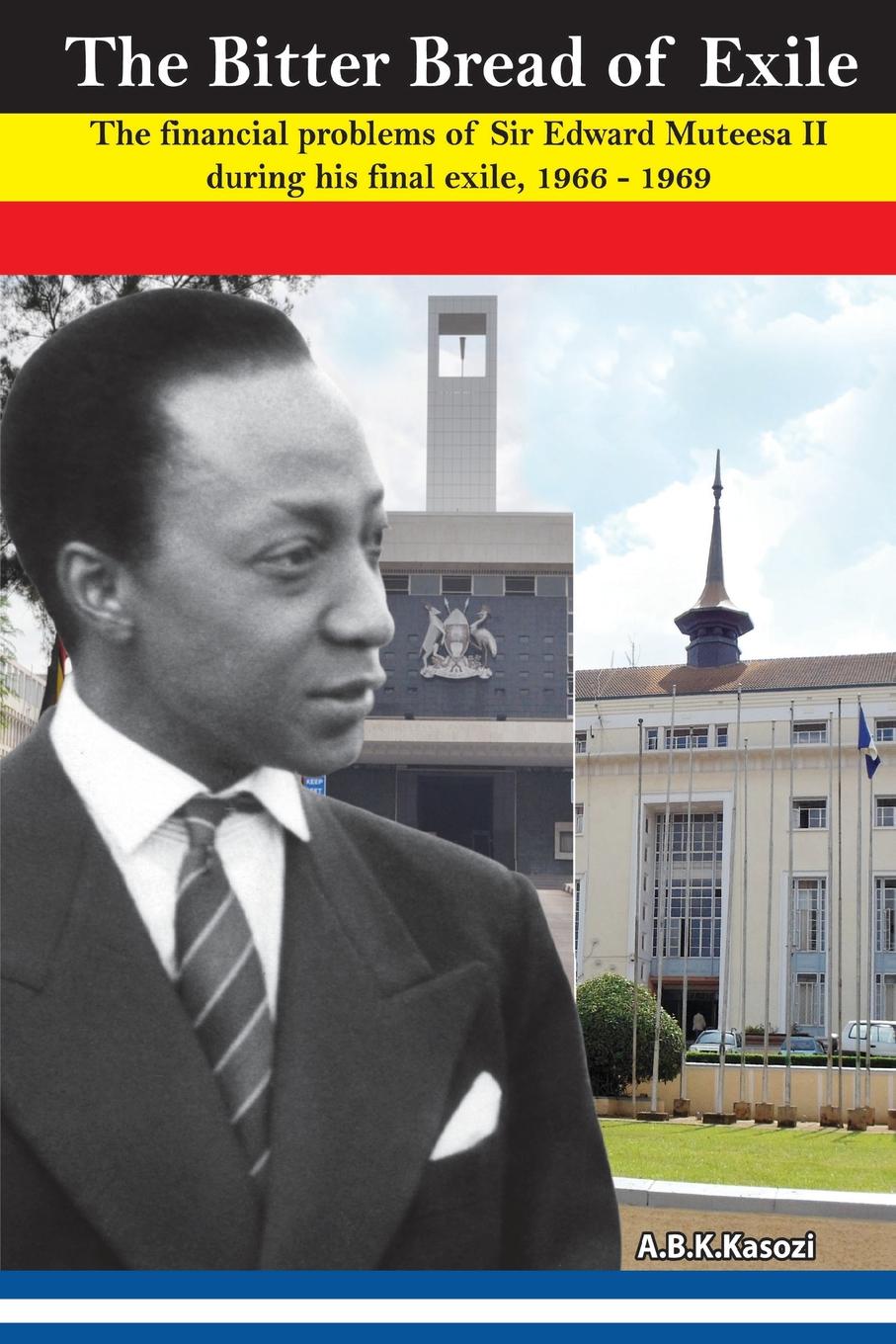
mutesaAt the African Studies Association meetings last November, I picked up a copy of Bitter Bread of Exile – Sir Edward Mutesa II by A.B.K. Kasozi.  It was not until the next day that I realized that the Kasozi writing the book was the Kasozi I knew, via my colleague Kate Parry of FAVL (her husband!).  It is a fascinating collection of short essays/chapters on various aspects of Mutesa’s exile in England, until his death, and also dealing with the burial question.  I know almost nothing about Uganda, so everything was new and interesting.  As Kasozi writes, the book is hopefully an invitation for lots more research on this period.  Too much of history of early post-independence Africa (and even contemporary Africa) is being lost: records were deliberately not kept, lies were propagated, evidence destroyed.  One can think of innumerable episodes.  I hope younger generations are inspired.

Posted in Politics | Comments Off on Bitter Bread of Exile – Sir Edward Mutesa II

Ambassador Mushingi delivers a clear message in Burkina Faso

Apparently this is what he said on 4th of July:

« Au fil des années, nous avons clarifié ce que « Egalité » signifiait et formulé 27 Amendements à la Constitution. La plupart des amendements ont élargi les libertés de l’individu. Les autres ont délimité le pouvoir du gouvernement, comme le 22è Amendement limitant la présidence à deux mandats. Aujourd’hui, nous, Américains, restons unis sur la base de notre entendement que nous sommes tous créés égaux et dotés de droits inaliénables, y compris le droit de participer au gouvernement.Excellences Mesdames et Messieurs. Du peu d’expérience que j’ai pu acquérir au cours de mes quelques mois de séjour ici, je vois que le Burkinabé possède non seulement la résilience, mais aussi et surtout le courage et la détermination pour atteindre ce même objectif ».

via Independence Day des Etats-Unis : Un autre Compact pour le Burkina Faso.  I think this is good diplomacy by the ambassador, but I hope there is a backup plan.  It is great to affirm over and over the importance of alternance and respect for the constitution.  But if President Compaoré bullies* through a referendum and then presidential vote, and a united opposition takes to the streets, sides will have to be chosen.

*bullies is a technical word in political science… it means… oh, sorry, gotta run to take this call.

Posted in Politics | Comments Off on Ambassador Mushingi delivers a clear message in Burkina Faso

Crime trends and levels in San Jose

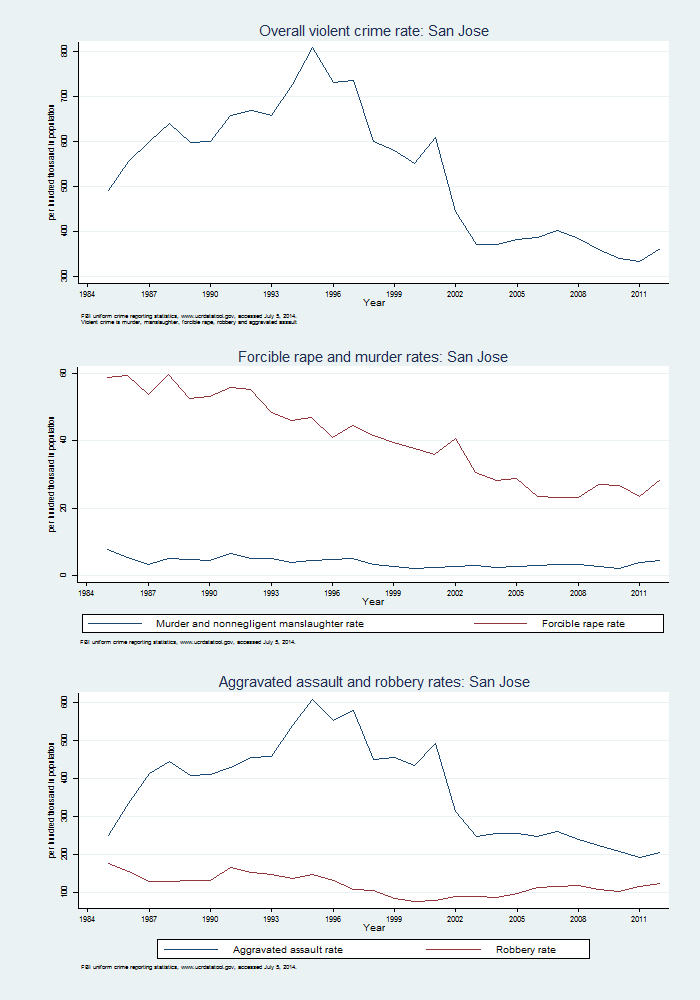
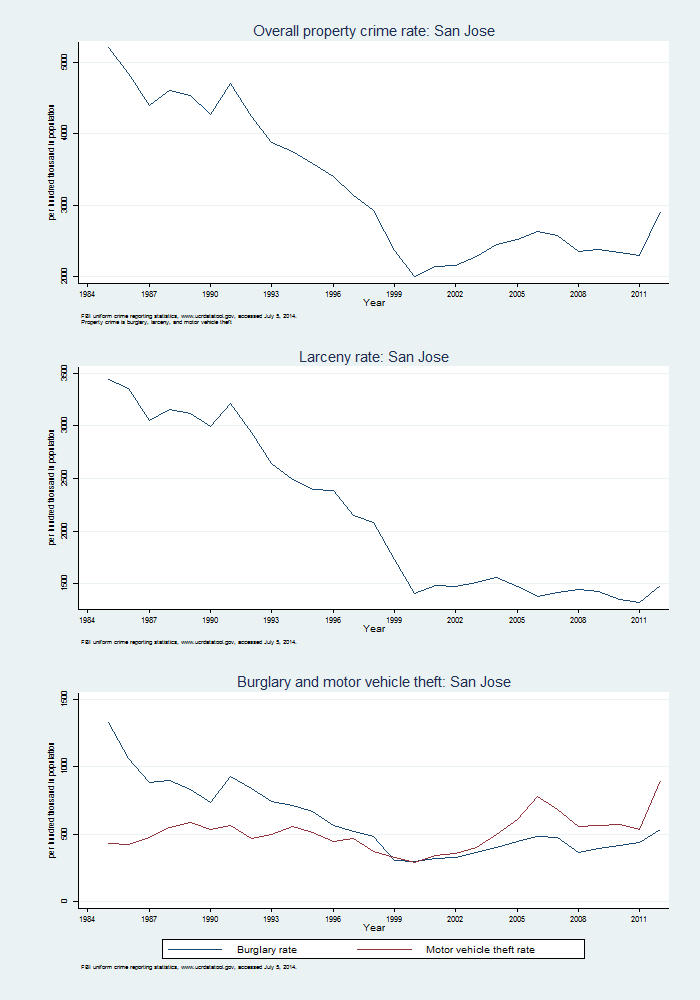
As the upcoming mayoral election comes up for San Jose, we have two candidates: Sam Liccardo and David Cortese.  Crime and policing are, at this point, going to be at the center of the campaign.  So I thought I should become a bit more educated about “the facts.”  So I turned to the FBI uniform crime reporting statistics.  The charts below give the crime rates per 100,000 of population.  The note on the table for San Jose declares “Due to reporting changes or annexations, 1997 figures are not comparable to previous years’ data.” But it doesn’t seem that there is any clear 1997 break in the series, so perhaps the change was relatively minor (experts weigh in perhaps?).  Anyway, I thought to present the whole series.  There is an uptick in 2012 (the last year available) in property crime, very clearly.  But still fairly small in the overall picture.  Tomorrow I’ll take a look and see if that uptick was common to other California cities.  On the whole, my takeaway is that the 2000s have seen a good, steady reduction in crime rates.  That is reassuring.  There is no “crisis” and policy shouldn’t respond to a rhetoric of crisis.  We need to keep building on good police work and social work of the past two decades.

(Right click on the graphs to open in new tab, to see more clearly.)

vcrimesj_start_1984               pcrimesj_start_1984

Posted in Politics | 1 Comment

I might start reading Stephen King… but first I have to finish more Shirley Jackson

So a librarian at Santa Clara University gave me a treat this long holiday weekend.  In the “fiction browsing” section I discovered Shirley Jackson’s We Have Always Lived in the Castle from 1962, apparently her last published novel.  It is wonderfully written.  I love a novel where the writing itself is part of your reading experience.  She repeats herself, elliptically, adding to the disorientation.  She is fully aware of the context a reader might bring, of a ghost story, and so she hints, with care, at how her characters could, indeed, be witches.  But they are not.  Instead, it is an intense portrait of an awkward relationship between the two sisters.  It is a novel about the daydream and the reality of withdrawal.  For an introvert, it is perfect.  Very little is communicated, much is observed.

How lovely, then, that right upon finishing Jackson’s novella, I start reading Colm Tóibín’s The Master… which seems, at first, to be also an historical novel about an introvert.

Posted in Book and film reviews | Comments Off on I might start reading Stephen King… but first I have to finish more Shirley Jackson

#InstagrammingAfrica: The Narcissism of Global Voluntourism

How are you not narcissistic when criticizing your former narcissist self?

Voluntourism organizations don’t have to advertise, because they can crowdsource. Photography—particularly the habit of taking and posting selfies with local children—is a central component of the voluntourism experience. Hashtags like #InstagrammingAfrica are popular with students on international health brigades, as are #medicalbrigades, #globalhealth, and of course the nostalgic-for-the-good-days hashtag #takemeback. It was the photographs posted by other students that inspired me to go on my first overseas medical mission. When classmates uploaded the experience of themselves wearing scrubs beside adorable children in developing countries, I believed I was missing out on a pivotal pre-med experience. I took over 200 photos on my first international volunteer mission. I modeled those I had seen on Facebook and even pre-meditated photo opportunities to acquire the “perfect” image that would receive the most Likes.

via #InstagrammingAfrica: The Narcissism of Global Voluntourism – Pacific Standard: The Science of Society.

Posted in Development thinking | Comments Off on #InstagrammingAfrica: The Narcissism of Global Voluntourism

Lake Chad area resource conflicts

Lake Chad gets talked about a lot in the environmental discussions of the Sahel.  I know little about the science. But a quick perusal of various articles by hydrologists suggests that human water management decisions (bad ones, naturally) have been a significant share of the explanation of the decrease in water contained by the lake.

Given that billions of dollars were invested in the Chad oil pipeline, and billions in revenue have been generated by the pipeline, my inclination would be to think that any “environmental” or “climate” effects of the diminished resource base due to reduced water supply, should really be thought of as “political” effects.  That is, relatively inexpensive (compared to the oil pipeline) mitigation investments could have greatly reduced the changes that have taken place in the hydrology of Lake Chad.

Over the last 40 years, Lake Chad, once the sixth largest lake in the world, has decreased by more than 90% in area. In this study, we use a hydrological model coupled with a lake/wetland algorithm to simulate the effects of lake bathymetry, human water use, and decadal climate variability on the lake’s level, surface area, and water storage. In addition to the effects of persistent droughts and increasing irrigation withdrawals on the shrinking, we find that the lake’s unique bathymetry—which allows its division into two smaller lakes—has made it more vulnerable to water loss. Unfortunately the lake’s split is favored by the 1952–2006 climatology. Failure of the lake to remerge with renewed rainfall in the 1990s following the drought years of the 1970s and 1980s is a consequence of irrigation withdrawals. Under current climate and water use, a full recovery of the lake is unlikely without an inter-basin water transfer. Breaching the barrier separating the north and south lakes would reduce the amount of supplemental water needed for recovery.

via On the causes of the shrinking of Lake Chad – Abstract – Environmental Research Letters – IOPscience.

Posted in Sahel | Comments Off on Lake Chad area resource conflicts

Espen Stranger-Johannessen on promoting a reading culture in Uganda

Espen, who has been affiliated with the Uganda Community Library Association and Kitengesa Community Library, both supported by FAVL, has a new article in the IFLA Journal.  It is based on his fieldwork in Caezaria Library in Uganda.

It is a fine article, and I thought well worth some attention.  So here are some comments in the spirit of … we need more discussion and attention to community (and public) libraries in Africa!

I have some quibbles with Espen’s definition of community library.  It seems to me that the origin or even control of the library matter little.  An NGO insisting on stocking European classics only, and a village schoolteacher insisting on stocking her favorite anti-colonial literature dated from the 1950s…. both are equally “un-community” libraries.  What matters is the usage, involvement, sense of belonging, efforts to create ties, openness to change, etc.  A community library is one that is responsive to local readers, is used by local potential readers (a community library in a village with low literacy will have few readers), and makes efforts for local leaders (and readers) to be involved in governance.  I also think that the distinction between community libraries and public libraries is overblown.  Any good public library will be responsive to local readers, will be used, and will make efforts for local people to be involved.  The ideal public library is a community library!  The ideal community library is a public library!

Espen then has a section that quite properly raises some general theoretical questions about community libraries.  In essence: it is entirely reasonable and right to question library collection priorities and reading programs.  Given the focus on community libraries, however, I think Espen elides a thorny issue.  A community is really a set of communities: villages (in English-speaking Africa) have anglophones, anglophiles, anti-colonialists, Daneille Steele lovers, grumps, Bible readers, terse and laconic intellectuals… all types.  Sometimes they agree, but sometimes they disagree.  Again, a library ideal is to be responsive, within constraints of budget and time, to these many constituencies.  Extreme cases can arise: in American library history trashy novels were the subject of endless disputes between moralizing librarians and library boards (one part of the community) and many readers (another part of the community).  So community conflict over libraries is to be expected.  Indeed… maybe it is a good sign that people take reading seriously enough that it becomes controversial!

I like Espen’s brief aside (following Lareau) that one of the effects of libraries is to prepare children to be more comfortable with adults in the “adult” world  of office spaces.  Too often rural children are completely unprepared for the more informal and collaborative work of an office.  They are used to simply following directions.  In an office setting, where knowledge is both tool and product, collaboration and communication are much more valuable.  A library, a social space where children interact with adults, may help develop that skill.  A librarian’s question, “What did you think about this book?” may be the only sincere and respectful intellectual conversation a child has with an adult!

Overall, a fine article, well-worth reading!

Stranger-Johannessen, Espen. “Promoting a reading culture through a rural community library in Uganda.” IFLA Journal 40.2 (2014): 92-101.

Posted in Reading | Comments Off on Espen Stranger-Johannessen on promoting a reading culture in Uganda

Janet Yellen and Bubbles

Ms. Yellen stakes out her position in about as clear a language as you’ll see from a central banker: She believes that it would most likely be a bad idea to raise interest rates to fight financial excesses. Her focus, crucially, is not on preventing Wall Street from having ups and downs, but on making sure that those ups and downs don’t bring economic disaster.This focus on resilience differs from much of the public discussion, which often concerns whether some particular asset class is experiencing a “bubble,” and whether policy makers should attempt to pop the bubble. Because a resilient financial system can withstand unexpected developments, identification of bubbles is less critical.

via Janet Yellen Signals She Won’t Raise Rates to Fight Bubbles – NYTimes.com.

Posted in United States | Comments Off on Janet Yellen and Bubbles

Must reading for Iraqis under siege

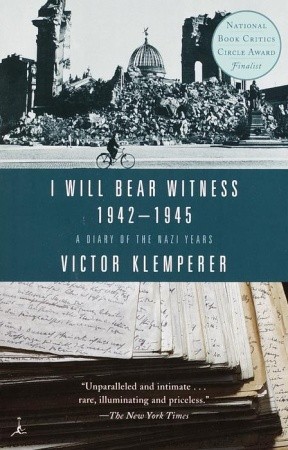
190572Victor Klemperer’s I Will Bear Witness: A Diary of the Nazi Years 1942-45.  He survives.  The diary is gripping reading. He wrote practically every day and gave the pages to a trusted friend.   At the end you get all the daily humiliations, the constant shuffling from hope to despair.  The friends who are shipped away, never to return.  And the constant rumors.  Would it be any different in the Internet age?  A New York Times review is here.   Most complicated.

Posted in Book and film reviews | Comments Off on Must reading for Iraqis under siege

Sudan and BNP Paribas

I have not been following this case at all, but this NY Times story, all about Iran, has this one sentence about Sudan:

BNP was also doing business with Sudan at a time that the nation was operating a genocidal regime.

Well…. alleged crimes against humanity and war crimes…  a little more “factual” for the newspaper of record… what sloppy reporting.  In addition to being a truly horrible sentence.

The full complaint of the prosecutor is available here, and there are 3-4 pages on Sudan, though basically describing the mechanics of the evasion/fraud scheme, and not naming any of the parties in Sudan, nor why they were intent of using U.S. routed bank transfers to cover their tracks.

via A Grieving Father Pulls a Thread That Unravels BNP’s Illegal Deals – NYTimes.com.

Posted in Sudan | Comments Off on Sudan and BNP Paribas

More Paramanga Yonli

Posted in Politics | Comments Off on More Paramanga Yonli

Paramanga Yonli rallies the troops….

Posted in Politics | Comments Off on Paramanga Yonli rallies the troops….

How many deaths will result from marijuana legalization

My gut feeling is that nowhere close to the deaths and disability years of alcohol.

Excessive alcohol use accounts for one in 10 deaths among working-age adults ages 20-64 years in the United States, according to a new report. Excessive alcohol use led to approximately 88,000 deaths per year from 2006 to 2010, and shortened the lives of those who died by about 30 years. These deaths were due to health effects from drinking too much over time, such as breast cancer, liver disease, and heart disease; and health effects from drinking too much in a short period of time, such as violence, alcohol poisoning, and motor vehicle crashes.

via One in 10 deaths among working-age adults in U.S. due to excessive drinking, report finds — ScienceDaily.

Posted in Politics | Comments Off on How many deaths will result from marijuana legalization