Trying to fix my old turntable in basement I turned into a voyeur

Posted in Personal Kevane life | Comments Off on Trying to fix my old turntable in basement I turned into a voyeur

Don’t watch the Sean Penn Hulu space show

Unless you really enjoy conventional, comfortable story telling. I have lot of sympathy for Sean Penn since he was visiting a relative on the same floor of hospital in LA where my mother was for a time. But I can’t say I ever liked him as an actor, and the chapo and macho shtick is lame. His new vehicle on Hulu….I am a sucker for space shows, but this was god awful. Tiresome and predictable plotting, writer’s room choices, and scenes: (“how about she runs a tattoo parlor!?”; “let’s copy that scene from Contact, maybe? Oh good idea I loved that scene!”; “let’s make the explosion be the same as the Challenger!”).  BTW, what male astronaut does not have a buzz cut?  Could they not have the central character be a Sunita Williams type, in 2018?

Posted in Book and film reviews | Comments Off on Don’t watch the Sean Penn Hulu space show

I think I may be done with Iain Banks: Against a Dark Background

I finished Against a Dark Background earlier this week. A basic adventure space opera with a sympathetic android and a fairly obvious bad guy who is slowly revealed.  It moves quickly and occasionally the settings are interesting but quite often they veer towards the silly/sophomoric. Nuance is present occasionally, but stock emotions and characterization prevail. Technique is interweaving flash backs without clear signals. Less experienced readers will be confused. Aims for noirish despair in tone, occasionally succeeds.

Posted in Book and film reviews | Comments Off on I think I may be done with Iain Banks: Against a Dark Background

Legacy of slavery in the United States: a few readings and perspectives

Heather O’Connell and Robert Reece find sizable correlation of extent of slavery with public school enrollment and attendance in the present (see summary here):

Drawing from our regression analysis, we argue that slavery history shaped the local social structure in a way that facilitates contemporary white disinvestment from public school systems. We examine two potential explanations for this legacy of slavery—the number of private schools and racial threat—particularly their manifestation within the Deep South. Despite evidence of subregional differences rooted in history, neither pathway explains the initial slavery association. We argue that processes tied to the legacy of slavery are a foundational component of black disadvantage and that further examination of this foundation is necessary to stem the tide of recent resegregation.

And slave counties had considerably slower decline in a major public health outcome, heart disease mortality, according to a multi-author study:

Nearly 50 years of declining heart disease mortality is a major public health success, but one marked by uneven progress by place and race. At the county level, progress in heart disease mortality reduction among Blacks is associated with place-based historical legacy of slavery. Effective and equitable public health prevention efforts should consider the historical context of place and the social and economic institutions that may play a role in facilitating or impeding diffusion of prevention efforts thereby producing heart healthy places and populations.

1-s2.0-S2352827317300460-fx1

Glenn Loury back in 1998 had many interesting things to say on the issue. An example from his essay, provocative to some but to others almost banal in its reasonableness:

A social scientist of any sophistication recognizes that societies are not amalgams of unrelated individuals creating themselves anew–out of whole cloth, as it were–in each generation. A complex web of social connections and a long train of historical influences interact to form the opportunities and shape the outlooks of individuals. Of course, individual effort is important, as is native talent and sheer luck, for determining how well or poorly a person does in life. But social background, cultural affinities, and communal influence are also of great significance. This is the grain of truth in the conservatives’ insistence that cultural differences lie at the root of racial inequality in America. But the deeper truth is that, for some three centuries now, the communal experience of the slaves and their descendants has been shaped by political, social, and economic institutions that, by any measure, must be seen as oppressive.

More regression analysis from Acharya, Blackwell and Sen:

We show that contemporary differences in political attitudes across counties in the American South trace their origins to slavery’s prevalence more than 150 years ago. Whites who currently live in Southern counties that had high shares of slaves in 1860 are more likely to identify as a Republican, oppose affirmative action policies,and express racial resentment and colder feelings toward blacks. These results cannot be explained by existing theories, including the theory of racial threat. To explain the results, we offer evidence for a new theory involving the historical persistence of racial attitudes. We argue that, following the Civil War, Southern whites faced political and economic incentives to reinforce racist norms and institutions. This produced racially conservative political attitudes, which in turn have been passed down locally across generations. Our results challenge the interpretation of a vast literature on racial attitudes in the American South.

Posted in Burkina Faso, United States | Comments Off on Legacy of slavery in the United States: a few readings and perspectives

Sexual harassment in factories in Indonesia: extraordinary short documentary

Posted in Gender | Comments Off on Sexual harassment in factories in Indonesia: extraordinary short documentary

Tariffs and trade wars, some comments

We are having an informal Civil Society Institute discussion on the tariffs and trade war issue this week, so I  thought I would do a little round-up.

My friend Tom Prusa summarizes some of the basics for a New Jersey television program: “Are people going to lose jobs? You cannot have the type of protection that are being announced and now being implemented without loss of jobs. This is almost unprecedented, the level of tariffs that not just the United States, but other countries are currently now ready to apply.”

Tom may have overlooked one job creation bright spot: “As of Thursday afternoon, the department had received more than 10,000 applications to exclude certain products from the tariffs. Earlier this month, a Commerce spokesperson told Marketplace it has expanded its staff from six people to 19 to process the applications. Officials did not respond to a request for more details about the qualifications of those staffers.”

The irony should not be lost: the party of deregulation is creating a regulatory tariff structure where the often arbitrary decisions of bureaucrats makes private enterprise more or less profitable. Reason.com is all over that aspect of the trade wars.

Economists predict at their peril: June 1: ““I do think this throws a wrench into the NAFTA negotiations and find it very unlikely that they’re going to conclude positively any time soon,” said Chad Bown, a senior fellow at the Peterson Institute for International Economics.” October 1: New trade agreement announced.

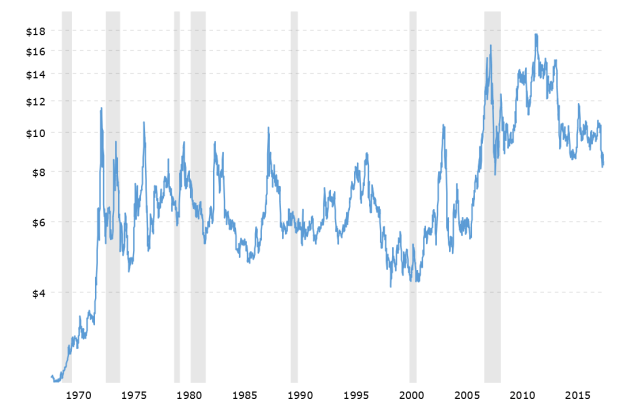
Much discussion about soybeans since they matter for politics (because small-population farm states have so much overrepresentation in the Senate):

Soybean Prices – 45 Year Historical Chart

soybean-prices-historical-chart-data-2018-10-01-macrotrends

As can see, despite recent falls in prices, soybean prices are still at hostoric highs. “Don’t cry for me soybean farmers…”

Posted in Teaching international trade, Teaching macroeconomics | Comments Off on Tariffs and trade wars, some comments

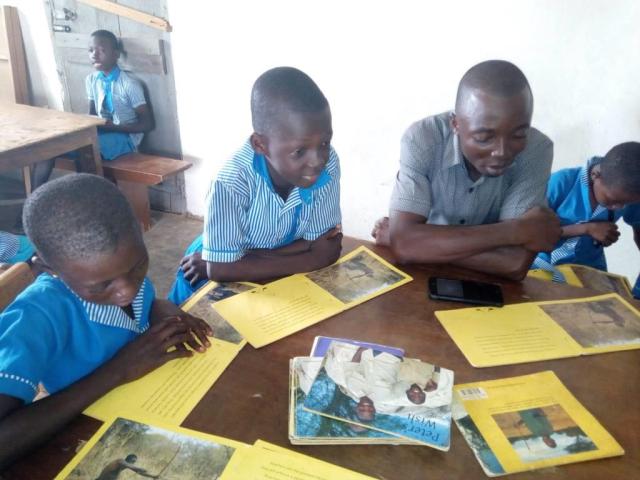
Photo of readers in Sheigu library in Upper East, #Ghana

reading in library sm

Posted in Reading | Comments Off on Photo of readers in Sheigu library in Upper East, #Ghana

Some recent news on the American economy

The Census Bureau a couple of weeks ago released an update on the U.S. economy for 2017. The headline was that real median household income had increased by 2.6 percent, and was about $61,000, and the poverty rate was 12.3%. The poverty line for a family of four with two children under 18 is about $25,000. (The New York Times defines an “affordable” seaside getaway as costing about $500 a night, so there is room for disagreement on what constitutes poverty.)

Median Household Income[Source: U.S. Census Bureau]

Note: A Brookings commentary suggests viewing the Census report, based on responses to surveys, with caution, since the quality of survey measures in general has been declining as Americans are less likely to respond.

If you think that improving health insurance coverage is a good measure of progress in constructing a society of equal opportunity for all, where people can afford to be more entrepreneurial because they will have insurance against serious illness, then this graphic suggests the country has been moving in the right direction.

Population Without Health Insurance Coverage[Source: U.S. Census Bureau]

The one area probably that worries economists the most about the U.S. economy is persisting low (relative the pre-2007) prime-age participation in the labor market. One study by the San Francisco Fed staff suggested that this decline was mostly “attributable to the disappearance of manual labor positions in manufacturing and other industries…”. The study concludes on a pessimistic note:

Moreover, as the job market has evolved and some labor force participants have dropped out, other long-term economic and social trends have reinforced low participation rates among prime-age individuals. As discussed in Abraham and Kearney (2018), these factors include the rise in disability claims and other indicators of poor health (such as opioid abuse), an increasing fraction of individuals (primarily men) with prison records, and improvements in the availability and quality of leisure pursuits, such as online gaming; these factors are also discussed in Board of Governors (2018) and CBO (2018).

Posted in Burkina Faso, United States | Comments Off on Some recent news on the American economy

Good interview regarding recent dozo- koglwéogo confrontation in Karangasso-Vigué in #Burkina Faso

Le 12 septembre dernier, des affrontements ont éclaté à Karangasso-Vigué, causant la mort du fils aîné du chef de canton et de deux koglwéogo. Dites-nous ce qui a bien pu conduire à un tel drame.Yacouba Drabo (Y.D.) : Avant d’entrer dans le vif du sujet, permettez-moi de présenter mes sincères condoléances à la grande famille des dozo du Burkina et d’Afrique, particulièrement au dozo-bâ [grand dozo, en langue dioula], chef de Karangasso-Vigué, Bamory. Pour revenir à votre question, je dirai qu’il y a toujours eu une incompréhension entre dozo et koglwéogo. Il y a longtemps que nous avons essayé de faire comprendre aux koglwéogo que nous ne pouvons pas cohabiter.

Source: Relations dozo- koglwéogo : « Qu’on ne nous provoque pas », prévient maître Yacouba Drabo, chef de la confrérie des dozo – leFaso.net, l’actualité au Burkina Faso

Posted in Burkina Faso | Comments Off on Good interview regarding recent dozo- koglwéogo confrontation in Karangasso-Vigué in #Burkina Faso

Loyola University New Orleans student newspaper article on Jesuit presidents

Despite the shift in lay presidents, Dziak said that the men and women taking over these leadership positions were not chosen on a whim. They are qualified to represent these schools and that there is no lack of qualification or respect for the Jesuit mission.“Many Jesuits today are moving into other disciplines than administration and it is a numbers game,” Dziak said, “we will pick the person most qualified, and if that person happens to be lay, then so be it.”Along with Loyola’s new president’s outstanding qualifications, many other universities hold their leadership to similar qualification standards. Georgetown University in Washington D.C.’s president, John J. DeGioia, worked as an administrator and teacher at Georgetown before taking office. Like Tetlow, DeGioia was familiar with the university and its Jesuit values.

Source: Jesuit universities slowly losing Jesuit presidents – The Maroon

Posted in Burkina Faso | Comments Off on Loyola University New Orleans student newspaper article on Jesuit presidents

Excellent articles on Peulh (Fulani) mobilization in central Mali

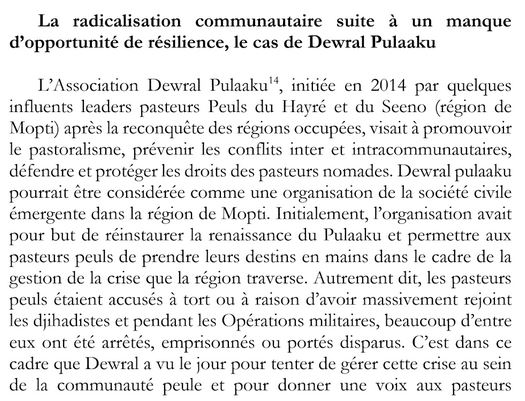
These are in a book Biographies de la Radicalisation: Des messages cachés du changement social edited by Mirjam de Bruijn that just came out in 2018. (Gated on project Muse, here.) The first is by Modibo Galy Cissé and traces the path of Hamadoun Kounfa towards becoming leader of one the numerous insurgent group (if he indeed is still alive!). (Another paper of Cissé’s is here.) Lots of interesting details and a thoughtful and clear introduction to the many issues in the Peulh community.  The second is more traditional conflict analysis, by Boukary Sangaré.  Both are well worth reading!

Sangare extract

Posted in Burkina Faso, Politics, Sahel | Comments Off on Excellent articles on Peulh (Fulani) mobilization in central Mali

Opposition march in #Burkina Faso set for September 29

The leader of the political opposition in Burkina Faso, Zéphérin Diabré, has called for a march of protest on 29 September against what the opposition characterizes as the failed policies of the presidency of Roch Marc Christian Kaboré, at the 2 year midpoint of MPP’s control over presidency and government. The next elections are set for 2020.

The local newspapers published the declaration of the opposition. After noting that for the first two years they have tried to be a “loyal opposition” and work within government, and feeling dismissed by the MPP, they have decided to be more forthright in their opposition. Here are their main points of difference with the MPP, as enumerated in the declaration.

  1. Terrorism continues to grow and the government seemingly has no coherent strategy and has appointed incompetent people to important positions.
  2. Standards of living are declining and misery is spreading.
  3. Housing is in crisis, especially in the peripheries of large towns where speculators are driving up prices and the government is not moving fast to regulate and distribute parcels to those who need them. Instead, the opposition charges, government seems more intent of taking away the villas of old regime Compaoré regime members and distributing them to the new insiders.
  4. Youth and women have been neglected. opposition says MPP promised all sorts of jobs and easy loans for these economically marginal groups.
  5. Corruption continues. The opposition signals a reform in public procurement known as PPP where expedited procedures can be used to approve purchases.
  6. Justice has been instrumentalized to favor the MPP and persecute adversaries.
  7. Fundamental liberties are being threatened. Opposition charges that the MPP is taking a harsh stand on the rights of unions to strike, and is accusing opposition figures of “destablisation” and arresting people without real evidence.
  8. Democratic elections are threatened. The opposition accuses the MPP of fostering violence during the municipal elections of 2016, of passing a reform of the CENI without consensus, and of writing policies to diminish opportunities for Burkinabe residing abroad to participate in elections.
  9. Administrative, civil service positions are being politicized. According to the MPP, promotions and appointments to leadership civil service positions are being made according to party membership, not merit.
  10. 10. In Burkina Faso, the word “incivisme” stands for everything from running red lights to grand corruption. The opposition thinks the MPP is contributing to incivisme.
  11. National reconciliation. The opposition thinks the MPP is dividing and fostering enmity rather than reconciliation.
  12. Economic growth. Not good, according to opposition.
  13. Public investment. opposition thinks the government is just recycling old projects and claiming them as their own.

Seems like a reasonable list of political grievances. My own preference would have been for a more positive agenda of clear proposals and priorities. But I’m a social scientist, not a cognitively-biased confirmation-seeking group-affiliating socially-constructed contingent identity-seeking multiply-selved prospective voter.

Posted in Burkina Faso | Comments Off on Opposition march in #Burkina Faso set for September 29

Good background on Katiba Macina, Fulani rebel group in central Mali

A nice summary by Manon Elissa Murray, nothing new but clearly written and organised, if the English grammar leaves a little bit to be desired.  The full text is here.

The purpose of Katiba Macina was originally the restoration of a Fulani caliphate. Now, with its alliance with Tuareg jihadist group Ansar Dine, and indirectly with more transnational organizations, it looks like Katiba Macina’s goal is to impose Shariah law in the region. Central Mali is therefore currently undergoing a classic scenario of people-centric insurgency, like the one we might have seen in South Vietnam or in Afghanistan in the past. Katiba Macina is systematically targeting state symbols: at least three village chiefs or mayors were assassinated in Mopti in early 2017, city halls or custom houses have been attacked, militaries, policemen and judges have also been targeted. The group did not only target other ethnic groups but also Fulani, as many refused to join or to support Katiba Macina, and Fulani imams were killed. This demonstrates the fragmentation and the heterogeneity of the Fulani, who, like any group, do not stand together as one political and social entity.

By eliminating these agents of power and replacing them with their own, Katiba Macina is taking over governance in the region, becoming a kind of “shadow government”. Its followers are hence typically following the intimidation strategy used by terrorist groups to gain control over the population, by creating insecurity[2], thus leading many civilians to join jihadist groups like Katiba Macina in order to seek protection. As a response to this surge of violence, and with the lack of an appropriate response by the government, ethnic-based militias have been created for self-protection and retaliation, particularly the Bambara militia called the Dozos. As a result, exactions are now committed on a daily basis by both jihadists and militias, targeting people on the grounds of their ethnic group, thus creating ethnic tension within populations who were not involved in any armed movement, and who are pushed to join these groups for protection due to the helplessness of the government.

The government, however, has not been passive. Armed forces have been accused of indiscriminately abusing citizens, by conducting arbitrary arrests, torturing and killing, the victims being mostly Fulani, for the sole reason that Katiba Macina’s jihadists are Fulani.

Posted in Burkina Faso, Politics, Sahel | Comments Off on Good background on Katiba Macina, Fulani rebel group in central Mali

Reading and French movies on trip to Burkina Faso

On the Air France flight I enjoyed (the standard on a 10 hour flight is low, but they were all better than Deadpool 2) several films (that incidentally I has never heard of):

Les derniers Parisiens: A low-budget film about a group of hustlers in the Place Pigalle area, centered around two brothers who own a bar, one recently released from prison (the the work that got them the bar) and the other trying to break out of the vicious circle of the low education grind. Almost all the characters are men; it is about how they talk, their dreams and strategies, and ultimately their defeat.

Razzia: Sometimes overly solemn and definitely very upper class take on “life” (five somewhat intertwined separate character portrayals) in Casablanca, including one of the last Jewish owners of a restaurant whose schtick is partly “Sam’s”. The lyrical portrayal of a Berber teacher who has an affair with a widow, and the denouement of their relationship, is lovely even though somoewhat cliche in this kind of movie. Still, some very good acting. Script could have been tightened up: too many shots of people staring directly into the camera with moving background music.

Camille Redouble:  An absurd sometimes quite bad movie about a middle-aged woman very unhappy, drinking herself into divorce and separation from everything that means anything to her, who gets a second chance, and wakes to find herself in the body of her younger self 25 years earlier. The time travel of course makes no sense at all and the film does not even bother with that. Instead, watching the main actress go from a dour frown to beautiful smile and grace over an hour is delightful.

Le Brio : Pretty stale drama about a young child of immigrants trying to make it in law school. With ambivalent and reluctant help from a cranky politically incorrect professor. Think I had seen some of the scenes in other movies, it was that familiar. Including a speech from the taxi driver boyfriend with heart of gold.

For reading, an old French novel that I picked up from one of the FAVL donation boxes, Francoise Sagan’s Dans un mois, dans un an, a breezy year in the life of young bourgeois Parisians (and some middle-aged- does she have to call the two 50 year olds “old”?). Pretty much the opposite of Les derniers Parisiens. These are the original chic-bubble Parisians…. the kind that Sagan and a culture industry created in the minds of people around the world, the image that was nicely captured almost as a parody by Jeff Goldblum’s wonderful cameo turn as an American professor in Paris in Le Week-end.

Posted in Book and film reviews | Comments Off on Reading and French movies on trip to Burkina Faso

American Gods by Neil Gaiman

Read this on the flight to Burkina Faso and then over a few days. Entertaining and occasionally compelling but the writing was just not edited enough to really shine. I appreciated the central idea, but the execution left me unsatisfied. Occasional digressions (let’s see if I can list a bunch of old gods and imagine them in different characters that are semi-American) were just filler (equivalent of the old TV shots of plane taking off and then plane landing …. B-roll is that what they call it?). Shadow’s somnolence was never really explored. Because he did not know his true father, he did not know himself? Is that a thing that Gaiman thinks is generally important… I guess for fantasy writers that’s a general conceit. The boy who is really son of king. Finding your parentage is the quest.  Seems very self-centered for a modern novel. How about becoming a city planner instead?

Posted in Book and film reviews | Comments Off on American Gods by Neil Gaiman

Why Steve Bannon is an incoherent blowhard who The New Yorker should disinvite

I’m in Ouagadougou, Burkina Faso,doing good things hopefully, talking with interesting people, learning about how our programs to support village libraries are going, and this Steve Bannon-The New Yorker thing comes up and I’m sooooooo disappointed. And pissed. Why? Because The New Yorker stands (or stood) in my home as a child, and in my mind in the present, for clear-thinking discussion and the best fiction and poetry, and well-written and provocative culture reviews (and oh so clever cartoons). And now they have decided to invite a boorish blowhard to their festival.  Any intellectually alive person knows he is, and indeed The New Yorker knows he is.

Can we verify though that he is a blowhard (and set aside the boor part)? For evidence we need look no further than Bannon’s Vatican “speech” (can you call a speech something so obviously cobbled together or just made up on the spot?) that Buzzfeed kindly reproduced here. So some summary, and extracts, in sequence, with commentary.

He starts by saying “the Judeo-Christian West” is in “crisis” and he started Breitbart to let people know about the crisis. Then he calls something ironic, and it is clear he has no idea what “irony” actually means. He says it is ironic the audience is meeting that day because 100 years earlier was the start of World War I.  Please if you can come up with a way that is ironic, let me know.  I guess if they were meeting to discuss “A re-appreciation of tourism potential in the Balkans in the early 1910s” that would be ironic. Or a meeting to celebrate a new book “Assassinations of imperial personages are unimportant historical events.” That would be ironic.Whatever though.

He goes on, “Just to put it in perspective, with the assassination that took place 100 years ago tomorrow in Sarajevo, the world was at total peace.” No grammatical sense or even historical sense. Just go look at Wikipedia’s list of wars during that period. The Mexican Revolution was total peace?

He goes on to say there were a lot of wars in the 20th century. OK so the “total peace” was just a little poetic license. Then what happened? “But the thing that got us out of it”…. followed by an incoherent shambling set of words and then, “the underlying principle is an enlightened form of capitalism…” So not clear if that is “the thing” or “an underlying principle” but who needs to be clear when it’s Steve Bannon, right? That thing or principle “beat back a barbaric empire in the Far East.” Wait. Russia? Germany? Japan? Soviet Union? I don’t think he even cares what he is saying.

Then: “It was many, many years and decades of peace.” Wait, so the 20th century after 1914 suddenly wasn’t all war, like he said at the beginning. By the way, that empty poorly constructed phrase: “It was many, many years and decades of peace.” Sound like anyone you know?

Early speech climax now: “And I believe we’ve come partly offtrack in the years since the fall of the Soviet Union and we’re starting now in the 21st century, which I believe, strongly, is a crisis both of our church, a crisis of our faith, a crisis of the West, a crisis of capitalism.” Hmmm… the “both” there doesn’t quite work, does it? From “partly offtrack” to “crisis” seems also a bit of a rhetorical stretch. Are they the same? Would an editor at The New Yorker say, “Wow that is fresh writing for sure this guy’s great”?

What is the crisis? State-sponsored capitalism is one part. Define it, Steve! Give us an example of that here in the United States. No? OK, keep moving. To where? To this: “However, that form of capitalism is quite different when you really look at it to what I call the “enlightened capitalism” of the Judeo-Christian West. It is a capitalism that really looks to make people commodities, and to objectify people, and to use them almost — as many of the precepts of Marx — and that is a form of capitalism, particularly to a younger generation [that] they’re really finding quite attractive. And if they don’t see another alternative, it’s going to be an alternative that they gravitate to under this kind of rubric of “personal freedom.”

Hello? Anybody listening. (Gotta get in Marx there! He’s bad, I think, for Steve, but unclear why or how). Any coherence here or just words? Yes, you are right, dear reader, words of the worst sort. Strung together to signal a mood, with no actual content.

I give up. Read the rest if you like. (I mean, it is not really reading, more like frowning your way through it.)


Posted in Burkina Faso, United States | Comments Off on Why Steve Bannon is an incoherent blowhard who The New Yorker should disinvite

Never forget this is how people died: Mrs. Fanny Longfellow in 1861

From the New York Times July 12, 1861

A sad accident,which proved fatal yesterday forenoon, befel Mrs. FANNY LONGFELLOW, wife of Prof. HENRY W. LONGFELLOW, at their residence in Cambridge, on Tuesday afternoon. While seated at her library table, making seals for the entertainment of her two youngest children, a match or piece of lighted paper caught her dress, and she was in a moment enveloped in flames. Prof. LONGFELLOW, who was in his study, ran to her assistance, and succeeded in extinguishingthe flames, with considerable injury to himself, but too late for the rescue of her life. Drs. WYMAN and JOHNSON, of Cambridge, and HENRY J. BIGELOW, of this city, were summoned, and did all that surgical skill could do. Both of the sufferers were under the influence of ether through the night, and yesterday morning Mrs. LONGFELLOW rallied a little, but at 11 o’clock she was forever released from suffering. Mrs. LONGFELLOW was a gifted and accomplished lady, the daughter of Hon. NATHAN APPLETON. She leaves five children to mourn, with their father, their common loss.

Posted in Burkina Faso | Comments Off on Never forget this is how people died: Mrs. Fanny Longfellow in 1861

Sad television on situation in Arua, Uganda

No charges, tortured and beaten, and possibly disappeared. Justice in its most elementary form. Listen the the lawyers at about 22:00.

Posted in Development thinking | Comments Off on Sad television on situation in Arua, Uganda

Key leader in the Burkina Faso tri-border area interviewed about… how to spend lots of money!

Great interview with Le Pays.

L’Emir du Liptako est l’autorité coutumière suprême dans la province du Seno. Sa Majesté a bien voulu nous accorder une interview à travers laquelle il nous fait remonter dans l’histoire de l’Emirat du Liptako. Vu le contexte sécuritaire dans la région du Sahel, l’Emir du Liptako a aussi abordé la question du terrorisme qu’il dit être liée à «l’explosion démographique et aux conditions de vie précaires des populations de la région du Sahel ». Pour Sa Majesté, le Programme d’urgence pour le Sahel (PUS) est une aubaine en ce sens qu’ « avec ses réalisations, c’est la population elle-même qui va se dresser contre le terrorisme ». Mais pour y arriver, l’Emir du Liptako pense qu’il faut plus de concret dans le PUS car, dit-il, « l’époque des vaines promesses pour plaire est révolue ». Tout compte fait, Sa Majesté estime que « c’est par l’appropriation de son destin que la communauté de la région du Sahel arrivera à bout de ses problèmes ».

Source: OUSMANE AMIROU DICKO, EMIR DU LIPTAKO A PROPOS DU PROGRAMME D’URGENCE POUR LE SAHEL : « L’époque des vaines promesses pour plaire est révolue » – Editions Le Pays

Posted in Burkina Faso | Comments Off on Key leader in the Burkina Faso tri-border area interviewed about… how to spend lots of money!

Who would have thought in other countries there is also demand for protectionism? Ghana’s footwear manufacturing industry

“We are no longer able to compete with the influx of imported and inferior products on the Ghanaian market, and this is a worry to all stakeholders,” he noted, adding that this called for prompt intervention on the part of government to save the situation. The Association, amongst others, is advocating the promulgation of comprehensive policies and regulations to revamp the industry.They are proposing the setting up of a local footwear enclave with state-of-the-art facilities, creation of ready market for local products and certification of manufacturers in order to streamline their activities.Additionally, the footwear makers are asking the Ministry of Trade and Industry (MoTI), to partner the National Board for Small Industries (NBSSI) and related agencies to roll out comprehensive training regime to build the capacity of footwear manufacturers for efficient work.Mr Kuffour said “if possible, the government should also issue a fiat to ban temporarily the importation of foreign footwear products for the benefit of the local industry.

Source: Ghana’s footwear manufacturing industry collapsing – Association | Business News 2018-07-28

Posted in Burkina Faso | Comments Off on Who would have thought in other countries there is also demand for protectionism? Ghana’s footwear manufacturing industry