What does literature do anyway? Provocative reality from China

HT: Deb Garvey.

Much like Chinese authorities today, Lu Xun himself was conflicted about the effect his voice might have on future generations. Reflecting on whether or not to speak out, he posed an analogy:

Imagine an iron house without windows, absolutely indestructible, with many people fast asleep inside who will soon die of suffocation. But you know since they will die in their sleep, they will not feel the pain of death. Now if you cry aloud to wake a few of the lighter sleepers, making those unfortunate few suffer the agony of irrevocable death, do you think you are doing them a good turn?

Perhaps in the spirit of an early Lu Xun, Sina Weibo user @lvyiyao voiced a sarcastic support for the removal of his works from children’s textbooks: “It’s actually better for the children. Ignorant swine are far happier than humans who know what’s going on.”

via Chinese Literature Textbooks Modified to Curb ‘Deep Thinking’ | TLN.

Posted in Reading | Comments Off on What does literature do anyway? Provocative reality from China

Conspiracy theories running rampant about Kosyam “attack” … who can tell?

On comprend alors pourquoi selon RFI un haut gradé de l’armée a laissé entendre « il nous a beaucoup emmerdés » parlant des événements survenus à la présidence. Ce qu’on peut retenir donc de ces témoignages, c’est que ce qui parait être une tentative d’assassinat du président du Faso, est un vrai montage pour éliminer un soldat gênant qui aurait des accointances avec un groupe de combattants Touaregs Burkinabè qui avaient été recrutés par Blaise Compaoré pour combattre aux côtés du président ivoirien Alassane Dramane Ouattara lors de la crise postélectorale contre Laurent Gbagbo. Ces touaregs avaient leur base à Abobo. Et depuis la fin de la crise postélectorale, Blaise Compaoré refuse de leur donner ce qui leur avait promis comme argent après la chute de Gbagbo.

via Alassane Ouattara cité dans l’affaire du Burkina.

Posted in Politics | Comments Off on Conspiracy theories running rampant about Kosyam “attack” … who can tell?

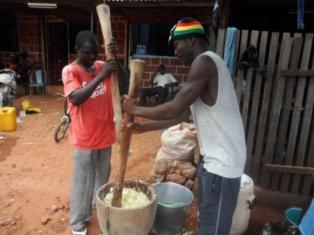
Gender barriers breaking down: men pounding foutou in Burkina Faso

En effet, se disant Ghanéen de nationalité, il dit avoir été estomaqué de voir des femmes se donner à cette tâche au Burkina Faso. « Au Ghana, ce ne sont pas les femmes qui pillent l’igname. C’est généralement une activité d’hommes pour la simple raison qu’elle requiert beaucoup d’énergie physique », dit-il. Souleymane fait ce métier depuis 6 ans. Et, dit-il : « J’en suis fier, car il me permet de ne pas tendre la main à quelqu’un, ou pire, d’aller voler ». Dès 9 h 30, chaque matin, le jeune Souleymane se rend à son service. Un petit restaurant situé au centre-ville et dont le met principal, par ailleurs très prisé par les clients, est le « foutou ». Des femmes font bouillir l’igname avant de le mettre à leur disposition, lui et son collègue. A deux, ils se chargent de le rendre en patte élastique dans un mortier. « Il faut être physiquement fort et avoir du courage pour mener un tel métier », dit-il l’air assez fier.

via Société : Ils font des métiers jadis réservé à la femme – leFaso.net, l’actualité au Burkina Faso.

Posted in Culture, Politics | Comments Off on Gender barriers breaking down: men pounding foutou in Burkina Faso

Bicycles and cash transfers

A new paper Cycling to School finds that bicycles are even better than cash transfers (HT: Marginal Revolution).

We find that the Cycle program was much more cost effective at increasing girls’ enrolment than comparable conditional cash transfer programs in South Asia, suggesting that the coordinated provision of bicycles to girls may have generated externalities beyond the cash value of the program, including improved safety from girls cycling to school in groups, and changes in patriarchal social norms that proscribed female mobility outside the village, which inhibited female secondary school participation.

Not to ring by own bicycle bell, but I argued/intuited something similar for South Sudan back in 2005 (eight long years ago… where has the time gone?) in a short opinion piece on the Joint Assessment Mission report for Forced Migration Review:

Why not give away the $8bn?  When we consider that reconstruction spending is to target around 20 million marginalised Sudanese (of a total population of around 32 million) then you have spending of about $160 per person. After subtracting modest bureaucratic, consultancy and other delivery costs, this amounts to an annual payment of $150 for each poor person in Sudan for the next few years. Most poor people would undoubtedly prefer to receive such a sum as an income supplement rather than as a bundle of services. Why did the JAM authors assume that they could plan more wisely, and government counterparts in the GoS or SPLM could spend more effectively, than poor citizens in Bahr al-Ghazal or the Nuba Mountains or the Red Sea Hills? Why should we not trust Sudanese to make strategic and livelihoods-enhancing choices – a farmer to buy a younger and stronger donkey, parents to send their children to a better school, or a tea-seller to invest in another set of tea glasses?
It is disappointing that no consideration seems to have been given to an income support scheme, at the least for elderly women and families with school-age children. Numerous studies have shown that these programmes can be just as effective as government spending, and they have ripple effects throughout the private sector.  Education and roads are at the core of the JAM budget. One has to ask whether the private sector cannot manage education successfully, especially in the south where Christian missionaries and NGOs are more than willing to subsidise schooling. Everybody likes the idea of building roads. But the poor, in Sudan and elsewhere, know that their benefits go disproportionately to the rich. No doubt they would rather have bicycles, yet bicycles merit no mention at all in the JAM documents. As Sudan rebuilds, there is a real danger that the smart and the rich will take advantage of public investment, while everyone else stays at the bottom of the well.

It is good to see the emphasis validated.  Sad, too, because the hyper-governmentalized vision that triumphed in South Sudan (apex: giraffe shaped new capital city) will take the new country (in a John Kerry “It’s a guarantee” kind of way) not to Rwanda but to C.A.R.   In Burkina Faso, BTW, bicycles are fast becoming second-hand news, and what everyone now wants is an Apsonic  motorized rickshaw.

Posted in Development thinking | Comments Off on Bicycles and cash transfers

Ordinary courage… very inspiring from Sudan

More information is here.

Posted in Sudan | 1 Comment

The report on the Senate in Burkina Faso released

Here are the highlights of the recommendations:

Reduce the size of Senate, by cutting Presidential appointees (why there are *any* appointees to the Senate is something that should be up for much more debate).

– Sur la composition du Sénat : le comité de suivi a retenu la réduction du nombre de sénateur de 89 à 71. Sur les composantes devant faire partie du Sénat, il a aussi retenu celles actuellement prévues par la loi organique et la Constitution qui sont : des représentants des collectivités territoriales ; des représentants des autorités coutumières et religieuses ; des représentants des organisations syndicales ; des représentants du patronat ; des représentants des Burkinabè vivant à l’étranger ; des sénateurs nommés par le chef de l’Etat.

Lower the age for eligibility to 35.

– Sur l’âge des sénateurs : les discussions au sein du comité de suivi et d’évaluation ont permis d’adopter le principe de ramener l’âge minimum requis de 45 à 35 ou 30 ans. Sur les vingt-cinq (25) membres du comité de suivi et d’évaluation présents à la séance, dix huit (18) ont opté pour un âge minimum de 35 ans, cinq (05) ont opté pour 30 ans et deux (02) se sont abstenus.

Figure out a way for opposition to pick some Senators (but the task force does not suggest any procedures… so I still think president should pick based on consultation with opposition).

– Sur le corps électoral : les débats ont abouti au maintien des conseillers municipaux comme corps électoral des sénateurs représentants les collectivités territoriales. Toutefois, le comité de suivi et d’évaluation propose de prendre des mesures transitoires pour permettre la participation des partis politiques de la majorité et de l’Opposition au Sénat de façon à éviter que celui-ci ne soit monocolore.

This one is weird… who can represent regions… like Hilary Clinton moving to New York…

– Sur l’éligibilité des sénateurs représentant les collectivités territoriales : permettre que l’éligibilité soit ouverte à tout citoyen ayant des intérêts économiques et sociaux certains dans la région et proposé par parti ou une formation.

Something the bishops wanted?

– sur les relations entre le Sénat et l’Assemblée nationale : créer une commission mixte paritaire à inscrire les questions d’ordre religieux aux domaines prévus en première lecture par le Sénat tel qu’édicté à l’article 25 de la loi organique.

via Sénat : Voici les principales conclusions du rapport. Que va faire Blaise Compaoré ?

Posted in Politics | Comments Off on The report on the Senate in Burkina Faso released

Meanwhile, in Africa, heights barely budged…

The data from Africa very strongly suggests height did not improve over past 50 years.  There are a number of sources.  Here is a good NYTimes summary.

The average height of European males increased by an unprecedented 11 cm between the mid-nineteenth century and 1980, according to a new paper published online today in the journal Oxford Economic Papers. Contrary to expectations, the study also reveals that average height actually accelerated in the period spanning the two World Wars and the Great Depression.

via Average height of European males has grown by 11 centimeters in just over a century.

Posted in Development thinking, Gender | Comments Off on Meanwhile, in Africa, heights barely budged…

Ten novels describing what grinding poverty is really about

I started thinking about this awhile ago.  When I read The Bridge in the Jungle.  If I get some more good suggestions I will update… so put them in comments please.

  1. Beppe Fenoglio, Ruin, He is an amazing writer about the Piedmont area of Italy, and his short novels from the 1930s and 1940s are well-worth reading.  I first read Ruin as a random selection while browsing in San Jose Public Library.  I mean random: I said to myself I would pick a random short novel off the shelf to read.  Ruin was it.  Wow.  Here’s a nice appreciation of a new French translation.
  2. B. Traven, The Bridge in the Jungle, I found this outside of George Akerlof’s office as he was culling his book collection. Phenomenal writing, and a great mystery goes with it: nobody really knows who B. Traven was (a German anarchist living in Mexico?). Reading this means you are then justified in watching Humphrey Bogart in Treasure of the Sierra Madre, one of the all-time great movies.
  3. Daniel Mason, A Far Country.  A very flattering New York Times review suggests looking at the film Black Orpheus to better appreciate the book: who could disagree with that happy suggestion?
  4. Alan Garner, The Stone Book Quartet  What I like about Garner’s four very short novellas is that despite being about very poor English country-folk, there is magic, mystery, fulfillment and beauty all around.  Everything is from the point of view of an adult’s memory of how it feels to be a child; so a ride down a hill on a sled is like a climb of Mt. Everest… we all know that feeling, of those special moments in our childhood, and we know that our children experience events in similar ways. Reading Garner is a wonderful way of capturing that feeling.
  5. Uwem Akpan, Say You Are One of Them.  OK, ultra-depressing poverty, Africa-variety. This is to shock naive young students: yes, this is all real, and you are playing video games.
  6. Jean-Marie Le Clézio, Poisson d’or , not my favorite novel, but pretty grim.  And in intermediate level French.  But as numerous readers on GoodReads note, you never really develop much attachment to the protagonist, partly because she seems a little robot-like.
  7. The Beautyful Ones Are Not Yet Born by Ayi Kwei Armah.  I have not read this in 25 years, but I vividly recall the shock of reading how corruption is linked, metaphorically, to shit.  As a novel about corruption, it does the job well.
  8. Sister Carrie by Theodore Dreiser.  I’m surprised there is no African ripoff, really.  This is both a novel about being really poor, in a world where plenty of people are very well off, and a novel that poor people want to read (i.e. like much 19th century literature from Dickens onwards…).  Great way to understand people’s lives under industrialization.
  9. God’s Bits of Wood by  Ousmane Sembène.  I was assigned this in college, many years ago.  It stands the test of time pretty well, especially for understanding factory-style poverty.
  10. The Pearl.  Steinbeck.  I think it illustrates the whole “poor have cognitive difficulties” approach very nicely.  Would be interesting to go through it carefully and count all the bad choices people make.
Posted in Development thinking | Comments Off on Ten novels describing what grinding poverty is really about

Scathing assessment of Jeff Sachs as development project implementor….

With almost every intervention, she documents the chasm that exists between the villagers and those running the project. At one point, the Millennium Villages Project persuades the farmers in Ruhiira to grow maize instead of their traditional crop, called matoke. “The results were fantastic,” she reports, a bumper crop. Except there were no buyers for the maize, so most of it wound up being eaten by rats. In Dertu, Sachs’s staff decided it should set up a livestock market. It flopped. Efforts to convince villagers to start small businesses largely failed. The critical problem of getting clean water to the villages was enormously expensive.

Ultimately, reports Munk, Dertu was abandoned by the Millennium Villages Project while Ruhiira is today lauded as one of the project’s most successful villages. “There is no question the lives of people in Ruhiira have been improved,” Munk told me. “I’ve seen it.” But she is dubious about what that means — other than the fact that if you pump millions of dollars into an isolated African village, the villagers’ lives will be better. (Sachs’s defenders say that most of her reporting was done before the project really found its footing.)

via Fighting Poverty, and Critics – NYTimes.com.

Posted in Development thinking | 1 Comment

Exciting new development in the politics of Burkina Faso’s Senate

Shots fired at presidential palace, and President in press conference with IBK says that he was delighted that commission report (that he read over the weekend while listening to shots fired?) was such a delightful document, and he is very happy that the process of establishing the Senate has been really quite a pleasant task.

C’est dire donc que ça c’était essentiel pour nous ; mais aussi élargir cette représentation de ceux qui doivent être mandatés par le peuple ; nous pensons que tout cela ne fait que consolider nos possibilités de stabilité et bien sûr, de meilleure visibilité pour la construction du développement de notre pays. Alors, c’est vous dire que j’ai vraiment eu plaisir à échanger encore avec ces hommes et ces femmes qui ont aussi le souci de la stabilité du Burkina, mais aussi le souci de notre engagement commun pour que la région ouest-africaine soit une communauté plus ouverte, plus dynamique.

Basically, it is all roses!

via Rapport sur le sénat, tirs à la présidence du Faso : Les réactions de Blaise Compaoré .

Posted in Politics | Comments Off on Exciting new development in the politics of Burkina Faso’s Senate

Weird news from Burkina Faso about apparent assassination attempt… the opaque semi-authoritarian regime eats its children

Des sources proches de la présidence burkinabè évoquent une tentative d’’assassinat du chef de l’Etat Blaise Compaoré par un ancien soldat du régiment de la sécurité présidentielle, dans la nuit du 30 au 31 août. Cette nuit là, des explosions et des coups de feu ont été entendus à Ouagadougou, la capitale. Une partie de la ville a été plongée dans le noir. C’est d’abord l’explosion d’un groupe électrogène qui avait été évoquée, avant, donc, d’évoquer cette deuxième version.

via Burkina Faso : le président Compaoré cible d’une tentative d’assassinat – Burkina Faso – RFI.

Posted in Politics | Comments Off on Weird news from Burkina Faso about apparent assassination attempt… the opaque semi-authoritarian regime eats its children

Everything *is* rainbows and unicorns in “Our Sudan”….

OK, nice hopeful video… one can imagine something different, but there is a place for this too.

Posted in Sudan | 1 Comment

Because we all know that really expensive training programs work really well in really poor countries

The development objective of the Youth Employment and Skills Development Project for Burkina Faso is to increase access to temporary employment and skills development opportunities for out-of- school youth. The project has three components. The first component is labor intensive public works. The short-term objective of this component will be to provide immediate employment for youth with no or little education through Labor Intensive Public Works (LIPW). It will promote the participation of women by selecting activities that are supportive of women employment and reserving a percentage of the LIPW jobs specifically for women. This component will also (with third component) support the mainstreaming of LIPWs into national policies, strategies and procedures and the establishment of a permanent capacity for LIPWs in the country. The second component is skills development. This component aims to improve youth employability by offering youth with different skills levels within their first training experience. This component has following three sub-components: (1) development of initial vocational training through a dual training approach for economic sectors (sub-component 2-1 A) and establishment of a demand driven training system and provision of training (sub-component 2-1 B); (2) apprenticeship program; and (3) entrepreneurship training and provision of follow up support to entrepreneurs. The third component is institutional capacity strengthening and project management. The purpose of this component is to: (a) strengthen the capacity of private and public sector institutions to engage in an informed policy dialogue on skills and employment on a regular basis, e.g. through technical capacity strengthening and the creation of a mechanism for consultations and collaboration; and (b) improve the knowledge base on employment and youth

Can you imagine that someone actually wrote: “development of initial vocational training through a dual training approach for economic sectors…”?  Maybe time for Mr. Snark to take a break.  But seriously, youth unemployment and low skills are a big problem, but somehow I doubt that two big elephants like World Bank and GoBF are going to do very much except spend a lot of money on themselves.

via La Banque Mondiale se prépare à aider le Burkina Faso à offrir des emplois temporaires et des formations professionnelles à plus de 46 000 jeunes déscolarisés.

Posted in Economy | Comments Off on Because we all know that really expensive training programs work really well in really poor countries

Madame Gorogho Hado Leontine

Posted in Culture | Comments Off on Madame Gorogho Hado Leontine

What is the bilan of the MCC in Burkina?

A thought: Given expiration in July 2014 of MCC’s $480 million, and given important money newly allocated to Sahel, there should be a USAID-MCC stock-taking, examining effectiveness of U.S. spending in Burkina.  I’ll go out on a limb, and say that my gut feeling, without having examined the programs and program documentation in detail, is that the United States gets limited value (broadly speaking) for its investments in aid in Burkina.  A big chunk of the land tenure money may be frittered away on per diems for training, with little real impact.  The road projects are fine, but road traffic in Burkina’s outlying areas is very low, so the cost-benefit calculus is dubious.  Schools are AOK in my book.  But given the dearth of books in most rural areas, you’d think some more investment in soft-power would be warranted (distribute REN-LAC’s Kouka and Mady Kafando’s bandes dessinées to every kid entering sixième would be a great idea).

More importantly, I wonder whether this the aid has fostered much “engagement” favorable to U.S. national interest.  For sure it builds a patron-client network (that explicitly only lasts five year?).  But Qatar, Kuwait and Saudi Arabia build mosques because that way every Friday a large crowd gathers, listens to an imam, and becomes a “potentially mobilizable” group of people.  At the end of the day, as President Obama surely knows, mobilizing people (the job of the activist) is where deep political power lies.  And U.S. investments in foreign aid do not seem to have an eye on that important political reality.  Of course, the whole premise might be to make economic activity so much more productive that people will be “de-mobilized” the way that religion was the “opium” in Karl Marx’s day…  I guess this is also the whole “anti-politics” intended/unintended consequence of foreign aid.

I see from MCC website that only $200m of the $480m allocated has been spent, and there are only six months left.  I am available for weekend consulting.

Posted in Economy, Politics | Comments Off on What is the bilan of the MCC in Burkina?

Over weekend I read four short stories. You should read them too.

Margaret Atwood’s Stone Mattress, The New Yorker, December 2011.  Just one word: Fun.  Here’s the review of the story at Mookse.  And here is excerpt from good review by Reader’s Quest:

… I think that a possible key can be found in the sentence that followed Verna’s aphoristic second thoughts: “Why should any human being be judged by something that was done in another time, so long ago that it might be centuries?” The root of the word aphorism is boundary, and I think that Atwood is using cliché and aphorism to light up a flashing neon sign (cliché?) that points to a question of memory, judgment, history, and the boundaries of good and evil.

If Reader’s Quest is right, then story may be indirect homage to Ile Forest by Ursula K. Le Guin, that has a very similar theme.

Miracle by Tope Folarin.  Last line: “My sight miraculously returned.”  Wonderful, classical-style short story published in Transition.  Elegant writing, straight ending.  Won the 2013 Caine Prize.  Author wears thick glasses.

Foreign Aid by Pede Hollist, shortlisted for Caine Prize.  Sympathetic description of Sierra Leonean returning home to visit after 20 years in the United States.  Great reading for a class dealing with contemporary African diaspora.

Yu Hua’s short story Victory in The New Yorker.  The full story is here.  Gripping in portrayal of marriage, but the least compelling of the four, for me.  Betsey at Mookse and the Gripes has an excellent review.

“Victory” reads easily as an allegory. A somewhat dictatorial husband who holds all the power in a marriage finds that his marriage lacks life. He is drawn to a mysterious young woman in a red dress, exchanging chaste meetings and flirtatious letters. But it is the wife who in the end has the passion that can counter the husband’s dreams of perfection. Here it is the wife who stands in for the people of the nation, while the woman in the red dress represents, perhaps, the emptiness of Maoist idealism. One wonders if Yu Hua is suggesting that the people of China must find a way bring their social contract to life, as if for now, life as a Chinese citizen is settling for “just living.”

Posted in Book and film reviews | Comments Off on Over weekend I read four short stories. You should read them too.

Etienne Traoré offers tidbits of political opinion

Most of the interview is generalities that everyone knows; I am continually dismayed at how even fierce critics of the government offer only the blandest information… they blame and criticize, but themselves never appear to take the time to do and share their own “investigatory analysis” so as to offer the public more than platitudes and generalities.

Dans un deuxième temps, je pense que l’ADF-RDA (Alliance pour la démocratie et la fédération/ Rassemblement démocratique africain) a des velléités de séparation d’avec le CDP, ou en tout cas de distanciation. Je ne sais pas comment ce parti va évoluer, mais cela peut jouer sur l’Assemblée nationale.

Je constate aussi que le CDP vient de retirer le seul poste d’ambassadeur concédé à l’ADF/RDA à Dakar. Serait-ce le signe d’un divorce au sein de la majorité présidentielle ? Je n’en sais rien.

Mais, pour le moment en tout cas au niveau de l’Assemblée, le CDP est encore très majoritaire et dicte un peu sa loi. Ce qui est regrettable, essentiellement du côté du CDP, c’est que le rôle du député ne semble pas être bien compris. Le rôle du député c’est aussi de critiquer et non d’être de façon systématique du côté de ceux qui sont au pouvoir, et le niveau même des débats fait parfois problème. Cela est dû au fait que beaucoup de titulaires au CDP ont préféré aller être présidents d’institution ou ministres, au lieu d’être à l’Assemblée. Ce qui fait que de leur côté, il y a des gens qui ne sont jamais battus nulle part, ni dans un syndicat, ni dans un parti, et qui n’ont peut-être jamais pris la parole dans un espace public, qui se retrouvent ainsi là-bas, sans la moindre expérience ou formation politique. Et cela baisse un peu le niveau du débat. Et leur chef n’est pas fait pour arranger les choses, M. Alain Yoda, qui pense que lorsque les ministres viennent à l’hémicycle, il doit se transformer en leur défenseur systématique, engueulant au passage ses collègues pour leurs critiques négatives de l’action gouvernementale. Lui-même, il est le premier exemple de ceux qui ne comprennent pas le rôle d’un député. Et ça rejaillit sur l’ensemble de sa majorité.

via Etienne Traoré : Et si Blaise annonçait la fin du Sénat et son retrait en 2015 ?

Posted in Politics | Comments Off on Etienne Traoré offers tidbits of political opinion

Book groups? Edward Steed in The New Yorker

Steed cartoon

More of his cartoons are here.

Posted in United States | Comments Off on Book groups? Edward Steed in The New Yorker

Kim Stanley Robinson’s Pacific Edge

I read/skimmed Kim Stanley Robinson’s Pacific Edge, one of the “Three Californias” trilogy.  I don’t know if these were written before or after Red Mars, his most famous book, but Pacific Edge deals with a favorite theme, nature and human’s role in shaping it.  We “terraform” even on earth.  Unfortunately, the story didn’t resonate with me, even though I feel very comfortable with the characters (I spent several years in Davis, and have hiked many of the places he describes).  But Robinson desperately wants his writing to convey an intensity of feeling about everything, from softball to morning dew.  The writing just isn’t up to the task; maybe a perennial problem with writing about Americana.  The emotions of the characters all seem somewhat childish.  Nobody really seems like an adult.  The female characters are particularly under-developed, and the main character Kevin doesn’t really have much character development.  The epiphany comes in love-making with the “girl of his dreams”, which I find a very implausible Hollywood-style trope.  All in all the story just isn’t very interesting.  The drowning at sea in a shipwreck of one of the main characters is truly a strange plot device.  Robinson I guess means the underwhelming plot to be deliberate: the small-town development battle of 2065, over whether to build a lovely semi-industrial plant at the top of a small hill, in a sense is a small deal, but thousands of small deals like that later we are at sprawling Orange County working for giant corporations and pretty soon, The Matrix down the line.  I get it.  Doesn’t make good literature though.

Lots of other reviews (many echoing my own thoughts) are on Goodreads.  Would be a nice book to inspire undergraduates to debate what a semi-realistic alternative to growth oriented corporate capitalism would look like.  Lots of interesting points for debate, in that sense, so gotta give Robinson credit for that.

Posted in Book and film reviews | Comments Off on Kim Stanley Robinson’s Pacific Edge

Ou sont les moustiquaires promises ?

An incredibly important public health issue.  A description of the 2013 campaign (10 million bednets) is here.  Alizeta Ouedraogo’s companies had some of the contracts for the  distribution I believe.   An article in Bendré by Jean Paul Bamogo reviews how back in the 2010 distribution her company Liz-Telecom-Azimmo was the subject of a parliamentary investigation.  I assume there will be a response in the coming days.

La moustiquaire n’est pas une panacée pour éviter le paludisme, certes. Mais, elle peut beaucoup y contribuer. Raison pour laquelle, d’ailleurs, les autorités ont initié avec leurs partenaires la présente campagne de distribution gratuite de MILDA, dont le coût global est estimé à 21 milliards de francs CFA. Mais, près de deux mois après le lancement en grande pompe de l’opération à Dédougou, de nombreux ménages du pays n’ont pas encore senti l’odeur d’une moustiquaire imprégnée…

via Grégoire B. BAZIE, Prévention du palu au Faso : Que deviennent les moustiquaires promises ? – leFaso.net.

Posted in Economy | Comments Off on Ou sont les moustiquaires promises ?