Sahel having an excellent season, second year in row

Last year was a very good agricultural season, and this year appears to be even better.  Hmmm…. I believe that 2000 years ago Joseph had good advice for what to do after a good season. But he wasn’t so good at inter-personal relations.

La campagne agropastorale, marquée par une installation tardive des pluies, est caractérisée par une pluviométrie faible et irrégulière de mai à mi juillet. Une reprise significative de la pluviométrie a été observée à partir de mi juillet et s’est intensifiée au cours du mois d’août occasionnant par endroits des inondations. Globalement, les pluies recueillies ont été assez bien réparties dans le temps et dans l’espace depuis le mois d’août. Même si, les cumuls saisonniers sont en général plus faibles que ceux de l’année passée exceptionnellement pluvieuse, ils sont supérieurs à la normale 1971-2000.

Sur le plan hydrologique, les débits des différents cours d’eau ont débuté leur évolution de manière timide. A partir de juillet, ils ont atteint des niveaux proches de ceux de l’an passé et supérieur à la moyenne. Le niveau de remplissage des barrages évolue normalement, ce qui présage de bonnes disponibilités d’eau pour la production agricole de contre-saison. Comme conséquences de la physionomie de la pluviométrie et de l’hydrologie, les semis ont globalement accusé des retards et des re-semis ont été observés en juin et juillet et par endroits en août. A partir de fin juillet, les cultures ont bénéficié d’assez bonnes conditions hydriques et de la mise à disposition des intrants pour leur croissance et développement végétatif. La majorité des cultures sont en phase de reproduction et maturation. Seuls les semis tardifs sont actuellement en phase de croissance végétative et ont besoin d’apports hydriques jusqu’en octobre 2013. Les rendements espérés seront équivalents à supérieurs à la moyenne 1971-2000 et inférieurs dans certaines localités du Nord Sénégal, des régions de Tillabéri, de Tahoua et l’Est de Zinder au Niger, les Wilaya du Gorgol et de Guidimakha de la Mauritanie et les régions du Lac et de Biltine au Tchad.
via Avis sur les perspectives agricoles et alimentaires 2013 / 2014 au Sahel et en Afrique de l’Ouest – leFaso.net.

Posted in Economy | Comments Off on Sahel having an excellent season, second year in row

Djafar Héma in Bobo makes the news… not sure what the import of everything is… except he is Sunni

« Je n’ai rien contre Blaise, mais je suis contre ses faits. Notamment les tueries », propos de Djafar Héma pour entamer la question du sénat. Comme dit, comme prévu par lui lors de ses prêches, la communauté musulmane par la voie de ses représentants qui se sont exprimés ont dit oui au sénat. Il ne pouvait pas en être autrement selon Djafar. Pour mainte raison. Premièrement, parce que la Fédération des associations musulmane n’est pas entièrement faite d’expert en droit ou en démocratie. Deuxièmement, parce que les dirigeants de cette fédération ne peuvent pas dire la vérité à Blaise Compaoré. Ils ne font que lui dire ce qu’il veut entendre. Et selon lui, les leaders religieux musulmans ne demandent pas l’avis des fidèles ou des dignitaires religieux qui osent les contredire. A cause donc des mauvais conseillers, le Président du Faso est trompé selon Djafar. Un homme « à qui on fait croire qu’il devient intelligent lorsque sa tête grossie pour cause de maladie ».

via Sexe scandale à Bama : Le réquisitoire de Djafar Héma contre l’Imam Dao – leFaso.net.

Posted in Politics | Comments Off on Djafar Héma in Bobo makes the news… not sure what the import of everything is… except he is Sunni

Electricité au Faso

Bon reportage de Patindé Amandine Konditamdé; j’aurai aimé savoir ce que le SONABEL dit comme réponse.

La SONABEL serait en train de consommer son capital à en croire Luc Adolphe Tiao, lors de l’émission télévisuelle « Dialogue avec le gouvernement » du mardi 17 septembre 2013 sur la RTB (radiodiffusion et télévision du Burkina). Dans la même lancée, il ajoute qu’il ne croit pas que le problème de délestage au Burkina se résolve un jour.  Est-ce à dire que les consommateurs doivent redouter une augmentation du prix du kilowatt (kw) dans les prochains mois ? Ce qui est certain, c’est que le pessimisme du Chef du gouvernement n’est pas pour rassurer. Un aveu d’impuissance qui inquiète. Et pour cause les gouvernants n’ont-ils pas vocation à trouver des solutions aux problèmes des populations, qu’à leur tenir ce genre de discours ?  Rappelons enfin que la SONABEL a été déclarée déficitaire lors d’une récente assemblée générale des sociétés d’Etat. Un audit a-t-il été fait pour situer les responsabilités et des sanctions ont-elles été prises comme cela devrait se faire pareille occasion ? Difficile d’y répondre par l’affirmative. Car pour l’heure c’est bien le service public de l’électricité qui continue de disjoncter !

via Electricité au Faso : Silence, on coupe ! – leFaso.net, l’actualité au Burkina Faso.

Posted in Economy | Comments Off on Electricité au Faso

Great interview with Ibrahim Coulibaly, who many thought the force behind 2002 Force Nouvelles that divided Ivory Coast

Hard to know how credible is the source. Ibrahim Coulibaly was killed in 2011 in Abidjan by Alassane Ouattara and Guillaume Soro’s forces, as they ostensibly tried to disarm his small group of commandos.  War is a messy business indeed.  One surprise is the apparent paltry sums needed to mount the rebellion… 60 m FCFA is one “gift” he mentions, about $150,000. Paul Collier often talked of the cost-effectiveness of Western military intervention, but as AQIM and allies have discovered… $100,000 operations that lead to $500 m operations of retaliation by West…well… hopefully they haven’t actually figured out that calculation… otherwise taxpayers are in big trouble.

Je suis rentré en France d’où j’ai rallié le Burkina Faso. C’est à partir du Burkina que j’ai commencé à appeler mes amis. Et nous avons mis un système en place, de telle sorte que quand il y a eu un cafouillage pendant les élections de 2000, nos amis sont allés attaquer la poudrière d’Akouédo pour libérer nos amis qui y étaient en prison. Nous avons usé de subterfuge pour les faire rentrer à Ouagadougou. Pendant ce temps, Guillaume Soro était encore à Abidjan. Il était candidat aux élections législatives à Port-Bouët avec Henriette Diabaté. Blaise Compaoré m’a permis de récupérer tous mes éléments qui étaient dans des situations clandestines à Abidjan. On a pu faire sortir Tuo Fozié, Adam’s, Wattao, Zaga-zaga et plein d’autres.C’est dans ce schéma d’infiltration que Guillaume Soro me joint pour me dire de faire quelque chose pour lui. Je lui réponds que, comme présentement je suis entouré de militaires et que les journalistes ne cessent de m’appeler pour avoir des interviews, des déclarations, viens t’occuper d’entretenir les journalistes. C’est ainsi que j’ai fait venir Guillaume Soro à mes côtés à Ouagadougou pour être mon porte-parole. C’est à partir de cet instant que nous avons monté le 19 septembre. J’ai préparé mes hommes sur près de 6 mois. J’ai fait deux mois et demi à Ouagadougou, mais pour la préparation, nous nous sommes retirés dans la forêt sur près de 6 mois.Avant de faire partir mes hommes sur le terrain, un ami m’a aidé financièrement et l’Etat burkinabé nous a aidés. Il nous a donné des villas. Après la formation, un ami libanais m’a envoyé 60 millions Fcfa. J’ai demandé à notre intendant, Dja Gao actuel commandant du commando d’Abobo de faire des enveloppes de 300.000 Fcfa chacune pour tous les éléments qui devaient rentrer en Côte d’Ivoire. Et je les ai divisé en trois grands groupes parce qu’il devait avoir trois attaques simultanées : Abidjan, Bouaké et Korhogo.

via Révélations. Comment la rébellion a été montée contre Gbagbo.

Posted in Politics | Comments Off on Great interview with Ibrahim Coulibaly, who many thought the force behind 2002 Force Nouvelles that divided Ivory Coast

Next time you get mad at a retailer for not letting you charge under $5… the law changed

Embarassing… at least I didn;t yell, or throw down my bagels… (but I didn;t threaten to “report them”)…. this morning I got peeved at a $5 minimum sign (my order was $3.8)… but turns out… they were right… the retail industry lobbied and got their dream wish…

New rules: up to $10 minimum OK

The request received little notice because it was tucked into a bill that became an 848-page legislative behemoth — the Dodd-Frank Wall Street Reform and Consumer Protection Act. As fierce debates took place over whether the legislation created or preserved “too big to fail” banks, and whether to set a cap on debit card interchange fees, the short section on credit card minimum payments survived, there on page 698.  It went into law in July 2010, and all those handwritten signs went from forbidden to federally blessed.  The law says that merchants can set a credit card minimum purchase of up to $10, as long as they treat all cards the same. It also allows the Federal Reserve to review and increase the minimum payment amount.  

To which I reply: “They’re thieves. They’re thieves. They’re filthy little thieves. Where is it? Where is it? They stole it from us, my precious. Curse them, we hates them! It’s ours it is, and we wants it!”

Read more: http://www.creditcards.com/credit-card-news/credit-card-minimum-payment-purchases-law-1282.php#ixzz2fMX0juvM

Posted in United States | Comments Off on Next time you get mad at a retailer for not letting you charge under $5… the law changed

Richard Ford Reads Harold Brodkey

A very long story by Brodkey, “State of Grace” that I listened to while on a long run.  Interesting and precocious.  I am sure it is a fine story to teach in undergraduate classes.  Almost the same key as Catcher in the Rye (nobody understands me!) but a completely different style.  I prefer the snappy monologue of Holden.  Once you hit fifty, though, patience for this kind of story declines terribly.  Interesting to wonder why that is, but not terribly compelling, because might lead to platitude rather than insight.  A nice reading, and entertaining discussion follows.

Posted in Book and film reviews | Comments Off on Richard Ford Reads Harold Brodkey

Sudanese starting to read books again? Or New York Times reporter with human interest angle?

When Leslie and I were in Khartoum we bought and browsed extensively in the bookstores.  At that time mostly English stuff, but as Arabic improved occasionally we purchased simple Arabic texts.  On each successive visit, a bookstore would have closed.  Finally there was practically nothing.  When I went to Khartoum in 2008 (I think?) I was so pleasantly surprised to find a small bookstore open, and I bought all three copies they had of my edited volume Kordofan Invaded (co-edited with Endre Stiansen, now Norwegian special envoy to Sudan!) to give to my Sudanese colleagues.

“We want to bring people back to books,” said Abdullah Al-Zain, 58, who started a project with friends called Mafroush — a Sudanese Arabic word meaning displayed.

In a monthly showcase held every first Tuesday, participating used-book sellers come to downtown Khartoum’s Etinay Square and lay their books on the ground over cloth sheets or flattened carbon boxes.  Hundreds of book lovers, including students, artists and writers, showed up on a recent afternoon, some gazing over the sprawl of covers, some flipping pages attentively. Others arrived with more books for the display.

Al-Mutasim Hassan, 25, a graduate student, came searching for philosophy books. “I think Mafroush is a creative endeavor, and you meet other readers,” he said.  Mr. Hassan holds himself apart from others in his generation who think “Facebook and chat are the only expressions of progress,” he said.  “I find myself, however, that when I read a book, I feel alive,” he added.

HT: Tim Kevane via In a Faded Literary Capital, Efforts at a Revival – NYTimes.com.

Posted in Reading, Sudan | 1 Comment

Tahar Ben Jelloun’s short story “By Fire” in The New Yorker

Another story to add to “literature about poverty.”  I found it pretty powerful, but I knew what the story was about by the third paragraph.  So it reinforces a sense of injustice and outrage at the petty abuse of authority that was so characteristic of so many authoritarian countries.  It’s literary value hard to estimate separately.  Here are two contrasting views.

Discovering that the story is based on a real man’s death makes it unforgettable, but in the end, it is the form of fiction which gives the story its power. Free to imagine Mohamed’s mother, brothers and girlfriend, Ben Jelloun’s style allows the story to rise above reporting to something more universal. Most of all, Ben Jelloun honors these men when he insists upon recognition for the conditions that brought them to their deaths: that poverty created of their lives a vast and crushing denial.

That from Mookse.

Le livre est mince, lapidaire, ce qui, dans le cas présent, ne veut pas dire dense ou méditatif encore moins condensé, loin de là ; il se lit en une demi-heure, tant il est plat, sans relief, sans la moindre interrogation ; pas une seule phrase qui soulève l’admiration, pas d’images fortes qui invitent à la relecture d’un paragraphe, non plus de métaphores pour enrichir l’imagination, aucune tension, pas de suspense. On feuillette sans surprise, attendant ce qui devait arriver et rien n’arrive, on n’a pas été surpris une seconde par le déroulement de l’histoire archiconnue du martyr. Pas de description qui nous a retenus, pas de montage à déchiffrer, la narration y est calme, paisible. Mince et sans esprit. L’ouvrage est-il utile? On est gêné pour l’auteur qui nous a nourris de meilleurs romans et autres productions.

from allAfrica.com: Tunisie: Par le feu, de Tahar Ben Jelloun.

Posted in Book and film reviews | Comments Off on Tahar Ben Jelloun’s short story “By Fire” in The New Yorker

Macroeconomics for dummies… it takes a Nobel Prize Winner… George Akerlof’s Nobel lecture

Probably the best single guide to the behavioral perspective on macro… why it is relevant, why it is better, and what the models are doing…  Can be read over and over again for nuance.  Did he have help from Thomas Pynchon?


Posted in United States | Comments Off on Macroeconomics for dummies… it takes a Nobel Prize Winner… George Akerlof’s Nobel lecture

Howard French summarizes Nina Munk’s evisceration of Sachs… Only Easterly left standing, because he didn’t do anything

Maybe Sachs will decide he needs some good PR and fund 20 libraries in Burkina Faso?  Who knew FAVL would last longer than MVP!  And probably we’re learning more too.  With his $100 million, we could have established and operated like 4000 libraries, enough for the whole Sahel for a decade or more.  And think how easy it would have been to do randomized control trials.  And ethical too!  And he would have read a lot of good fiction, improved his French… Ah the waste!

BY THE END OF Munk’s book, the Millennium Villages Project is winding down (it is officially scheduled to end in 2015). Sachs seems defeated by Africa, but defeated in the manner of charismatic savior figures everywhere, for whom setbacks only ever spur quests for new, bigger stages. He campaigned to run the World Bank. He wrote about the need for a “new progressive movement.” He published a flailing jeremiad titled “A World Adrift,” and talked about a “very, very dark cloud” threatening to envelop humanity.  “For a long time, I wanted to simplify the problems by putting aside the rich world’s issues and so forth and focusing on extreme poverty,” he tells Munk. “But it’s all interconnected.”  Munk asks where the money will come from to finish the work in the Millennium Villages. “It is what it is,” he says. “And that’s not meant to be callous.”

via Jeffrey Sachs’ Failure to Eradicate Poverty in Africa.

Posted in Development thinking | Comments Off on Howard French summarizes Nina Munk’s evisceration of Sachs… Only Easterly left standing, because he didn’t do anything

Cautionary words for Deans and University Presidents

It’s easy for university administrators to ignore the fundamental truth here, and be constantly reaffirmed by their underlings, so that they can (with some old-fashioned cognitive dissonance) tell themselves they are perplexed and befuddled when suddenly a crisis erupts and they find out that nobody likes their policies.

A good illustration of this phenomenon appears in “Moral Mazes,” a book by the sociologist Robert Jackall that explored the ethics of decision making within several corporate bureaucracies. In it, Jackall made several observations that dovetailed with those of Arendt. The mid-level managers that he spoke with were not “evil” people in their everyday lives, but in the context of their jobs, they had a separate moral code altogether, what Jackall calls the “fundamental rules of corporate life”:

(1) You never go around your boss. (2) You tell your boss what he wants to hear, even when your boss claims that he wants dissenting views. (3) If your boss wants something dropped, you drop it. (4) You are sensitive to your boss’s wishes so that you anticipate what he wants; you don’t force him, in other words, to act as a boss. (5) Your job is not to report something that your boss does not want reported, but rather to cover it up. You do your job and you keep your mouth shut.

Jackall went through case after case in which managers violated this code and were drummed out of a business (for example, for reporting wrongdoing in the cleanup at the Three Mile Island nuclear power plant).

Incidentally, I think the same is true of many university committees.  Is this what FAVL employees are doing?  (just kidding, I hope)… but  still… how do I know they are not?

via The Banality of Systemic Evil | Common Dreams.

Posted in United States | Comments Off on Cautionary words for Deans and University Presidents

And now… for the traditional chiefs (of the Mossi that is)…

The chiefs (of the Mossi, let’s be precise… and probably in English their title is more like king or prince than chief) visited Presidential palace in Kosyam, and publicly declared their backing of the Senate.  It’s like a long line of yes-men … Burkina Faso would be a lot more interesting and politically alive if one of these guys dared to stand up in front of the cameras and just say “No.  I am against it, and think it was a mistake, and it should be abrogated.”  Poor Zephérin Diabré… he seems to be unable to muster much more than the “radical” 20%.

Le sénat étant créé par une loi, le chef de l’Etat voudrait, selon les hôtes du jour, « que le sénat soit préservé et qu’il soit institutionnalisé et fonctionnel ». Pour prendre part à cette 2e chambre du parlement burkinabè, la chefferie coutumière donne son OK. « Oui, si le sénat doit mis en place, la chefferie va être représentée », affirme le Koupiendieli de Fada, porte-parole du jour. Mais les « bonnets rouges », désireux de préserver la paix sociale souhaitent auparavant « qu’il y ait une entente avec tous les partis d’opposition ». La mise en place du sénat dépend « de plusieurs acteurs surtout de l’opposition dont il faut tenir compte pour aller au fond des choses », lance le porte-parole du jour.

via Sénat : La chefferie coutumière sera représentée si… – leFaso.net, l’actualité au Burkina Faso.

Posted in Politics | Comments Off on And now… for the traditional chiefs (of the Mossi that is)…

Best hype ever… odor-cancellation against mosquitos. Could they noise-cancel the whine too?

Les nouveaux composants que nous étudions rendent la personne inodore. Le moustique entre dans la pièce et ne sent rien. La personne est devenue invisible…

via Les humains bientôt «invisibles» pour les moustiques? – Science – RFI.

Posted in Economy | Comments Off on Best hype ever… odor-cancellation against mosquitos. Could they noise-cancel the whine too?

Marginal Revolution succumbs to gee whizism

I have no doubt the paper is terrific and interesting and insightful, but the broad thrust of the economic history agenda seems to be that people kind of stay the same in many ways for a long time.  Well… it’s kinda weird.  On a global scale, the Chinese are still largely Confucian, and the Americans still largely Christian.  And they still speak the same languages for almost 300 years.  Is that remarkable?  Is there a theory that suggests that as the scale of “culture” gets smaller, it should be more quick to change?  Will children of body piercers and tattooers not embrace their body art culture?  Would it be significant if they did or did not?  Maybe the bottom line of this research is that “people have a lot of inertia unless something big makes them change”?

That is a new paper (pdf) by Avidit Acharya, Matthew Blackwell, and Maya Sen, here is the abstract:

We show that contemporary differences in political attitudes across counties in the American South trace their origins back to the influence of slavery’s  prevalence more than 150 years ago. Whites who currently live in Southern counties that had high shares of slaves population in 1860 are less likely to identify as Democrat, more likely to oppose affirmative action policies, and more likely to express racial resentment toward blacks. These results are robust to accounting for a variety of attributes, including contemporary shares of black population, urban-rural differences, and Civil War destruction. Moreover, the results strengthen when we instrument for the prevalence of slavery using measures of the agricultural suitability to grow cotton. To explain our results, we offer a theory in which political and racial attitudes were shaped historically by the incentives of Southern whites to propagate racist institutions and norms in areas like the “Black Belt” that had high shares of recently emancipated slaves in the decades after 1865. We argue that these attitudes have, to some degree, been passed down locally from one generation to the next.

I find it odd that in the abstract they don’t mention black political attitudes.  Did they not differ from county to county?  Something to look at.

via Marginal Revolution — Small steps toward a much better world..

Posted in United States | Comments Off on Marginal Revolution succumbs to gee whizism

Fédération des Associations Islamiques du Burkina supports the Senate in Burkina Faso

The comments are scathing.  Hard not to be.  “”Muslims are in favor of Senate.” “Our association is not political.”

« La position des musulmans sur le Sénat est connue depuis 2011 parce que nous sommes partie prenante du consensus qui créait le Sénat. Les musulmans du Burkina ont fait des propositions pour améliorer l’ouvrage afin qu’il satisfasse la majorité des Burkinabè. Nous sommes prêts à aller au Sénat parce que les musulmans trouvent leurs intérêts dans le Sénat. Le débat autour du Sénat est un débat politique et la Fédération des Associations Islamiques du Burkina n’est pas une organisation politique qui a pour vocation la prise du pouvoir ou le partage du pouvoir. Le débat politique doit rester sain, sans violence et que les gens exercent leur liberté en plaçant l’intérêt général de la Nation au-dessus de toute autre considération », a affirmé le porte-parole des musulmans du Burkina.

via Mise en place du SENAT : Le soutien franc des musulmans du Burkina … – leFaso.net, l’actualité au Burkina Faso.

Posted in Politics | Comments Off on Fédération des Associations Islamiques du Burkina supports the Senate in Burkina Faso

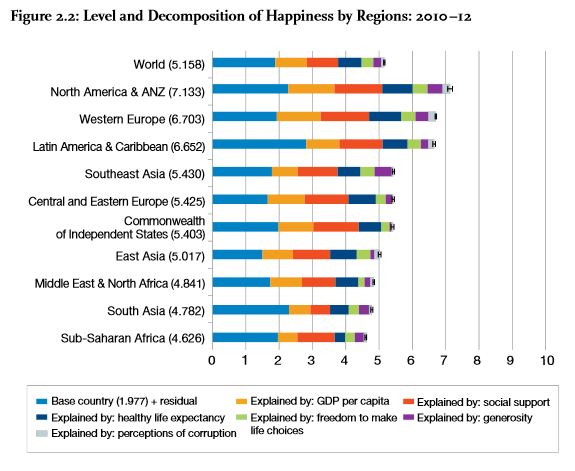
Africa least happy place… millions of tourists corrected

The gap between perception (Africa? Are you sure? Isn’t it dangerous?) and perception (Everyone is so happy and helpful and hospitable.) finally can be eroded due to some serious social science effort.  Africa turns out to have lowest levels of happiness, and it is not just a low income thing.  The graphic is hard to read (numbers to the third digit? little tiny black confidence intervals at end of bars? And everyone knows what the Commonwealth of Independent States is, right?)  Source is the World Happiness Report.  A news report is here, with very smiling John Helliwell.

happiness

Posted in Development thinking | Comments Off on Africa least happy place… millions of tourists corrected

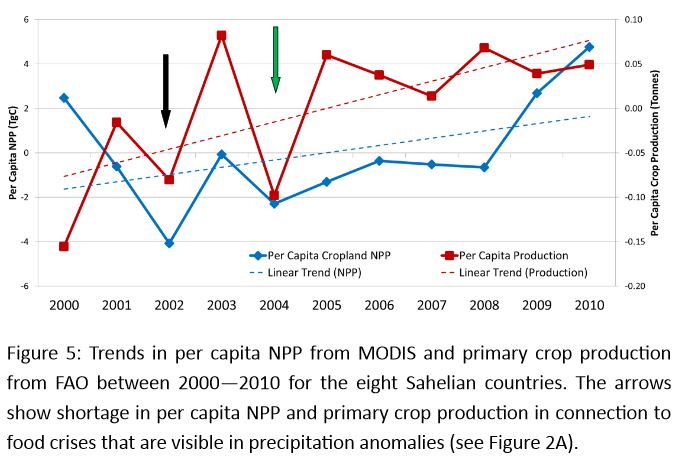
Sahel crop production and vegetation production trends, seen from space…

Sahel trends

From a poster by Lund Earth Observation Group.  Overall this conforms with what the data generally is saying, that Sahel for last 40 years has been on gentle improvement trend in terms of climate, after the very bad 1970s, and with normal variation that sometimes results in very serious droughts and consequent suffering, but as has been known since Biblical myth-times, virtually all of the human suffering in the Sahel is human caused, not climate caused.  If there were open borders people would have left for a better climate, obviously… no farmer chooses to farm in a terrible place for agriculture… but borders are not open, people cannot move the the fertile soils of Iowa, and they are stuck there.  The resulting excess suffering is caused by misgovernance, not by a climate god angered because not enough people are purchasing Prius’s.  Plenty of bad things are likely and likely will happen because of human-induced climate change, there is no need to add the unfortunate woes of the Sahel to the list, for which at present there is little evidence.

Posted in Politics | Comments Off on Sahel crop production and vegetation production trends, seen from space…

Nice little reminder of what makes for better graphics (HT #cblatts)

Posted in Development thinking | Comments Off on Nice little reminder of what makes for better graphics (HT #cblatts)

For shame… Santa Clara City council wants to turn only natural area left in the city into soccer fields

The irony is that council itself created Ulistac Natural Area 15 years ago from an abandoned golf course that was “going natural”… Here’s a very recent Yelp review:

The beauty of Ulistac is that it is left natural and a bit on the wild side. The amount of wildlife here is incredible. I can’t take a walk through here without seeing many new things each time. There is great variety in this small area. When the traffic along Lick Mill isn’t too crazy, you can really soak in all the sounds of nature. It’s incredible that you can get away to a natural and relatively undisturbed spot right in the midst of the Valley! I hope they keep it this way and don’t make it all tidy and manicured (for example, leaving the brush piles around is good as it provides habitat for birds and other creatures).

Here’s the city’s own website:

Ulistac Natural Area, 40 acres of open space that showcases seven distinctive natural habitats, opened in Santa Clara in 2001 after months of volunteer efforts to restore California native vegetation and preserve wildlife habitat. This land was originally used as a seasonal encampment for the Ohlone Indians (Ulistac was the name of an Ohlone chief)

Here’s the crazy proposition to turn it into a soccer field:

Members of the Santa Clara City Council want to move the city soccer field facility away from the NFL stadium on Tasman Drive.  They tasked the Dept. of Parks & Recreation to find new locations for the soccer fields and associated clubhouse and maintenance building.  At a strategy session on Thursday, Sept. 12,  the department presented the council with 5 options.  The council narrowed it down three and asked for further work to be done.  One of the three sites is Ulistac Natural Area.

If the soccer facility is built at UNA, it will be a rectangle that starts just north of the Hetch Hetchy aqueduct and goes north almost all the way to the wetlands.  The rectangle will also extend back almost all of the way to the levee.  All that will be left will be the wetlands and the area immediately around and south of the bird and butterfly habitat garden.

Councilmembers Gillmor and Mahan spoke in favor of placing the soccer fields on Ulistac.  Councilmembers O’Neil and Matthews advised against it.  Councilmembers Marsalli, Davis, and Kolstad did not indicate their positions.  The stadium is supposed to become active in June 2014 and the general consensus was that the fields need to be moved before then.  Any of the sites will cost around $10 Million dollars to create.

I’d love to know whether the 49ers are picking up the tab, or is this something the city council, in the rush to get the stadium “forgot” about.  Moreover, I’d love to know how much current council members received in contributions from developers.  I’d also like to know whether Council feels that all the fast food restaurants in Santa Clara contribute to public well-being.  Because if not, why not use the funds to buy and raze a couple blocks of fast food restaurants and turn *them* into soccer fields.

Posted in United States | Comments Off on For shame… Santa Clara City council wants to turn only natural area left in the city into soccer fields

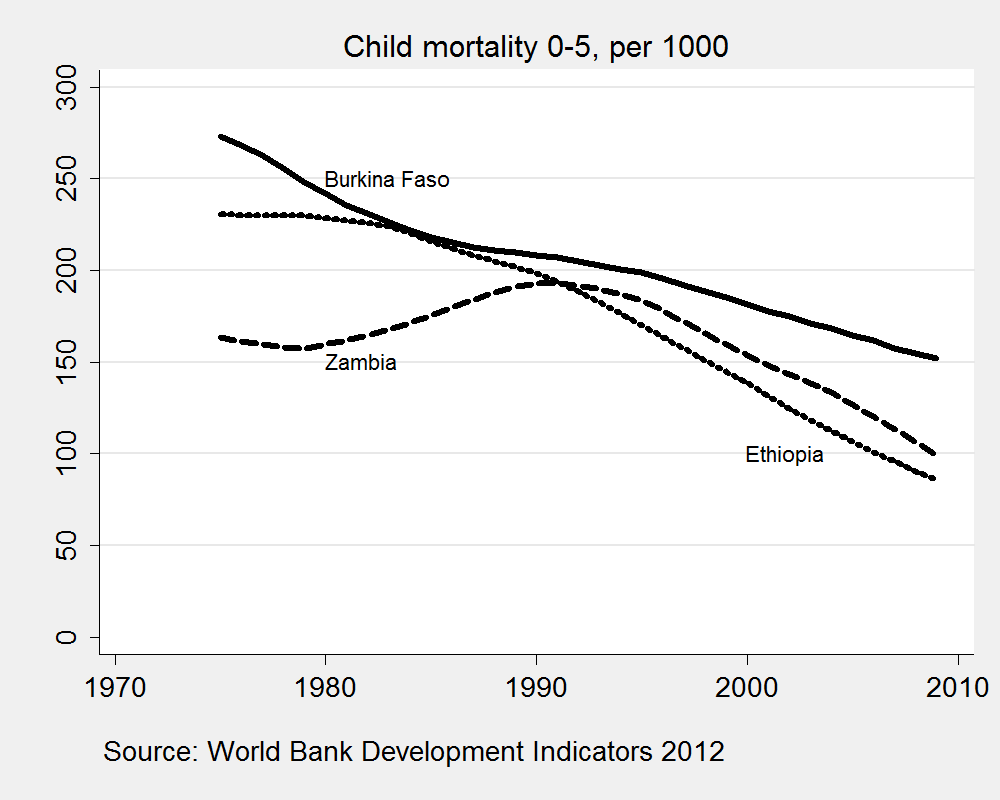
Decline in child mortality in Africa…

BBC had a news story touting decline in child mortality in Ethiopia.  Just blather? Because the same thing is happening in pretty much every African country that has reasonably functioning government.

chmortBF_ETH


Posted in Politics | Comments Off on Decline in child mortality in Africa…