
BBC had a news story touting decline in child mortality in Ethiopia. Just blather? Because the same thing is happening in pretty much every African country that has reasonably functioning government.
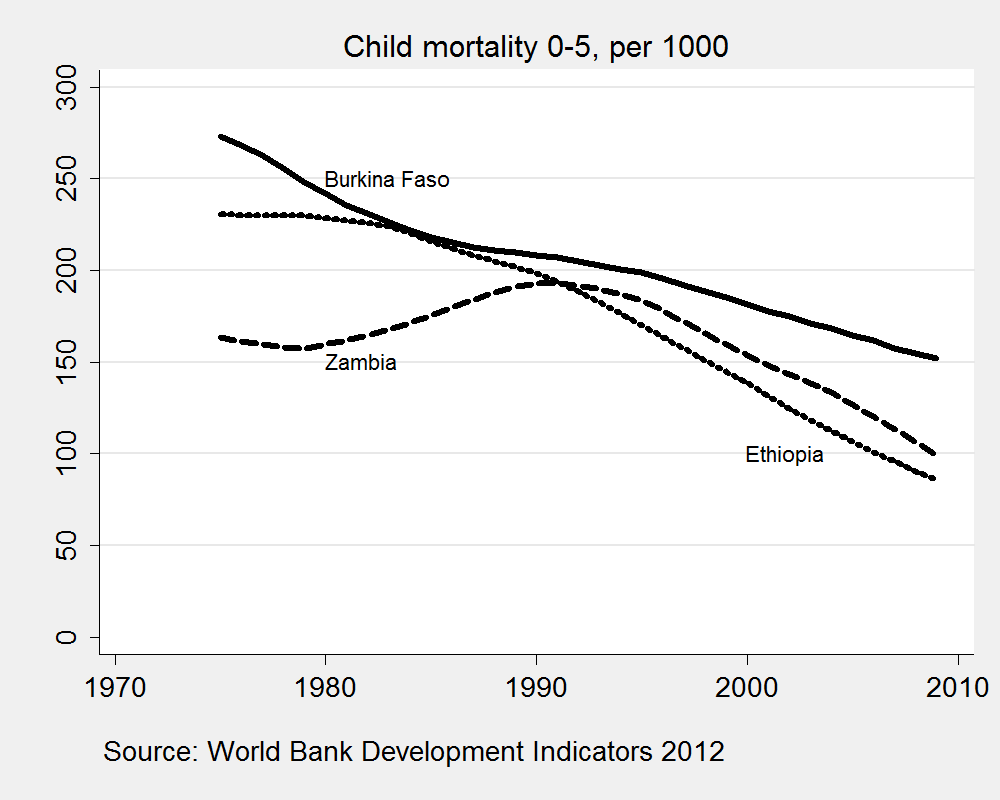
BBC had a news story touting decline in child mortality in Ethiopia. Just blather? Because the same thing is happening in pretty much every African country that has reasonably functioning government.
Nor do humanities specialists, let alone English majors, seem to be particularly humane or thoughtful or open-minded people, as the alternative better-people defense insists. No one was better read than the English upper classes who, a hundred years ago, blundered into the catastrophe of the Great War. (They wrote good poetry about it, the ones who survived anyway.) Victorian factory owners read Dickens, but it didn’t make Victorian factories nicer. (What made them nicer was people who read Dickens and Mill and then petitioned Parliament.)
I love the “might”, “likely,” “makes sense”… why not, “it is also likely this is an expected correlation and has no implications for anything….”
Study author Dr Alice Sullivan said: “It may seem surprising that reading for pleasure would help to improve children’s maths scores. “But it is likely that strong reading ability will enable children to absorb and understand new information and affect their attainment in all subjects.” Speaking on BBC Radio 4’s Today programme, she said: “It absolutely makes sense that you would expect reading for pleasure to improve children’s vocabularies. “But I think that that also does improve children’s ability to take on new information and new concepts across the curriculum. “A child who has a narrow vocabulary may constantly be coming across things they don’t understand.”
via BBC News – Maths advantage for pupils who read for pleasure.
Because this is what blogs are for, right? The TIAA-CREF form for the Keogh electronic delivery (why exactly should I save them money? Did they reduce their service fees?) asks, towards the end, for this: adopting employer as primary authorizer (print). Let me read it again: adopting employer as primary authorizer (print). Is that me? The university? Not to worry. Boldly printed just below: call us at the Administrator Telephone Center at 888 842 7782 for questions. This is right after a warning that, should you try to save us money by filling out this form, but you do not fill it out completely, this will “delay processing”! Well I called. And… no answer? What corporation has a telephone that… nobody answers? A home, sure. They are at work. But a telephone number sent to hundreds of thousands of people… I’m the only one who called? “Jerry!!! Phone’s ringing!!!! Aw, must be a wrong number, let it go…” So now what do I do? I mean, now that the blog entry is finished.
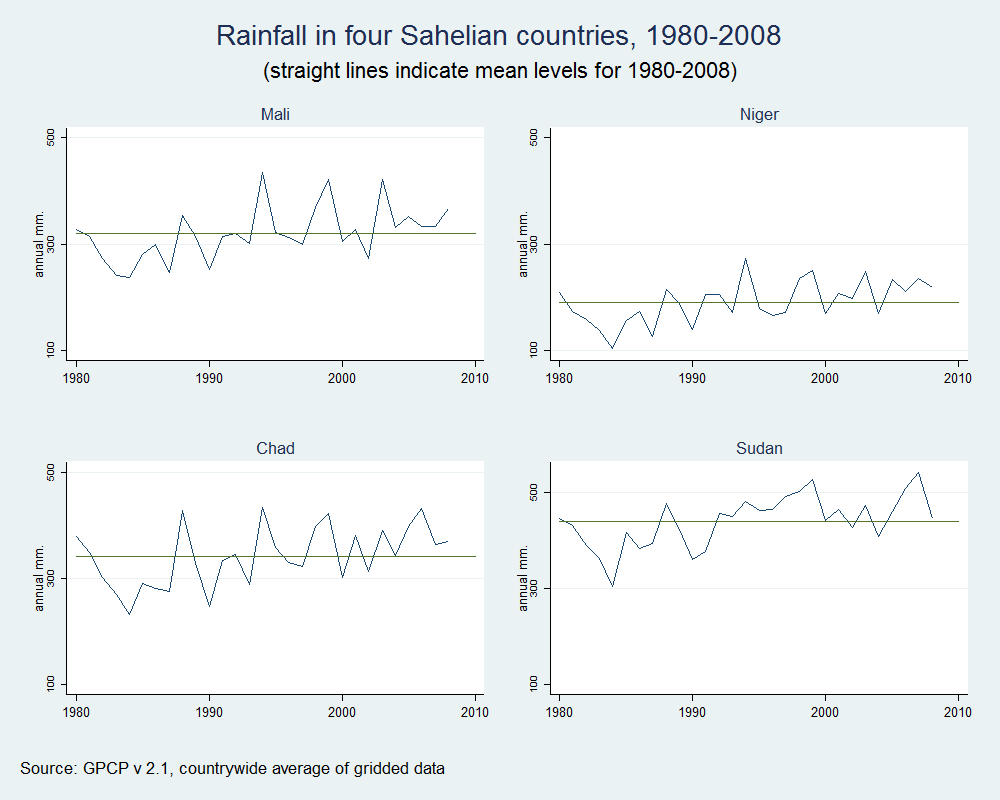
For example this NPR fairly glib reporting…
The region of Africa known as the Sahel is a grassy band running coast to coast along the southern edge of the Sahara. It always has faced periods of drought, but now they’re coming faster and faster.
“Instead of 10 years apart, they became five years apart, and now only a couple years apart,” says Robert Piper, the United Nations regional humanitarian coordinator for the Sahel. “And that in turn is putting enormous stresses on what is already an incredibly fragile environment and a highly vulnerable population.”
Tell me, where do you see that “faster and faster” in the data? Rainfall was above the 30 year mean for the entire 2000s, practically. To which they might respond, “you can’t prove it wasn’t due to climate change” to which I might respond, “you can’t prove it wasn’t due to Issa Bagayogo’s great music.” And we both might pause to listen to a few Bagayogo songs. Stalemate in the social science of climate change causality.
To all my Georgetown friends (I think it was Prusa, McKay, Duda, Ehrehfeld?) who accompanied me, and then abandoned me (actually I don’t remember who actually lasted through the 15 1/2 hours of movie…), here are the scenes/images/thoughts I remember quite vividly:

A truly amazing comprehensive review is here. Another great review is here.
Reminder that publication bias is important… but seems not to have greatly affected results in a number of reviews.
I might have added that an important set of explanatory variables might be the “breadth” of the field, the likely incentives for publishing null results, and the “recentness” of the field… in other words, there is likely to be a lot more positive publication bias in a recent, faddish field where only a dozen papers have been published than in a mature, established field where there might be large returns to publishing negative results, in part because the implications of the results have immediate real-world consequences (i.e. as in medicine) rather than unlikely consequences (as in “my DSGE paper will convince the Fed to end quantitative easing in two months rather than 12 months”).
Publication or related biases were common within the sample of meta-analyses assessed. In most cases these biases did not affect the conclusions. Nevertheless, researchers should check routinely whether conclusions of systematic reviews are robust to possible non-random selection mechanisms.
via Empirical assessment of effect of publication bias on meta-analyses | BMJ.
He was sweetly nostalgic at his 50th law school reunion speech. For my 15 year old, it was perhaps eye-opening to see fairly maudlin remarks delivered in a sincere and heartfelt way. Take a little of that millennial irony edge off, going forward, perhaps. He also spoke passionately about law school and its importance for his life and public service… again, a young person might have his “life changed” hearing someone make the pitch the way Panetta did. He described, not at length, the Osama operation. He delivered (very well) an old joke:
A rabbi sat next to a priest at a boxing match. The fighters entered the ring, full of bravado; prepared for the bout ahead. As the bell rang, one of the fighters made the sign of the cross. The rabbi leaned over to the priest and asked, “What does that mean?” The priest nodded and said, “Not a damn thing if he can’t fight.”
He also delivered a nice but shambling appeal to “This is America, America stands for good things, American values (of wanting a better life for our children) are great, but we have really bad leadership.”
Unfortunately that went on too long, so there was no time for questions. I had wanted to ask him whether the cruise missile attack on al-Shifa pharmaceutical plant in Sudan in 1998, fifteen years ago this past August 20, on apparently weak evidence that the plant was being used to produce a chemical weapon/nerve agent, may not have set or reinforced a bad evidentiary standard… Panetta had resigned as chief of staff in 1997, but it seems likely he would have had a strong opinion at the time. He certainly minced no words this evening: he said president Obama should have destroyed targets in Syria as soon as he decided the chemical weapons attack in Syria posed a national security threat.
A powerful combination of fear-mongering and hero worship has made Canada’s fire departments largely immune to budget cuts. As a consequence, the citizens are getting hosed.
via Marginal Revolution — Small steps toward a much better world..
Sachant que le rapport demande la poursuite de la mise en œuvre du sénat, les journalistes cherchaient en conséquence quelques nouvelles informations. Notamment le sort qui sera réservé aux sénateurs déjà élus. Apparemment, rien n’a été prévu. « Il n’y a rien de décidé », a en effet indiqué Arsène Yé. L’autre information importante est qu’une des recommandations du rapport a déjà été prise en compte par le Président du Faso, estime le ministre Yé. Il s’agit de l’appel lancé hier vendredi par Blaise Compaoré à « élargir les concertations à toutes les composantes sociales et politiques » sur le sénat. Les membres du comité veulent ceci comme une réponse à la question posée par les journalistes sur la non participation du Chef de file de l’opposition politique aux travaux du comité. Dabo Amadou, 1er vice-président du comité, indique que cette non association remonte au CCRP que le chef de file avait boycotté. « Ce ne sont pas les prérogatives du comité de suivi d’appeler les gens au dialogue », explique le vice-président de l’UNDD, en indiquant que ceci relève du Chef de l’Etat. Enfin, il faut noter que si le Président du Faso décide de continuer la mise en place du sénat, il faudra réunir des préalables avant de voir naître la deuxième chambre, a expliqué Bongnessan Yé. Il s’agit pour le chef de l’Etat de requérir l’avis du Conseil constitutionnel sur la légalité des décisions prises par l’Assemblée nationale et ensuite, de réviser la loi organique portant organisation du Parlement pour introduire les nouvelles modifications. « Ça va prendre du temps », a mesuré le ministre Yé, qui a rappelé et insisté sur le fait que « le sénat n’a pas pour but de modifier l’article 37″.
via Nouveau format du Sénat : L’ADF/RDA est d’accord « Burkina24 – L’Actualité du Burkina 24h/24.
Le train d’économies mis en place par la présidente du Malawi, Joyce Banda, se poursuit. Le pays va utiliser le produit de la vente de l’avion présidentiel, 15 millions de dollars, pour aider à nourrir les populations les plus pauvres et cultiver des légumes, afin de combattre la malnutrition, a indiqué jeudi un responsable gouvernemental.
«Il s’agit d’une décision collective du gouvernement pour que le produit de la vente de l’avion soit utilisé à l’achat de maïs sur le marché local et aussi à la culture de légumes», a déclaré un porte-parole du ministère Nations Msowoya.
L’avion de 14 places avait été acheté par le précédent président —Bingu wa Mutharika, décédé l’an dernier— pour 22 millions de dollars.
Mais après cet achat, la Grande-Bretagne, ancienne puissance coloniale et principal soutien bilatéral du Malawi, avait réduit son aide au pays de 4,7 millions de dollars. En raison des coûts liés à l’entretien de l’appareil, la présidente Joyce Banda a finalement décidé l’an dernier de le vendre.
via La présidente du Malawi en fait peut-être un peu trop | Slate Afrique.
Last night I read “The Story of a Scar” by James Alan McPherson, and I have to say that it is an excellent short story. The dialogue is gripping, and the characters sympathetic. I wasn’t quite sure about the ending. Not sure how/why it tied the story together; it does so in an obvious way, but in short stories like this there is a deeper text, that I just didn’t apprehend right away. Have to think more about it. I had never heard of McPherson, even though he apparently still teaches at Iowa. So I have some more stories to look forward to. His collection, Elbow Room, won the Pulitzer prize back in 1978.
He appears to be backing down, by calling on government to have more “concertations“… that means delay. His request that “acteurs politiques” create other fora for discussion seems quite odd… shouldn’t he be asking the National Assembly to have an open debate? Is this an invitation to Le Balai Citoyen? Tea leaves, tea leaves.
Le Sénat est une institution d’un grand intérêt pour la démocratie en permettant d’élargir à des composantes non partisanes, la production législative : il mérite, à ce titre, d’être bien compris. En tant que Président du Faso et garant de l’unité nationale, j’appelle le Gouvernement à élargir les concertations à toutes les composantes sociales et politiques pour bien asseoir la pertinence de cette institution républicaine. Par ailleurs, j’invite les acteurs politiques à créer et à développer entre eux des échanges constructifs pour un raffermissement continu de la cohésion sociale et un approfondissement de notre processus démocratique.
So… according to Benicio del Toro, supposedly Che Guevara ordered printing and distribution of Cervantes’ Don Quixote, after the revolution took Havana. Did a lot of people read it? Was Cuba better off? (Things look bad for the answer to that question, but remember the counterfactual… think how bad Cuba might have been without Don Quixote!) Maybe a regression discontinuity design here?
I saw the first two on the plane back from Burkina last month. I guess I can give them reasonably positive recommendations since I didn’t turn them off (but I was on a 10 hour flight): Robert Redford’s The Company You Keep and Steven Soderbergh’s Side Effects (pretty standard TV movie, actually). I have very vivid memories of and would recommend over these films Soderbergh’s biopic Che, which had all the flaws attributed to it (too boring, too crafty in “overlooking” a lot of the bad stuff, too weird with the inexplicable New York scenes. And Che delivers some decent hisotory and piques more interest in history (so does Redford’s film, in a good way).
I haven’t read the paper (by Richard Akresh, Joyce Chen and Charity Moore) yet… so caveat emptor!
Altruism among family members can inhibit cooperation by increasing the utility players expect to receive in a non-cooperative equilibrium. To test this, we examine agricultural productivity in West African polygynous households. We find cooperation, as evidenced by more efficient production, is greater among co-wives than among husbands and wives. Using a game-theoretic model, we show this outcome arises because co-wives are less altruistic towards each other than towards their husbands. We present a variety of robustness checks, which suggest results are not driven by selection into polygyny, greater propensity for cooperation among women, or household heads enforcing others’ cooperative agreements.
the full paper is here: Akresh-Altruism-Efficiency.

Plus que le discours plutôt convenu du nouveau président malien, c’est la présence de l’ancien chef de l’Etat Moussa Traoré et les compliments à son égard d’IBK, que retient Le Républicain, autre quotidien bamakois. «L’ancien président Moussa Traoré, qui a régné sans partage sous l’ère du parti unique entre 1968 et 1991 et qui a eu la réputation d’un dictateur convaincu, a été consacré hier ‘grand républicain’, déplore le journal, par le nouveau président élu du Mali, Ibrahim Boubacar Kéita. (…) Par ailleurs, comme un paradoxe voulu, IBK a passé sous silence tous les sacrifices des Maliens qui ont abouti à l’ouverture démocratique au Mali en 1991. Il passera également sous silence les présidents Modibo Kéita, Alpha Oumar Konaré, Amadou Toumani Touré. De Moussa Traoré, il en est venu à Dioncounda Traoré, passant superbement la gomme sur les 20 ans de l’ère multipartite.»
via A la Une : plusieurs invités-surprise à l’intronisation d’IBK – RFI.
 Friends of African Village Libraries (I post regularly here)
 Michael Kevane