Librarie universitaire

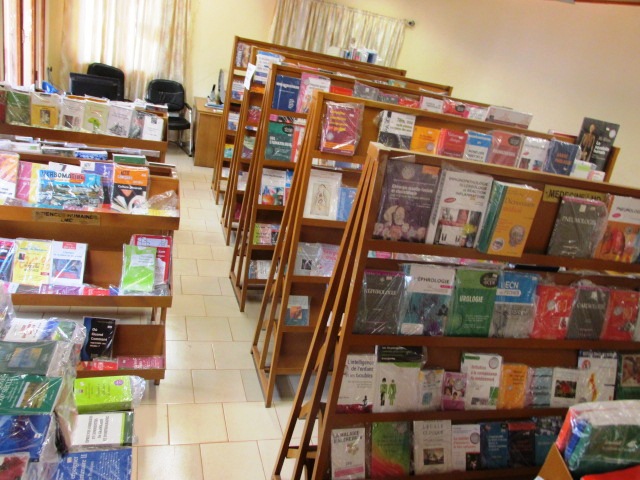
I dropped off copies of our book Promotion de la Lecture au Burkina Faso at the Librarie universitaire… A nice spot on the center of campus. Mostly just textbooks, but a small section with novels… including a Mongo Beti novel I had never read. We bought about 20.000 FCFA ($40) of books for the libraries. librarie universitaire

Posted in Burkina Faso | Comments Off on Librarie universitaire

Religion and politics in Burkina Faso

An old colleague Magloire Somé and I agreed to meet for dinner, after a panel he was on for the American Political Science Association “study tour”of Burkina Faso…. so I went to the panel. It looked like it might be pretty boring at the beginning, but Magloire, true to form, launched a provocation that got everyone talking. His historian colleague Isa Cissé brought up what he called a “fusillade” at the mosque of Dassasgho after some incidents at the mosque of Zanghoettin in February-April 1995. I vaguely recall this, though of course we are talking pre-Internet here so searches do not come up with much. I wonder why, and whether, this incident really is a touchstone for the Muslim community in Burkina?

What looks like a very good source is this MS thesis from Laval: Frédérick Madore “Islam, Politique Et Sphère Publique À Ouagadougou (Burkina Faso) : Différentes cohortes d’imams et de prêcheurs entre visibilité nouvelle et reconfiguration des rapports intergénérationnels (1960-2012).”

Magloire and I over dinner wondered whether there are good examples of intra-Christian sectarian violence in Africa… I guess Lords Resistance Army was one, though they targeted the state, I think, and not really other Christian groups, though I may be wrong especially in their early days.

Posted in Burkina Faso | Comments Off on Religion and politics in Burkina Faso

Flash points ahead…. marches planned for Ouagadougou

The CDP is planning a march this Saturday and opposition talking of counter-march… responses to last Saturday’s march against the Senate. Opposition finally found a nice wedge issue… average person has hard time agreeing with fairly lame justifications for Senate, and instead is sympathetic to evocative “budgetivore” characterization, as well as “backdoor trap to revise two term limit, article 37, of constitution.” Perception here is all that really matters, as with any good wedge issue.

Anyway, people will be a bit nervous about what may or may not be planned… Burkina usually does not have a big problem with provocateurs, but you never know.

Posted in Burkina Faso | Comments Off on Flash points ahead…. marches planned for Ouagadougou

Remorse… five variations

Not remorse over what I’ve been reading/viewing lately (with one exception, you guess), but rather, sometimes you find the same theme in very different materials… a straight flush this time, actually.

  1. To Have and To Have Not.  Found it on the bookshelf of place we are house sitting.  I had never read it.  First two parts fantastic, as they introduce Harry Morgan. Typical straightforward Hemingway.  Apparently they were published as short stories first.  Then book goes into a long novella, with a very silly digression on a writer in Key West (hmmm, what could that be based on).  But the ending is decent, and Harry Morgan’s remorse (over certain choices he made, not over what he did) is prominent.  A nice book for a philosophy or ethics class, I guess, as the ambiguity in Morgan’s position is very sharply drawn by Hemingway, who uses multiple points of view to reinforce the ambiguity.
  2. Il n’y a pas de petit querelle” by Amadou Hampate Ba.  Published posthumously, the title story of a collection of folktales… the animals one by one decide they are above “doing the right thing,” with bad consequences for them all.  Beaucoup de remorse.  I’m sure the story is told often in management seminars.
  3. The Sense of an Ending by Julian Barnes.  At first I really was enjoying the fine writing, but it slowly dawned on me that this was a “writing exercise.”  Please write a novel about remorse.  The situation really begins to become quite contrived, and Barnes tries to throw in some twists in the end.  But the whole thing didn’t work for me as a reader.
  4. Survivor: Nicaragua Matthew “Sash” Lenahan was a great example of someone who should have felt remorse. He should not have double-crossed Brenda.
  5. Bonjour Tristesse by Françoise Sagan probably the ultimate remorse book… found it on the bookshelf also.  Was fun to read; I had read it at 17 myself, so I vaguely remembered the plot.  I don’t know that it stands the test of time well.  Probably in 1954, Cécile’s lifestyle would have seemed to most readers almost like a fairy-tale… the leisure time, and the apparent extremely comfortable living.  Like a daydream for working class people, recovering from World War II, whose children were enjoying much better lives and far greater literacy.  But I wonder in a world of reality TV (Survivor?) Cécile doesn’t come across like Paris Hilton.
Posted in Burkina Faso | Comments Off on Remorse… five variations

Évaluation des politiques et institutions nationale: Le Burkina classé parmi les meilleurs en 2012

En effet, la dernière édition du rapport CPIA Country Policy and Institutional Assessment de la Banque mondiale, attribue au Burkina Faso une note globale de 4,28, l’une des plus élevées après celles du Rwanda, du Cap Vert et du Kenya.L’évaluation CPIA mesure 16 grands indicateurs du développement portant sur quatre domaines : i gestion économique, ii réformes structurelles ; iii politiques d’intégration sociale et d’équité ; et iv, gestion et institutions du secteur public. Les pays sont notés sur une échelle allant de 1 faible à 6 élevé pour chaque indicateur. La note globale CPIA représente la moyenne des 16 indicateurs.Les notes CPIA présentent des variations entre les divers groupes de pays. Par exemple, la mauvaise gouvernance, l’insuffisance des capacités du secteur public et les troubles civils ont réduit la note moyenne des États fragiles africains à 2,7—soit un niveau très inférieur à la note moyenne des pays non fragiles, qui est de 3,5 . De même, les pays riches en ressources de la région, dont la note CPIA moyenne s’établit à 3,0, traînent derrière leurs homologues pauvres en ressources, dont la note moyenne atteignait 3,2 en 2012.

via Évaluation des politiques et institutions nationale: Le Burkina classé parmi les meilleurs en 2012 « Alertes 24H/24 « Burkina24 – L’Actualité du Burkina 24h/24.

Posted in Economy, Politics | Comments Off on Évaluation des politiques et institutions nationale: Le Burkina classé parmi les meilleurs en 2012

Not sure I have the whole picture…

Kerfluffle in Burkina Faso over some stolen, smuggled gold, magistrates demand resignation of Minister of Justice…. (and before you think that 23,000 kg is a lot, remember that in French numbers , is a . so it is 23 kg only… about $1 million worth).

Le 6 mars 2012, le sieur DAMBINA Sékou était arrêté sur la route nationale n°4 au poste de péage de Koubri, route de Pô aux environs de 2 heures 30 du matin par les éléments de la Brigade Nationale de Lutte Anti –Fraude de l’or BNAF en possession de 23,528 kg d’or.

via MONDE JUDICIAIRE – Les Editions Le Pays.

Posted in Burkina Faso | Comments Off on Not sure I have the whole picture…

Burkina Faso : le tournant politique de 2015 pourra-t-il avoir lieu ?

A decent piece summarizing current political situation leading up to 2015, which will be a very interesting transition for Burkina Faso.  Pundits and alarmists will have a field day I am sure.  I think the lesson I draw from watching Sudan for three decades is this: no matter how much a focal point – election of 2015- seems like a focal point, it really isn’t.  Sudan goes from focal point to focal point…. even the splitting of the country in two in some sense barely changed underlying dynamics. So much as you want to say November 2015 will be the reckoning, January 2016 will have politics as usual going on in the country…

Le leader de l’UPC Union Pour le Changement, Zéphirin Diabré, qui tient la tête de l’opposition semble travailler pour une opposition plus unie et plus forte. Il est même apprécié par une grande partie de l’opinion publique. Mais un ancien ministre du président Compaoré peut-il conduire l’opposition pour vaincre le CDP ? Sans doute, pourquoi pas ? Il saura déjouer les glissades politiques mais pas la manipulation ethnique ! En décembre 2012 quand je suis allé accomplir mon devoir politique, j’ai surpris une conversation entre deux dames. La première avouait qu’elle allait voter UPC et la deuxième lui rétorquait que le leader de l’UPC est un Bissas [sic] ethnie du Centre Est du Burkina qui n’a pas bonne réputation auprès des Mossés qui sont majoritaires dans le pays. Aussitôt la première dame changea sa décision de vote, vers un autre parti. C’est donc dire que le Burkina n’est pas à l’abri des votes ethniques. Au grand bonheur de certains manipulateurs politiques !

nb.  I pretty much totally disagree with the author’s point about ethnic manipulation… and certainly don’t approve of a generalization based on an overheard conversation!  As far as I am aware, there is very little research confirming strong ethnic biases in government, and the recent campaign of Alphonse Bonou did not go very far in the southwest…  (at via Burkina Faso : le tournant politique de 2015 pourra-t-il avoir lieu ? | Contrepoints.

Posted in Politics | 2 Comments

Research Initiative: Test the Impact of a Radio Campaign Addressing Child Mortality

Very interesting research project.

The intervention that this research initiative is exploring is a 2.5-year radio campaign that began broadcasting in March 2012. It involves the broadcast of health messages using radio spots (60-second adverts) and radio phone-in programmes (see videos below). DMI and LSHTM are broadcasting this behaviour change campaign to 7 randomised geographic areas (clusters) across Burkina Faso and are using 7 additional clusters as controls. Organisers say that a controlled trial using radio would not normally work due to the risk that people in “control” areas would listen to radio stations broadcasting from “intervention” areas. However, Burkina Faso has a very localised, radio-dominated media environment, so organisers can use local FM radio stations to broadcast messages to intervention areas without “leaking” into the control areas.

…. The model predicts that a campaign can reduce childhood mortality by 8-15% per year, by the third year. It also predicts that its cost-effectiveness (at between US$2 and US$10 per “disability-adjusted life year” or DALY) is better than any other currently available intervention, including bed nets for malaria and childhood immunisations.

Midline results (on behaviour change) are expected in late 2013, with full endline data (including child mortality outcomes) being published in 2015. The evaluation includes a baseline survey of 50,000 households and an endline mortality survey with a sample size of 100,000.

via Research Initiative: Test the Impact of a Radio Campaign Addressing Child Mortality | The Communication Initiative Network.

Posted in Economy | Comments Off on Research Initiative: Test the Impact of a Radio Campaign Addressing Child Mortality

There is probably an interesting story here: Mayor of Ouagadougou “fires” all the youth employed at quasi-minimum wage ($75 per month) working as traffic guards (they are really helpful)

Pour le président du conseil municipal de la commune de Ouagadougou, c’est un manque de respect et de reconnaissance à l’endroit d’un gouvernement qui a été à l’origine de la mise en œuvre du projet en fin 2010. Si Marin Casimir Ilboudo reconnaît que des difficultés existent faiblesse du salaire, irrégularité des paies, tenues insuffisantes, celui-ci a indiqué qu’ils ne sauraient balayer du revers de la main, ce que le gouvernement a fait pour eux : « Au lieu de rejeter tout en bloc, les jeunes de la brigade devaient être reconnaissants vis-à-vis du gouvernement pour avoir initié le programme parce qu’il permet d’octroyer un salaire mensuel de 37 000 FCFA à plus de trois mille jeunes. Ce qui coûte plus d’un milliard de FCFA par an à l’Etat ».Pour M. Ilboudo, le montant est bon à prendre car supérieur au Salaire minimum interprofessionnel garanti SMIG qui est de 35 000 FCFA. « Personne ne vous a contraints à souscrire au projet. Si vous estimez que le gouvernement ne fait rien pour vous, personne ne vous retient », a-t-il ajouté.Pour l’heure, le maire de Ouagadougou a mis fin au contrat des volontaires pour la sécurité routière. Cependant, le fil qui liait les deux parties n’est pas totalement rompu : « Pour ceux qui souhaiteraient revenir, ils ont 48 heures pour rédiger une demande dans laquelle, ils reconnaîtront leur tort et présenteront leurs excuses », a indiqué le maire.

via Commune de Ouagadougou: “Les volontaires virés pour comportement “inspectueux”.

Posted in Economy | Comments Off on There is probably an interesting story here: Mayor of Ouagadougou “fires” all the youth employed at quasi-minimum wage ($75 per month) working as traffic guards (they are really helpful)

Smackdown time… ouchie!

I think you have to be a development economist with a 15 year old indeed to appreciate this line which made me burst out laughing two minutes ago (11:25 pm Ouagadougou time) while we house-sit at unnamed European embassy staffer house with air-conditioning full blast!!!!!

… explaining why societies with a high degree of sharing nevertheless exhibit selfish game play, Ensminger suggests that ‘self-enforcement need not develop when second party enforcement is ever-present’ (2004:359). This seems somewhat improbable, since second party enforcement is an ineffective approach, involving massive transaction costs, however small and face to face the group, as anyone who has ever had to enforce domestic labour by teenagers will know.

Massive indeed!  Getting the table cleared often requires a long lecture that goes back to first principles… “A. The moral foundations of civil behavior  B. Consequences throughout history of uncivil behavior. C. Digression on internal logic of consequentialism” … Thank you Cecile Jackson.

Posted in Burkina Faso | Comments Off on Smackdown time… ouchie!

Hard to criticise without seeming a spoilsport…

I wish them luck, but nothing on the website suggests they really have any idea what they are doing other than doing something “cool”…  They claim their “digital library” will be profitable… yet the turnover in cybercafe’s (isn’t that what a “digital library” is?) is huge, and the management problems severe.  Do they know?  Do they know that half of WorldReader’s Kindle’s broke within one year?  They apparently have nothing on the ground… do they even know about Osu Children’s Library Fund?

We are building a library the likes of which the world has never seen before. It will be the first that will actively engage users as content creators, the first that will operate on a sustainable business model, and the first designed to maximize the potential of high-speed information exchange in developing markets.By backing this Kickstarter project YOU will be the first in the world to see these designs go into construction, be the first to receive original works created at the library via digital subscription, and have your name hand-written on the wall of the library to recognize your contribution to inventing the library of the future.

via LIBRII: NEW MODEL LIBRARY IN AFRICA by Architecture for Humanity DC — Kickstarter.

Posted in Reading | Comments Off on Hard to criticise without seeming a spoilsport…

Friends in high places…. Matthiasson wines in Napa

What a great plug for Jill and Steve, who deserve it!

Matthiasson is another example of the antithesis of Napa Valley’s glamorous side. Steve and Jill Klein Matthiasson are farmers, essentially — he is a leading vineyard consultant — and their wines bear an agricultural stamp, as fresh, lively and alive as the best produce from a farmers’ market, made from grapes that they either grow themselves or monitor before they purchase. Their wines are a pleasure, whether Friulian varieties blended with sémillon and sauvignon blanc, straightforward chardonnay, an unusual refosco, a shapely merlot or a mouthwateringly tangy rosé made from syrah.

via California Wines Score Style Points – NYTimes.com.

Posted in United States | Comments Off on Friends in high places…. Matthiasson wines in Napa

100 million dollars – upcoming Obama trip to Africa

I always like to do the basic math.  We (FAVL) set up village libraries for about $15,000 and that covers about five years of operations until the office of the mayor can take over.  Let’s say there is no book renewal or much maintenance afterwards… still you get about 10 years of 500 villagers reading a lot.  How many villages?  Well, 100 million divided by $15,000 is 6,666… so village libraries could be established pretty much across the entire Sahel, for this one ten day trip… What do you think about that?  Maybe President Obama can just make a Skype call instead?  Oh wait, those are tapped by NSA.

Lorsque Barack Obama se déplace, cela coûte cher au contribuable américain. Selon le Washington Post, sa prochaine visite en Afrique pourrait coûter jusqu’à 100 millions de dollars. Cela comprend le transport de plus de 50 véhicules, dont 14 limousines officielles, la présence d’avions et de navires militaires, et le déploiement de dizaines d’agents du secret service chargés d’assurer la protection du président et de sa famille qui va l’accompagner.

via La prochaine tournée en Afrique d’Obama: un coûteux voyage de 100 millions de dollars – Etats-Unis – RFI.

Posted in Development thinking, General | 1 Comment

Sahel climate change alarmism

I got in a good Twitter back and forth with Michael Boyce of Refugees International…. what is right characterization of livelihood change in Sahel…

@MP_Boyce Compare rainfall/temp dist 1960-90 http://tinyurl.com/jw9bz7x  with 1990-09. Basically the same, no? #Sahel more complx than yr story.

Posted in Economy | Comments Off on Sahel climate change alarmism

Le Roi du Djadjo de Bali Nebie

Over the past week I read Le Roi du Djadjo by Bali Nebie.  I met Bali in February, when Jean-Pierre Jacob, the anthropologist, suggested we have a beer with him.  Jean-Pierre had found his book in the FAVL library we keep at headquarters, and had really been impressed.  Bali had come by and given it to our former representative Monique Nadembega.  Anyway, we met Bali and had a great conversation, mostly between him and Jean-Pierre about the “secret man-lion societies” that were (and remain) prevalent in many villages in Africa.  This is a central element of the story Le Roi du Djadjo.

While I enjoyed the conversation I also could not help thinking to myself “anthropology stuff…”  Growing up in the Catholic Church, every Sunday for about 15 years I was fully immersed in myths and ritual behavior.  While there were no exorcisms, I was constantly exposed to group-think.  Indeed, the whole experience of mass is a collective and deliberate “We believe…”  I’ve always then been a bit bored rather than fascinated by the arcana and mechanisms of belief.  If a fully “scienced” society like the one I grew up in had collective shared beliefs about magic and magical happenings, why wouldn’t a society where almost no one was literate?  I have no doubt that some shared beliefs are “better” than others.  In some ways that was the power of Jesus, Buddha and other major figures of world religions, to offer compassionate and subtle shared belief systems as opposed to tight and exclusionary ones (never mind that major religions often turned that compassionate and tolerant impulse into a justification for conquest “you really do need to hear the good news whether you like it or not…”).  And many small local religions have powerful lessons to teach about spiritual practices and respect for nature and insights into our common human dilemmas.  But at some level the arcana is all the same… transubstantiation… is it really so different from “eating souls”?

So finally last week I got around to reading Le Roi du Djadjo, and what a breath of fresh air.  Prose-wise, it is no great shakes.  Adequate.  But it is a deliberate de-mystification, and for Burkina Faso, that is a huge deal.  Bali has written a major work, and I’m surprised at how little it is known.  The fact that he has met with complete indifference I can only attribute to the continued stake that many (most?) Burkinabè have in leaving magical practices as social domain where explicit inquiry and critical thinking are impolite. In much the same way that questioning the basis of Catholicism was impolite when I was growing up, and is still considered by almost everyone to be rude behavior today.  I have no compulsion to be rude, and neither does Bali… I think.  But he puts it out there and hopes his book will testify and transform.  No compulsion in religion!  Anyway, if you read French, I definitely encourage you to read Le Roi du Djadjo, available here in Kindle edition.

Here’s a nice appreciation of the book:

Un soir que j’étais fatigué, trop pour prendre mon livre d’histoire en cours, je me suis mis à feuilleter le vôtre, dans mon idée c’était seulement pour le regarder un peu et non pour le lire, comme il me plaît de le faire avant mes lectures. Ensuite, Je n’ai pas pu le quitter et je suis allé jusqu’à m’endormir de fatigue dessus, je ne voulais pas le lâcher ! Félicitations ! Ce livre, d’abord dans la forme, donne une écriture plus souple que le 1er, le style est bien travaillé et il est agréable à lire. Quant au fond, il n’est rien de moins que remarquable. Je pense que vous êtes un homme d’avant-garde, éclairé par la rationalité et votre vision est alimentée par une connaissance sociologique très pertinente. J’ai adoré votre livre, vraiment.

Posted in Culture, General | Comments Off on Le Roi du Djadjo de Bali Nebie

From Sudan: I Almost Got Arrested For Wearing Pants | Blog #45

The rickshaw dropped us off by the office. Across the street, a large truck was parked, with two police officers standing beside it, talking to a young woman dressed not unlike myself; Jeans, white round-neck top, black cardigan. While one officer was “loading” a sit shai tea lady dressed in a tobe traditional garment Sudanese women wear onto the truck, the other was having a somewhat heated conversation with the young lady in jeans, pointing at her top, gesticulating that her pants were tight, that her top was too low-cut.I watched along with my friend, stunned, wondering why the sit shai was being arrested if the issue was attire. My friend turns to me, says, “I think you should go in the office”. I didn’t move

An excellent collection of postings from Sudan.  via I Almost Got Arrested For Wearing Pants | Blog #45.

Posted in Sudan | Comments Off on From Sudan: I Almost Got Arrested For Wearing Pants | Blog #45

David Kpelly, fantastic blogger….

Mais c’est la forme de la déclaration qui choque. Il est quand un peu aberrant de voir un ministre d’un grand, vaste et vieux pays comme le Mali qui depuis plus de cinquante ans maintenant crie sa souveraineté, aller s’arrêter devant les représentants d’autres pays, devant des caméras et des micros – au grand mépris de la mémoire de tous ces pères-fondateurs nationalistes de nos Etats qui avaient tant cru en ce continent – et lancer : « Nous avons besoin d’argent, c’est pour cela que nous sommes là. » Même les talibés, ces petits enfants laissés-pour-compte que des marabouts véreux transforment – au nom de l’islam – en mendiants, savent cacher leur quête sous des bénédictions qu’ils récitent d’une voix mielleuse aux passants.

via Afrique, mon pleurer-rire.

Posted in Development thinking, Mali | Comments Off on David Kpelly, fantastic blogger….

What has happened to heights of women in Africa over post-colonial period?

One of those questions that is relevant and interesting.  Akachi and Canning use the DHS surveys and trace how birth cohorts have attained different height.  Interestingly, in the simple time trend heights are steady (on average just under 160 cm or about 5’2″).  Only a handful of the 20 countries have significant time trends, and these are small.  Of course, there are mortality selection effects, and for earlier cohorts stunted children may have been more prone to die and not reach adulthood.  Once country-level GDP and infant mortality are controlled for, the trend in height appears to be downwards.  Unfortunately, Africa is one of the only world regions with declining per capita GDP for several decades, followed by rising GDP, so interpreting the conditional time pattern is hard.

This negative time dummies effect may reflect omitted variables that negatively impact height and is indicative of a negative trend in the biological standard of living in Sub-Saharan Africa. It may also reflect a changing relationship between health as measured by mortality rates and stature.This suggests the need for a more detailed measure of health than mortality rates,particularly measures that reflect the disease environment and morbidity, in understanding the evolution of heights. However, the interpretation of the time effect remains an open question.

There is lot of variation between countries (and I imagine between ethnic groups).  The Sahel countries are quite a bit taller.  Madagascar quite a bit shorter.
Akachi, Y. and D. Canning (2007). “The height of women in Sub-Saharan Africa: The role of health, nutrition, and income in childhood.” Annals of Human Biology 34(4): 397-410.

Posted in Development thinking | Comments Off on What has happened to heights of women in Africa over post-colonial period?

Encore des voitures de $100,000?

Vraiment je ne comprends pas la Banque Mondiale…Peut-être le car de transport ca se vend a $100,000, mais des 4×4?  Et plus généralement, si le secteur minier et “porteur” pour le gouvernement, pourquoi la Banque ne refuse d’octroyer des crédits pour appuyer les structures gouvernementales concernées et demande qu’ils s’autofinancent?

D’un coût total de 300 millions de FCFA, Toutes taxes comprises TTC, ce don est composé de 8 véhicules, soit 5 véhicules 4×4 station wagon, 1 véhicule 4×4 pick-up, un car de transport de 30 places et une voiture de ville de type berline.

via Sidwaya – Le Quotidien.

Posted in Economy | Comments Off on Encore des voitures de $100,000?

More kids go to school with cash transfer programs that make kids go to school?

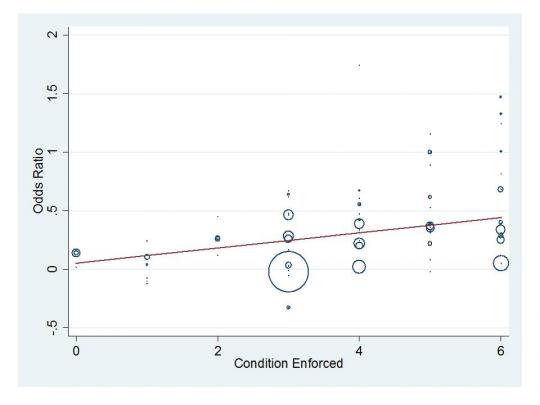
However, using the categorization above, the picture is much clearer. In a random-effects meta-regression model with effect size as the dependent variable and this moderator describing the ‘intensity of conditionalities’ as the only independent variable, the coefficient estimate is large and statistically significant at the 1% level. The linearization suggests that each unit increase in the intensity of the conditionality is associated with an increase of 7% in the odds of being enrolled in school:

via Do Conditions Moderate the Effects of Cash Transfer Programs? Preliminary Findings from a Systematic Review | Impact Evaluations.

Posted in Development thinking | Comments Off on More kids go to school with cash transfer programs that make kids go to school?